
NOAA's TMC Seabed Filing Clears a Box, Not a Permit
A "fully compliant" finding on TMC USA's Clarion-Clipperton application starts the clock on review, not production.
The GENIUS Act's Section 3 proposal doesn't ban stablecoins. It decides who's allowed to sell them here, starting in 2028.
The station-density default now covers 80 zones; the consultee overhaul trimming heritage and sport oversight still awaits its regulations.
Washington's Section 232 playbook: investigate, proclaim, tier the duties, dangle an onshoring carrot. Drones are the latest test case.
A Michigan coal plant slated to close in 2025 just got its sixth federal reprieve, and the paper trail shows who is actually paying for it.
New York secured a three-year ZIP-code presence and inflation-capped pricing deal from Western Union just as California abruptly suspended its own approval for the same transaction.
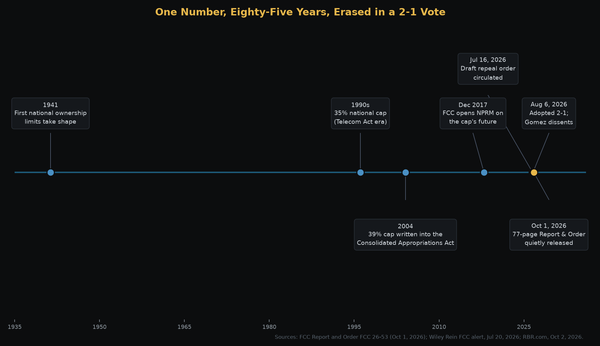
The FCC keeps the price and speed disclosures on broadband labels but scraps verbatim phone scripts, full-label point-of-sale display, and two years of archiving.
A new EU regulation just made specific PFAS thresholds law for food packaging, with recycled-content and labeling mandates still to come through 2040.
The FCA's PS26/15 slashes reporting fields, scope and lookback windows, with a modeled 745.5 million pound ten-year payoff, but the 2028 deadline leaves room for slippage.
FDA wants to shift 3D mammography from full PMA review to a faster 510(k) pathway, and the device named throughout the proposal now belongs to a private company.
A private-fund clearing carve-out is now final, but cross-border repo exemptions stay open through August 31 as a December 31 mandate approaches.
The UK proposed a load-control licensing regime for EV chargers and home batteries. The flexibility market it targets already grew 117% in a year, and National Grid is positioned to benefit from consolidation.