NOAA's TMC Seabed Filing Clears a Box, Not a Permit
A "fully compliant" finding on TMC USA's Clarion-Clipperton application starts the clock on review, not production.

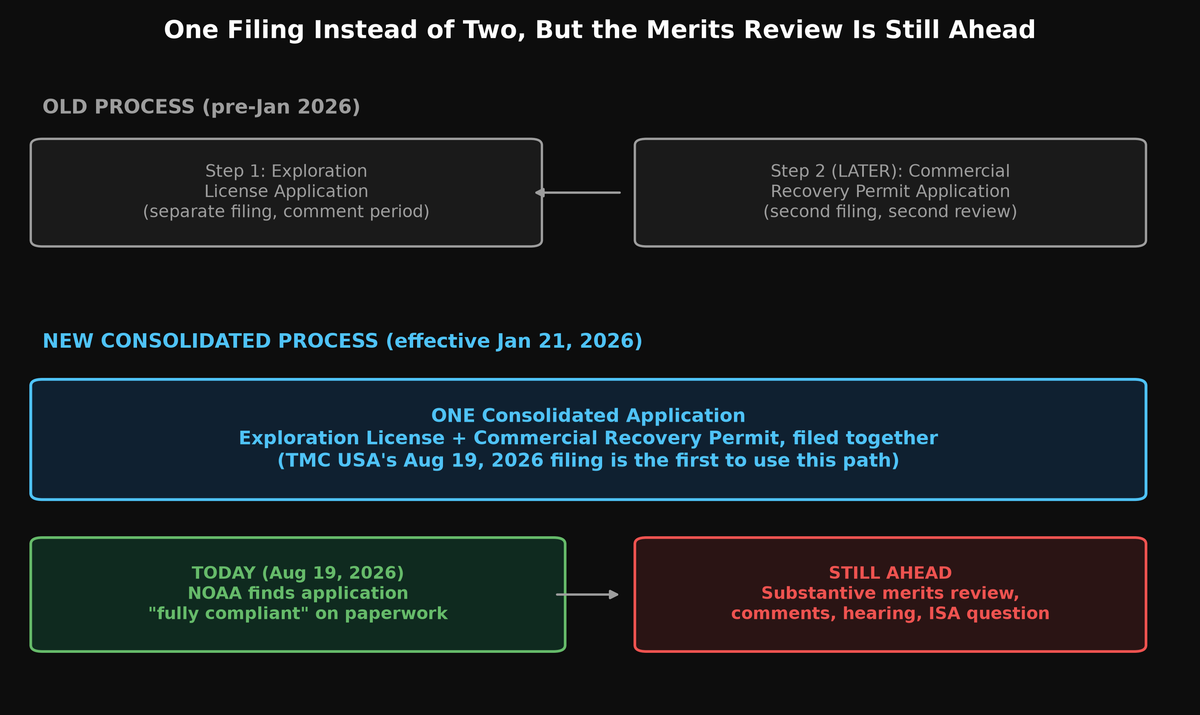
On August 19, 2026, NOAA published a Federal Register notice stating that an amended consolidated application from The Metals Company USA, LLC (TMC USA) is "fully compliant with the applicable information requirements" of the Deep Seabed Hard Mineral Resources Act (DSHMRA) (Federal Register 2026-16869). That is a procedural milestone inside a pending, multi-step federal review, not an issued license, permit, or approval of any kind. The application, seeking both an exploration license and a commercial-recovery permit for a swath of the Clarion-Clipperton Zone, now moves into a public comment period and a scheduled hearing, with the substantive merits review still ahead (Federal Register 2026-16869).
Key Highlights
- NOAA received TMC USA's amended consolidated application on March 19, 2026, seeking an exploration license and a commercial recovery permit for the Clarion-Clipperton Zone under DSHMRA (Federal Register 2026-16869).
- The application sits in docket NOAA-NOS-2026-1751; written public comments are due October 19, 2026 (Federal Register 2026-16869).
- A virtual public hearing is set for October 13, 2026, from 3:00 to 5:00 PM ET, with registration capped and closing October 9, 2026 (Federal Register 2026-16869).
- NOAA's January 21, 2026 final rule (FR Doc. 2026-01044, 91 FR 2642) created the consolidated license-and-permit process this filing uses, letting an applicant pursue exploration and commercial recovery together instead of filing sequentially (govinfo.gov FR-2026-01-21 2026-01044).
- TMC USA is a subsidiary of TMC the metals company Inc. (Nasdaq: TMC), per the company's own SEC-filed release (SEC filing, TMC); TMC's most recent 10-Q reported $98.7 million in cash and no financial debt as of June 30, 2026 (TMC 10-Q, June 30 2026).
What NOAA's Consolidated Application Process Actually Is
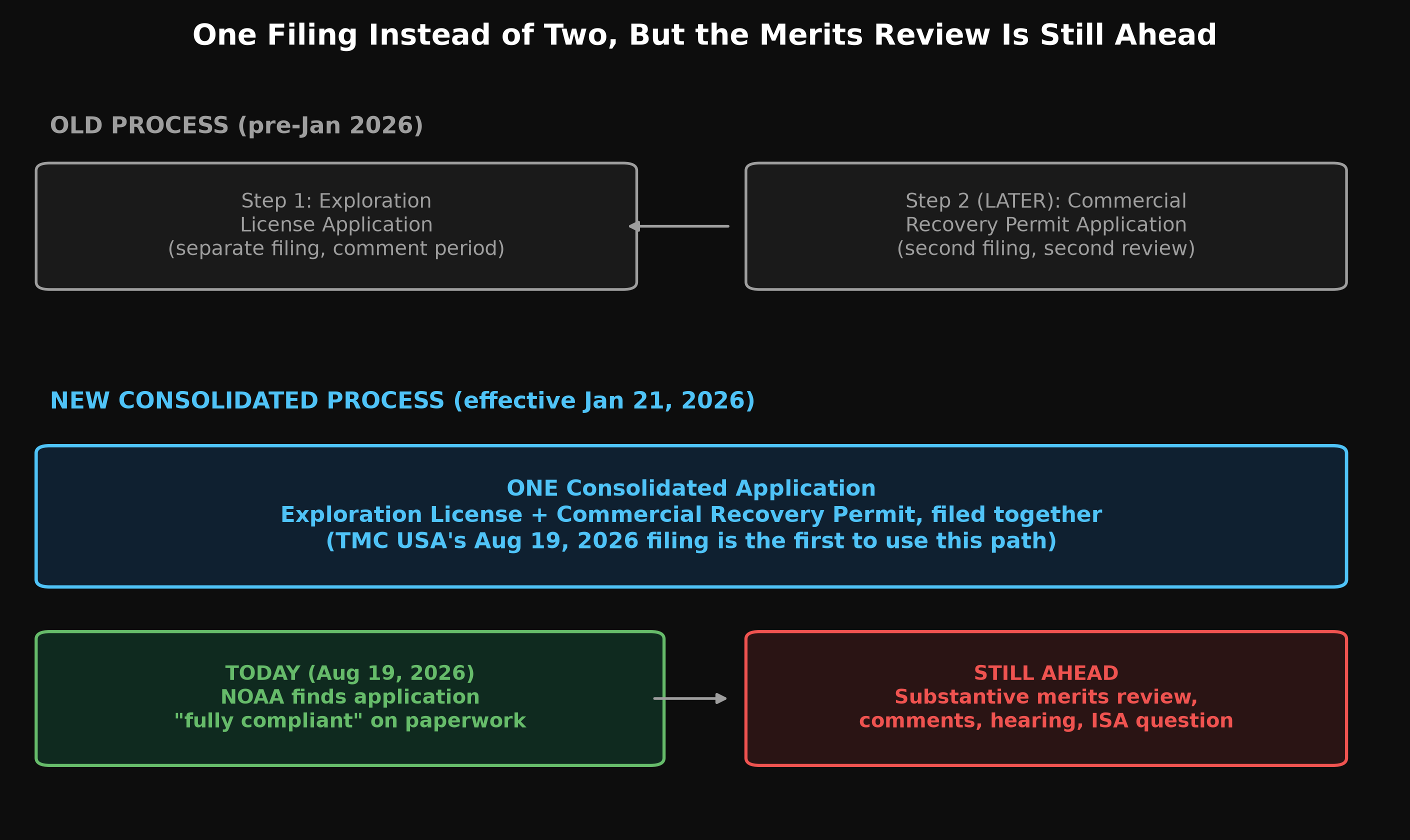
Until this year, a company seeking to mine the deep seabed under DSHMRA had to run two separate tracks: first an exploration license, then later a commercial recovery permit, each with its own filing and comment period. NOAA's January 21, 2026 final rule changed that by adding a consolidated license-and-permit application process to the DSHMRA regulations, letting an applicant fold exploration and commercial recovery into a single filing (govinfo.gov FR-2026-01-21 2026-01044). The logic: exploration-phase environmental, geological, and engineering data can feed directly into the commercial-recovery review rather than being re-litigated in a second, sequential application.
TMC USA is the first applicant to actually use it. The August 19 notice describes an "amended consolidated application" that supersedes a prior TMC USA filing ("Application A") which had sought only an exploration license and was noticed on December 23, 2025 (Federal Register 2026-16869). A separate TMC USA exploration license application, "Application B," was noticed at the same time and continues on its own, unaffected track (Federal Register 2026-16869). In practical terms, TMC USA converted a narrower exploration-only bid into the broader combined filing the new rule allows, seeking both pieces of authorization at once for the same seabed footprint.
What "Fully Compliant" Means, and What It Doesn't
NOAA's notice states plainly that the consolidated application "is fully compliant with the applicable information requirements of the Act and its implementing regulations" (Federal Register 2026-16869). Read that sentence carefully: it says the paperwork contains what the regulations require it to contain. It does not say NOAA has evaluated whether the exploration plan is environmentally sound, whether the commercial recovery methodology meets DSHMRA's substantive standards, or whether the application should ultimately be granted. NOAA's own description of the DSHMRA process is explicit that there are multiple steps before a license or permit is actually issued, and that final approval authority rests with the NOAA Administrator, a separate and later decision point from the information-completeness check that just occurred (NOAA Ocean Service, Deep Seabed Mining).
What happens now is the public-facing phase of review: written comments accepted through October 19, 2026, and a virtual hearing on October 13, 2026, capped at 1,000 attendees with a three-minute limit per speaker (Federal Register 2026-16869). That record feeds into NOAA's substantive evaluation, where the application could still be modified, conditioned, delayed, or denied. The gap between "your paperwork is complete" and "you may proceed" separates a Federal Register notice from a commercially usable authorization, and it is a gap that has swallowed more than one permitting story before the underlying project ever generated revenue.
Get the next one first. Free, daily, one email when a new regulatory catalyst breaks. Subscribe free.
TMC's Own Resource Claims
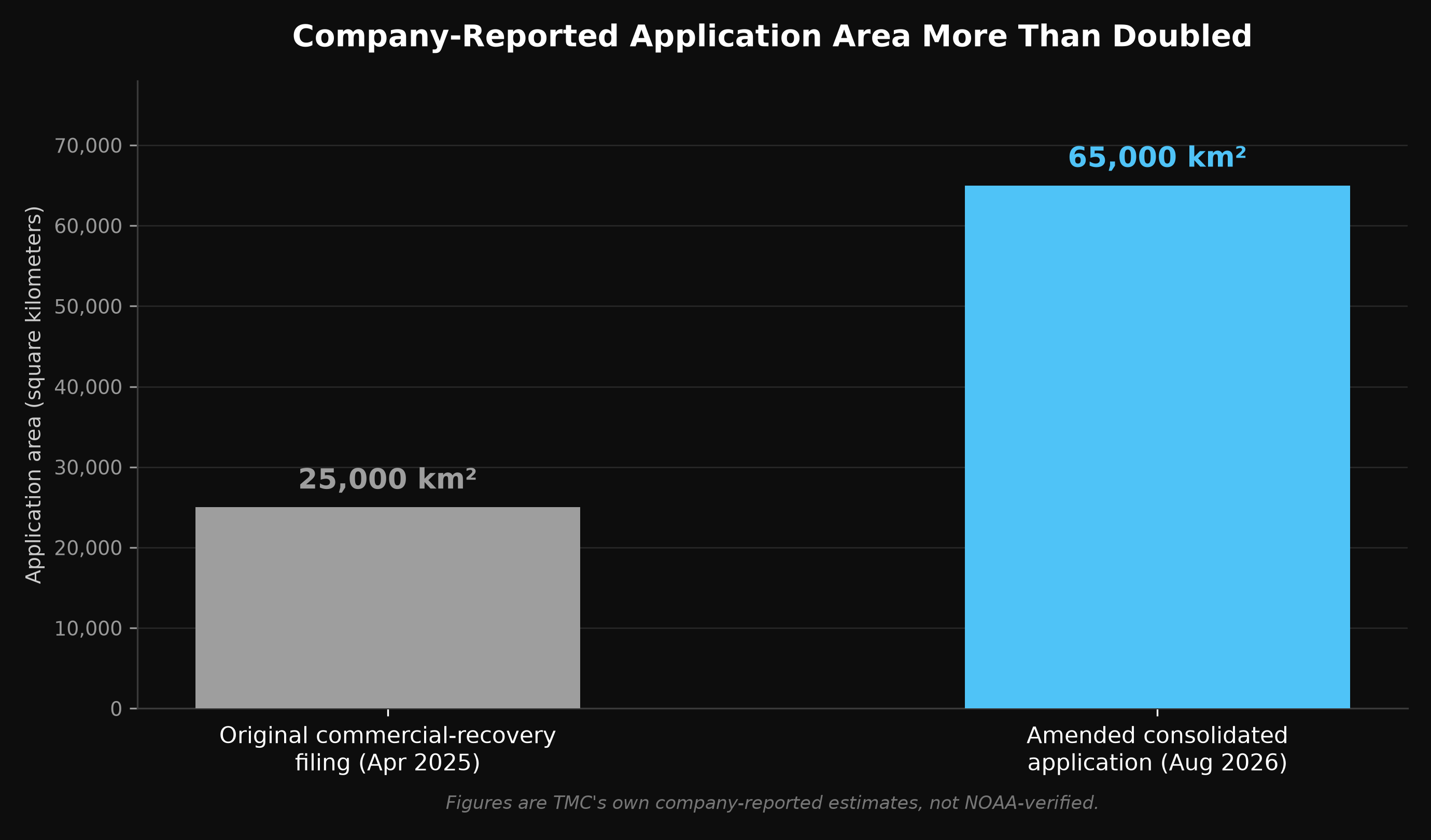
TMC's own SEC-filed release describes the consolidated application as covering an approximately 65,000 square kilometer exploration and commercial recovery area in the Clarion-Clipperton Zone, up from roughly 25,000 square kilometers in TMC USA's original commercial-recovery filing from April 2025 (SEC filing, TMC). The same release puts the application's estimated resource at 619 million tonnes of wet polymetallic nodules, plus potential exploration upside of another 200 million tonnes (SEC filing, TMC). Every figure here is company-reported, not an independently audited reserve estimate; NOAA's compliance finding does not validate the tonnage, since NOAA's notice concerns whether the application contains the required information categories, not whether the company's resource math holds up.
TMC frames the filing as informed by more than a decade of environmental baseline studies and offshore engineering work conducted by the company and its partners (SEC filing, TMC), and TMC the metals company Inc. is confirmed as the parent on the SEC's own EDGAR company page under CIK 0001798562 (SEC EDGAR company page). That history matters for NOAA's later substantive review, but it remains TMC's own characterization of its work product, not a third-party audit.
The Unresolved International-Law Layer
DSHMRA governs U.S. licenses and permits for hard mineral resources in areas beyond national jurisdiction, meaning international waters outside any nation's territorial claim, and it requires public notice of applications as part of the domestic review (NOAA Ocean Service, Deep Seabed Mining). But DSHMRA is a domestic U.S. statute. The international body most countries recognize as having jurisdiction over deep seabed mining in international waters is the International Seabed Authority (ISA), operating under the U.N. Convention on the Law of the Sea (UNCLOS). The United States has never ratified UNCLOS. That leaves a live, unresolved legal and diplomatic question sitting on top of NOAA's entire domestic process: whether a U.S. DSHMRA license and permit, even if eventually issued, would be treated as sufficient authorization to mine international seabed by other governments, commercial counterparties, or international courts, absent any ISA sign-off. This is a separate gating question from NOAA's procedural and substantive review, one today's Federal Register notice does not touch, resolve, or purport to resolve.
Bear Case
Start with the most basic point: NOAA's finding here is procedural, not substantive. A "fully compliant" determination confirms the application has the required information; it says nothing about whether NOAA will ultimately approve the exploration license or the commercial recovery permit once it evaluates the underlying merits, the environmental record, and the comment record generated by the October 19, 2026 deadline. Historical base rate for complex federal permitting reviews with mandatory environmental components: substantive review periods run long, generate significant conditions, and sometimes end in denial rather than issuance, regardless of how clean the initial paperwork was.
Layer the ISA/UNCLOS question on top of that. Even if NOAA eventually issues both the license and the permit, the application area sits in international waters, and the U.S. has never ratified the treaty framework most of the world uses to govern that space. If commercial nodule buyers, insurers, financing partners, or foreign governments treat ISA authorization as a precondition for legitimate seabed extraction in the Clarion-Clipperton Zone, a domestic U.S. permit alone may not be commercially usable, and it could draw international legal challenges unrelated to whether NOAA's domestic process was followed correctly. This structural risk exists independently of how well TMC USA's application performs in NOAA's substantive review.
Finally, there is the environmental and financing dimension. Deep-sea nodule mining has drawn sustained opposition from environmental organizations and segments of the scientific community globally, concerned about disturbance to poorly understood deep-ocean ecosystems, and that opposition tends to surface heavily in comment periods and hearings like the one scheduled for October 13, 2026. Separately, this remains unproven technology at commercial scale: TMC's own 619 million tonne resource figure and 200 million tonne exploration upside are company estimates, not independently audited reserves, and the company's most recent 10-Q shows a development-stage enterprise with no operating revenue, a net loss of $60.1 million for the quarter ended June 30, 2026, cash of $98.7 million, and negative shareholders' equity, funding a capital-intensive offshore buildout on speculative future permits (TMC 10-Q, June 30 2026).
Investment Idea
The setup: TMC the metals company Inc. (Nasdaq: TMC) is the parent of TMC USA, the applicant named in NOAA's Federal Register notice (Federal Register 2026-16869; SEC filing, TMC). This is a regulatory-milestone research lead worth tracking, not a recommendation. The financial mechanics suggest a company still years from commercial nodule revenue, with financing capacity tied heavily to the pace of federal permitting news rather than to operating results.
Catalyst: The October 13, 2026 hearing and the October 19, 2026 comment deadline are the next concrete dates on the NOAA docket (NOAA-NOS-2026-1751); that record feeds directly into NOAA's substantive merits review of the license and permit (Federal Register 2026-16869). A future NOAA merits decision, in either direction, would be a materially larger event than today's compliance notice.
Risk: Multiple independent layers of risk stand between today's procedural notice and any commercial production revenue: (1) NOAA's substantive review of the merits could modify, condition, or deny the license or permit; (2) the unresolved ISA/UNCLOS question could limit the commercial usability of a domestic license even if issued; (3) environmental review and organized opposition could extend timelines well past current dates; and (4) TMC's own financing position, a net loss of $60.1 million in the second quarter of 2026 against $98.7 million in cash, means the company needs continued capital access to reach any production decision, independent of how the permitting process resolves (TMC 10-Q, June 30 2026).
Principle
"Compliant with information requirements" is one of the more common traps in regulatory-headline investing. It sounds like progress because it is progress: the application cleared a real administrative hurdle and moved to the next stage of a defined process. But it is a checklist finding, not a judgment on the substance of what was filed, and coverage built around the word "compliant" tends to blur that distinction faster than the underlying agency does. The reader who hears "NOAA determines application compliant" as "NOAA approves seabed mining" has skipped the step that actually matters: the merits review that comes next, on a date nobody has yet announced. That gap between procedural completeness and substantive approval is where regulatory headlines get misread most often, and it is worth checking which side of the gap a given news item sits on before treating it as a catalyst.
Tracking a permitting story we're missing in the critical-minerals space? Hit reply.
Related analysis
Read next: Treasury's Stablecoin NPRM Builds a Two-Tier Wall Around the U.S. Market
Read next: Pennsylvania Turns Data Centers Into a Permitting Bargain
The Free Markets Report is provided by Lead-Lag Publishing, LLC. All opinions and views mentioned in this report constitute our judgments as of the date of writing and are subject to change at any time. Information within this material is not intended to be used as a primary basis for investment decisions, and should also not be construed as advice meeting the particular investment needs of any individual investor. Trading signals produced by The Free Markets Report are independent of other services provided by Lead-Lag Publishing, LLC, or its affiliates, and the positioning of accounts under their management may differ. Please remember that investing involves risk, including loss of principal, and past performance may not be indicative of future results. Lead-Lag Publishing, LLC, its members, officers, directors, and employees expressly disclaim all liability with respect to actions taken based on any or all of the information in this writing.