A 2025 Drone Probe Just Became a Three-Tier Tariff Regime
Washington's Section 232 playbook: investigate, proclaim, tier the duties, dangle an onshoring carrot. Drones are the latest test case.

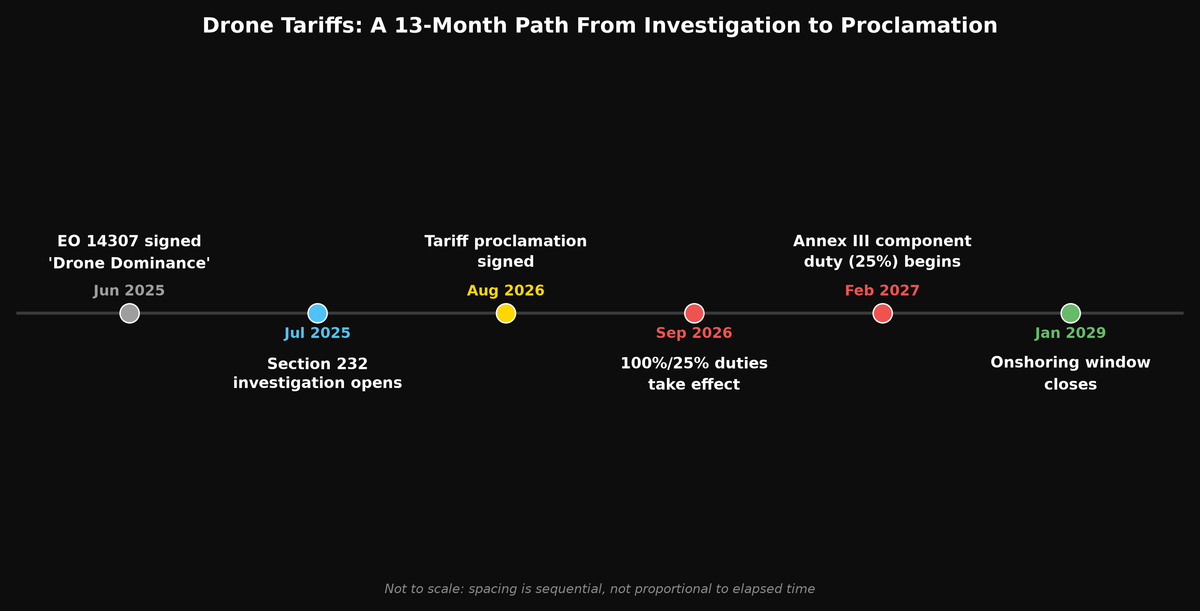
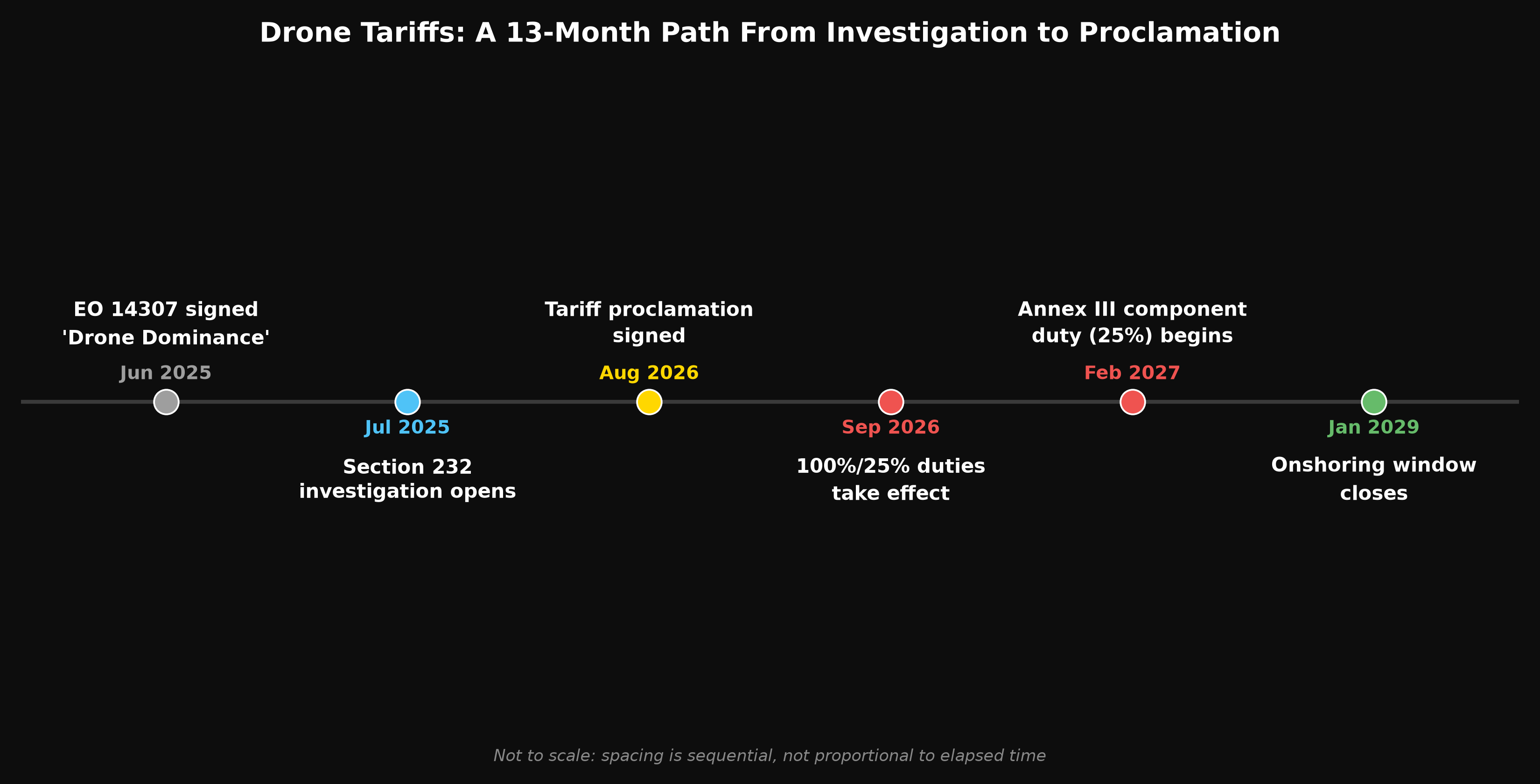
On August 13, 2026, the White House issued a Section 232 proclamation imposing new tariffs on unmanned aircraft systems (UAS) and their components, ranging from 25% to 100% depending on the product, with allied nations eligible for capped rates as low as 10% (White House proclamation). The bulk of the duties take effect September 3, 2026, at 12:01am ET, with a separate component tariff phasing in February 9, 2027, and a duty-free onshoring window running through January 20, 2029 (White House proclamation). The move caps a process that started 13 months earlier with a national-security investigation, and it is worth studying closely, because this is now the template.
Key Highlights
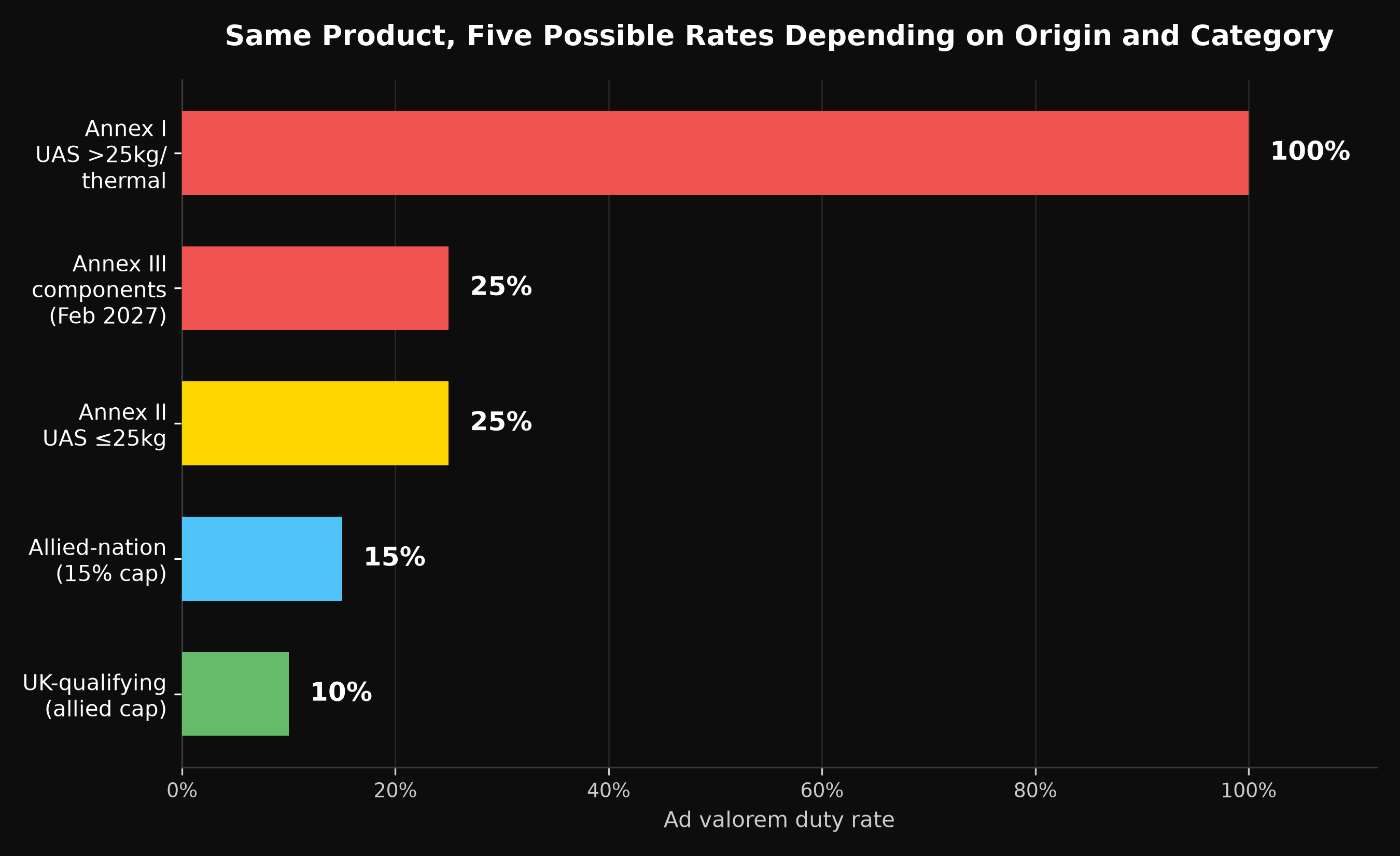
- 100% ad valorem duty on UAS above 25kg, UAS with thermal imagers, covered docking stations, and specified Annex I components, effective September 3, 2026 at 12:01am ET (White House proclamation).
- 25% ad valorem duty on UAS at or below 25kg (Annex II), also effective September 3, 2026; a separate 25% duty on Annex III components doesn't hit until February 9, 2027, 180 days after signing (White House proclamation).
- Allied-content caps: products sourced substantially from the US plus Japan, South Korea, Taiwan, Switzerland, Liechtenstein, or an EU member get a combined 15% rate; UK-qualifying products cap at 10% (White House proclamation).
- The investigation that produced this proclamation opened just over a year earlier: Commerce/BIS launched the Section 232 inquiry on July 1, 2025, with the Federal Register notice published July 16, 2025 (Federal Register).
The Mechanism: Three Tiers, Three Clocks
Read the proclamation closely and it isn't one tariff. It's three, layered on different timelines, and the sequencing tells you something about intent.
The first tier, 100%, hits the products the administration considers most sensitive: UAS over 25kg, anything with thermal imaging, docking stations, and a set of critical components enumerated in Annex I (White House proclamation). These are systems the fact sheet frames as central to "modern armed conflict" and "present and future U.S. military operations" (White House fact sheet).
The second tier, 25%, applies to smaller UAS at or below 25kg under Annex II, described as lacking "capabilities particularly implicating national security" (White House fact sheet). Both tiers land on the same date, September 3, 2026 (White House proclamation).
The third tier is the one to watch most closely: a 25% duty on specified Annex III components, delayed until February 9, 2027, exactly 180 days after the proclamation, and explicitly tied to onshoring incentives (White House proclamation). That gap isn't an accident, it's a runway. Companies that assemble drones domestically but still import components have roughly a year and a half before the component tariff bites, presumably time meant for building US capacity. Whether that capacity materializes in time is a separate question, and one worth tracking.
The Allied-Nation Carve-Out Logic
The rate structure isn't just punitive, it's a sorting mechanism. Products certified as substantially sourced (hardware, software, and critical technology) from the US, Japan, South Korea, Taiwan, Switzerland, Liechtenstein, or an EU member state qualify for a combined maximum rate of 15%, well below the 100% or 25% baseline tiers (White House proclamation). UK-qualifying products, under a similar certification standard, cap at 10%, the lowest rate in the whole structure (White House proclamation).
The message: this isn't a blanket "buy American" mandate, it's a "buy American or trusted-ally" mandate. Adversarial sourcing gets the full tariff; allied sourcing gets a discount; domestic sourcing (implicitly) gets the best treatment once an onshoring plan is approved. The proclamation also references the Department of War's Blue UAS Cleared List, the Blue UAS Framework, and the FCC's Conditional Approval List as mechanisms for delayed treatment of qualifying products, meaning companies already vetted through existing defense and telecom-security processes get a smoother transition than the general market (White House proclamation).
But certification isn't free. Someone has to document, verify, and defend the "substantially all critical components" claim for every qualifying product, subject to Commerce's own verification process. That's a compliance layer stacked on top of a tariff regime, and it will separate companies with existing customs infrastructure from those without.
The Historical Analog: From Investigation to Proclamation
This didn't come out of nowhere. Commerce's Bureau of Industry and Security opened the underlying Section 232 national-security investigation into UAS imports on July 1, 2025, formalized in a Federal Register notice published July 16, 2025 (Federal Register). That inquiry followed Executive Order 14307, "Unleashing American Drone Dominance," signed June 6, 2025, which named Commerce, Defense, the FAA, State, the Export-Import Bank, the DFC, TDA, and OSTP as agencies involved in strengthening the US drone ecosystem (EO 14307).
Thirteen months elapsed between the investigation's opening and the proclamation's signing. That's the pattern worth internalizing: this administration has now run the same sequence, most visibly on steel, aluminum, and semiconductors, and is running it again here. Open a 232 investigation, let Commerce build the factual record, then issue a proclamation with graduated timelines, allied carve-outs, and an onshoring incentive attached. If you're tracking sectors for the next iteration of this pattern, the lead indicator isn't the tariff announcement itself, it's the Federal Register notice announcing the investigation, which now arrives roughly a year ahead.
If someone forwarded you this, the fastest way to keep getting it is subscribing directly, no cost, no catch.
The Onshoring Program
The proclamation directs Commerce's Secretary to build an onshoring program. Companies can submit plans committing to build, refurbish, or expand US facilities producing covered UAS or components, provided construction begins before January 20, 2029 (White House proclamation). If approved, the company can import covered products and the equipment needed to build the facility duty-free, but only during construction, and only in volumes consistent with the plant's anticipated output once finished (White House proclamation).
Commerce retains real teeth: it can monitor approved plans, require audited reporting, and rescind (including retroactively, for fraud or deliberate misrepresentation) the duty benefits if a company fails to meet its commitments (White House proclamation). It's a real carrot, but conditional and auditable, not a blanket exemption. Read against the February 2027 component tariff date, the design intent looks clear: give companies committed to building domestically an 18-month grace period before component costs rise, while everyone else pays on schedule.
Bear Case
The most immediate exposure sits with US drone assemblers who don't yet have domestic component supply and haven't filed, or don't qualify for, an onshoring plan. They face the September 2026 tariffs on finished UAS and the February 2027 tariff on components, while still relying on imports because domestic capacity for critical parts, batteries, sensors, flight controllers, doesn't spin up overnight. Higher input costs land before any onshoring benefit can offset them, and margins compress in the interim.
Allied-content certification, while structured as a relief valve, is its own burden. Proving "substantially all critical components and technology" originate from an approved country list requires documentation and ongoing verification that Commerce controls. For companies with complex, multi-country supply chains, that process could slow qualification rather than accelerate it. There's also standard trade-friction risk: allied nations whose exporters now face a 15% (or 10% for the UK) floor rather than zero could push back, even if the proclamation frames these as preferential rates rather than punitive ones.
The timing mismatch is the structural risk worth tracking longest. The onshoring window runs through January 20, 2029; the Annex III component tariff starts February 9, 2027, nearly two years earlier. If domestic component manufacturing capacity doesn't scale fast enough to fill that gap, companies pay the higher costs well before the onshoring structure produces enough US-made components to matter. That's a bet on execution speed, and execution speed in industrial buildouts is exactly the variable that most often disappoints.
Investment Idea
No company is named anywhere in the proclamation or the fact sheet (White House proclamation; White House fact sheet), so treat what follows as research leads, not a recommendation.
AeroVironment (AVAV) and Red Cat Holdings (RCAT) are the two most obvious US-listed drone makers whose products sit conceptually in the categories this proclamation targets. If their manufacturing footprint and component sourcing turn out to be exposed to the tariffed import categories, or if either qualifies for Blue UAS Cleared List or FCC Conditional Approval List treatment, they could see a relative cost advantage over import-reliant competitors. iShares US Aerospace & Defense ETF (ITA) offers broader, more diversified exposure to the theme without betting on a single name. None of this is confirmed: the proclamation's actual product coverage lives in Annexes I through IV, which weren't available in the text reviewed for this piece, and neither company's specific component sourcing has been checked against those annex lists.
Catalyst: Commerce is required to deliver an update to the President on UAS and component imports within 120 days of the proclamation, and the Secretary will begin approving (or rejecting) onshoring plans on a rolling basis, both of which should surface which companies Washington is actually treating as strategic beneficiaries (White House proclamation).
Risk: If AVAV, RCAT, or the broader domestic drone-supply ecosystem still depend on imported components not covered by an approved onshoring plan, the September 2026 and February 2027 tariff dates raise their input costs before any competitive benefit shows up, undercutting the bull case for owning them purely on tariff-protection logic.
The Principle
Section 232 has become a slow-moving but predictable machine: investigate, document, proclaim, tier, and attach an onshoring incentive that rewards patience over speed. The asymmetry for investors isn't in the headline tariff rate, it's in the gap between the effective date and the date domestic capacity can realistically absorb the demand that gap creates. That gap is where costs get paid before benefits arrive, and it's also where the companies willing to commit capital early, and able to navigate Commerce's certification and monitoring apparatus, separate themselves from everyone waiting to see how the policy shakes out. Reregulation, like deregulation, doesn't distribute its effects evenly. It rewards the prepared and taxes the slow, and the proclamation's own calendar tells you exactly how much time each side has.
Got a drone-supply-chain angle you think we're missing, or a read on whose components actually sit in Annex I? Hit reply, we read every one, and if you're not already getting this in your inbox each morning, subscribing takes about ten seconds.
Related analysis
Read next: Trump Invokes a 96-Year-Old Tariff Law Against Canada. Autos Barely Show Up.
Read next: The Tariff Wall Got Rebuilt Under a Different Statute
The Free Markets Report is provided by Lead-Lag Publishing, LLC. All opinions and views mentioned in this report constitute our judgments as of the date of writing and are subject to change at any time. Information within this material is not intended to be used as a primary basis for investment decisions, and should also not be construed as advice meeting the particular investment needs of any individual investor. Trading signals produced by The Free Markets Report are independent of other services provided by Lead-Lag Publishing, LLC, or its affiliates, and the positioning of accounts under their management may differ. Please remember that investing involves risk, including loss of principal, and past performance may not be indicative of future results. Lead-Lag Publishing, LLC, its members, officers, directors, and employees expressly disclaim all liability with respect to actions taken based on any or all of the information in this writing.