The UK Just Proposed Making It a Crime to Control Your Own EV Charger Without a License
The UK proposed a load-control licensing regime for EV chargers and home batteries. The flexibility market it targets already grew 117% in a year, and National Grid is positioned to benefit from consolidation.

Key Highlights
- On August 7, 2026, the UK's Department for Energy Security and Net Zero opened a consultation on class exemptions from a brand-new load-control licence, part of the Smart Secure Electricity Systems program under the Electricity Act 1989. Comments close 11:59pm on September 7, 2026.
- The regime would make it a criminal offense to run unlicensed load-control activity on EV chargers, heat pumps, and home batteries once a 12-month transition period ends, with three proposed exemption classes carving out narrower activity.
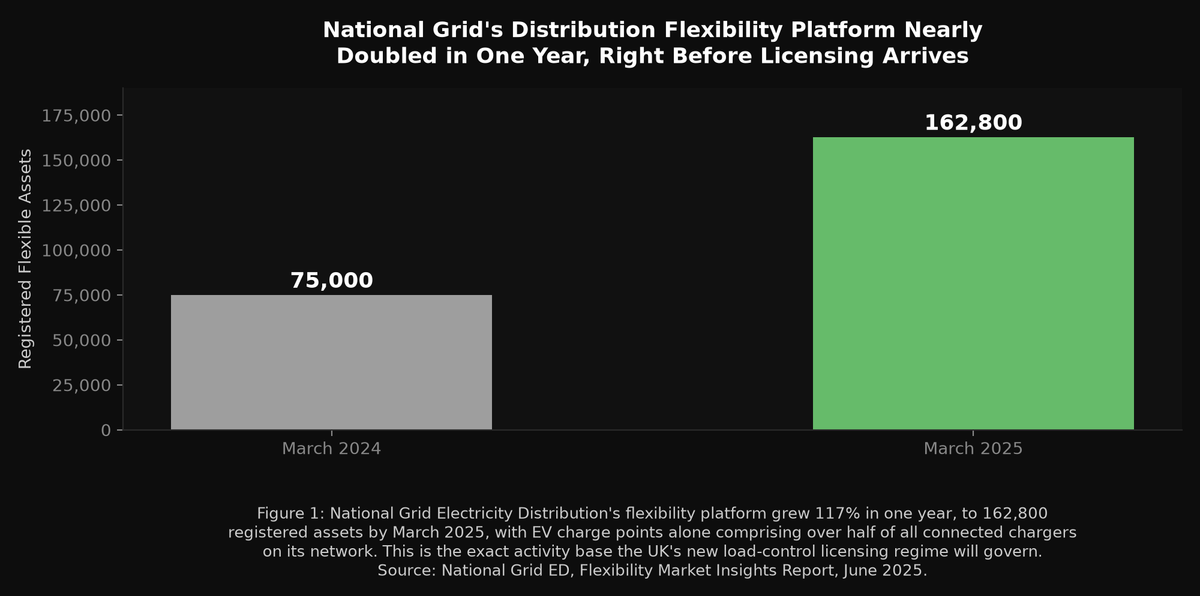
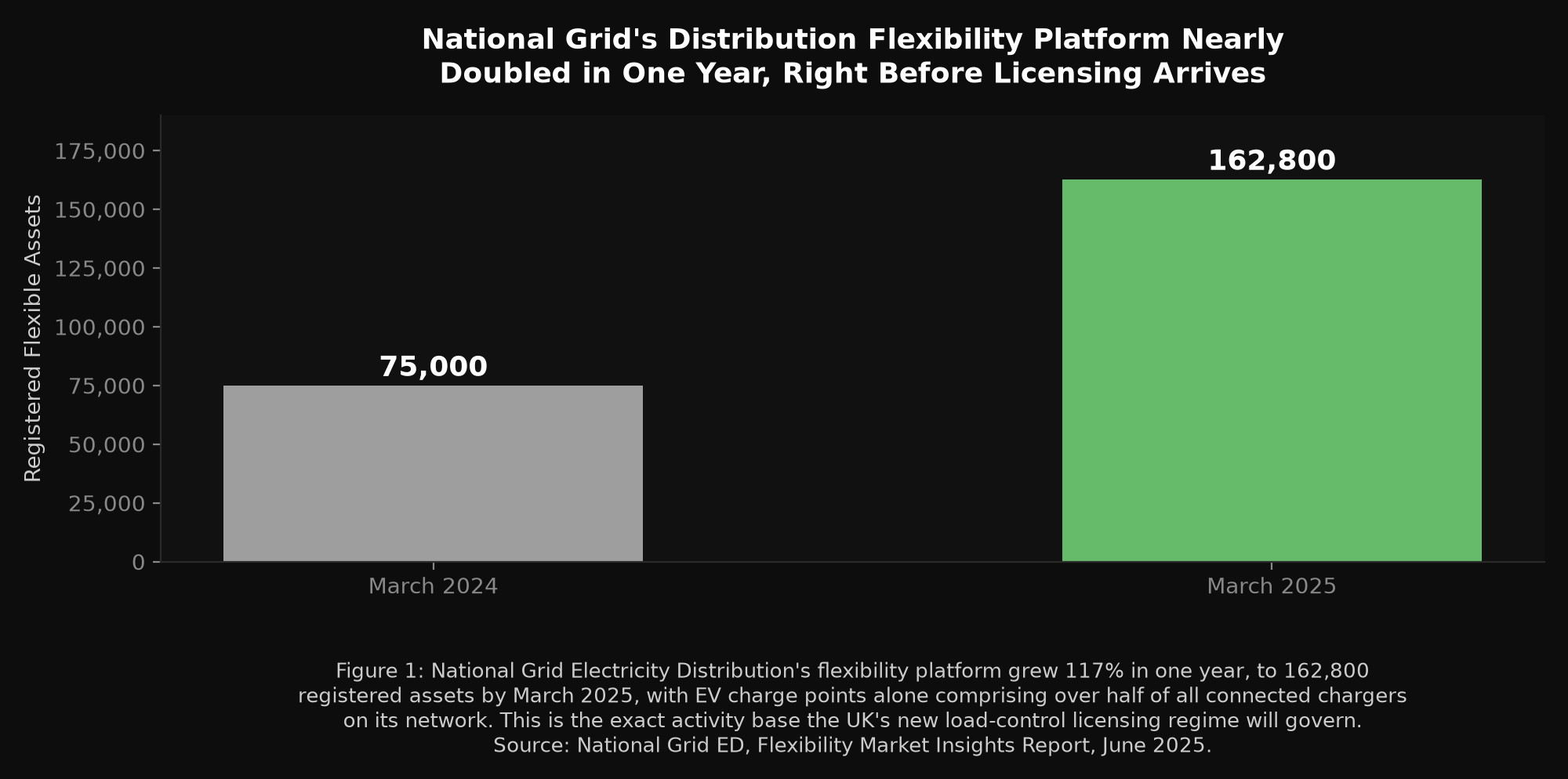
- National Grid's own distribution flexibility platform, the infrastructure this licensing perimeter would sit directly on top of, grew from 75,000 to 162,800 registered assets in one year, more than half of them EV charge points.
- National Grid (NGG) is mid-way through a five-year, at-least-£70 billion capital program; the licensing regime's compliance cost, not yet estimated by either DESNZ or Ofgem, is the thing to watch, not the headline consultation itself.
- The real risk isn't to National Grid's balance sheet. It's to the aggregators and smaller flexibility service providers who don't have National Grid's compliance budget.
A government agency opened a consultation on August 7 asking, in effect, who should be allowed to turn your electric car charger off. That is not a rhetorical framing. It is the literal mechanism at the center of Britain's new load-control licensing regime, and it is the first time the UK has proposed making it a criminal offense to remotely manage a home battery or EV charger without a license.
The Regime Nobody Asked For, Aimed at a Market Growing Faster Than the Rulemaking
The UK's Department for Energy Security and Net Zero (DESNZ) published a statutory notice on August 7, 2026, proposing three class exemptions from a new requirement to hold a load-control licence under Section 5(1) of the Electricity Act 1989.1 The underlying draft regulations, also published for consultation, would add unlicensed load-control activity to the list of things you cannot legally do without government permission, with the criminal-offense provision taking effect 12 months after the regulations are made.2 Comments on the exemptions close at 11:59pm on September 7, 2026, per the notice's own text, despite a typo on the page itself that misspells the month.1
Load control, in plain terms, is the activity of remotely turning a device's electricity draw up or down. An EV charger that only draws power overnight when the grid is quiet is being load-controlled. A home battery that discharges during a peak-demand event is being load-controlled. Ofgem's own separate consultation on implementing the licensing regime describes the target activity as anything delivered through an "Energy Smart Appliance," a category that explicitly includes EV chargers and heat pumps.3
The problem the regime is trying to solve is real. As more of Britain's electricity demand becomes remotely controllable, a bad actor with access to enough EV chargers or batteries could, in theory, destabilize a local grid or a national one. Ofgem frames the licence requirement around three goals: consumer protection, cyber security, and grid stability.3 None of that is unreasonable. What matters for an investor is that DESNZ expects the regulations to take effect by the end of 2026, and the actual licence requirement, the point where unlicensed activity becomes a crime, by the end of 2027, after the 12-month transition.3
The Market This Regime Would Regulate Has Already Doubled Once
Here is the part that makes this a genuine investment story rather than a compliance footnote: the market this licensing regime targets did not wait for the rulemaking to finish. It has already grown explosively under a lighter-touch framework, and it shows no sign of slowing down while DESNZ finalizes the rules that will eventually govern it.
National Grid Electricity Distribution (NGED), the distribution arm of National Grid plc (NGG), publishes its own flexibility market data. In its most recent Market Insights Report, NGED disclosed that the number of flexible assets registered on its market platform rose from 75,000 in March 2024 to 162,800 in March 2025, a 117% increase in a single year.4 EV charge points alone made up 125,000 of those assets, more than half of every EV charger currently connected to National Grid's distribution network.4
That growth is not slowing. National Grid's separately published distribution flexibility procurement report shows registered assets on its Market Gateway platform nearly doubling again, past 309,000, with a ten-fold increase in long-term flexibility volume awarded compared with the prior tender.5 Nationally, the government's own Clean Flexibility Roadmap estimates total UK flexibility capacity will reach 55.2 gigawatts by 2030 and 204 gigawatts by 2050.6 On the demand side, an estimated 353,000 home EV chargers were installed across the UK in 2025 alone, up nearly 30% year over year, pushing the installed base close to 1.4 million.7
The regulatory calendar moves slower than the market it's trying to govern. Free, daily, one email when a new catalyst like this breaks. Subscribe free.
The Case for Skepticism, and Why It Matters for Investors
The instinctive read is that a new licensing regime is a headwind: more compliance cost, more paperwork, more friction on a market that has been growing precisely because it has been relatively unregulated. That instinct deserves a real hearing, not a dismissal.
Neither DESNZ nor Ofgem has published a compliance-cost estimate for this specific licensing regime. That is a genuine gap. Every prior UK regulatory action The Free Markets Report has covered in the financial-services space has come with at least a rough cost estimate attached; this one has not, as of the documents available at the time of writing.1 3 An investor betting that "this is basically a rounding error for National Grid" is making an inference from the company's overall capital scale, not from a disclosed number specific to this rule.
The stronger version of the bear case is not about National Grid at all. It is about the aggregators and smaller flexibility service providers who do not have National Grid's £70 billion five-year capital program to absorb a new compliance regime. National Grid's own procurement data shows its long-term flexibility tender roster tripled from 13 to 43 Flexibility Service Providers in the most recent cycle.8 If licensing costs land disproportionately on smaller aggregators, the realistic outcome is consolidation among flexibility providers, not damage to National Grid's own network-operator economics. That is a real effect, just not the one the headline "new licensing regime" framing implies.
What would falsify this thesis: if DESNZ or Ofgem publishes a compliance-cost estimate before the licence requirement takes effect (expected by end of 2027) that shows per-participant costs material enough to reverse the current growth trajectory in registered flexible assets, for example, a quarter-over-quarter decline in NGED's own registered-asset count following the regulations coming into force in late 2026, that would be the signal the market got this wrong in the other direction.
National Grid's Capital Program Dwarfs Any Plausible Compliance Cost
National Grid (NGG) reported capital investment of £11.58 billion for its fiscal year ended March 31, 2026, up 21.3% from £9.542 billion the prior year.9 The company has committed to at least £70 billion of investment over its 2026/27–2030/31 five-year framework, targeting 8–10% compound annual asset growth and roughly 10% compound annual growth in underlying earnings per share.9 Underlying operating profit rose to £5.68 billion in FY2026 from £5.221 billion the prior year, an 8.8% increase, while statutory net income reached $3,243 million, up from $2,829 million a year earlier.10
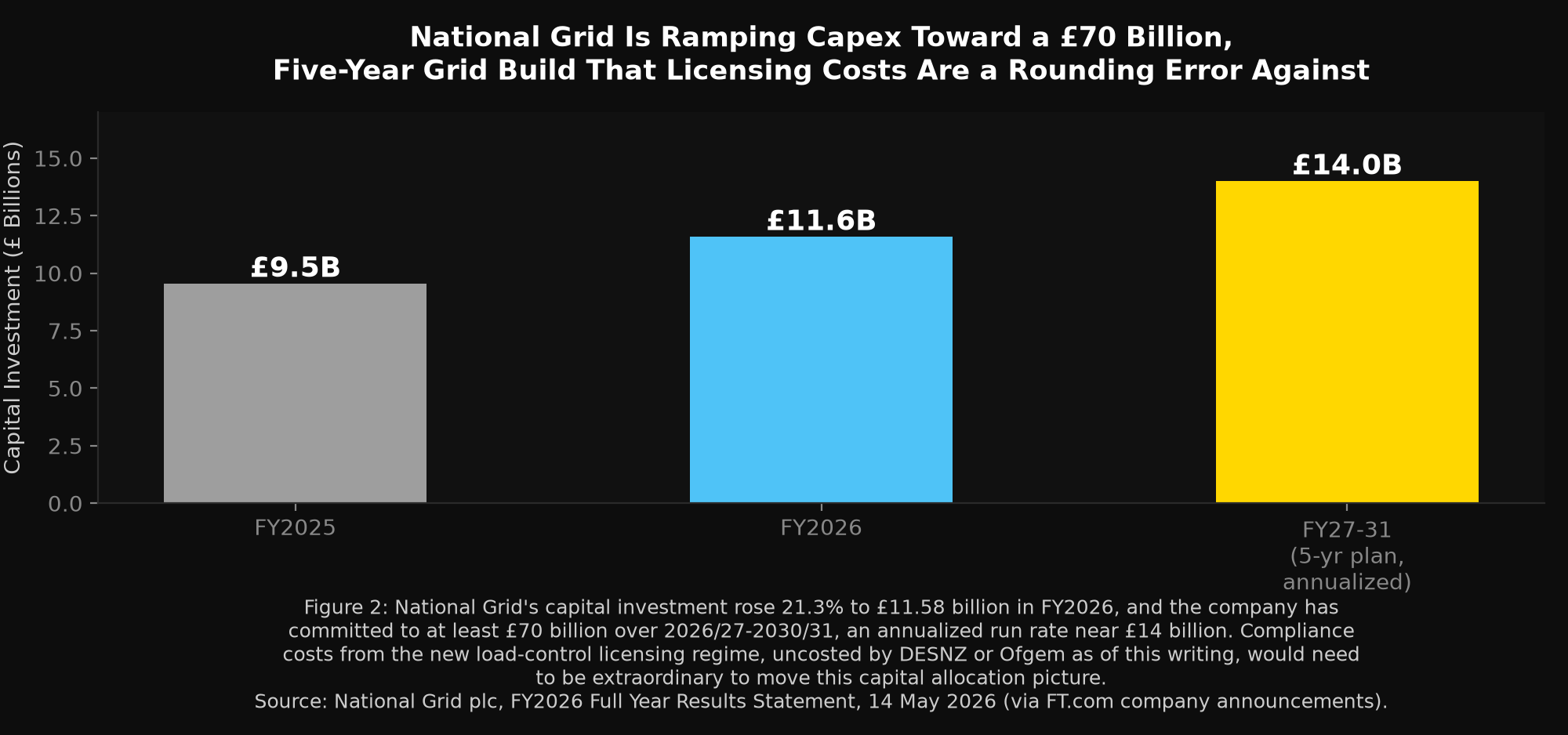
Put those numbers side by side with the flexibility licensing story: National Grid is currently trading at $80.88 per share, with a market capitalization of roughly $81.3 billion and a trailing price-to-earnings ratio of 18.46.11 Even a licensing regime with a genuinely expensive compliance burden would need to reach an implausible scale to move a company deploying capital at this rate. The flexibility platform itself is a small, high-growth piece of a much larger regulated-infrastructure business, which is exactly why this is a story about market structure and second-order participants, not about National Grid's earnings power.
The Non-Obvious Angle: Home Charger Growth Keeps Outrunning the Rulemaking
The regulatory perimeter DESNZ is drawing today is being drawn around a moving target. UK home EV charger installations grew nearly 30% in 2025 according to Barbour ABI's market research, adding an estimated 353,000 new units and pushing the total installed base toward 1.4 million.7 Every one of those chargers is a candidate Energy Smart Appliance under the framework Ofgem is proposing to license.3 The installed base the regime will eventually have to cover keeps expanding while the rulemaking is still working through a September 2026 comment period.
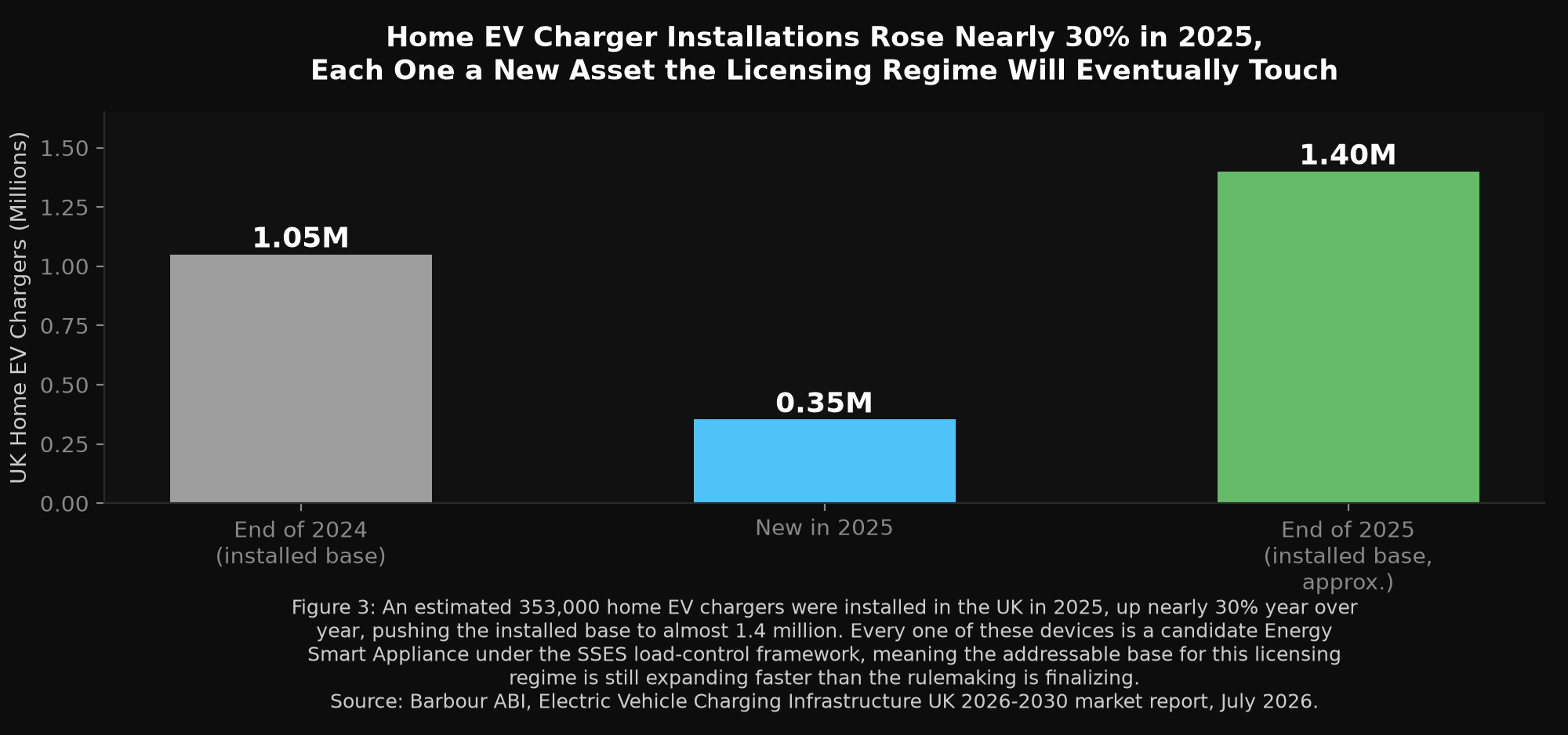
That mismatch, fast-growing addressable market against a slow-moving licensing framework, is the actual investable signal here. It suggests that whichever entities are best positioned to absorb licensing compliance costs without slowing their own growth (large, well-capitalized network operators like National Grid) gain relative share of a market that keeps expanding regardless of the regulatory calendar.
INVESTMENT IDEA: National Grid plc (NGG)
Thesis type: Primary beneficiary
Deregulatory catalyst: Proposed UK load-control licensing exemptions and the underlying SSES framework, which will govern the exact flexibility-market activity National Grid's distribution arm already operates at scale
Current price: $80.88 (as of August 7, 2026 close, Perplexity Finance real-time quote data)11
Key financial data: FY2026 capital investment of £11.58 billion (+21.3% YoY); underlying operating profit £5.68 billion (+8.8% YoY); statutory net income of $3,243 million (+14.6% YoY)9 10
Regulatory constraint removed: None yet. This is a pending consultation, not a finalized rule. The thesis is about scale advantage under a future compliance regime, not about relief from an existing one.
Bull case: National Grid's distribution flexibility platform has already demonstrated it can scale 117% in a single year under a lighter regulatory touch.4 A formal licensing regime that imposes real compliance costs disproportionately burdens smaller aggregators and flexibility service providers, not a company already deploying £70 billion of five-year capital investment, potentially consolidating National Grid's relative position in a still-expanding market.
Bear case: Neither DESNZ nor Ofgem has published a compliance-cost estimate for this specific regime.1 3 If the eventual licence requirement (expected by end of 2027) proves more burdensome than currently modeled, or if legal challenges delay implementation past the current timeline, the market-structure benefit to large incumbents could take years longer to materialize than the growth data above suggests.
What to watch: Any DESNZ or Ofgem compliance-cost estimate published ahead of the regulations coming into force (expected end of 2026); National Grid's next flexibility market insights report showing whether registered-asset growth continues at a comparable pace once the licensing framework is finalized.
Time horizon: 18–36 months
The Principle
A licensing regime aimed at a fast-growing market rarely stops that market from growing. It changes who captures the growth. National Grid's flexibility platform did not need this regulation to reach 162,800 registered assets. It will not need favorable treatment under the new regime to keep growing, either. It needs the compliance-cost floor to be high enough that smaller competitors consolidate toward it, not low enough that everyone keeps competing on equal footing. Watch the cost estimate DESNZ has not yet published. That number, not the consultation itself, is the actual catalyst.
Have a regulatory angle we should be tracking? Hit reply and tell us what you're watching.
Footnotes
1. UK Department for Energy Security and Net Zero, "Smart Secure Electricity Systems: proposed class exemptions from the requirement to hold a load control licence," published August 7, 2026, consultation deadline 11:59pm September 7, 2026. gov.uk
2. Draft Electricity Act 1989 (Load Control Licence) Regulations 2026, consultation draft. gov.uk
3. Ofgem, "Smart Secure Electricity Systems: Implementing the load control licensing regime," consultation, December 10, 2025. ofgem.gov.uk
4. National Grid Electricity Distribution, "Flexibility Market Insights Report," June 2025. nationalgrid.co.uk
5. National Grid Electricity Distribution, "Distribution Flexibility Services Procurement Report 2025-26." nationalgrid.co.uk
6. UK Government, "Clean Flexibility Roadmap: July 2026 update." gov.uk
7. Barbour ABI, "Electric Vehicle Charging Infrastructure UK 2026-2030" market report, cited in The Energyst, July 27, 2026. theenergyst.com
8. National Grid Electricity Distribution, "Performance panel submission." nationalgrid.co.uk
9. National Grid plc, "FY2026 Full Year Results Statement," May 14, 2026. FT.com company announcements
10. National Grid plc, Annual Report on Form 20-F 2025/26, filed with the SEC. nationalgrid.com
11. Perplexity Finance, real-time quote data for NGG, as of August 7, 2026 market close.
The Free Markets Report is provided by Lead-Lag Publishing, LLC. All opinions and views mentioned in this report constitute our judgments as of the date of writing and are subject to change at any time. Information within this material is not intended to be used as a primary basis for investment decisions, and should also not be construed as advice meeting the particular investment needs of any individual investor. Trading signals produced by The Free Markets Report are independent of other services provided by Lead-Lag Publishing, LLC, or its affiliates, and the positioning of accounts under their management may differ. Please remember that investing involves risk, including loss of principal, and past performance may not be indicative of future results. Lead-Lag Publishing, LLC, its members, officers, directors, and employees expressly disclaim all liability with respect to actions taken based on any or all of the information in this writing.
Related coverage: The NRC Just Rewrote the Reactor Rulebook. Uranium Is the Trade.; Washington Chose Talks Over Tariffs on Jets. RTX Still Booked the Cost.