DOE Orders a Dead Coal Plant Back to Life, for the Sixth Time
A Michigan coal plant slated to close in 2025 just got its sixth federal reprieve, and the paper trail shows who is actually paying for it.

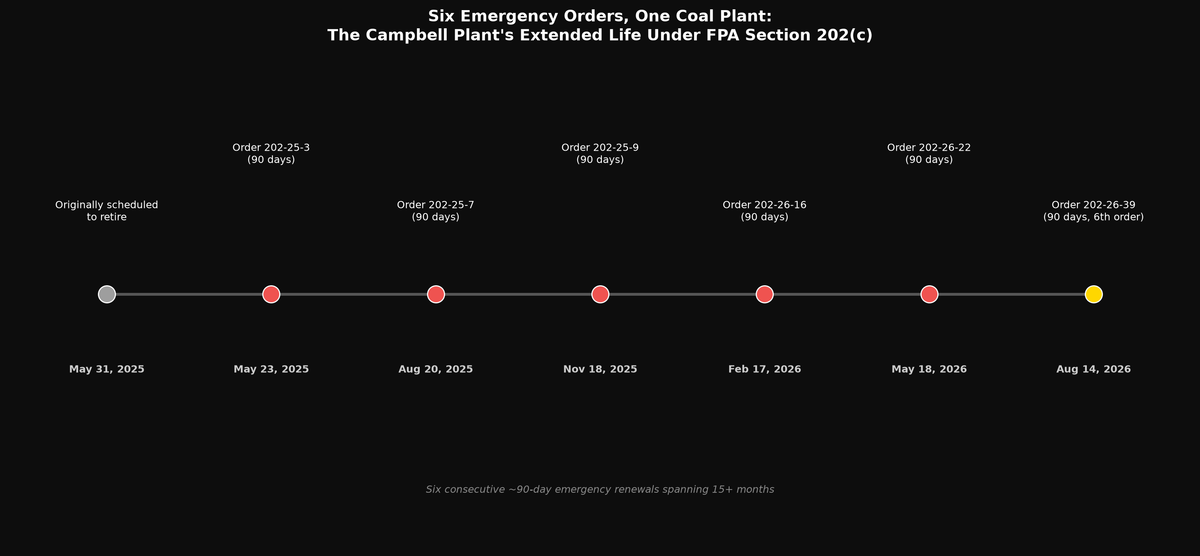
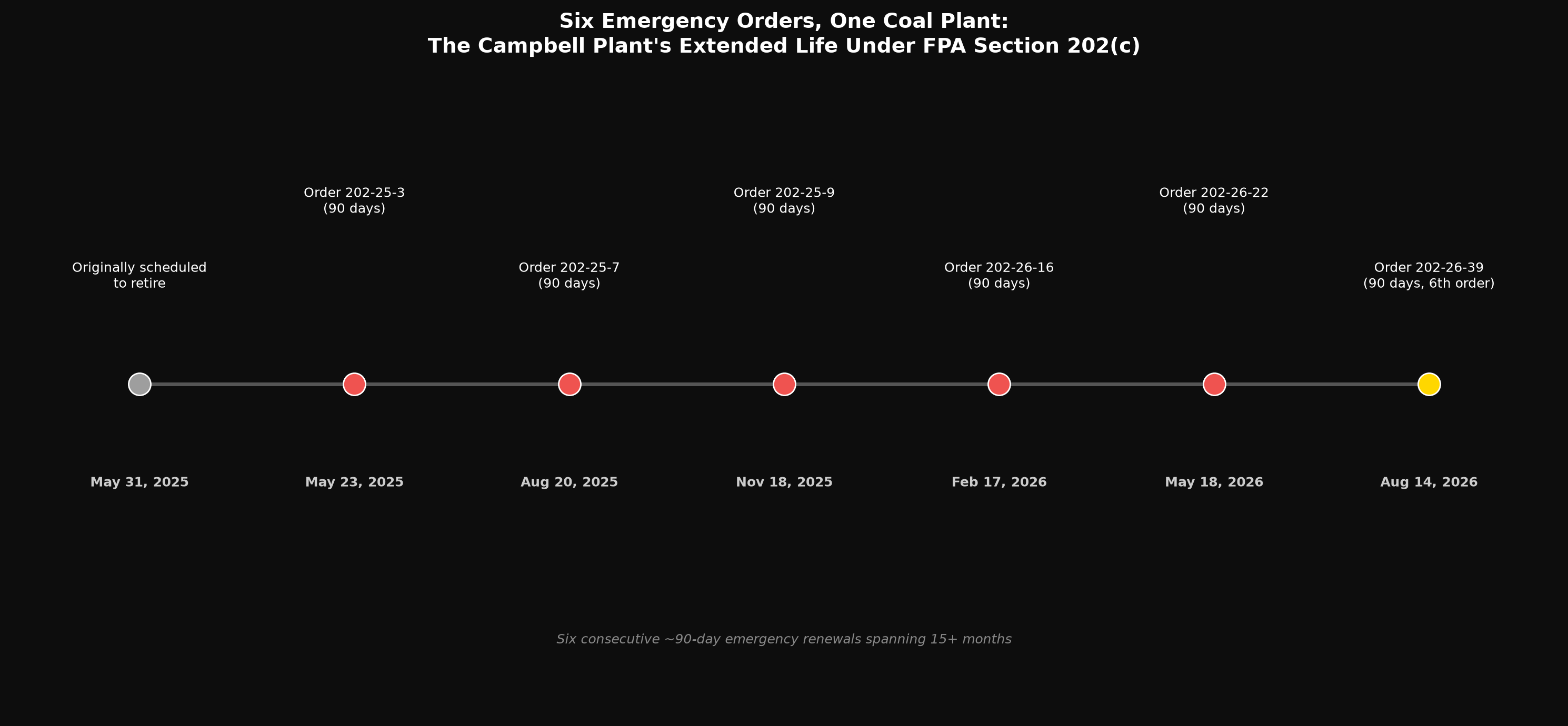
On August 14, 2026, the U.S. Department of Energy ordered the J.H. Campbell coal plant in West Olive, Michigan, to keep running through November 14, its sixth consecutive emergency reprieve since a retirement date that has now been postponed for more than fifteen months. Order No. 202-26-39, signed by Secretary of Energy Chris Wright under Federal Power Act section 202(c), directs MISO and Consumers Energy Company to keep the 1,420-MW plant available to operate, using economic dispatch, from August 17 through November 14, 2026 (DOE Order No. 202-26-39). It is the same legal tool, the same plant, and largely the same reasoning DOE has now used five times before.
Key Highlights
- DOE's Order No. 202-26-39, issued August 14, 2026, is the sixth emergency order compelling continued operation of the Campbell plant since its originally planned May 31, 2025 retirement (DOE Order No. 202-26-39).
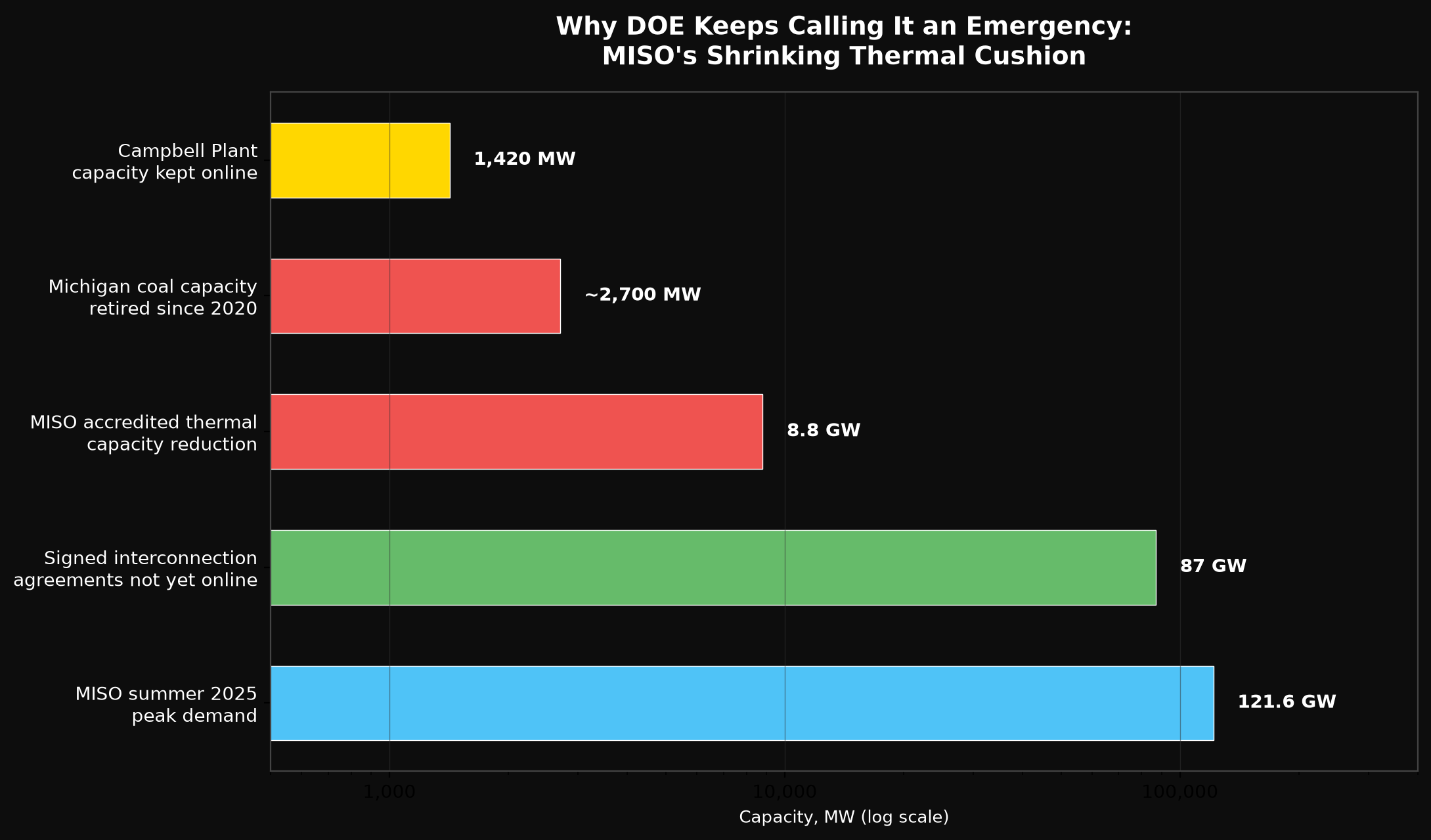
- The order cites 1,431,336 MWh of Campbell net generation from January through May 2026, an 8.8-GW reduction in MISO's accredited thermal capacity, and 87 GW of signed generator-interconnection agreements still not online (DOE Order No. 202-26-39).
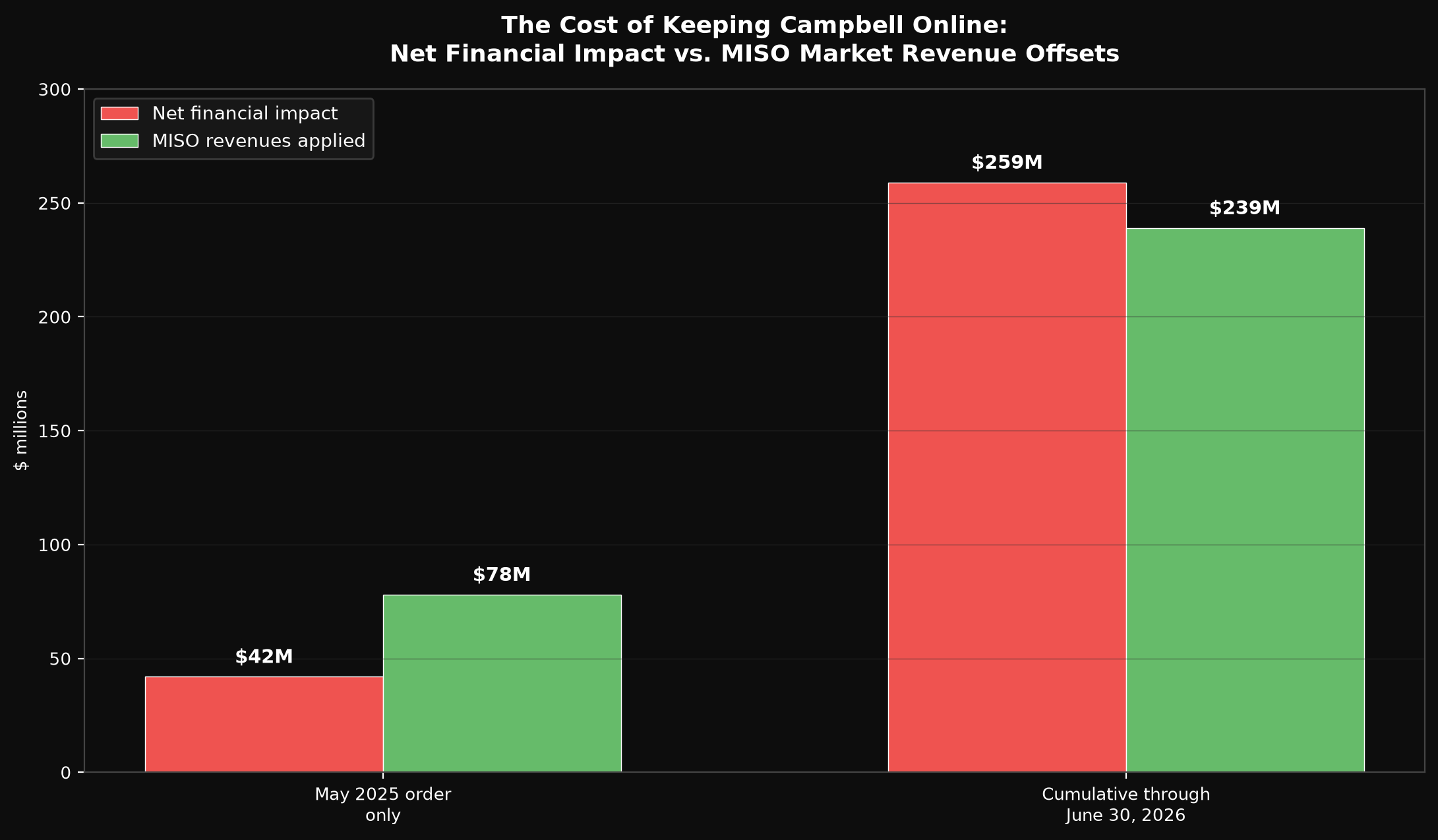
- Consumers Energy, a 100%-owned subsidiary of CMS Energy Corporation, has recorded a cumulative net financial impact of $259 million from complying with the Campbell orders through June 30, 2026, after applying $239 million in MISO market revenues, with FERC recovery still pending (CMS Energy Q2 2026 10-Q).
- The order explicitly states Campbell "shall not be considered a capacity resource," meaning it does not count toward MISO's long-term capacity obligations even while it is compelled to run (DOE Order No. 202-26-39).
- CMS Energy reaffirmed 2026 adjusted EPS guidance of $3.83-$3.90 and introduced 2027 guidance of $4.08-$4.17 in its July 28, 2026 earnings release, even as it works through recovery of Campbell-related compliance costs (CMS Energy Q2 2026 earnings release).
A Plant That Was Supposed to Be Gone
Consumers Energy announced in 2021 that it would retire the coal-burning units at Campbell fifteen years before the end of their scheduled design life, targeting May 31, 2025 (DOE Order No. 202-26-39). That closure never happened. Days before the shutdown, DOE issued Order No. 202-25-3 on May 23, 2025, forcing the plant to keep running for 90 days, until August 21, 2025 (DOE 2025 202(c) Orders index). DOE then renewed that order four more times: Order No. 202-25-7 on August 20, 2025 (through November 19, 2025), Order No. 202-25-9 on November 18, 2025 (through February 17, 2026), Order No. 202-26-16 on February 17, 2026 (through May 18, 2026), and Order No. 202-26-22 on May 18, 2026 (through August 16, 2026) (DOE 2026 202(c) Orders index). Order No. 202-26-39 is the sixth link in that chain, keeping Campbell online through November 14, 2026 (DOE Order No. 202-26-39).
Each order runs for roughly 90 days, the statutory ceiling under FPA section 202(c), and each has relied on a similar finding: that emergency conditions "exist in portions of the MISO region" due to a sudden increase in demand, a shortage of electric energy or generation and transmission facilities, or other causes, and that keeping Campbell available "will best meet the emergency and serve the public interest" (DOE Order No. 202-26-39). The order states that the emergency conditions underlying all five prior orders "continue in both the near term and the long term," and that Campbell's output "will continue to be a critical asset for maintaining reliability in MISO" (DOE Order No. 202-26-39).
The Reliability Case DOE Is Making
The order leans heavily on NERC and EIA data to justify a sixth extension. Per EIA-923 data, Campbell generated 1,431,336 MWh of net electricity from January through May 2026, averaging 286,267 MWh per month, evidence the order cites that the plant has been "providing vital generation capacity to the region" (DOE Order No. 202-26-39). The order also notes roughly 2,700 MW of Michigan coal-fired capacity has retired since 2020, with no new coal facilities planned, while Michigan's nuclear fleet has shrunk since Big Rock Point closed in 1997 and Palisades closed in 2022 (Palisades was reportedly expected to resume service in 2026) (DOE Order No. 202-26-39).
At the MISO-wide level, NERC's assessments cited in the order describe an accredited thermal capacity decline of 8.8 GW, driven mainly by reduced accreditation of existing plants and retirements, alongside a five-year outlook in which "projected resource additions did not keep pace with escalating demand forecasts" (DOE Order No. 202-26-39). The 2026 Organization of MISO States survey cited in the order found 87 GW of signed generator-interconnection agreements still not operating, against projected load growth of 3.1% to 5.1% annually over five years (DOE Order No. 202-26-39). The order also cites real-time stress: MISO issued dozens of reliability alerts in its Central Region between June and November 2025, and declared back-to-back Energy Emergency Alerts during Winter Storm Fern on January 24, 2026, with more than 60% of such "MaxGen" events now occurring outside summer (DOE Order No. 202-26-39).
Six orders in, and the paper trail keeps getting more interesting. Get the next chapter before it hits the wires. Subscribe free.
What the Order Actually Requires, and What It Doesn't Grant
Mechanically, Order No. 202-26-39 requires MISO and Consumers to keep Campbell available to operate beginning August 17, 2026, with MISO directed to employ economic dispatch "to minimize costs to ratepayers" and to set operating parameters that minimize environmental impact, plus daily compliance notifications and a fuller accounting to DOE by August 31, 2026 (DOE Order No. 202-26-39).
Two provisions matter most for investors. First, the order states that "because this Order is predicated on the shortage of facilities for generation," Campbell "shall not be considered a capacity resource" (DOE Order No. 202-26-39). Campbell doesn't get credited toward MISO's formal capacity-adequacy accounting even though it is compelled to generate power, an unusual position for an asset DOE simultaneously calls "critical" to reliability. Second, the order explicitly preserves, rather than waives, Campbell's environmental obligations: monitoring, reporting, recordkeeping, fees, offsets and emissions allowances all remain in force, and the order "does not provide relief" from any of them (DOE Order No. 202-26-39). This is a narrowly scoped dispatch mandate layered on an otherwise unchanged compliance regime, not a general environmental exemption.
On cost, the order directs Consumers to "file tariff revisions or waivers with FERC, as needed," noting "rate recovery is available pursuant to 16 U.S.C. 824a(c)" (DOE Order No. 202-26-39). That sentence confirms only that the statute lets a utility complying with a federal emergency order seek recovery through the normal FERC ratemaking process; it specifies no dollar amount, payer, or timetable. In practice that process has been slow: Consumers filed a complaint at FERC in June 2025 seeking a MISO Tariff cost-allocation mechanism, which FERC granted in August 2025; MISO's first compliance filing was rejected by FERC in March 2026, and its revised April 2026 filing remained pending as of CMS Energy's Q2 2026 report (CMS Energy Q2 2026 10-Q). A separate January 2026 request to recover the $42 million net financial impact of the May 2025 order, net of $78 million in MISO revenues, was likewise still pending FERC approval (CMS Energy Q2 2026 10-Q).
The Company Actually on the Hook
Consumers Energy Company is a wholly owned subsidiary of CMS Energy Corporation (NYSE: CMS), confirmed as 100%-owned in CMS Energy's own SEC subsidiary listing (CMS Energy Exhibit 21.1). CMS Energy's second-quarter 2026 10-Q puts real numbers on the Campbell saga: from the effective date of the first emergency order through June 30, 2026, the cumulative net financial impact of keeping Campbell running was $259 million, after applying $239 million of MISO market revenues Consumers earned selling Campbell's output; Consumers also expects up to $4 million in staff retention costs per 90-day order period, also to be sought through FERC (CMS Energy Q2 2026 10-Q).
On earnings, CMS Energy reported Q2 2026 net income available to common stockholders of $117 million ($0.37 diluted EPS), down from $198 million ($0.66) a year earlier; H1 2026 net income was $455 million ($1.47 diluted EPS), down from $500 million ($1.67) in H1 2025 (CMS Energy Q2 2026 earnings release). The filing notes the absence of coal-fueled generation costs tied to the Campbell matter added $5 million to the quarterly comparison and $16 million to the six-month comparison, a technical accounting note rather than a headline profit driver (CMS Energy Q2 2026 10-Q). Despite the decline, CMS reaffirmed 2026 adjusted EPS guidance of $3.83-$3.90 and introduced 2027 guidance of $4.08-$4.17 (CMS Energy Q2 2026 earnings release). Shares closed August 14, 2026 at $71.11, up 0.85%, for a market capitalization of roughly $22.3 billion (CMS Energy Investor Relations).
Costs are also surfacing at the state level. Consumers requested an approximately $436-$460 million electric rate increase from the Michigan Public Service Commission in June 2025; the Commission approved $276.6 million plus deferral costs effective May 1, 2026, and Consumers filed for a further roughly $456 million increase in June 2026, which Michigan Attorney General Dana Nessel said she would contest (Michigan Public Service Commission; Michigan AG, June 2026). Nessel separately challenged the fourth Campbell order in February 2026, citing at least $135 million in reported costs at that point (Michigan AG, February 2026); by March 31, 2026, S&P Global reported cumulative losses of $180 million, pending FERC recovery (S&P Global Market Intelligence).
Bear Case
These are temporary, roughly 90-day emergency renewals under FPA section 202(c), not a durable capacity solution or a policy reversal on coal retirements. Investors should not read a sixth renewal as a long-term reprieve for coal generation broadly, particularly since the order itself refuses to classify Campbell as a capacity resource (DOE Order No. 202-26-39).
Rate recovery mechanics also do not guarantee CMS Energy profits. The statute authorizes Consumers to seek reimbursement; it does not obligate FERC to approve any amount on any timeline, and multiple recovery filings, including the $42 million May 2025 request, remained pending as of the most recent 10-Q (CMS Energy Q2 2026 10-Q). At best, recovery offsets costs already incurred; it does not create new profit.
Six consecutive emergency orders for the same plant is itself a risk signal about MISO grid adequacy, not a reassuring one: DOE keeps patching the same reliability gap every 90 days rather than resolving it. The D.C. Circuit Court of Appeals heard oral argument on May 15, 2026 on the legality of the original May 2025 order, and the Michigan Attorney General, the Organization of MISO States, and public-interest groups have filed multiple rehearing petitions against subsequent orders (S&P Global Market Intelligence). That litigation and rehearing risk is live, not hypothetical.
Finally, environmental compliance costs are not waived: Consumers still bears monitoring, reporting, recordkeeping, fee, offset, and emissions-allowance obligations in full, on top of whatever operating losses the plant generates (DOE Order No. 202-26-39). None of that goes away because DOE calls the situation an emergency.
Investment Idea
Ticker: CMS (CMS Energy Corporation). The financial mechanics suggest a structural pattern rather than a one-time event: Consumers Energy is bound by a repeating federal mandate, has quantified $259 million in cumulative net compliance costs through mid-2026, and has multiple state and federal avenues for pursuing recovery, even as final FERC approval remains outstanding (CMS Energy Q2 2026 10-Q). Management reaffirming 2026 guidance and introducing 2027 guidance of $4.08-$4.17 per share suggests Campbell is being managed as a working-capital and regulatory-timing issue, not a threat to the earnings algorithm (CMS Energy Q2 2026 earnings release). More broadly, this is a structural tailwind for the regulated-utility capital-recovery model: a company can be compelled to run an asset it planned to retire, absorb near-term costs, and pursue reimbursement through an established, if slow, rate-recovery apparatus.
Catalyst: FERC rulings on Consumers' pending cost-recovery filings, especially the $42 million May 2025 order request and the resubmitted MISO Tariff compliance filing, would clarify whether recovery becomes realized cash flow rather than a deferred regulatory asset. The November 14, 2026 expiration of Order No. 202-26-39, and whether DOE issues a seventh order, is a fixed calendar catalyst, as is any ruling from the D.C. Circuit Court of Appeals following its May 2026 oral argument.
Risk: See Bear Case above: no guarantee of full or timely recovery, persistent litigation risk, unwaived environmental costs, and repeated emergency orders that reflect an unresolved MISO reliability gap rather than a stable outcome.
The Principle
Emergency authority is, by design, meant to be temporary and exceptional. When the same emergency finding gets renewed six times over fifteen months for the same asset, the legal label starts to describe something closer to a standing arrangement than a one-off intervention. The lesson for investors isn't that this coal plant is now a reliable annuity: it's that when regulators keep reaching for the same emergency tool to patch the same gap, the more durable trade sits in the underlying deficit itself, here the mismatch between retiring thermal capacity and the pace of new generation coming online, rather than in the specific asset being kept alive to cover for it.
Have thoughts on how DOE's repeated use of Section 202(c) should factor into utility investment analysis? Reply and let us know; reader input shapes what we dig into next.
Related analysis
Read next: The Swarf Clause: Washington Moves To Keep America's Scrap At Home
Read next: Two Utah Monuments Shrank 90 Percent. Watch September 11, Not July 13.
The Free Markets Report is provided by Lead-Lag Publishing, LLC. All opinions and views mentioned in this report constitute our judgments as of the date of writing and are subject to change at any time. Information within this material is not intended to be used as a primary basis for investment decisions, and should also not be construed as advice meeting the particular investment needs of any individual investor. Trading signals produced by The Free Markets Report are independent of other services provided by Lead-Lag Publishing, LLC, or its affiliates, and the positioning of accounts under their management may differ. Please remember that investing involves risk, including loss of principal, and past performance may not be indicative of future results. Lead-Lag Publishing, LLC, its members, officers, directors, and employees expressly disclaim all liability with respect to actions taken based on any or all of the information in this writing.