Treasury's Stablecoin NPRM Builds a Two-Tier Wall Around the U.S. Market
The GENIUS Act's Section 3 proposal doesn't ban stablecoins. It decides who's allowed to sell them here, starting in 2028.

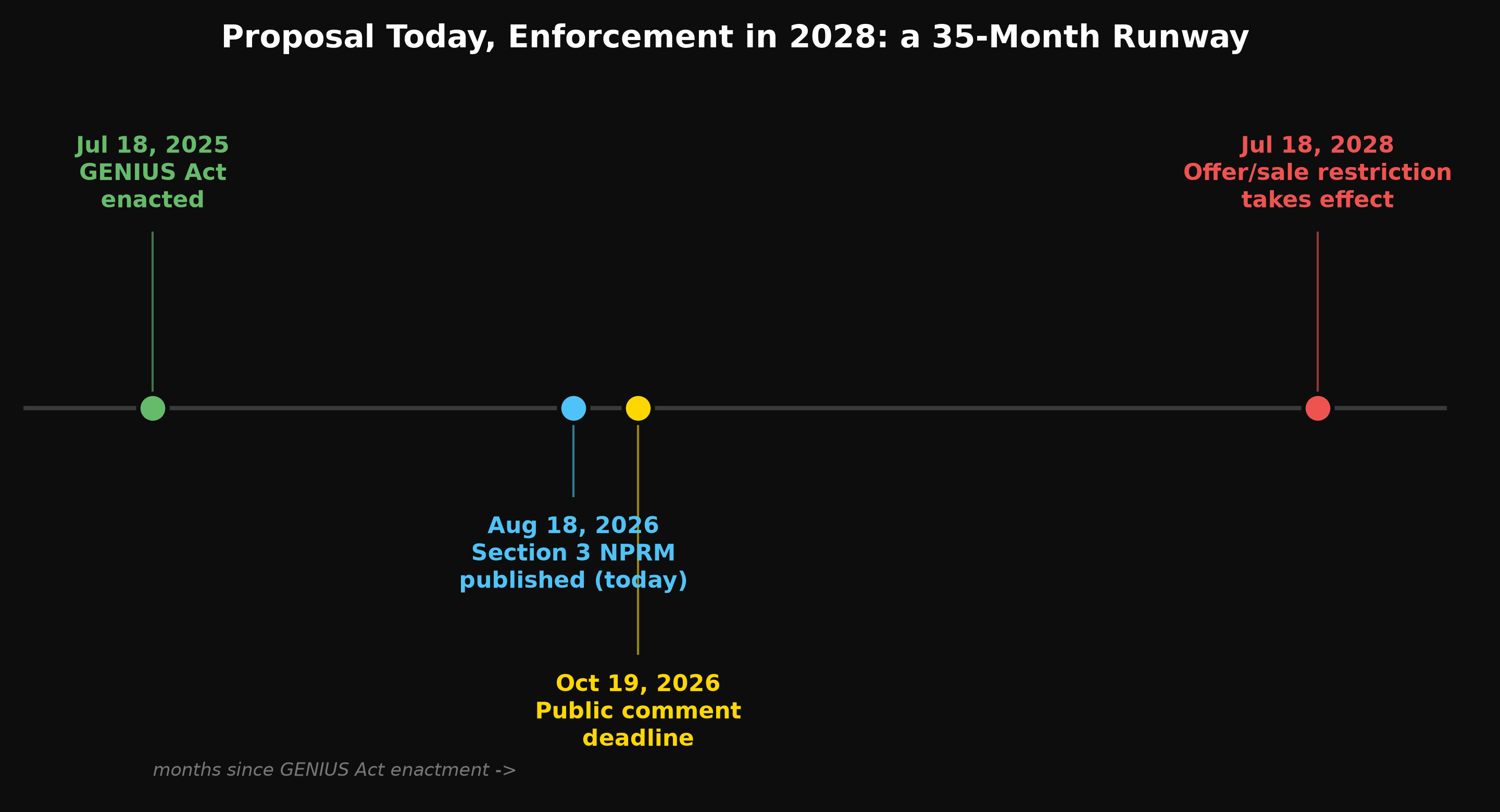
On August 18, 2026, the U.S. Treasury Department published a notice of proposed rulemaking (NPRM) implementing Section 3 of the GENIUS Act, via proposed new 12 CFR Part 1523 (Federal Register 2026-16796). The proposal governs who may lawfully issue, offer, or sell a "payment stablecoin" in the United States, drawing a hard line: permitted domestic issuers and qualifying foreign issuers on one side, everyone else locked out of U.S. distribution on the other. Comments are due October 19, 2026, and the restriction doesn't bind until July 18, 2028, so this is a proposal, not a settled outcome (Federal Register 2026-16796).
Key Highlights
- Proposed Section 1523.2 makes U.S. issuance of a payment stablecoin unlawful unless the issuer qualifies as a "permitted payment stablecoin issuer" or a "qualifying foreign payment stablecoin issuer" under Section 18(a) of the GENIUS Act (Federal Register 2026-16796).
- Starting July 18, 2028, three years after the GENIUS Act's enactment, proposed Section 1523.3(a) would bar any "digital-asset service provider" from offering or selling a payment stablecoin to a person located in the U.S. unless the issuer qualifies under the Act (Federal Register 2026-16796).
- Qualifying foreign issuers must sit under a comparable foreign regulatory regime, register with the Office of the Comptroller of the Currency (OCC), and demonstrate both the technological capability and willingness to comply with lawful orders and reciprocal arrangements (Federal Register 2026-16796).
- The GENIUS Act treats payment stablecoins as neither securities nor commodities, a foundational market-structure classification embedded in the statute itself, enacted July 18, 2025 (Congress.gov, S.1582).
- Public comments on the NPRM, including on whether Treasury should adopt de minimis safe harbors for low-volume or foreign stablecoin activity, are due October 19, 2026 via Regulations.gov (Federal Register 2026-16796).
What the Proposed Rule Actually Does
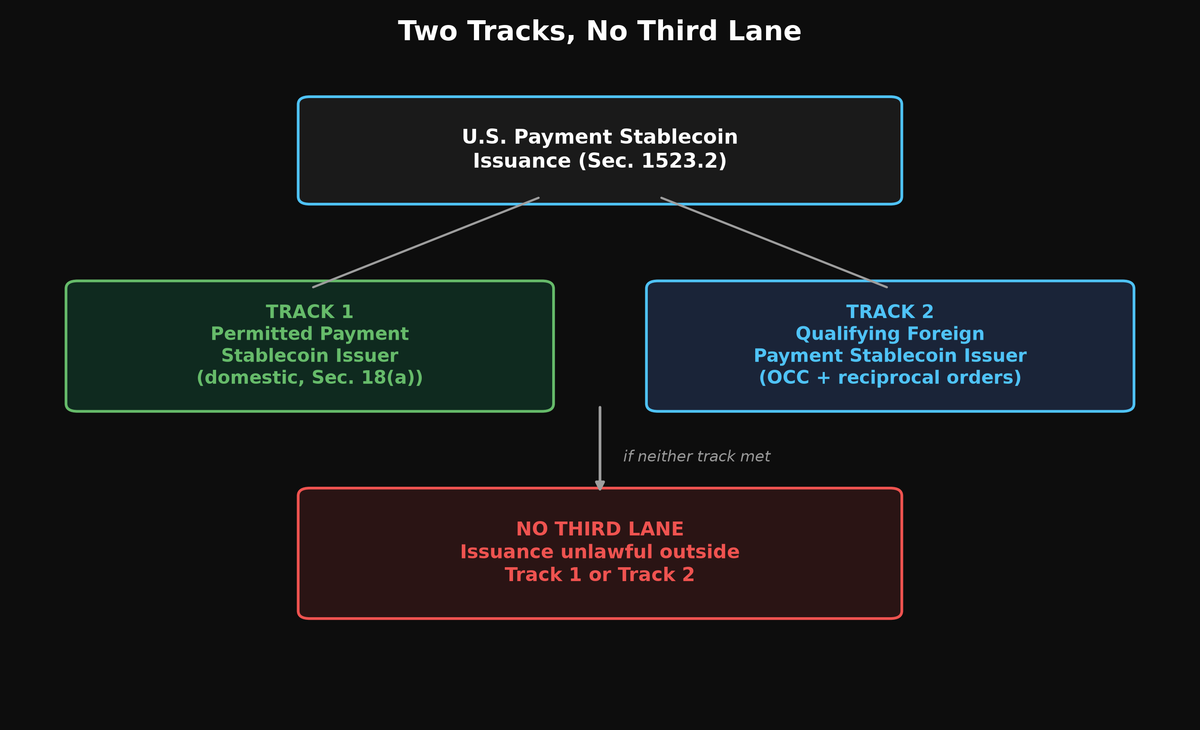
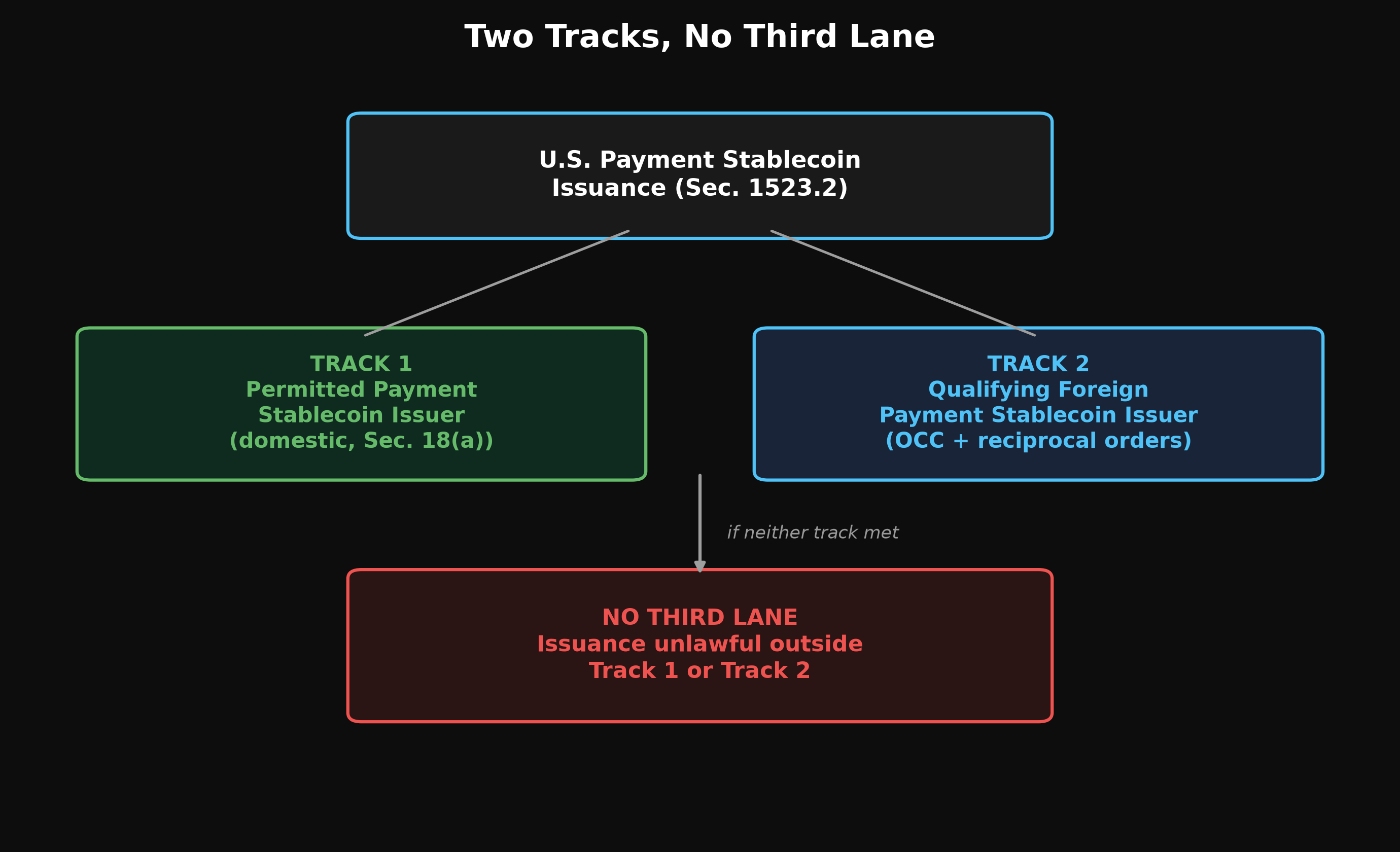
Strip away the CFR citations and the mechanism is simple. Treasury is proposing to make stablecoin issuance itself unlawful in the U.S. unless the issuer sits inside one of two named categories. Track one is the "permitted payment stablecoin issuer," the domestic path under Section 18(a) of the GENIUS Act. Track two is the "qualifying foreign payment stablecoin issuer," a narrower gate for non-U.S. entities seeking access to U.S. users without domiciling here (Federal Register 2026-16796).
That's the entire architecture of proposed Section 1523.2: no third lane. If you don't fit one of the two tracks, issuance is unlawful. This isn't primarily about paperwork for issuers already inside the tent; it's about defining the tent's exact perimeter and declaring everything outside it off-limits.
The proposal's definition of "payment stablecoin" reinforces the point: a redemption or repurchase obligation for a fixed monetary value, paired with a stable-value representation or expectation, with national currencies, deposits, and securities explicitly carved out (Federal Register 2026-16796). Combined with the GENIUS Act's own classification of payment stablecoins as neither securities nor commodities (Congress.gov, S.1582), Treasury is working from a statute that already answered the "what is this asset" question. The NPRM's job is narrower: decide who may issue and distribute it, not what it is.
Worth noting what's out of scope: Section 3(g) accounting, margining, and other-purpose treatment sit in a separate bucket, not addressed here (Federal Register 2026-16796). This NPRM is one piece, the issuance-and-distribution piece, of a larger regulatory buildout still in progress.
The Foreign-Issuer Pathway: A Narrower Door, Not a Closed One
The qualifying-foreign-issuer track deserves its own look; it's the part of this proposal most likely to reshape who actually competes for U.S. stablecoin volume over the next several years.
Three conditions stack together. First, comparable supervision: the foreign issuer must already sit under a regulatory regime Treasury deems comparable to the U.S. framework. Second, OCC registration: even with comparable home-country oversight, the issuer must register directly with the OCC, so there's no serving U.S. users purely on a foreign license. Third, technological capability and willingness to comply with lawful orders and reciprocal arrangements (Federal Register 2026-16796).
That third prong turns this from paperwork into an operational commitment. "Technological capability" to comply with lawful orders implies infrastructure, likely freeze, seizure, or transaction-monitoring capability, built before an issuer can claim qualifying status. "Reciprocal arrangements" implies a two-way relationship: the foreign supervisor and the OCC need mutual recognition or information-sharing in place, not a one-directional filing.
For offshore issuers eyeing the U.S. market, the pathway exists but isn't cheap or fast. OCC registration is a bounded process; demonstrating reciprocal-enforcement technical capacity is a different lift, closer to correspondent-banking compliance than a license application. The proposal doesn't foreclose foreign competition; it raises the fixed cost of entry well above "get licensed somewhere and ship an app."
Get the next one first. Free, daily, one email when a new regulatory catalyst breaks. Subscribe free.
Proposal, Not Law: Why the Dates Matter More Than the Headline
It's easy to read "Treasury restricts stablecoin issuance" and assume something has already changed. Nothing has changed yet, and the two dates in this NPRM are the reason why.
The comment deadline is October 19, 2026 (Federal Register 2026-16796). Until that window closes and Treasury reviews the input, there is no final rule, only a draft. Treasury is specifically asking the public to weigh in on whether de minimis safe harbors, for low-volume transactions or certain foreign stablecoin activity, should exist at all (Federal Register 2026-16796). That's a real open question. The version of this rule that emerges after comment could carry materially different carve-outs than the version published today.
The compliance deadline, separately, is July 18, 2028, exactly three years after the GENIUS Act's July 18, 2025 enactment (Federal Register 2026-16796; Congress.gov, S.1582). That's when the offer-and-sale restriction on digital-asset service providers actually bites. Treating today as the day the rule "took effect" would be a factual error. The direction is set; the final form and the compliance clock are not the announcement date.
What the Two-Tier Structure Means for Distribution Economics
The proposal's reach extends well past issuers. Proposed Section 1523.3(a) applies to "digital-asset service providers" offering or selling stablecoins to U.S. persons, a category broad enough to sweep in payment processors, exchanges, custodians, and wallet providers, not just entities minting the tokens (Federal Register 2026-16796).
That's what turns this from an issuer-compliance story into a market-structure story. Every exchange, payment rail, custodian, and wallet provider becomes a checkpoint responsible for verifying the underlying token comes from a permitted or qualifying issuer. By July 2028, distribution infrastructure across the stack needs issuer-verification logic built in, or a supported-token list already narrowed to compliant issuers.
The NPRM carves out narrow exemptions: pending-application, unusual-and-exigent-circumstances, direct-transfer, same-parent-company account, and own-custody-wallet (Federal Register 2026-16796). These read as targeted relief valves, not general safe harbors, designed to avoid criminalizing edge cases like internal corporate transfers or self-custodied wallets. The de minimis safe-harbor idea, which would matter far more to smaller players and cross-border flows, remains an open comment question rather than settled text.
Bear Case
Start with the plainest risk: this is a proposal, and Treasury is openly asking whether de minimis safe harbors should exist for low-volume or foreign stablecoin activity (Federal Register 2026-16796). That's not a technicality; it means the final rule's shape, particularly who gets swept into strict compliance versus who gets a lighter-touch carve-out, is genuinely undetermined. Anyone modeling this as fixed policy today is modeling a draft, not an outcome.
Second, the GENIUS Act itself is young, enacted July 18, 2025 (Congress.gov, S.1582), just over a year before this implementing NPRM. Statutes this recent carry more legislative-reversal and legal-challenge risk than mature law. A future Congress could amend permitted-issuer criteria, courts could narrow Treasury's implementing authority, or litigation over the digital-asset service provider definition could reshape enforcement before 2028. The historical base rate for young financial statutes says implementing rules get contested or narrowed more often than they sail through untouched.
Third, the OCC-registration-plus-reciprocal-order bar for foreign issuers cuts both ways. It's reasonable to read it as legitimate guardrail-building, ensuring foreign stablecoins operating in the U.S. answer to enforceable oversight. It's equally reasonable to read it as an access barrier: building reciprocal-enforcement technical infrastructure is a nontrivial cost smaller foreign issuers may not clear, concentrating U.S.-accessible supply among a handful of well-capitalized issuers rather than fostering competition. Both readings are defensible.
Finally, 2028 is a long way off. Administrations change and agency priorities shift; rulemaking that looks locked in today can slow or get deprioritized well before a multi-year compliance deadline arrives. The direction Treasury has signaled is clear. Whether it survives intact, on schedule, through 2028 is a separate and less certain question.
Investment Idea
No specific company or token appears anywhere in the NPRM or the underlying GENIUS Act text, and none should be inferred from this analysis. What the proposal does establish is a set of research categories worth tracking as the two-tier structure solidifies.
Category 1: U.S.-domiciled entities positioned to become "permitted payment stablecoin issuers." These are the domestic-track candidates most directly enabled by the rule's core gate. The financial mechanics suggest that early, credible movement toward permitted-issuer status could function as a structural tailwind for whichever domestic issuers clear the bar first, though none is named or confirmed by Treasury's text.
Category 2: Payment processors, exchanges, and wallet providers operating as "digital-asset service providers." These firms face the July 18, 2028 deadline directly under proposed Section 1523.3(a) (Federal Register 2026-16796) and will need issuer-verification and compliance infrastructure well ahead of that date. Firms that build this early reduce deadline risk relative to peers that wait.
Category 3: OCC-adjacent compliance and regtech providers. The foreign-issuer pathway's registration and reciprocal-order-capability requirements imply a services market: firms that help foreign issuers meet OCC registration standards and build the "lawful order" compliance technology the rule demands.
Catalyst: the October 19, 2026 comment deadline and any subsequent Treasury guidance narrowing or clarifying the permitted-issuer and qualifying-foreign-issuer standards would be the next concrete markers to watch, along with any movement toward a final rule ahead of the July 18, 2028 compliance date (Federal Register 2026-16796).
Risk: the rule could change materially between proposal and final form, particularly around de minimis safe harbors; legislative or legal challenges to the GENIUS Act's implementation could delay or alter the framework; and the 2028 deadline leaves substantial time for priorities, agency leadership, or statutory interpretation to shift before enforcement begins.
Principle
A young statute's implementing rulemaking rarely arrives fully formed. What Treasury published on August 18, 2026 tells you the direction (a two-track gate, a 2028 deadline, a defined role for digital-asset service providers) without telling you the final shape (which safe harbors survive comment, how strictly "comparable supervision" gets applied, whether the 2028 date holds). That gap between direction and final form isn't a flaw in the process; it's a multi-year window, and for anyone reading primary documents rather than headlines, that window is exactly where research edge lives.
Tracking a stablecoin compliance angle we're missing? Hit reply.
Related analysis
Read next: Britain Rewrites the Rulebook on Land Near Train Stations
Read next: NOAA's TMC Seabed Filing Clears a Box, Not a Permit
The Free Markets Report is provided by Lead-Lag Publishing, LLC. All opinions and views mentioned in this report constitute our judgments as of the date of writing and are subject to change at any time. Information within this material is not intended to be used as a primary basis for investment decisions, and should also not be construed as advice meeting the particular investment needs of any individual investor. Trading signals produced by The Free Markets Report are independent of other services provided by Lead-Lag Publishing, LLC, or its affiliates, and the positioning of accounts under their management may differ. Please remember that investing involves risk, including loss of principal, and past performance may not be indicative of future results. Lead-Lag Publishing, LLC, its members, officers, directors, and employees expressly disclaim all liability with respect to actions taken based on any or all of the information in this writing.