SEC Settles One Treasury-Clearing Question, Reopens Two Bigger Ones
A private-fund clearing carve-out is now final, but cross-border repo exemptions stay open through August 31 as a December 31 mandate approaches.

A private-fund clearing carve-out is now final, but cross-border repo exemptions stay open through August 31 as a December 31 mandate approaches.
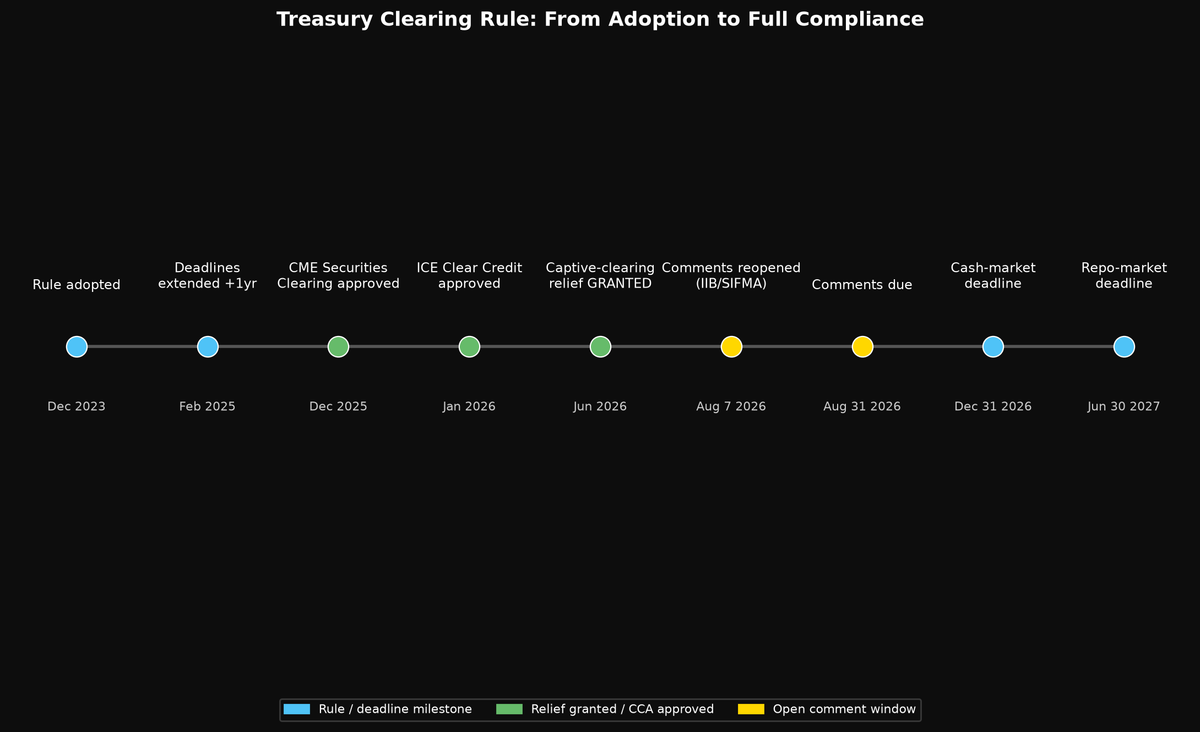
The Securities and Exchange Commission spent August 7, 2026 closing the book on one Treasury-clearing exemption and reopening the file on two more consequential ones, while the clock on mandatory clearing keeps running toward a December 31, 2026 deadline.
Key Highlights
- Cash-market Treasury transactions must be centrally cleared by December 31, 2026, and repo-market transactions by June 30, 2027, both already a one-year extension from the original schedule (SEC, Commissioner Uyeda Statement).
- On June 18, 2026, the Commission granted conditional exemptive relief (Release 34-105736) letting private funds clear repo trades through wholly owned "captive" clearing subsidiaries, provided three specific conditions are met (SEC Release 34-105736).
- The same day, the Commission reopened comments on two other unresolved exemption requests covering non-U.S. dealer transactions and inter-affiliate repo activity, due August 31, 2026 (SEC Release 34-106062).
- Three entities are now SEC-registered Treasury securities clearing agencies: FICC, CME Securities Clearing, and ICE Clear Credit, so mandate volume no longer flows to a single incumbent (SEC Release 34-106062).
- CME Group's BrokerTec U.S. repo average daily notional value grew 14% year over year to $386 billion in 2025, ahead of any mandatory clearing volume arriving (CME Group FY2025 volume release).
What Actually Got Decided
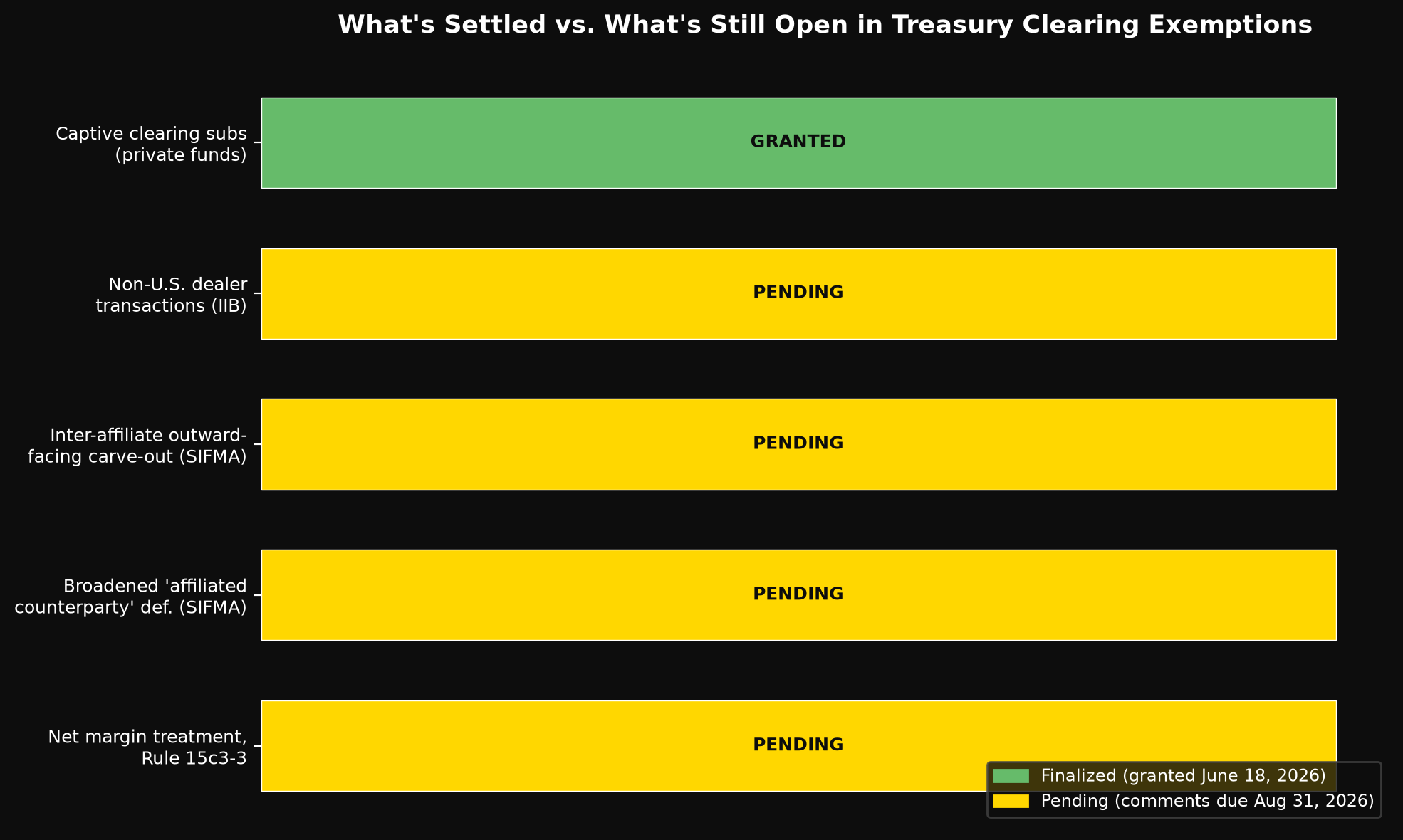
Start with what is final. On June 18, 2026, the SEC issued Release No. 34-105736, granting conditional exemptive relief under Sections 17A and 36(a) of the Exchange Act from the definition of an "eligible secondary market transaction" in Rule 17ad-22(a) (SEC Release 34-105736). In plain terms: private funds that route Treasury repo trades through a wholly owned "Captive Clearing Sub," a subsidiary that is itself a direct participant in a Treasury clearing agency, no longer have to treat those specific inter-affiliate trades as mandatory clearing transactions.
The order followed a two-year lobbying push. The Managed Funds Association raised the issue in a July 2025 letter, and SIFMA's asset-management arm followed with a joint letter in May 2026, arguing that the existing inter-affiliate exclusion's "bank/BD/FCM condition" effectively locked private funds out of using their own captive structures to access central clearing cost-effectively (SEC Release 34-105736). The Commission agreed, but attached three conditions: the Captive Clearing Sub must be wholly owned by one or more private funds; if owned by multiple funds, those funds must share a common investment adviser; and the broader Inter-Affiliate Exclusion conditions, majority ownership, accounting consolidation, and the "outward-facing condition," must still be satisfied (SEC Release 34-105736).
That last condition matters. It requires any repo transaction the fund or its captive sub executes with an unaffiliated third party to still be centrally cleared. The Commission's reasoning: since external transactions remain cleared, "the contagion risk would already be addressed," so clearing the internal leg too "would not create additional benefits" (SEC Release 34-105736). This is targeted relief, not a loophole.
One footnote matters for the investment case below: the order notes the exemption "applies to the definition of an eligible secondary market transaction generally and is not specific to FICC" (SEC Release 34-105736). The clearing landscape changed underneath this rulemaking. When MFA filed its original letter, FICC was the only registered Treasury clearing agency; by the time the Commission acted, CME Securities Clearing (approved December 2, 2025) and ICE Clear Credit (approved January 30, 2026) had joined FICC as registered Treasury CCAs (SEC Release 34-106062; Bloomberg). The relief was written for a three-clearinghouse world, not the one it was originally requested in.
What Is Still Pending, and Why It Is the Bigger Story
The captive-clearing order is done. Two other exemption requests are not, and the Commission's August 7 update signals it wants to solve them together.
The first is the IIB Notice, filed by the Institute of International Bankers, requesting relief from the Trade Submission Requirement for transactions between foreign financial institutions that are direct participants and their non-U.S. clients (SEC Release 34-106062). The second is the SIFMA Notice, seeking an expanded definition of "affiliated counterparty" covering nearly all affiliates except investment company entities, plus a carve-out from the outward-facing condition for repo between non-U.S. affiliates and non-U.S. counterparties below a specified threshold (SEC Release 34-106062).
Get the next one first. Free, daily, one email when a new regulatory catalyst breaks. Subscribe free.
Both notices went through initial comment periods that closed on May 29, 2026. Rather than rule on them separately, the Commission's August 7 reopening notice states that "a unified or holistic approach" to both may be workable and that it "is considering the issuance of a single exemption" (SEC Release 34-106062). The reopened comment window runs through August 31, 2026.
Two competing designs are on the table: a firm-specific approach, where a firm's "Qualifying Non-U.S. Transactions" would be exempt below a "Percentage Cap" of its overall repo activity (commenters propose 10% to 20%, including a step-down from 20% to 10% over roughly four years), and a market-wide ratio, a single industry-level threshold meant to prevent an uneven playing field between large domestic dealers and smaller, more foreign-skewed firms (SEC Release 34-106062). The Commission has not chosen between them; it posed fifteen numbered questions covering both designs and compliance consequences for exceeding whatever cap is set (SEC Release 34-106062).
A third open item adds to the pileup: a July 24, 2026 notice (Release 34-105980) asks whether broker-dealers can include a debit in reserve computations under Rule 15c3-3 for margin posted net rather than gross, when held at a qualified clearing agency (SEC, Commissioner Uyeda Statement). Comments are also due August 31, so one date now governs three unresolved tracks.
The Bear Case
Three risks temper the optimistic read. First, delay risk is not hypothetical: the original compliance dates were already pushed back a full year via Release 34-102487 in February 2025 (SEC, Commissioner Uyeda Statement). With three exemption questions unresolved less than five months before the cash-market deadline, and failed-trade treatment still an open, "critical" implementation question by the Commission's own admission (SEC, Commissioner Uyeda Statement), a further short delay is not off the table.
Second, exemption dilution cuts against the rule's purpose. A generous Percentage Cap, or a loose Market-Wide Ratio, could keep a meaningful share of non-U.S. and inter-affiliate repo volume outside central clearing indefinitely, undercutting the systemic-risk rationale behind the 2023 rule and shrinking addressable volume for every registered CCA.
Third, liquidity fragmentation and operational cost burden are structural, not transitional. Three competing clearing agencies rather than one means firms must build and maintain connectivity, margin models, and default-management procedures across multiple venues. Brookings/Hutchins Center researchers flag this directly, noting that "market participants are actively working to balance the benefits of increased competition" against "costs of possible fragmentation for margins and netting" (Brookings/Hutchins Center Working Paper #103). Smaller firms without dedicated implementation staff face real cost pressure regardless of how the final exemptions land.
Investment Idea: CME Group (CME)
The mechanism does not point cleanly to a single winner. FICC, the incumbent, sits inside DTCC, a private, member-owned utility with no publicly traded equity. ICE Clear Credit is a subsidiary of Intercontinental Exchange, but Treasury clearing is a small, early-stage piece of a much larger ICE business. CME Group is the more legible story: CME Securities Clearing is one of the three SEC-registered Treasury CCAs, sitting inside a company that reports Treasury-adjacent metrics investors can track, with executives explicit about the buildout in public testimony.
CEO Terry Duffy told a House Treasury Market Task Force in April 2026 that CME intends to launch its Treasury clearing service in Q3 2026, supporting both "done with" and "done away" clearing models, and that clearing Treasury securities directly would let CME extend the roughly $25 billion in daily interest rate margin efficiencies it already delivers via cross-margining with its derivatives products (Duffy testimony, House Treasury Market Task Force). That cross-margining angle is the differentiator: CME is bolting a new clearing venue onto an existing, massive Treasury futures and options complex that posted a record 8.3 million contracts of average daily volume in 2025 (CME Group FY2025 volume release).
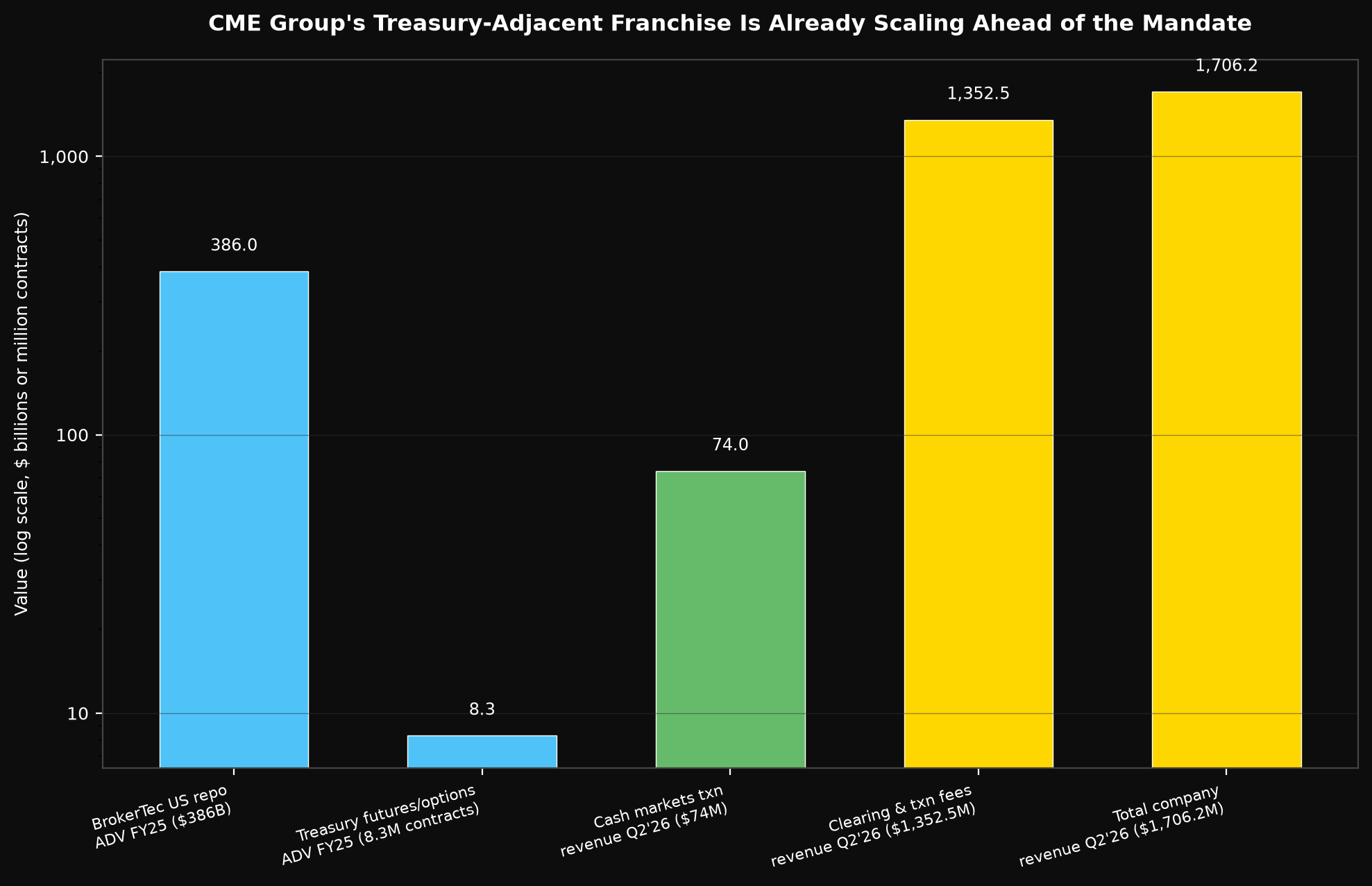
The financial mechanics suggest a structural tailwind for CME's cash-markets and clearing segments as mandatory volume phases in. BrokerTec's U.S. repo average daily notional value already grew 14% year over year in 2025, to $386 billion, before the mandate forced a single additional trade onto a cleared venue (CME Group FY2025 volume release). In the second quarter of 2026, CME's cash markets businesses, BrokerTec and EBS combined, generated roughly $74 million in transaction revenue against $1,706.2 million in total company revenue and $1,352.5 million in clearing and transaction fees (CME Group Q2 2026 press release; CME Group 2Q 2026 Earnings Commentary). That is a small base today, but a growing one, sitting inside a company with an $86.02 billion market capitalization as of its most recent earnings report (StockStory).
Catalyst: CME's Treasury clearing service launch, targeted for Q3 2026, alongside the SEC's resolution of the reopened IIB/SIFMA comment period after August 31, 2026, which will determine how much cross-border and inter-affiliate volume becomes addressable for all three registered Treasury CCAs, CME Securities Clearing included.
Risk: Cash markets remain a small fraction, roughly 4%, of CME's clearing and transaction fee revenue today, so a slow Treasury-clearing ramp would not register as a headline miss but also would not move the needle much near term. If the SEC's pending exemptions land broad, cutting a large share of non-U.S. and inter-affiliate volume out of mandatory clearing, the addressable market for all three CCAs shrinks versus current expectations. A further push of the compliance dates, which has already happened once, remains a live possibility given the unresolved questions still on the table five months before the deadline.
This is not investment advice. It is a description of how a specific regulatory mechanism intersects with a specific public company's disclosed business lines, meant as a starting point for readers' own diligence, not a conclusion.
The Principle
Regulatory implementation rarely happens in one event. It is a sequence of procedural decisions, an order here, a reopened comment period there, that collectively determine how much of a rule's original intent survives contact with the market it governs. The captive-clearing order shows the SEC granting targeted relief when the underlying risk-reduction rationale stays intact. The reopened IIB/SIFMA comment period shows the harder trade-offs, competitive fairness, cross-border consistency, systemic risk, still being negotiated in public. Investors watching this space should track the exemption mechanics as closely as the compliance dates themselves, since the exemptions will determine how much volume moves, and to which clearinghouse.
Have a regulatory mechanism you think we should be digging into next? Hit reply and tell us what you're watching.
The Free Markets Report is provided by Lead-Lag Publishing, LLC. All opinions and views mentioned in this report constitute our judgments as of the date of writing and are subject to change at any time. Information within this material is not intended to be used as a primary basis for investment decisions, and should also not be construed as advice meeting the particular investment needs of any individual investor. Trading signals produced by The Free Markets Report are independent of other services provided by Lead-Lag Publishing, LLC, or its affiliates, and the positioning of accounts under their management may differ. Please remember that investing involves risk, including loss of principal, and past performance may not be indicative of future results. Lead-Lag Publishing, LLC, its members, officers, directors, and employees expressly disclaim all liability with respect to actions taken based on any or all of the information in this writing.
Related coverage: The CFTC Just Stayed a CME Contract. The Precedent Is the Cost.; Basel Endgame Is Dead. The Capital Relief Is Not Where You Think.