The UK Just Cut Transaction Reporting Fields From 65 to 52: What It Is Worth
The FCA's PS26/15 slashes reporting fields, scope and lookback windows, with a modeled 745.5 million pound ten-year payoff, but the 2028 deadline leaves room for slippage.

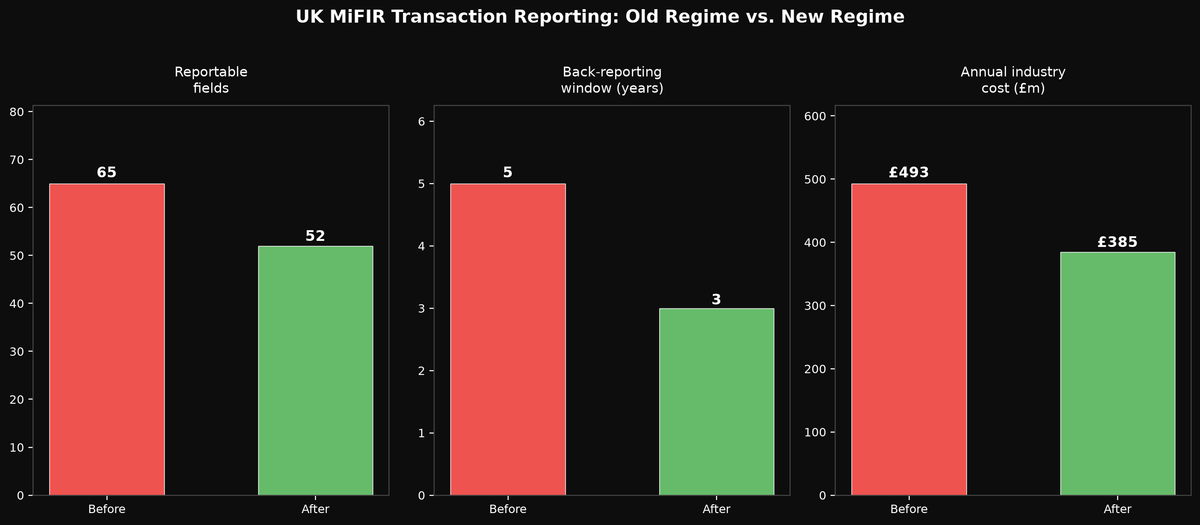
The UK's post-Brexit deregulation project just found its most concrete number yet: £108 million. That is the FCA's own estimate of the net annual saving to industry from PS26/15, its final policy statement reworking the UK MiFIR transaction reporting regime, published August 3, 2026.
Key Highlights
- The FCA's final Policy Statement PS26/15, approved as instrument FCA 2026/52 on July 30, 2026 and published August 3, 2026, cuts UK MiFIR transaction reporting fields from 65 to 52 and takes legal effect April 3, 2028 (FCA, PS26/15; FCA, PS26/15 PDF).
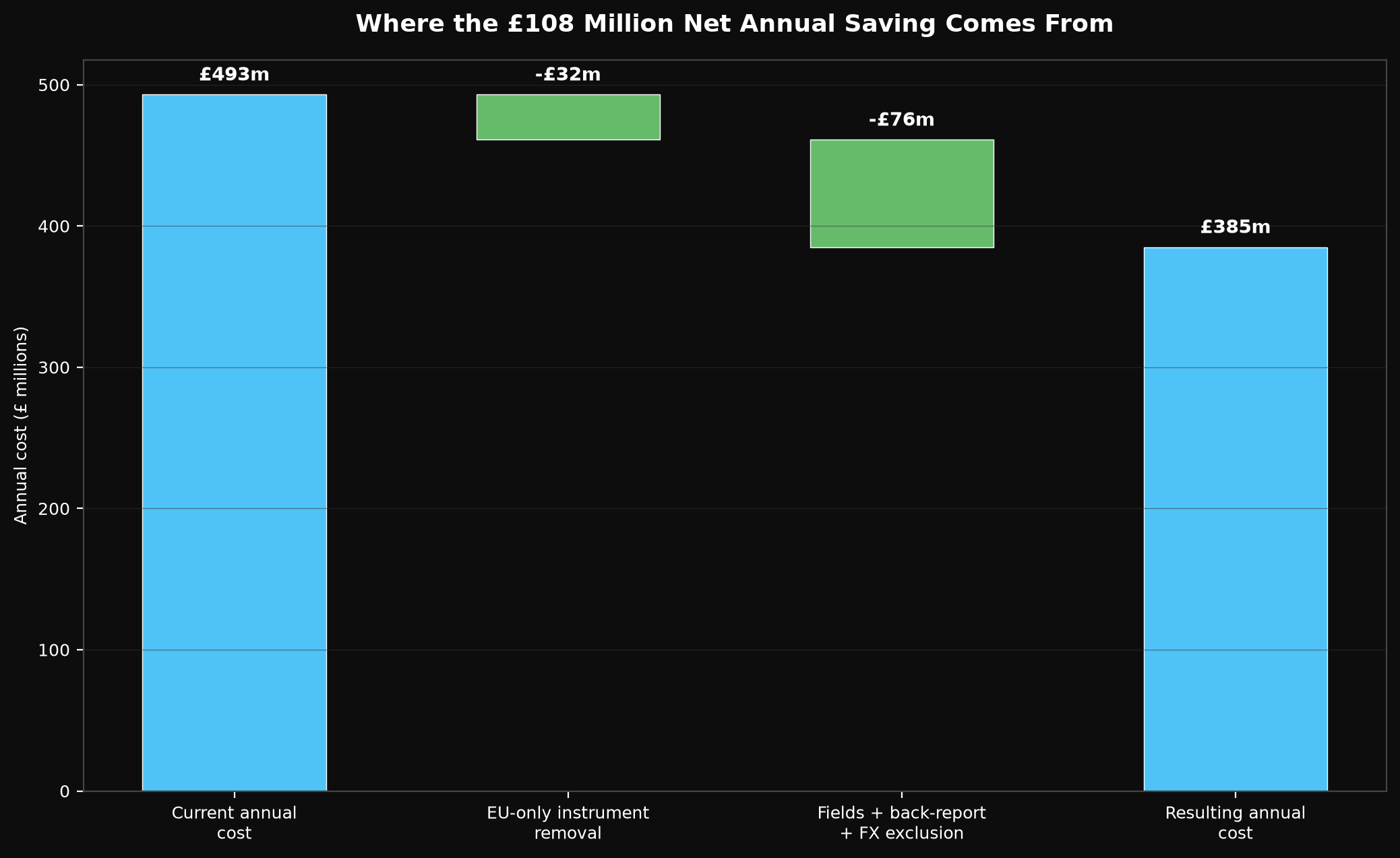
- Reporting obligations disappear for 7 million financial instruments only tradeable on EU venues, worth roughly £32 million a year in savings, while FX derivatives (not cryptoasset derivatives) are removed from scope entirely, cutting costs for over 400 UK firms (FCA press release; FCA, PS26/15 PDF).
- The FCA estimates the industry's total annual MiFIR reporting bill falls from about £493 million to about £385 million, a net saving above £100 million a year that reconciles with the policy statement's own modeled £115.3 million ongoing saving and £745.5 million ten-year net present value (FCA press release; FCA, PS26/15 PDF).
- A new optional Conditional Single-Sided Reporting mechanism lets firms in the same reporting relationship split obligations, but the FCA did not quantify its savings, and named respondents like AFME and ISDA pushed back on its workability (AFME response; ISDA statement).
- London Stock Exchange Group, TP ICAP, ICE Futures Europe, DTCC, SmartStream and OSTTRA are all named consultation respondents, but the FCA does not designate a single equity beneficiary anywhere in the document (FCA, PS26/15 PDF).
It is a rare case of a UK regulator putting a specific, defensible price tag on simplification, and it is worth understanding both what changed and what did not, because the gap between those two things is where the real investment implications live.
What PS26/15 Actually Does
The instrument behind the reform, FCA 2026/52, was approved by the FCA Board on July 30, 2026 and formally published three days later (FCA, PS26/15 PDF). It rewrites Articles 25 to 27 of UK MiFIR and the UK versions of Regulatory Technical Standards 22, 23 and 24 into new chapters of the FCA Handbook. The headline change is a reduction in reportable fields from 65 to 52, stripping out fields the FCA judged to deliver limited supervisory value, including option type, option exercise style, maturity date, several country-of-branch fields, and multiple indicator fields (FCA, PS26/15).
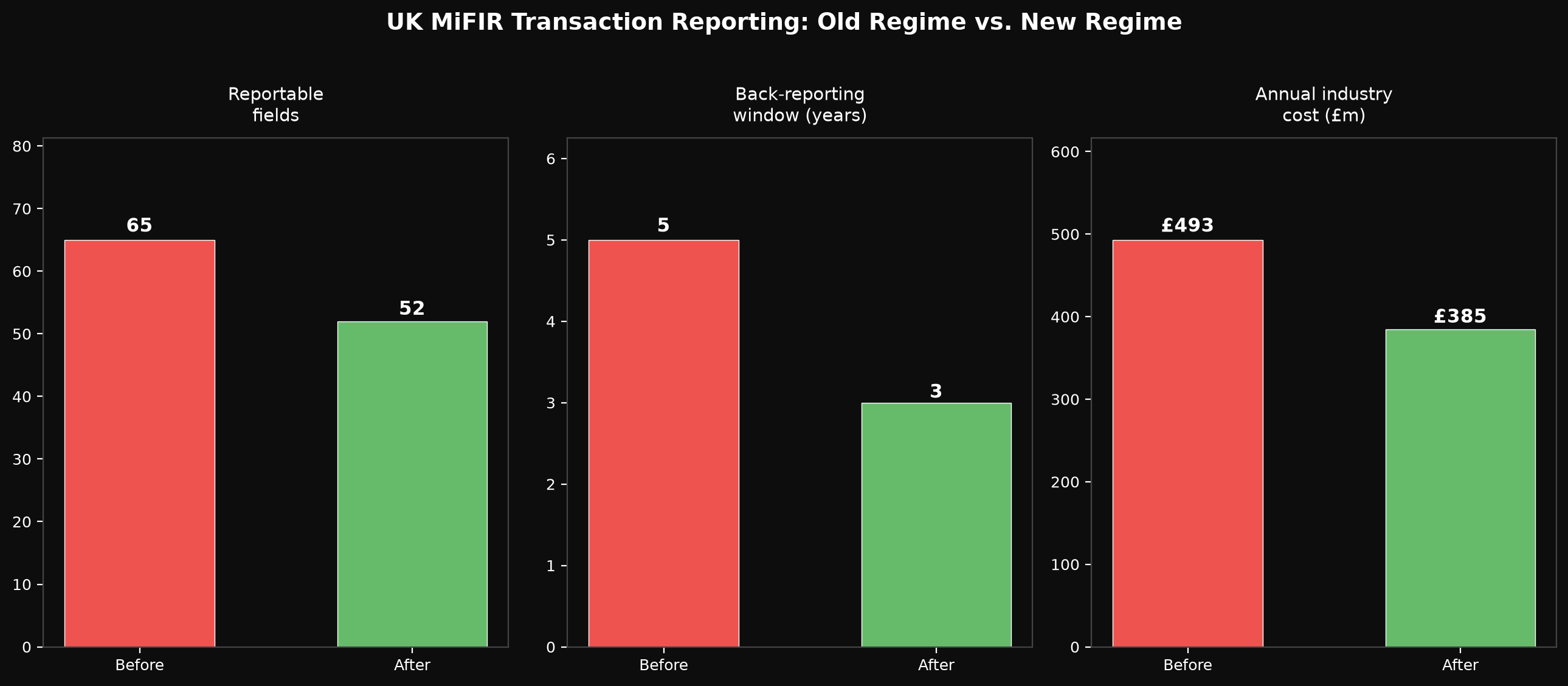
Scope is narrowing too. Roughly 7 million financial instruments tradeable only on EU venues will no longer need to be reported, as the FCA moves to a UK-venue-only reporting perimeter (FCA, PS26/15). Separately, FX derivatives, covering options, futures, swaps and forward rate agreements tied to currencies, are removed from reporting scope entirely, a change the FCA expects to reduce costs for more than 400 UK firms (FCA, PS26/15 PDF). That carve-out does not extend to cryptoasset derivatives, which remain fully reportable, a distinction that matters for any firm assuming a blanket derivatives exemption (FCA, PS26/15 PDF).
The default back-reporting period, the window regulators can require firms to go back and correct historical submissions, drops from five years to three, with the FCA retaining discretion to demand the full five years in exceptional cases. The regulator expects this alone to cut the volume of resubmitted reports by a third (FCA press release).
The Numbers, Reconciled
The FCA has published this reform with three different-sounding savings figures, and they are not three separate pots of money. The press release frames it simply: current annual MiFIR reporting cost to industry is about £493 million, and the FCA expects the reform to bring that down to roughly £385 million, a net annual saving of about £108 million, comfortably above the regulator's "more than £100 million a year" headline (FCA press release). The policy statement's own cost-benefit analysis, a more granular modeling exercise, arrives at an estimated ongoing annual saving of £115.3 million, and projects a ten-year net present value of benefits over costs of approximately £745.5 million (FCA, PS26/15 PDF). These are complementary views of the same reform rather than additive savings: the press release's £108 million is a simple gross-cost comparison, while the CBA's £115.3 million is a modeled ongoing-savings estimate that feeds into the ten-year NPV calculation.
Regulatory catalysts land here first. Free, daily, straight to your inbox. Subscribe free.
Both point the same direction and both undercount the truth by the FCA's own admission, since the cost-benefit analysis explicitly excludes any quantified benefit from the new Conditional Single-Sided Reporting mechanism and from the combined effect of the many smaller removed fields, on the grounds that take-up was too uncertain to model (FCA, PS26/15 PDF). Fifty-two firms gave feedback on the cost-benefit analysis during consultation, with nine offering specific critique, and the FCA concluded none of that feedback required material changes to its final cost and benefit estimates (FCA, PS26/15 PDF).
The Optional Mechanism Nobody Fully Agrees On
The most contested piece of PS26/15 is Conditional Single-Sided Reporting, or CSSR, a new optional framework letting a "sending firm" skip its own transaction report where a "receiving firm," typically a related entity in the same trading group, submits it instead. The sending firm's obligation drops from ten required information points to four: client designation, decision-maker details where relevant, trading capacity, and the sending firm's Legal Entity Identifier (FCA, PS26/15 PDF).
The FCA is proceeding with CSSR despite acknowledging it could not quantify the savings, noting that anticipated take-up was too uncertain to model and that no respondent supplied quantified cost estimates either (FCA, PS26/15 PDF). Context helps explain why: only 138 firms acted as a receiving firm under the existing, narrower transmission mechanism in 2025, and 164 in 2024, suggesting today's version of single-sided reporting is barely used (FCA, PS26/15 PDF). The FCA also notes that 92% of 2025 transaction reports contained no personally identifiable information in the buyer, seller or decision-maker fields, which it argues makes CSSR workable for many group transactions without raising data-protection concerns (FCA, PS26/15 PDF).
Industry groups were not uniformly convinced. AFME's response argued the CSSR model would not meaningfully simplify reporting and would instead shift compliance costs and data-ownership ambiguity onto receiving firms (AFME response). ISDA went further, arguing against introducing CSSR altogether and proposing the FCA instead adopt the unique product identifier over the ISIN for OTC derivatives reporting (ISDA statement). The Investment Company Institute flagged a narrower but practical concern: CSSR only helps a buy-side firm when it trades with a UK receiving firm, so a fund trading through a non-UK broker gets no relief at all (ICI comment letter).
Who Showed Up, and Who the FCA Didn't Crown
The list of non-confidential consultation respondents named in PS26/15 reads like a map of UK and global market infrastructure: London Stock Exchange Group, TP ICAP, ICE Futures Europe, DTCC, SmartStream, OSTTRA, alongside trade bodies like ISDA, AFME, ICMA, the Investment Association, and asset managers including BlackRock and Capital Group (FCA, PS26/15 PDF). The policy statement does not attribute specific comment positions to LSEG, TP ICAP, ICE Futures Europe, DTCC, SmartStream or OSTTRA individually, nor does it designate any single company as the reform's clear equity winner or quantify a company-level earnings effect anywhere in the document (FCA, PS26/15 PDF). Any investment framing has to be honest about that gap.
The closest genuine, sourced link between a UK-listed company and this specific rule change runs through London Stock Exchange Group's UnaVista platform, an FCA- and ESMA-authorised Approved Reporting Mechanism for MiFIR transaction reporting that has historically been described as the largest MiFID ARM in Europe (LSEG, Regulatory Reporting Solutions). UnaVista sits inside LSEG's Data & Analytics division, which generated £2,061 million of income in the first half of 2026 against £4,799 million in group total income excluding recoveries, growing 5.1% organically (LSEG, H1 2026 Interim Results). UnaVista itself is not broken out separately in LSEG's segment disclosure, so it is not possible to isolate exactly how much of that £2.06 billion is exposed to UK transaction reporting fee volumes specifically, which is exactly why this remains a sector story rather than a stock-picking exercise.
The Bear Case
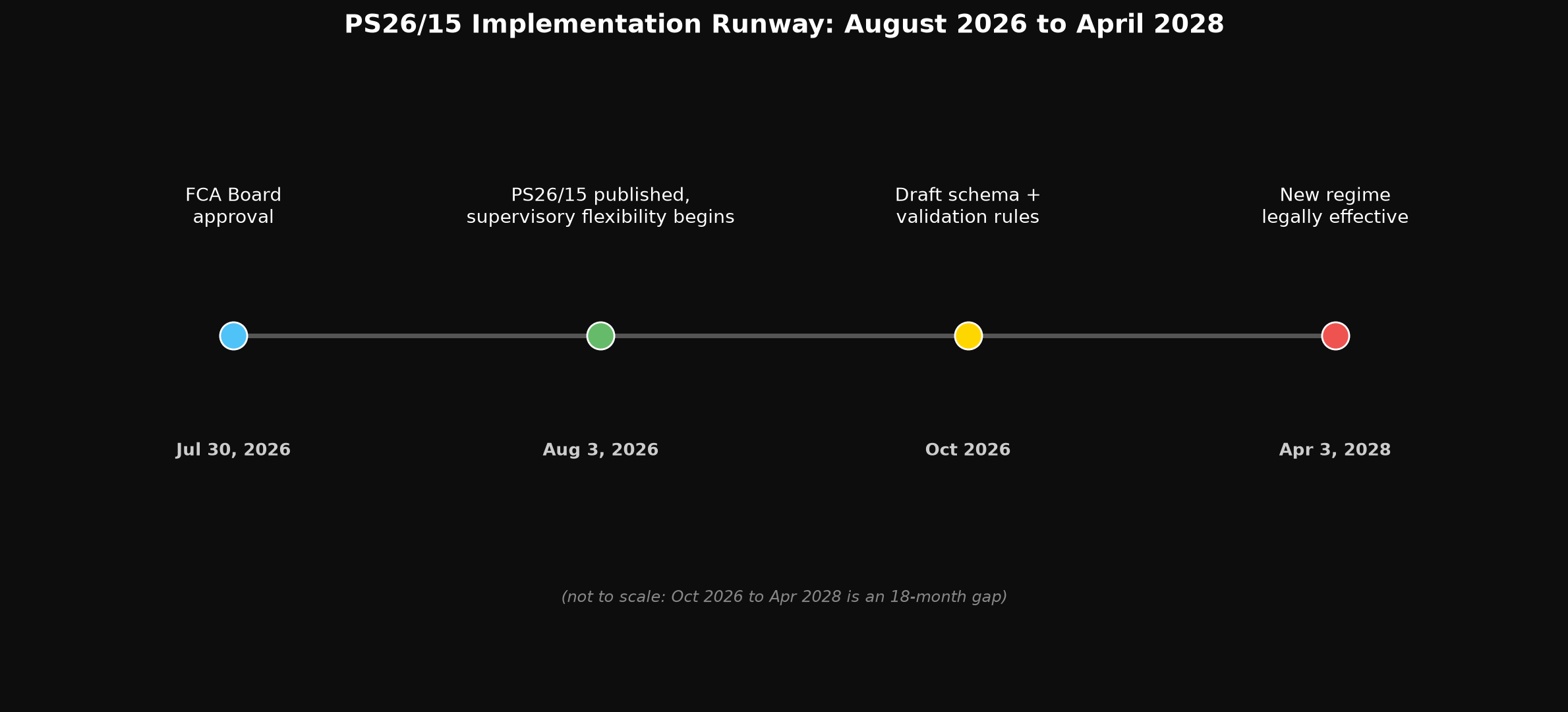
Three things could undercut the tidy narrative of "less paperwork, more savings." First, the timeline has real slack in it. The FCA won't publish the draft schema, validation rules and updated guidance until October 2026, and only then does the roughly 18-month implementation clock actually start ticking toward the April 3, 2028 effective date (Linklaters). Any delay in that October consultation compresses an already tight build window for firms rewriting reporting logic and retesting systems.
Second, reporting-infrastructure vendors that built commercial models around complexity, ARMs charging per report, per field, or per resubmission, face a structural headwind if the FCA's own projections hold: fewer fields, a narrower instrument universe, and a third fewer resubmissions all point toward lower reporting volumes flowing through third-party platforms, even before CSSR potentially removes some intra-group reports altogether.
Third, this reform deliberately diverges UK MiFIR from EU MiFIR, most visibly by dropping EU-only-traded instruments from UK scope while EU regulators keep their regime unchanged. For any cross-border firm operating both UK and EU venues, that divergence could mean maintaining two increasingly different reporting logics rather than one harmonized one, a dual-reporting cost that could offset some of the modeled UK-side savings for globally active dealers.
Investment Idea: Market Infrastructure and Regulatory-Cost Framing
Rather than force a single-stock call the FCA itself never makes, the more defensible framing is sector-level: UK sell-side and buy-side firms bearing the current £493 million annual reporting bill are structural beneficiaries of simplification, while reporting-infrastructure and data-vendor businesses, including but not limited to LSEG's UnaVista ARM, face a more ambiguous set of mechanics, where fewer fields and lower reportable volumes could pressure per-transaction fee revenue even as system-upgrade and consulting demand rises ahead of the October 2026 schema release. The financial mechanics suggest this is a story about compliance-cost relief for end users first, and a more contested question for the vendors who monetized the old complexity.
Catalyst: The October 2026 publication of the draft schema and validation rules will be the first real test of implementation timing and cost for affected firms and vendors alike.
Risk: The savings are modeled, not realized. Delays to the October consultation, a slower-than-projected drop in resubmission volume, or new dual-reporting costs from UK/EU divergence could all narrow the gap between the FCA's projections and what firms actually experience by April 2028.
This is not investment advice. It is a description of how a specific regulatory mechanism intersects with disclosed business lines across a sector, meant as a starting point for readers' own diligence, not a conclusion.
The Principle
Deregulation stories are easy to oversell as unambiguous wins for whoever gets named in the press release, but PS26/15 is a reminder that a regulator's own cost-benefit math, named respondents, and effective dates deserve as much scrutiny as its headline savings number. The FCA reduced 65 fields to 52 and a five-year lookback to three, and it built a defensible, if conservative, model showing hundreds of millions in ten-year value. What it did not do is tell investors who wins, and that discipline is worth matching on the analysis side too.
Have a regulatory change you think deserves this level of digging? Reply and tell us what to dig into next.
The Free Markets Report is provided by Lead-Lag Publishing, LLC. All opinions and views mentioned in this report constitute our judgments as of the date of writing and are subject to change at any time. Information within this material is not intended to be used as a primary basis for investment decisions, and should also not be construed as advice meeting the particular investment needs of any individual investor. Trading signals produced by The Free Markets Report are independent of other services provided by Lead-Lag Publishing, LLC, or its affiliates, and the positioning of accounts under their management may differ. Please remember that investing involves risk, including loss of principal, and past performance may not be indicative of future results. Lead-Lag Publishing, LLC, its members, officers, directors, and employees expressly disclaim all liability with respect to actions taken based on any or all of the information in this writing.
Related coverage: The FCA Reversed Its Own IPO Research Rules Effective the Same Day; Britain Just Stopped Naming Its Short Sellers. Here's Who Wins.