The Device That Invented 3D Mammography Just Lost Its Regulatory Moat
FDA wants to shift 3D mammography from full PMA review to a faster 510(k) pathway, and the device named throughout the proposal now belongs to a private company.

FDA wants to shift 3D mammography from full PMA review to a faster 510(k) pathway, and the device named throughout the proposal now belongs to a private company.
Key Highlights
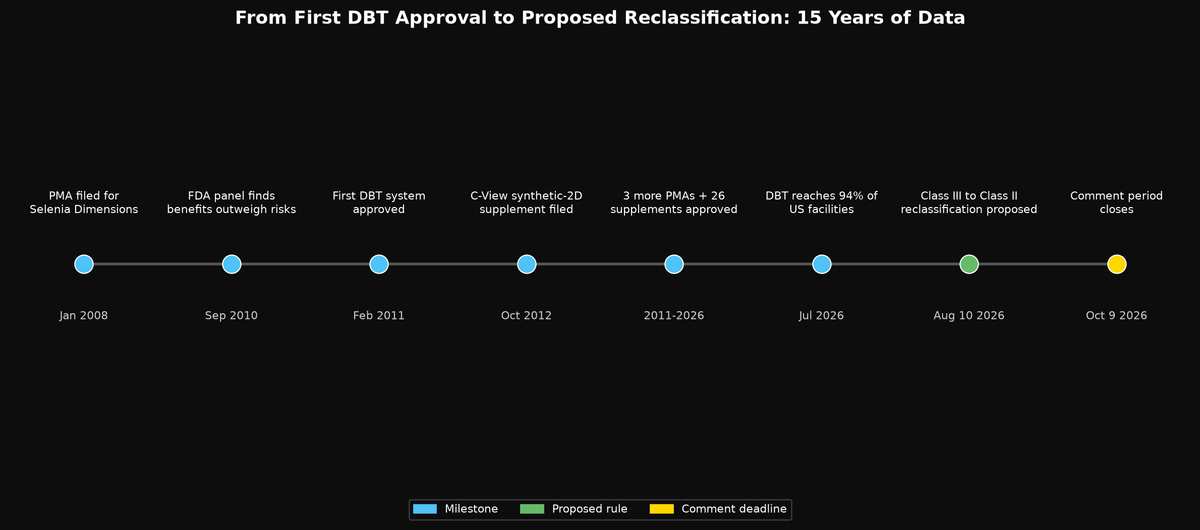
- FDA's August 10, 2026 proposal would reclassify DBT systems from Class III (full PMA) to Class II (510(k) clearance), with comments due October 9, 2026 (Federal Register).
- The rationale leans on 15 years of data: 3 additional PMAs, 26 PMA supplements, only five Class II recalls with no injuries, and a 42-study meta-analysis of 2.6 million patients showing DBT improves cancer detection (Federal Register).
- DBT has become the clinical default, present in 94% of the country's 9,107 MQSA-certified mammography facilities as of July 8, 2026 (Federal Register).
- Hologic, whose Selenia Dimensions anchors the entire proposal, was taken private by Blackstone and TPG on April 7, 2026 and delisted from Nasdaq, leaving former shareholders exposed only through a contingent value right (Hologic press release via Business Wire/Morningstar).
- The same reclassification that helps Hologic's next products reach market faster also erodes the PMA barrier that limited DBT to four manufacturers for 15 years, benefiting GE HealthCare, Siemens Healthineers, Fujifilm, and AI-detection entrants like RadNet's newly acquired iCAD unit (Radiology Business).
Fifteen years after the Food and Drug Administration approved the first 3D mammography system in the United States, the agency is proposing to strip digital breast tomosynthesis (DBT) systems of the strictest device classification in American regulation. On August 10, 2026, FDA published a proposed order in the Federal Register to reclassify DBT systems, product code OTE, from Class III, requiring full Premarket Approval, into Class II, requiring only the faster, cheaper 510(k) notification process (Federal Register, Docket No. FDA-2026-N-7630). The document centers on one device: Hologic's Selenia Dimensions 3D system, the first DBT system FDA approved, in 2011, and the reference point for every risk category and special control FDA now proposes (Federal Register).
The irony is that by the time this rule could take effect, the company whose device built the case for deregulation will not be a public company investors can buy. Hologic was taken private by Blackstone and TPG in a deal that closed April 7, 2026, delisting its shares from Nasdaq (Hologic press release via Business Wire/Morningstar). That turns what looks like an obvious single-stock trade into something more interesting: a regulatory tailwind hitting a business whose upside is locked inside a contingent value right, while the door swings open for competitors who spent a decade trying to catch up.
What FDA Is Actually Proposing
Devices that entered the market after May 28, 1976, without going through FDA's classification process are automatically placed in Class III under section 513(f)(1) of the Federal Food, Drug, and Cosmetic Act, and DBT systems have sat there since the Selenia Dimensions became the first cleared device in 2011 (Federal Register). Reclassifying a device out of Class III requires FDA to show that special controls, layered on top of general controls, can provide reasonable assurance of safety and effectiveness. That is the case FDA is making now, using data it is legally permitted to draw on under the "six-year rule" in section 520(h)(4) of the FD&C Act, which allows FDA to use clinical information from an approved PMA once it is at least six years old (Federal Register).
Since the original Selenia Dimensions approval, FDA has reviewed three additional original PMAs and 26 PMA supplements under the same product code (Federal Register). The postmarket safety record backs the case: as of July 21, 2026, FDA's recall database showed no Class I or Class III recalls and only five Class II recalls tied to product code OTE, with zero reported injuries, while MAUDE logged 968 medical device reports, roughly one percent involving serious injury not necessarily caused by the device itself (Federal Register).
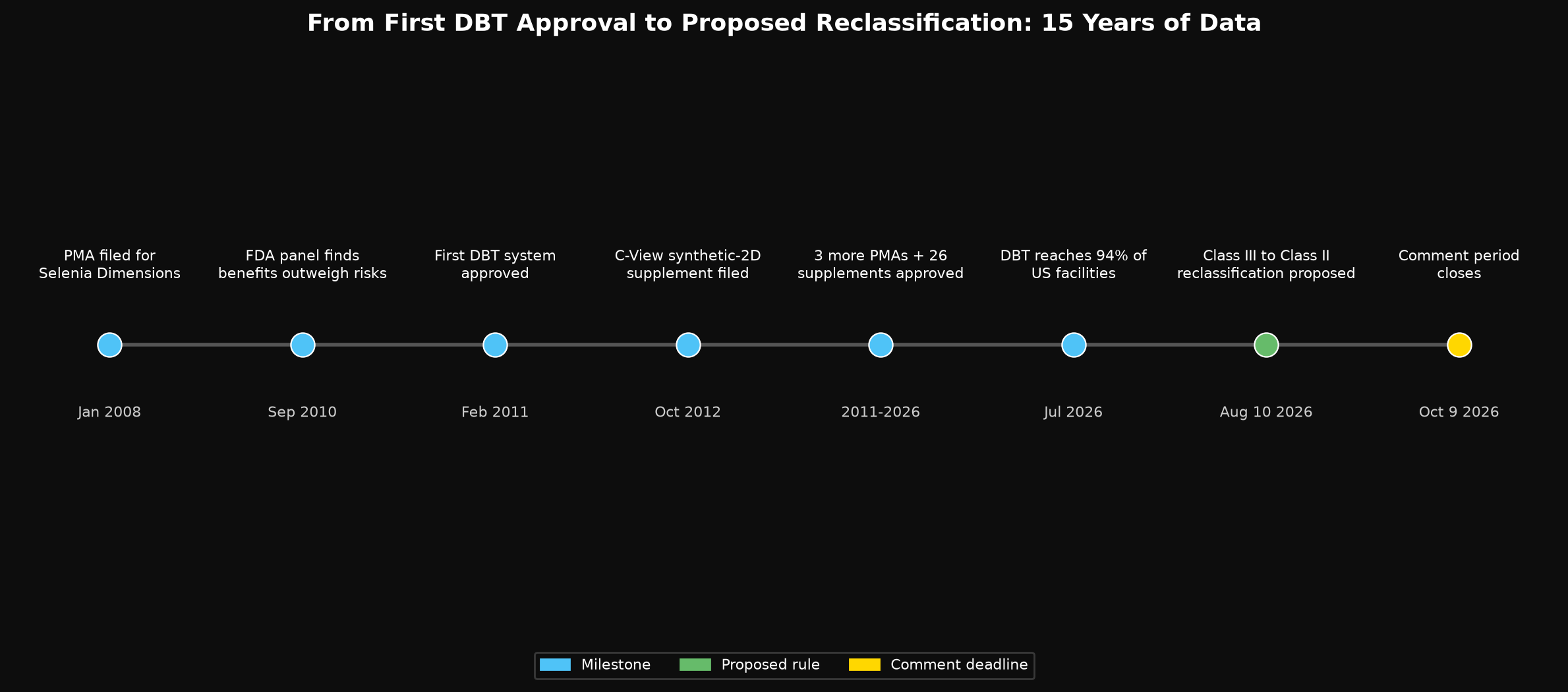
FDA also cites a meta-analysis of 42 studies covering more than 2.6 million patients and over 13,000 breast cancer cases, finding that combining DBT with 2D or synthetic-2D imaging produced higher cancer detection rates and lower recall rates than 2D mammography alone (Federal Register). DBT is now the standard of care: as of July 8, 2026, 94 percent of the country's 9,107 MQSA-certified facilities had DBT units installed, and 95 percent of accredited digital 2D units were also DBT-accredited (Federal Register). It is no longer niche. It is the default.
The Special Controls Replacing PMA Review
Rather than exempting DBT systems from oversight, FDA proposes a detailed menu of "special controls," codified at 21 CFR 892.1717, mapped onto ten risk categories identified through 15 years of PMA reviews: corrupted images, misinterpretation, inadequate breast coverage, inappropriate compression, device failure, use error, excessive radiation, electromagnetic interference, adverse tissue reaction, and infection risk from reusable components (Federal Register).
Regulatory catalysts land here first. Free, daily, straight to your inbox. Subscribe free.
Mitigations include bench testing, task-based diagnostic-accuracy assessment through reader studies or phantoms, software verification, electrical safety and electromagnetic compatibility testing, and a labeling regime requiring manufacturers to publish testing and quality-control summaries (Federal Register). FDA is explicit about the commercial logic: the 510(k) pathway is "less burdensome and generally more cost-effective for industry and FDA than the PMA pathway," and reclassification "would enable more manufacturers to develop these types of devices" (Federal Register).
Comments on the proposed order are due by October 9, 2026, and if the rule is finalized largely as written, any final order would take effect 30 days after its own publication (Federal Register).
Hologic's Business, Frozen at the Moment of Delisting
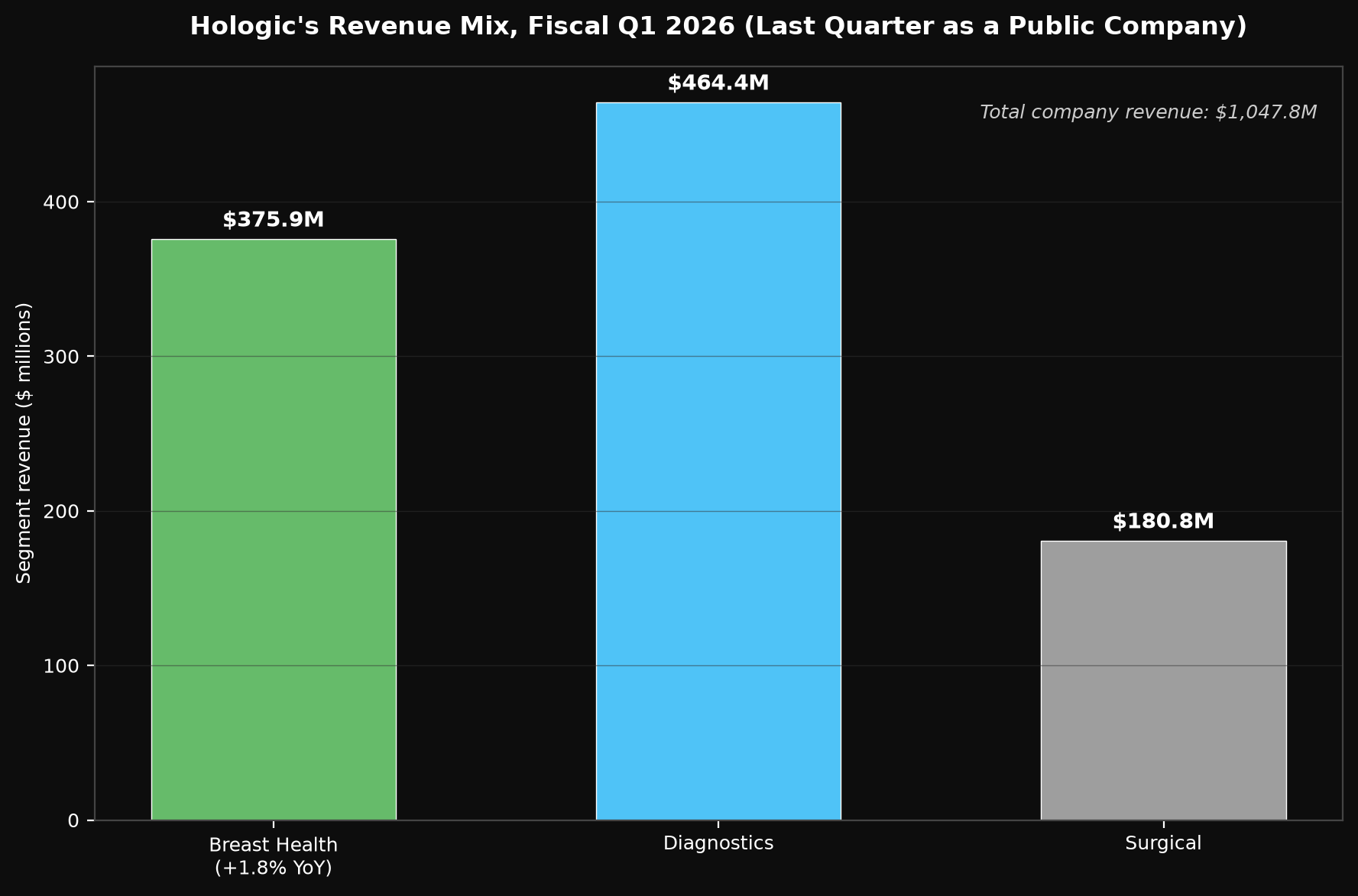
Because Hologic invented DBT and still built the evidentiary spine of this proposal around its Selenia Dimensions system, the obvious next question is what this means for the company financially. Hologic's public disclosure clock stopped in early 2026. In its last reported quarter as a public company, fiscal Q1 ended December 27, 2025, Hologic posted total revenue of $1,047.8 million, with Breast Health, the segment housing Selenia Dimensions, contributing $375.9 million, up 1.8 percent year over year, ahead of Diagnostics at $464.4 million and Surgical at $180.8 million (Hologic press release via Business Wire/Yahoo Finance). GAAP diluted EPS came in at $0.79 on GAAP gross margin of 56.0 percent (Hologic press release).
That was nearly the last quarter investors saw. Blackstone and TPG agreed on October 21, 2025 to take Hologic private for up to $18.3 billion including debt: $76 per share in cash plus a non-tradable CVR worth up to $3 more per share tied to Breast Health revenue targets in fiscal 2026 and 2027 (MedTech Dive). The deal closed April 7, 2026, delisting Hologic from Nasdaq and installing former Baxter International chief executive Jose (Joe) Almeida as CEO (Hologic press release via Business Wire/Morningstar). By July 2026, Reuters reported the new owners were already shopping Hologic's surgical unit for more than $4 billion, signaling active debt management (Reuters).
That leaves an unusual structure: the company benefiting most directly is privately held, and the only link between public markets and its Breast Health performance is a non-tradable CVR whose payout depends on revenue hurdles investors can no longer observe through quarterly filings.
The Bear Case: The Moat Cuts Both Ways
This is the tension underneath the entire proposal. For 15 years, DBT has been a four-company club. The Selenia Dimensions was the only PMA-approved DBT system for roughly three years before GE HealthCare's SenoClaire cleared the same bar in 2014, followed by Siemens Healthineers in 2015 and Fujifilm's ASPIRE Cristalle in January 2017 (Fierce Biotech). Each approval required the same multi-year, multi-million-dollar PMA gauntlet, precisely the barrier that kept the field this small for a decade and a half.
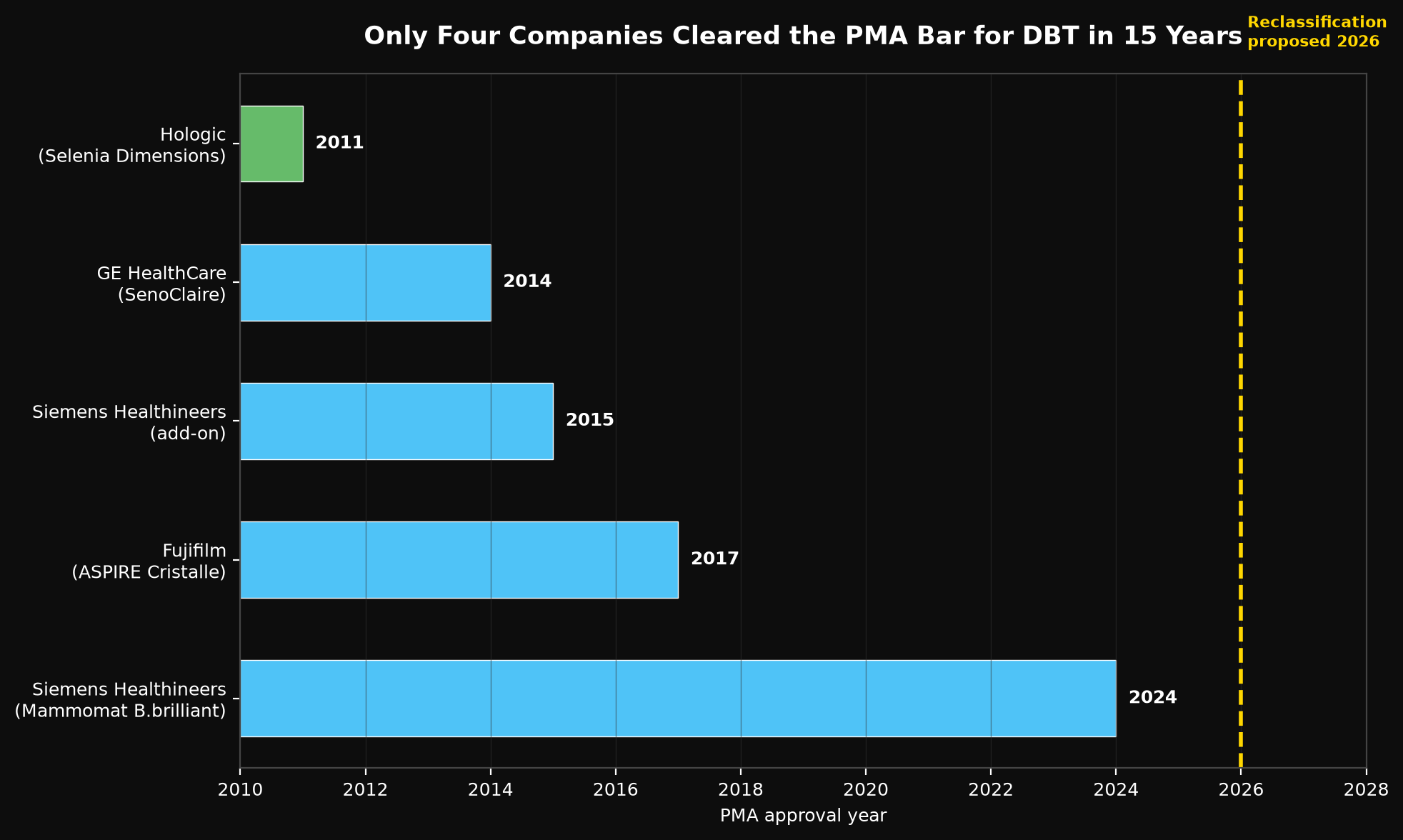
Reclassification removes that barrier for everyone, not just whichever company holds the strongest existing DBT franchise. GE HealthCare, the largest publicly traded medical-imaging peer here, posted second-quarter 2026 revenue of $5.3 billion companywide, with Advanced Imaging Solutions generating $3.77 billion, up 7.9 percent year over year, and a market cap of roughly $32.42 billion as of August 8, 2026 (Stock Titan, GE HealthCare 8-K filing; MarketBeat). GE HealthCare kept investing under the PMA regime, securing FDA approval in November 2025 for Pristina Recon DL, a deep-learning reconstruction tool for its 3D mammography line (Yahoo Finance). Siemens Healthineers won its own PMA approval on September 23, 2024 for the tomosynthesis portion of its Mammomat B.brilliant platform (FDA Premarket Approval database).
A faster-moving layer sits on top: AI detection software running across DBT hardware from multiple vendors. RadNet's acquisition of iCAD, whose tools work across GE, Hologic, Siemens Healthineers, and Fujifilm systems, extended RadNet's reach to 10 million annual mammograms across 1,700 sites in 50 countries and added roughly $19.6 million of annual revenue (Radiology Business). RadNet's Q1 2026 Digital Health segment posted revenue of $29.1 million, up 51.5 percent year over year, with AI revenue growing 125 percent (Stock Titan, RadNet 10-Q filing). A cheaper, faster 510(k) pathway lowers the cost of entry for exactly this kind of hardware-agnostic challenger.
A second, more mundane risk is comment-period drag: FDA could revise the special controls after feedback, or advocacy groups could push back on weakening oversight of a cancer-screening device, either pushing finalization past the implied 2026-2027 timeline.
Investment Idea
Ticker: HOLX (Hologic, Inc., formerly Nasdaq-listed, now privately held)
Thesis: The company most closely tied to this proposal is no longer accessible as a public equity. Hologic's Breast Health segment sits inside a private company owned by Blackstone and TPG, with former shareholders' only remaining upside routed through a non-tradable CVR worth up to $3 per share tied to fiscal 2026 and 2027 Breast Health revenue goals. The financial mechanics suggest a reclassification that eases new product launches is a structural tailwind for the revenue line the CVR depends on, even though that tailwind is no longer visible through public disclosure. Investors wanting direct public-market exposure should look instead to GE HealthCare and the AI-enabled software layer built on top of DBT hardware regardless of manufacturer.
Catalyst: The public comment window closes October 9, 2026, with a proposed 30-day effective date following any final order. On the Hologic side, the catalyst is disclosure tied to the CVR agreement itself, since Breast Health revenue performance will no longer appear in quarterly SEC filings the way it once did.
Risk: The same reclassification that eases Hologic's future launches also erodes the 15-year PMA barrier that limited DBT to four manufacturers, opening the door to GE HealthCare, Siemens Healthineers, Fujifilm, and AI-driven entrants exactly as Hologic transitions to debt-financed private ownership under an owner already shopping other business units. Separately, the rule could be delayed, narrowed, or watered down during the comment process.
This is not investment advice. It is a description of how a specific regulatory mechanism intersects with specific companies' disclosed business lines, meant as a starting point for readers' own diligence, not a conclusion.
The Bigger Principle
Deregulation rarely arrives as a pure gift to the incumbent whose data justified it. FDA can only ease a device out of its strictest classification once enough real-world evidence has accumulated, and that evidence is generated by whichever company got there first and absorbed the cost of building it. The reward for that first-mover investment is not a permanent moat, it is a temporary one, and its length is set by how long competitors take to reach the same evidentiary bar. Investors chasing single-company reclassification stories should always ask who else was standing at the same gate, and what happens the moment it swings open for them too.
Spotted a regulatory shift you think FMR should be digging into next? Just hit reply and tell us what you're watching.
The Free Markets Report is provided by Lead-Lag Publishing, LLC. All opinions and views mentioned in this report constitute our judgments as of the date of writing and are subject to change at any time. Information within this material is not intended to be used as a primary basis for investment decisions, and should also not be construed as advice meeting the particular investment needs of any individual investor. Trading signals produced by The Free Markets Report are independent of other services provided by Lead-Lag Publishing, LLC, or its affiliates, and the positioning of accounts under their management may differ. Please remember that investing involves risk, including loss of principal, and past performance may not be indicative of future results. Lead-Lag Publishing, LLC, its members, officers, directors, and employees expressly disclaim all liability with respect to actions taken based on any or all of the information in this writing.
Related coverage: The FDA Just Rewrote the Device Approval Moat; California Priced Its AI Labelling Rule at $5,000 a Day