The Fed Proposed a 4x Reset on Insider Lending. The Waiver Expires January 1.
Regulation O thresholds unchanged since 1994 would rise fourfold and index to nominal GDP, while the temporary relief holding the framework together lapses January 1, 2027.

Regulation O thresholds unchanged since 1994 would rise fourfold and index to nominal GDP, while the temporary relief holding the framework together lapses January 1, 2027.
Key Highlights
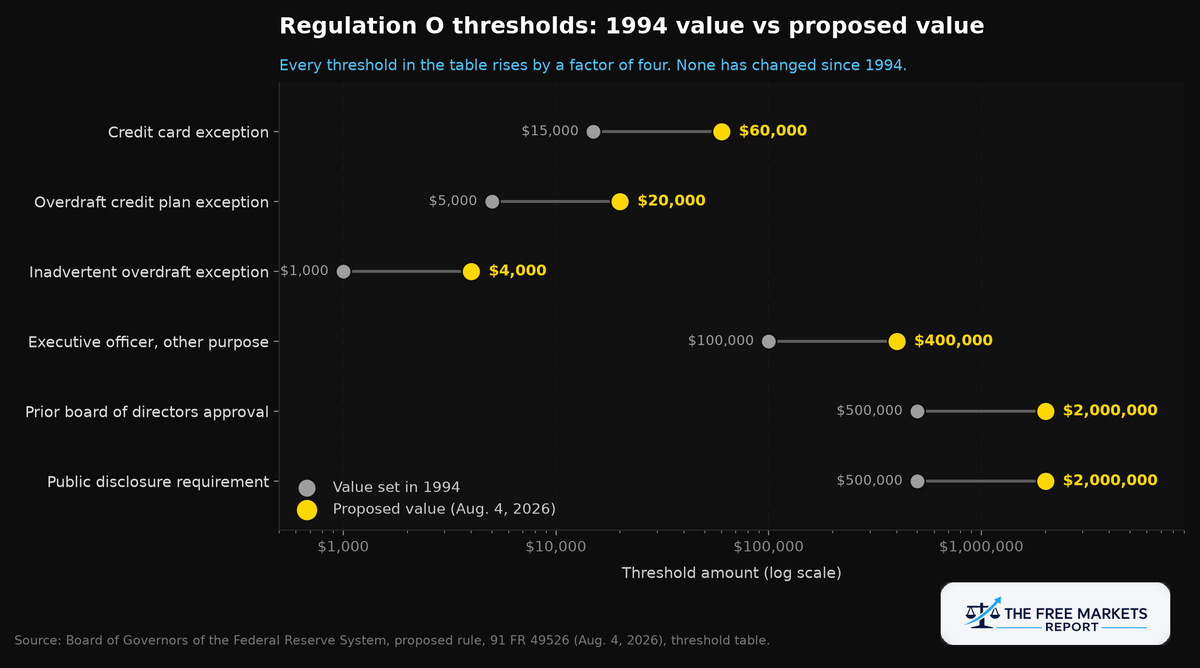
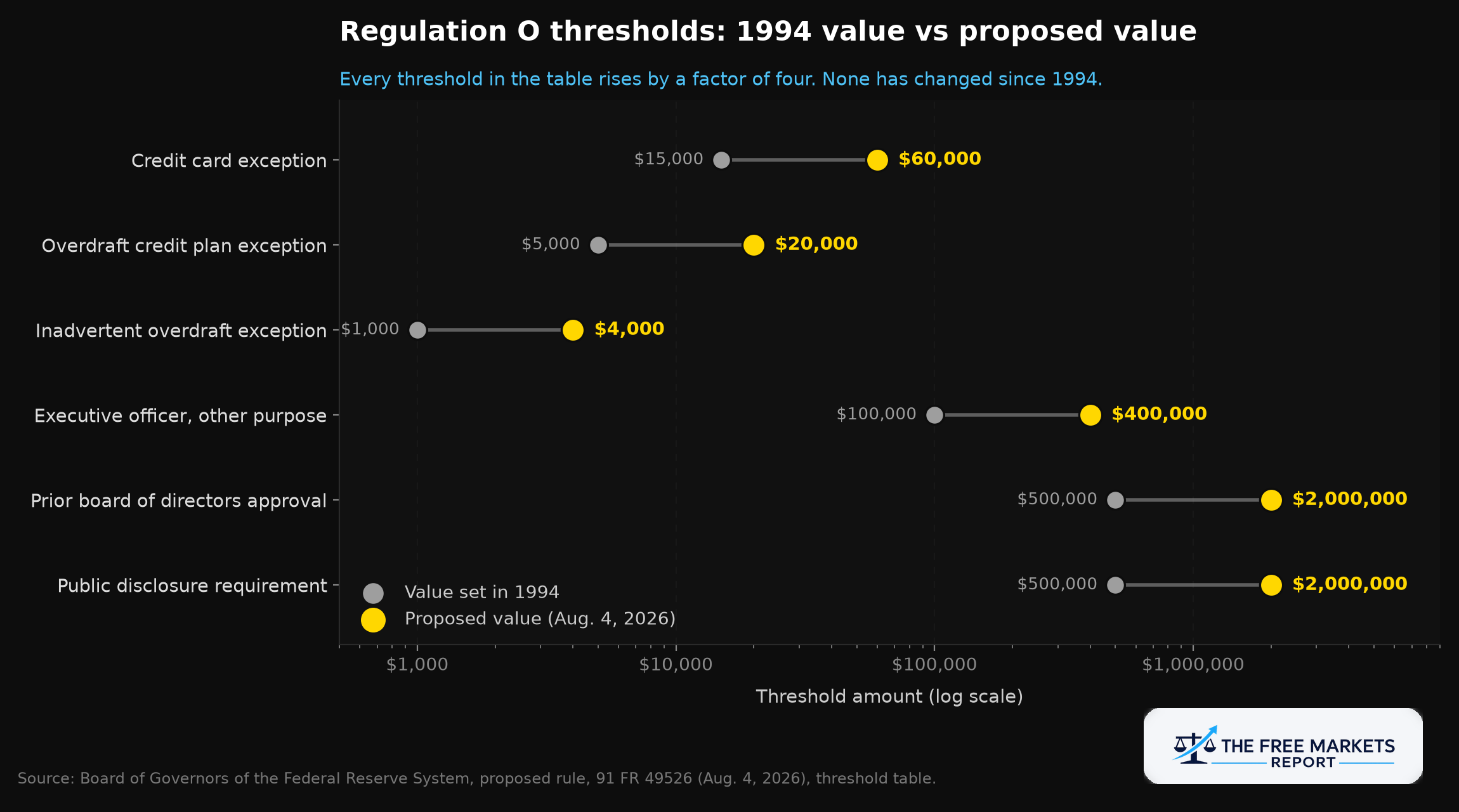
- The Federal Reserve Board published a proposed rule on August 4, 2026 (91 FR 49526, Docket No. R-1896) raising every Regulation O dollar threshold "by approximately fourfold to reflect nominal GDP growth since they were last updated" in 1994. Comments close October 5, 2026.
- The prior board approval and public disclosure thresholds both move from $500,000 to $2,000,000, and thresholds would then be re-indexed to seasonally adjusted nominal GDP every five years, with no adjustment if cumulative five-year growth is negative.
- Banks with a fund group holding 10 percent or more of a class of voting securities rose from 19 in the fourth quarter of 2004 to 66 in the fourth quarter of 2025, a 247 percent increase, per the Board's Table 1.
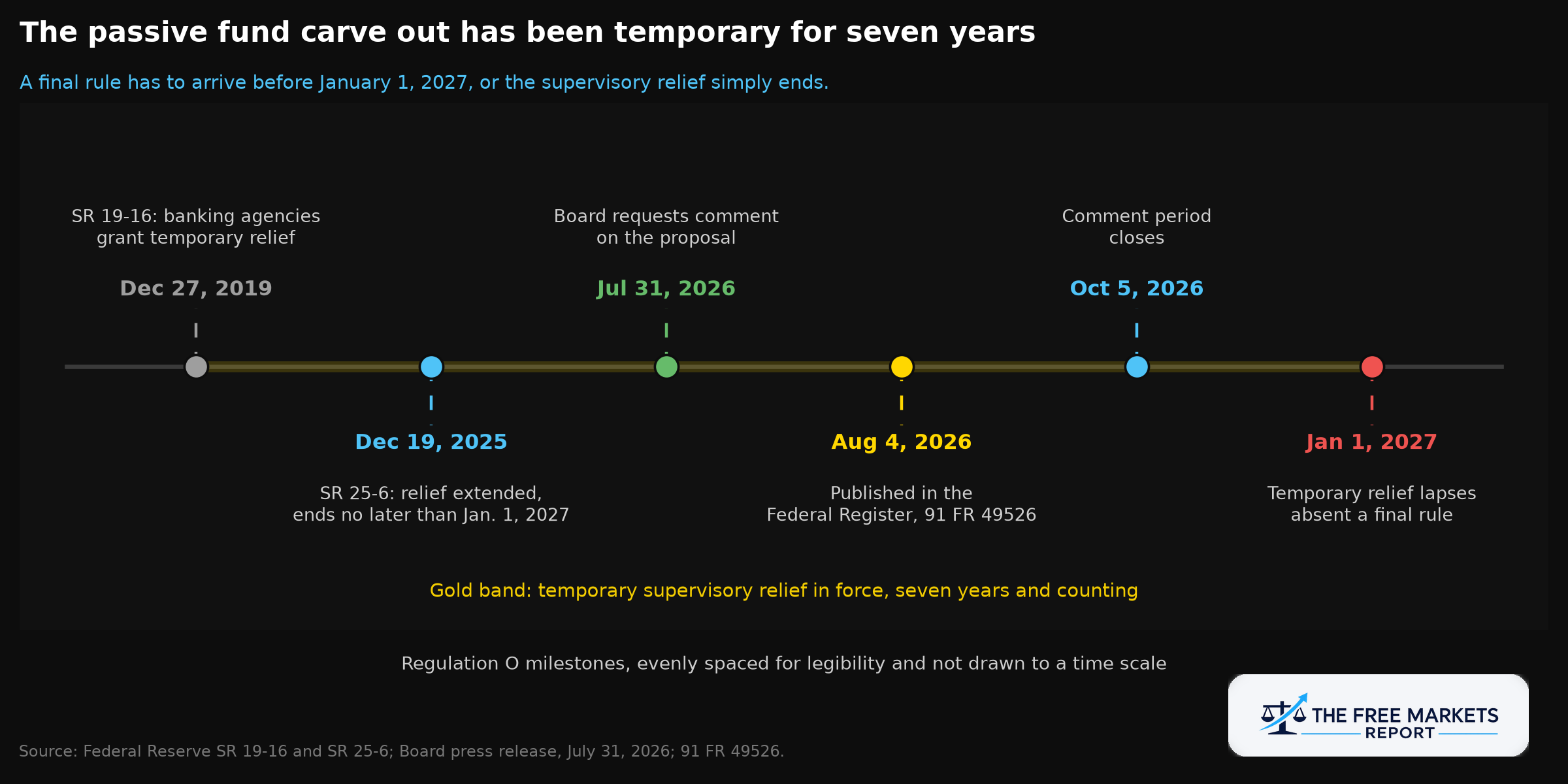
- The relief papering over that problem since 2019, last extended by SR 25-6, ceases on the sooner of January 1, 2027 or a final rule taking effect.
A rule priced for the economy of 1994 has been governing insider lending in the economy of 2026. The Federal Reserve Board's proposal, published August 4, fixes the arithmetic and attaches something more durable than a one time reset: automatic five year indexation to nominal GDP. The deadline is the part markets should notice. A temporary waiver in force since December 2019 ends January 1, 2027 whether or not the Board finishes.
A 1994 Price List in a 2026 Economy
Regulation O, codified at 12 CFR part 215, governs credit extended by member banks to their own executive officers, directors, and principal shareholders. Its architecture is dollar denominated, and the dollars stopped moving thirty-two years ago. Start with the numbers. Six thresholds quadruple at once, including executive officer "other purpose" credit from $100,000 to $400,000 and the two governance thresholds, prior approval by a majority of the bank's board and public disclosure on request, both from $500,000 to $2,000,000.1 Those last two are not paperwork. They are where an insider loan becomes visible.
The Board's framing is community bank governance, not credit expansion. Vice Chair for Supervision Michelle W. Bowman said the proposal "modernizes Regulation O by updating outdated dollar-based thresholds and ensuring their future relevance, while preserving necessary safeguards."3
The Ratchet Matters More Than the Reset
A one time fourfold increase is a headline. The indexing mechanism is the policy change. Thresholds would be adjusted using seasonally adjusted nominal GDP as published by the Bureau of Economic Analysis, measured from the fourth quarter of 1994 to the fourth quarter of 2025, then updated every five years.1
Two design details matter. The mechanism is asymmetric: if cumulative nominal GDP growth over a five year window is negative, no update occurs, so thresholds cannot ratchet down in a recession. And the Board explicitly considered the consumer price index instead, asking commenters which measure is more appropriate.1 Nominal GDP has historically outgrown CPI, so the index choice decides whether thresholds drift or keep pace.
A smaller provision has drawn less attention. A member bank with deposits under $100,000,000 could, by annual board resolution, raise its aggregate insider lending limit to twice unimpaired capital and surplus, but only while it meets all applicable capital requirements and holds a satisfactory composite examination rating.1 Conditioned on supervisory standing, not granted outright.
The Passive Fund Problem the Board Has Papered Over Since 2019
The most consequential piece is not the dollars. It is the new "qualifying fund complex" exception, which addresses a mechanical absurdity: an index fund that passively accumulates more than 10 percent of a bank's voting shares becomes a statutory "principal shareholder," turning that bank's loans to any portfolio company of the complex into insider loans.
The Board quantified the drift. Banks with a fund group holding at least 10 percent went from 19 in the fourth quarter of 2004 to 66 in the fourth quarter of 2025, while non-bank companies with the same ownership went from 1,423 to 2,047. Multiply the two and the Board reaches a maximum of 135,102 potential bank-borrower pairs.1 A scope estimate, not a loan book.
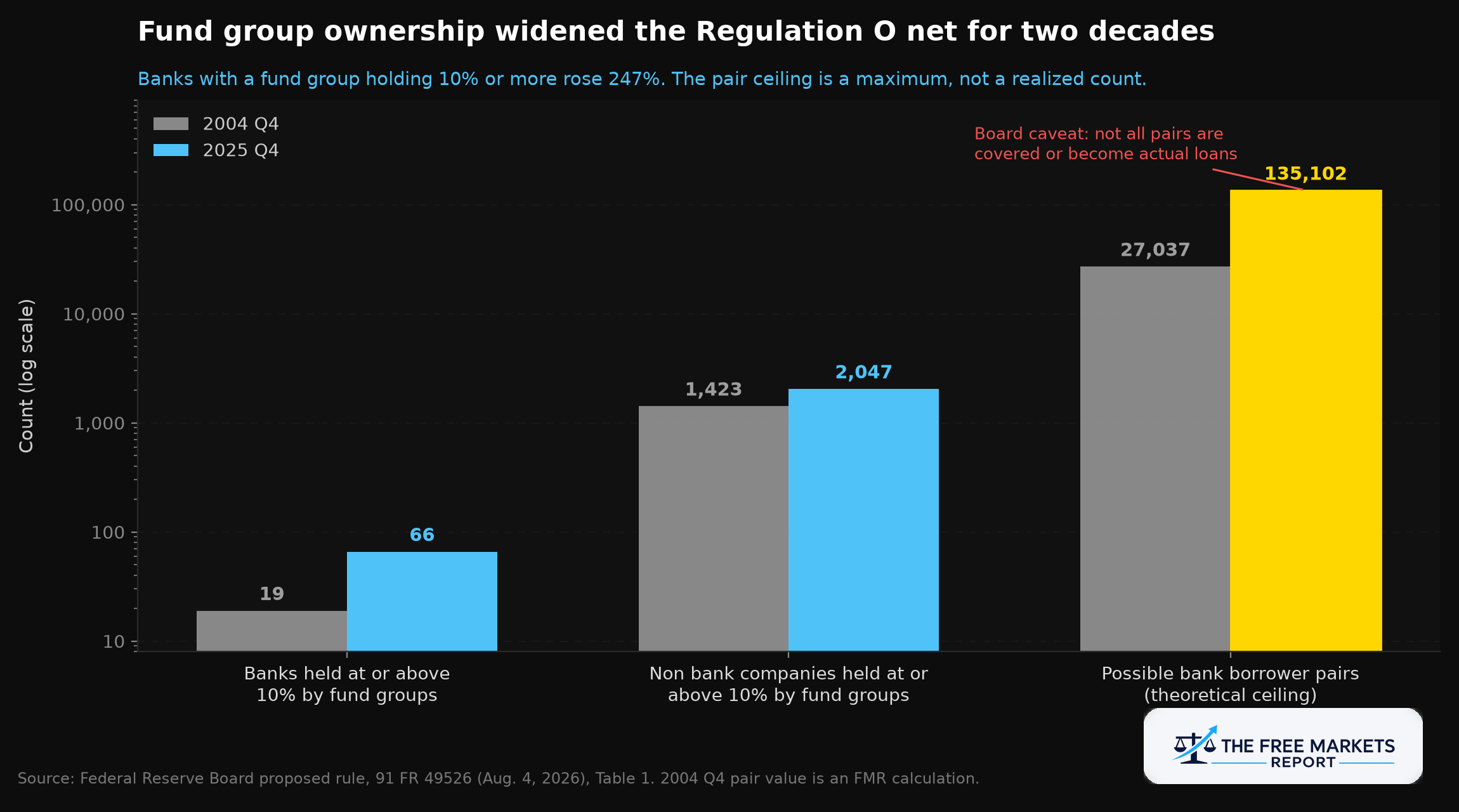
The exception is conditioned, not blanket. A complex qualifies only if it is not, and is not affiliated with, a depository institution or holding company supervised by the Board, the FDIC, or the OCC; no individual fund owns more than 10 percent of any class of voting securities of a regulated company; non-index funds do not in aggregate exceed 10 percent; and the complex does not trigger the rebuttable control presumptions in Regulation Y.1
Read the first condition again. Relief runs to independent asset managers and away from complexes affiliated with supervised banking organizations, an asymmetry inside a rule marketed as simplification.
Then there is the clock. Since a December 27, 2019 interagency statement, the agencies have declined to enforce the principal shareholder provisions against asset managers in these circumstances. SR 25-6 extended that relief in December 2025 and states it "will cease to be effective on the sooner of: January 1, 2027; or the effective date of a final Board rule revising Regulation O."2
Who Actually Sits in the Affected Population
The primary document names no issuer and no ticker. It names a population: 3,134 small depository institutions, per the Board's Regulatory Flexibility Act analysis, using Call Report data as of March 31, 2026, carrying 15,216 estimated annual burden hours.1 A compliance story about small banks, which is why the closest listed proxy is a community bank index fund, not a large cap financials product.
Bear Case
The strongest argument against reading this as a clean deregulatory win is the Board's own enforcement record. In August 2022 the Board fined EagleBank of Bethesda, Maryland $9.5 million after the bank extended credit totaling nearly $100 million to entities owned or controlled by its then chief executive, "without making appropriate disclosures to, or obtaining required approvals from, a majority of the bank's board of directors."5 The safeguard that failed there is the prior board approval requirement whose trigger the proposal quadruples. The comparison has limits: that was a controls breakdown at a bank far larger than the community institutions the Board describes. But the threshold is load bearing.
Three further constraints. This is a proposal, not a final rule: no effective date, comments open until October 5, 2026, open Board questions on the index choice.1 The 135,102 figure is an explicitly caveated ceiling built by multiplying two counts.1 And the Board itself names the cost as "regulatory arbitrage risks," arguing they are "substantially mitigated by the proposal's multiple qualifying criteria," while conceding higher thresholds "could potentially allow for larger transactions."1
And none of it is an earnings event. Regulation O relief lowers governance friction and administrative cost. It does not change net interest margins, credit quality, or loan demand. Reading it as a revenue catalyst is reading a compliance document as a financial statement.
Investment Idea: First Trust NASDAQ ABA Community Bank Index Fund (QABA)
Sector proxy. No issuer, ticker, or company is named anywhere in the primary document, and no single bank catalyst can honestly be derived from it.
- Underlying exposure: Nasdaq OMX ABA Community Bank Index, 160 holdings excluding cash as of August 3, 2026, median holding market capitalization $865 million as of June 30, 2026.4
- AUM: $94,223,607 as of August 3, 2026.4
- Expense ratio: 0.63 percent gross, 0.60 percent net, capped through April 30, 2027.4
- Deregulatory catalyst: the Federal Reserve proposal raising all Regulation O thresholds approximately fourfold, indexing them to nominal GDP, adding the fund complex exception, and letting banks with deposits under $100,000,000 double their insider lending limit by board resolution (91 FR 49526).1
- Performance since catalyst: none exists, because the notice published today. QABA closed at $69.78 on August 3, 2026, against a 52 week closing price range of $52.18 to $69.92.4
- Why the ETF rather than individual stocks: the affected population in the Board's analysis is 3,134 small depository institutions, so an index of community banks maps to it better than a diversified financials product.1
- Key holdings benefiting: Wintrust Financial Corporation (WTFC) 4.23 percent, Commerce Bancshares 3.38 percent, Central Bancompany 3.08 percent, United Bankshares 2.62 percent, as of August 3, 2026.4
- Bear case: governance relief is not revenue, the rule is not final, the safeguard being loosened is the one EagleBank circumvented at a cost of $9.5 million, and the fund is thinly traded, with average 30-day volume of 8,505 shares as of August 3, 2026.4,5
- What to watch: the October 5, 2026 comment close; whether a final rule is adopted before January 1, 2027, when SR 25-6 relief lapses; whether the fund complex conditions survive comment intact; and whether the Board switches the index to CPI.1,2
- Falsification condition: if the agencies issue yet another extension rather than finalizing a rule before January 1, 2027, the thesis that this is a durable framework fix is wrong.
One piece of context cuts both ways. Wintrust Financial Corporation (WTFC), QABA's largest holding, discloses BlackRock at 9.5 percent of its common stock in its 2026 proxy, just under the 10 percent line that converts a passive holder into a statutory principal shareholder.6 The exception solves a real problem for the 66 banks above that line, nothing for the rest.
The Principle
Deregulation that fixes arithmetic is the least glamorous and most durable kind. A dollar threshold set in 1994 and left alone becomes, by inaction, a progressively stricter rule, and the correction always looks like a giveaway even when it only restores the original stringency. What is new is the indexation, which converts a once in a generation political fight into a mechanical adjustment. Less drift. Less discretion. A safeguard that floats with the economy rather than against it. Watch the January 1 deadline, not the headline multiple.
- Board of Governors of the Federal Reserve System, "Loans to Executive Officers, Directors, and Principal Shareholders of Member Banks; Bank Holding Companies," proposed rule, 91 FR 49526, August 4, 2026, Docket No. R-1896, RIN 7100-AH27, comments due October 5, 2026. federalregister.gov
- Board of Governors of the Federal Reserve System, SR 25-6, "Status of Certain Investment Funds and their Portfolio Investments for Purposes of Regulation O and Reporting Requirements under Part 363 of FDIC Regulations," December 19, 2025. federalreserve.gov
- Board of Governors of the Federal Reserve System, press release, "Federal Reserve Board requests comment on a proposal to modernize its rule governing the extension of credit to bank insiders," July 31, 2026. federalreserve.gov
- First Trust Portfolios, "First Trust NASDAQ ABA Community Bank Index Fund (QABA)" fund summary page, fund data as of August 3, 2026. ftportfolios.com
- Board of Governors of the Federal Reserve System, press release, "Federal Reserve Board announces it has fined EagleBank $9.5 million for violation of the Board's insider lending regulation," August 16, 2022. federalreserve.gov
- Wintrust Financial Corporation, definitive proxy statement (Schedule 14A) filed April 9, 2026. sec.gov
The Free Markets Report is provided by Lead-Lag Publishing, LLC. All opinions and views mentioned in this report constitute our judgments as of the date of writing and are subject to change at any time. Information within this material is not intended to be used as a primary basis for investment decisions, and should also not be construed as advice meeting the particular investment needs of any individual investor. Trading signals produced by The Free Markets Report are independent of other services provided by Lead-Lag Publishing, LLC, or its affiliates, and the positioning of accounts under their management may differ. Please remember that investing involves risk, including loss of principal, and past performance may not be indicative of future results. Lead-Lag Publishing, LLC, its members, officers, directors, and employees expressly disclaim all liability with respect to actions taken based on any or all of the information in this writing.
Related coverage: Basel Endgame Is Dead. The Capital Relief Is Not Where You Think.; Britain Just Moved the Wall Around Its Biggest Banks. It Didn't Tear It Down.