The CFTC Wants to Bring Back Rule 4.13(a)(4). The Catch Is Form PF.
The CFTC proposes to revive a narrow RIA/QEP commodity-pool exemption and double the small-pool threshold to $800,000, while keeping investor tests and Form PF where required.

The Commodity Futures Trading Commission wants to remove a layer of commodity-pool registration for a narrow class of SEC-registered investment advisers. It also wants to double the small-pool capital threshold. Neither change is a free pass: the proposal trades registration for investor-sophistication tests, National Futures Association notices, recordkeeping, and Form PF where required. Federal Register Morgan Lewis.
That is the quiet shape of this deregulatory move. The headline is a return of a rule the CFTC rescinded in 2012. The operative detail is that the old exemption comes back with a new compliance perimeter, and that perimeter is designed to keep the CFTC and SEC from asking for the same information twice.
The small-pool change is the easy part
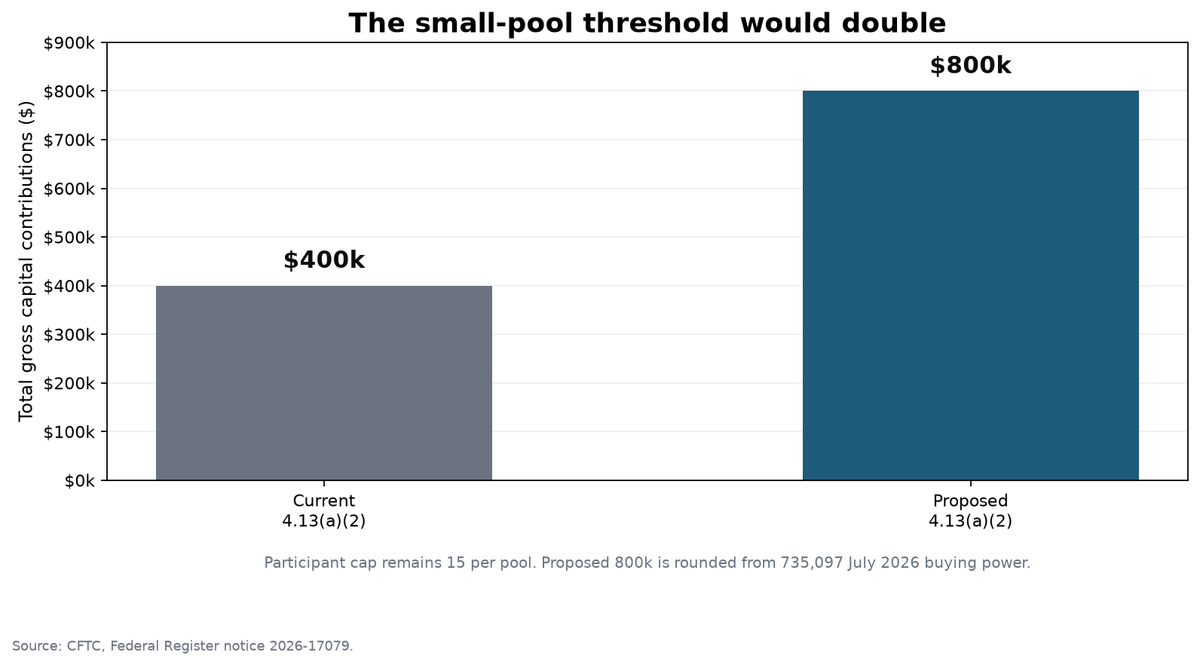
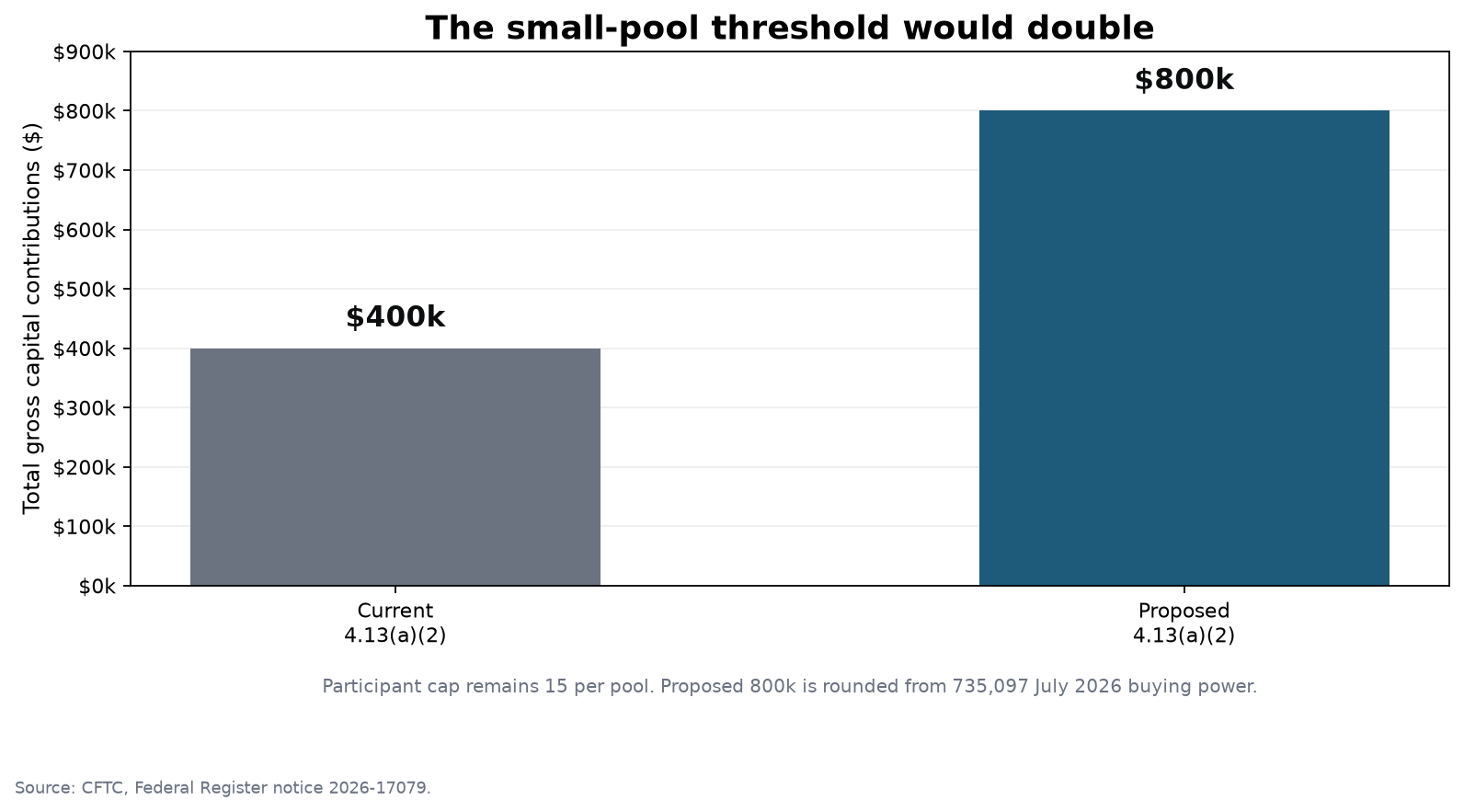
Today, the CFTC's Small Pool Exemption under Regulation 4.13(a)(2) covers a pool with no more than 15 participants and total gross capital contributions of no more than $400,000 across all pools operated or intended to be operated by the person, subject to specified exclusions. The proposal leaves the 15-person ceiling alone and raises the dollar threshold to $800,000. Federal Register.
The inflation argument is unusually transparent. The notice says that $400,000 in January 2003 had the buying power of $735,097 in July 2026. The commission proposes rounding that figure to $800,000 rather than pretending the old threshold still describes the same economic footprint. It is a mechanical adjustment, but it matters to small operators that have not become larger in substance and have nevertheless drifted out of the exemption in nominal dollars. Federal Register.
There is also a useful constraint in what the CFTC did not propose. It did not raise the participant limit. The rule would still be aimed at pools with a small investor base, not at a general exemption for private commodity vehicles. The dollar threshold changes the scale of the pool; the 15-person cap still limits its breadth.
The real story is the RIA/QEP exemption
Proposed Regulation 4.13(a)(4) would let an SEC-registered investment adviser claim an exemption from CPO registration for a qualifying commodity pool. The pool's interests would need to be exempt from Securities Act registration and offered without marketing to the public in the United States, with an exception for a pool also offered under Rule 506(c). The adviser would need to reasonably believe that each natural-person participant satisfies the relevant qualified-eligible-person standard and that each non-natural-person participant is either a qualified eligible person or a specified accredited investor. Federal Register.
That is a much narrower proposition than “private funds are now exempt.” It is an inter-agency alignment proposal. The adviser is already inside the SEC's regulatory framework; the CFTC is asking whether a second registration regime is adding information or merely duplicating it. Morgan Lewis describes the proposal as essentially reinstating the former Rule 4.13(a)(4), but with two material changes: eligibility is limited to SEC-registered investment advisers, and the CPO must file Form PF when Form PF or related securities rules require it. Morgan Lewis.
Form PF is the catch, and it is deliberate
The proposed exemption would not erase reporting that the SEC already requires. It expressly conditions relief on filing Form PF if the adviser is required to do so by Form PF and related securities regulations. The CFTC says that condition would allow it and other Financial Stability Oversight Council regulators to obtain non-duplicative data for market oversight and systemic-risk monitoring. Federal Register.
This is the policy bargain in one sentence: remove a second registration and reporting layer where the SEC already has the adviser, but do not remove the data that regulators say they need to see the private-fund system. That is why the proposal looks more durable than a simple repeal. It is not arguing that oversight is unnecessary. It is arguing that the same oversight should not be collected twice.
The paperwork does not disappear
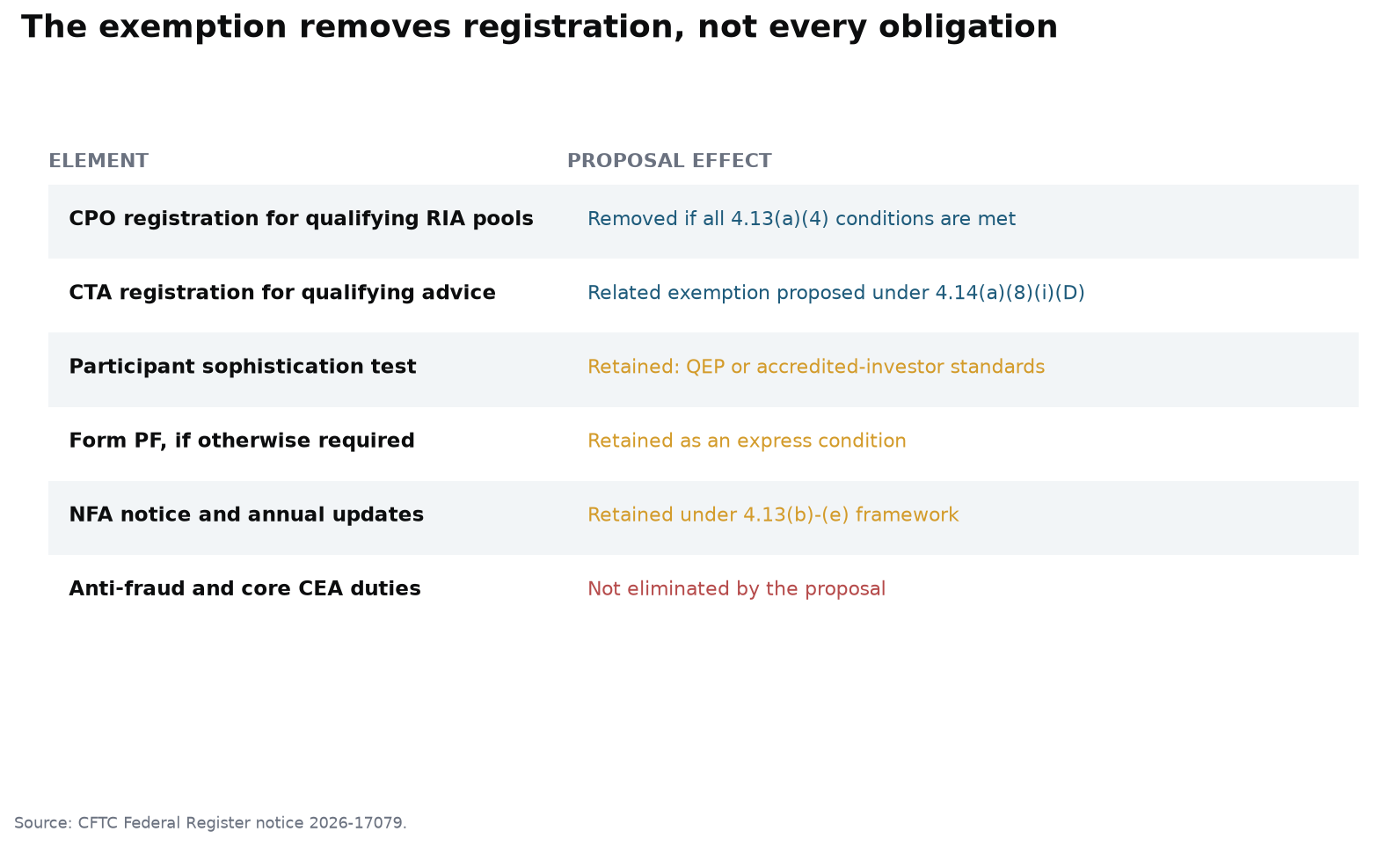
A person claiming the exemption would still file a notice with the National Futures Association, generally through its Online Registration System. Annual notices, updates, representations regarding statutory disqualifications, and recordkeeping would remain. If the adviser operates both exempt pools and pools for which it is a registered CPO, the proposal would also require written or electronic disclosure to prospective participants, a description of the criteria under which the pool will operate, and a redemption right for existing participants when the pool shifts into the exempt framework. Federal Register.
The related CTA change is easy to miss. Proposed Regulation 4.14(a)(8)(i)(D) would extend CTA registration relief to an investment adviser whose commodity-interest advice is directed solely to a CPO that has claimed the proposed 4.13(a)(3) or 4.13(a)(4) exemption, or to a registered CPO treating qualifying pools as exempt. In other words, the CFTC is trying to prevent the adviser-side relief from leaving a second registration problem on the advisory side. Federal Register.
What the comment period will decide
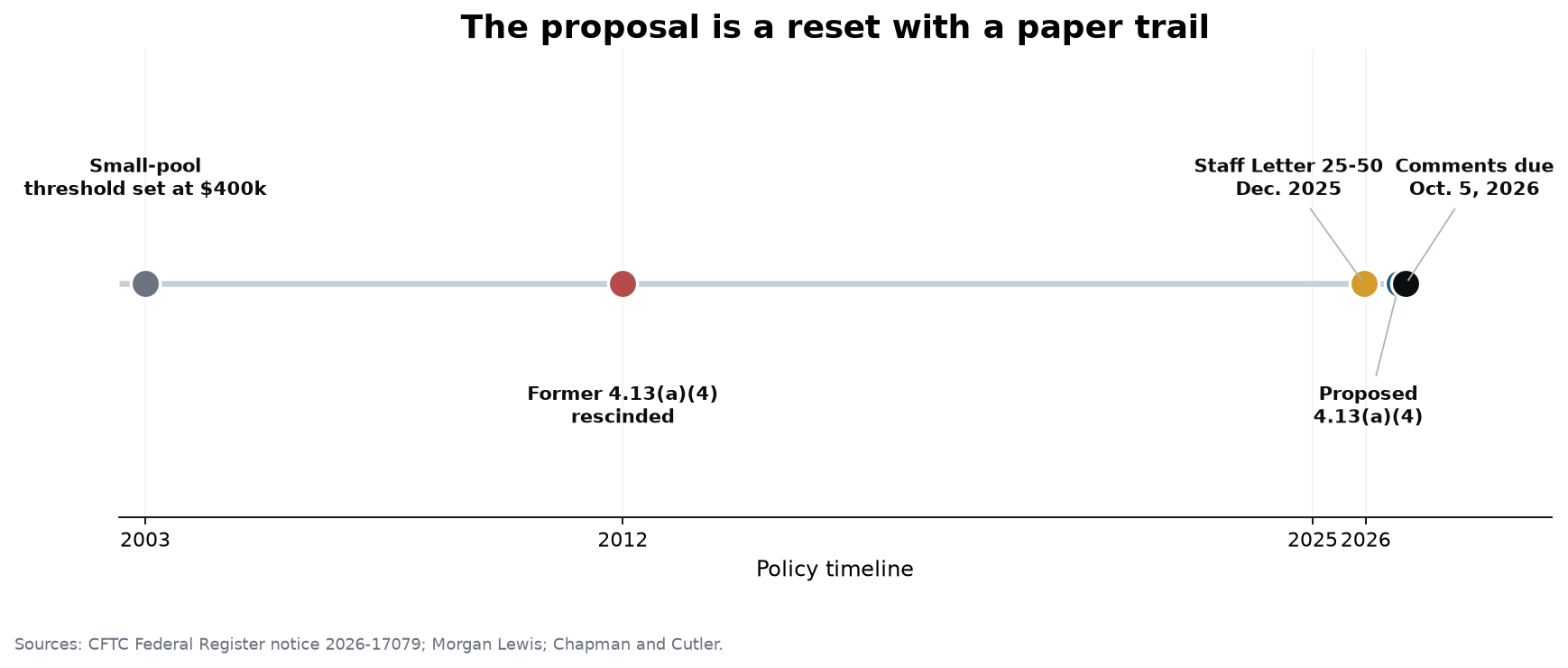
The proposal was published on August 21, 2026, and comments are due October 5, 2026. The CFTC asks whether the Form PF condition is enough, whether additional or alternative reporting requirements are needed, and whether the final rule should supersede CFTC Staff Letter 25-50 in full or only in part. That staff letter, issued December 19, 2025, supplied a no-action position similar to the former 4.13(a)(4) and 4.14(a)(8) exemptions. Federal Register.
The response will tell us whether the proposal is a clean rulemaking or a bridge between two regulatory systems. A broad objection to the QEP definition would force the CFTC to narrow the eligible pool. A demand for more reporting would reduce the cost advantage. A challenge to the supersession of Letter 25-50 would leave the market with two overlapping paths, which is exactly the duplication the proposal says it wants to remove. Chapman and Cutler describes the proposal as aimed at reducing duplicative regulation while expanding the small-pool exemption for inflation. Chapman and Cutler.
The bear case
This is a proposal, not relief that can be booked today. The CFTC has not finalized the exemptions, the comment deadline has not passed, and the agency is still asking whether its reporting conditions are sufficient. A private fund that assumes the new 4.13(a)(4) path exists before adoption would be treating a notice of proposed rulemaking as an operating authorization. It is not one. Federal Register.
The second risk is compliance complexity hiding inside deregulation. The eligible adviser must assess investor status, document that assessment, file the right NFA notice, maintain records, handle annual updates, and retain Form PF obligations where applicable. For a large adviser, that may be less expensive than dual registration. For a small adviser with one pool, the new path could be a choice between two complicated systems rather than a simple reduction in burden.
The larger point is still constructive. The CFTC is proposing to remove a registration layer where it sees overlapping SEC oversight, raise a nominal threshold that has not moved since 2003, and preserve the data it considers important for systemic-risk monitoring. The market should read the proposal not as “fewer rules,” but as a new division of labor: SEC registration and Form PF for the adviser, CFTC anti-fraud and eligibility conditions for the pool, and fewer duplicative gates in between.
Have a regulatory filing we should be tracking? Hit reply.
Know someone tracking market structure like this? Forward this one along.
The Free Markets Report is provided by Lead-Lag Publishing, LLC. All opinions and views mentioned in this report constitute our judgments as of the date of writing and are subject to change at any time. Information within this material is not intended to be used as a primary basis for investment decisions, and should also not be construed as advice meeting the particular needs of any individual situation. The accuracy, completeness, and timeliness of the information contained in this document is not guaranteed. The securities and strategies discussed may be unsuitable for investors depending on their specific financial position and investment objectives. Reproduction of this report without the express written consent of Lead-Lag Publishing, LLC is strictly prohibited. Past performance is not indicative of future results, and current performance may be lower or higher than the performance shown. Neither the information nor any opinion expressed in this report constitutes a solicitation, an offer to buy or sell any securities, or an offer to provide investment advice or services. Nothing in this report shall be construed to be an offer to provide investment advisory services in any jurisdiction in which Lead-Lag Publishing, LLC is not authorized to provide such services. All investments involve risk, including the risk of loss of principal. No representation is being made that any security, account, or strategy will or is likely to achieve results similar to those shown. Investing in securities involves risks, and there is always the potential of losing money when you invest in securities. Before investing, consider your investment objectives, and Lead-Lag Publishing, LLC's charges and expenses. This report is not a prospectus and does not contain all of the information necessary to fully evaluate any security or strategy discussed, including, but not limited to, the risk of adverse effects of related market developments. You should not rely solely on the information contained in this report, and should seek advice based on your situation from a licensed investment professional. Carefully consider the investment objectives, risks, charges and expenses of any investment product before investing. This report may not be copied or distributed without the express written consent of Lead-Lag Publishing, LLC. Any decisions made based on any or all of the information in this writing are the sole responsibility of the user, and the user should exercise caution and take appropriate advice before acting.