The Bank Exam Cycle Just Doubled. The Risk Test Did Not.
Federal banking regulators doubled the asset threshold for a longer exam cycle, but capital, management, and supervisory gates still decide who qualifies.

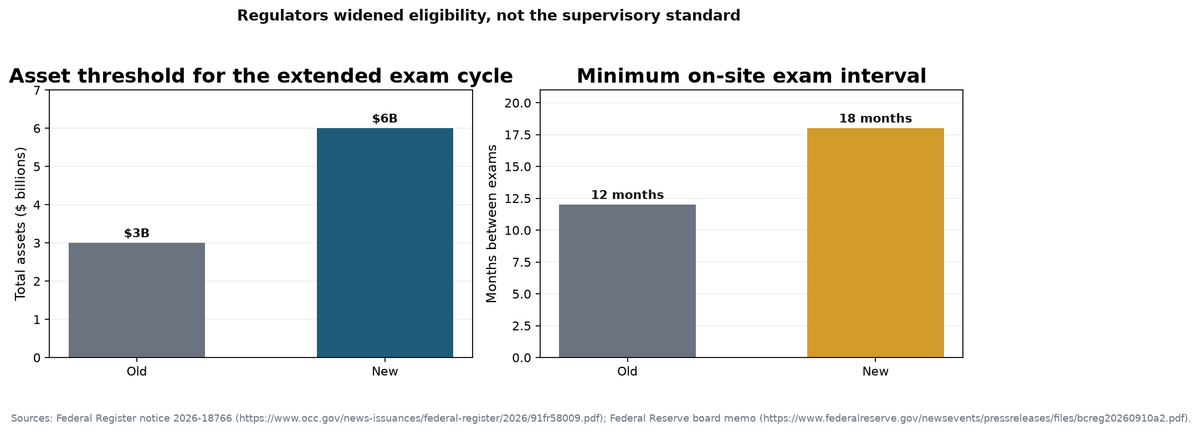
The federal banking agencies just doubled the asset threshold for a longer examination cycle. Qualifying institutions under $6 billion can now be considered for an 18-month on-site exam interval instead of the standard 12 months. The quiet catch is that the risk test did not move: capital, management, enforcement history, and supervisory ratings still decide who gets the benefit. Federal Reserve Federal Register.
That makes this a more interesting piece of deregulation than the headline suggests. The agencies are not declaring community banks safe by size. They are widening the doorway for institutions that already pass a supervisory screen, then keeping off-site monitoring and the power to examine more often when conditions require it.
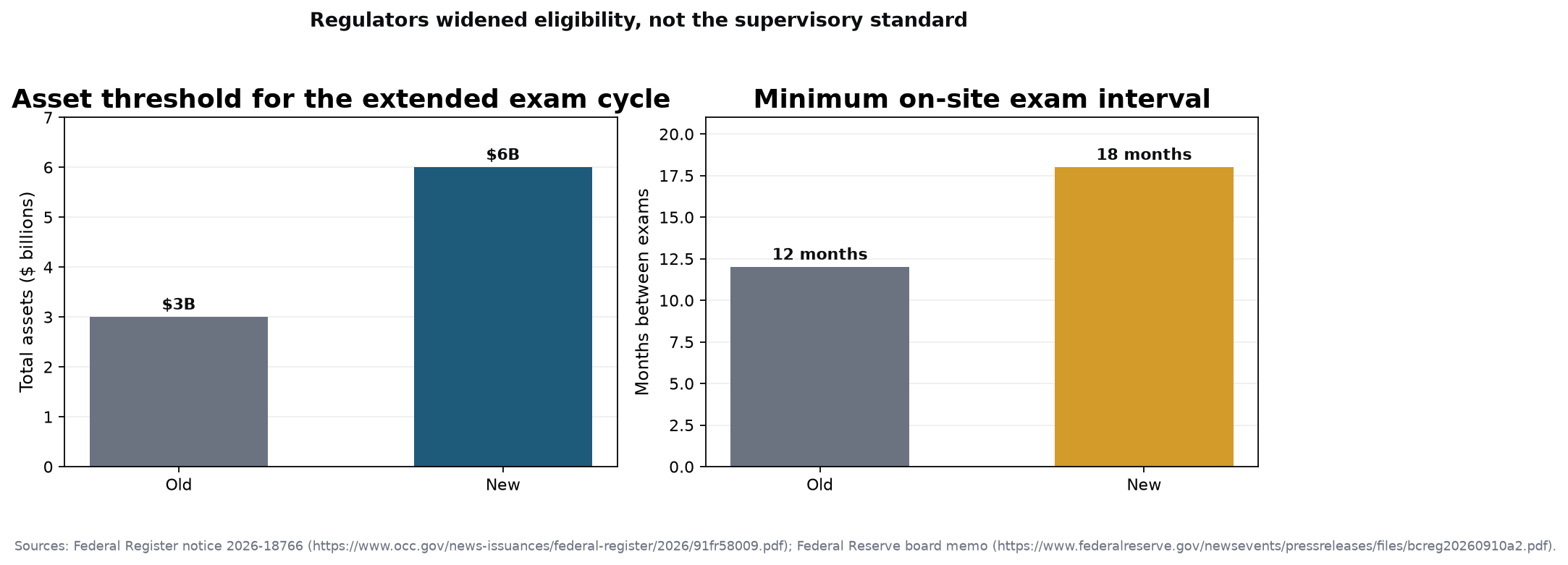
The numerical change is simple
Before this rule, the extended cycle generally applied to qualifying institutions below a $3 billion total-asset threshold. The interim final rule implements Section 903 of the 21st Century ROAD to Housing Act and raises that threshold to $6 billion. The same change applies to the parallel regulatory provisions covering qualifying U.S. branches and agencies of foreign banks. Federal Register.
The operational effect is a six-month extension in the normal interval between full-scope, on-site examinations. The baseline statutory cycle is at least once during each 12-month period. A qualifying institution can instead be examined at least once during an 18-month period, subject to the rule's conditions and the agency's continuing authority to act sooner. Federal Register.
The rule became effective on September 14, 2026, and the agencies are taking comments through October 14, 2026. That combination matters. This is live relief, but it is also an interim rule still exposed to a public comment process. Federal Register.
Who actually gets the longer runway?
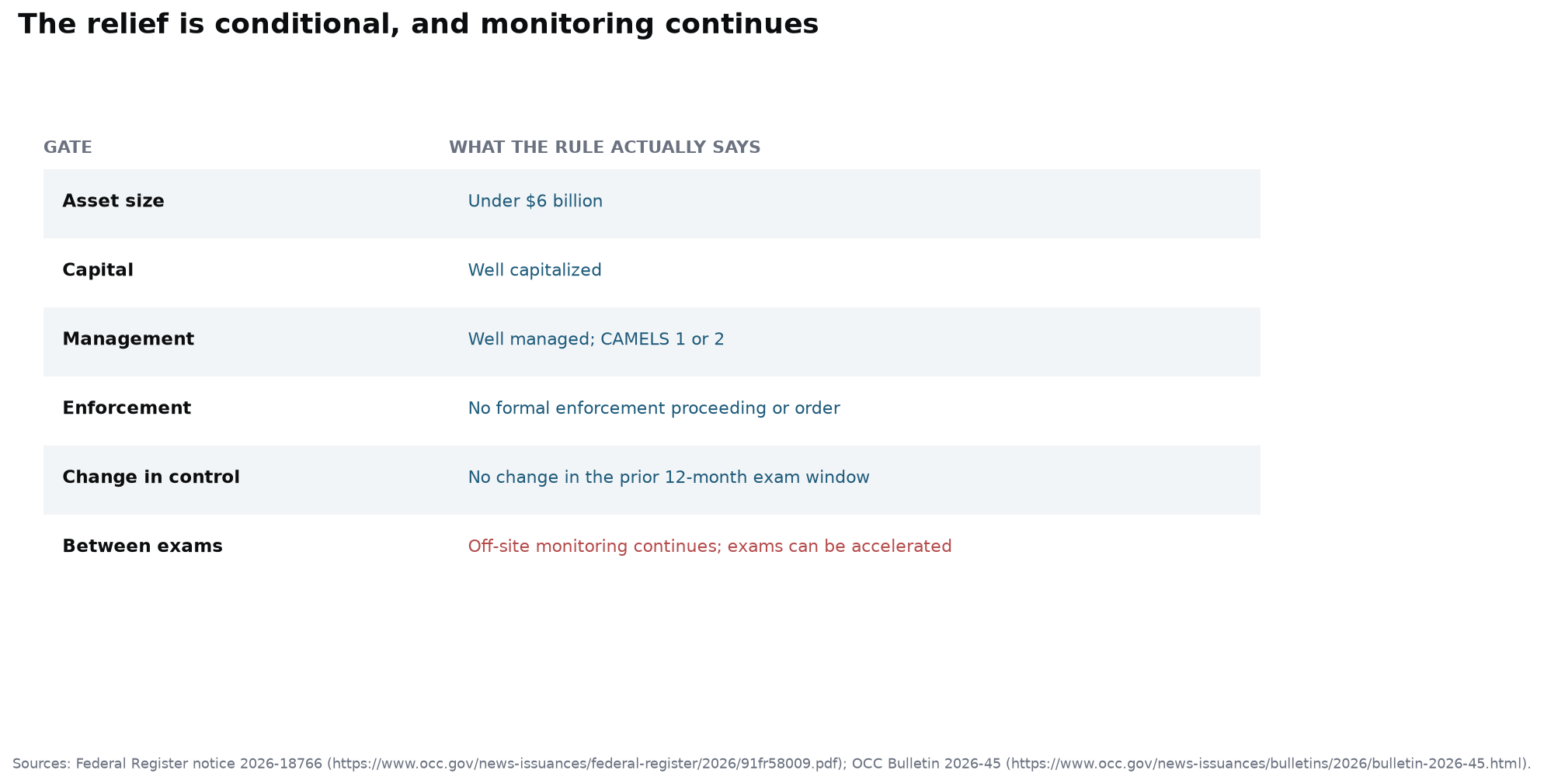
Size is only the first gate. An insured depository institution generally must have less than $6 billion in total assets, be well capitalized, and have been found well managed at its most recent examination. The rule also requires a qualifying composite condition, generally an “outstanding” condition for institutions in the expanded category. For institutions with no more than $200 million in assets, the rule recognizes the “good” composite condition as well. Federal Register.
In supervisory language, well managed is tied to a CAMELS composite rating of 1 or 2 and a management component rating of 1 or 2 at the most recent examination. The institution cannot be subject to a formal enforcement proceeding or order, and it cannot have undergone a change in control during the prior 12-month period in which a full-scope examination otherwise would have been required. Federal Register.
That is why calling the measure a blanket community-bank exemption would be wrong. A $5.9 billion institution with weak capital, a poor supervisory history, or a live enforcement matter does not qualify merely because it fits under the asset ceiling. The rule is an eligibility expansion for low-risk institutions, not a suspension of supervision.
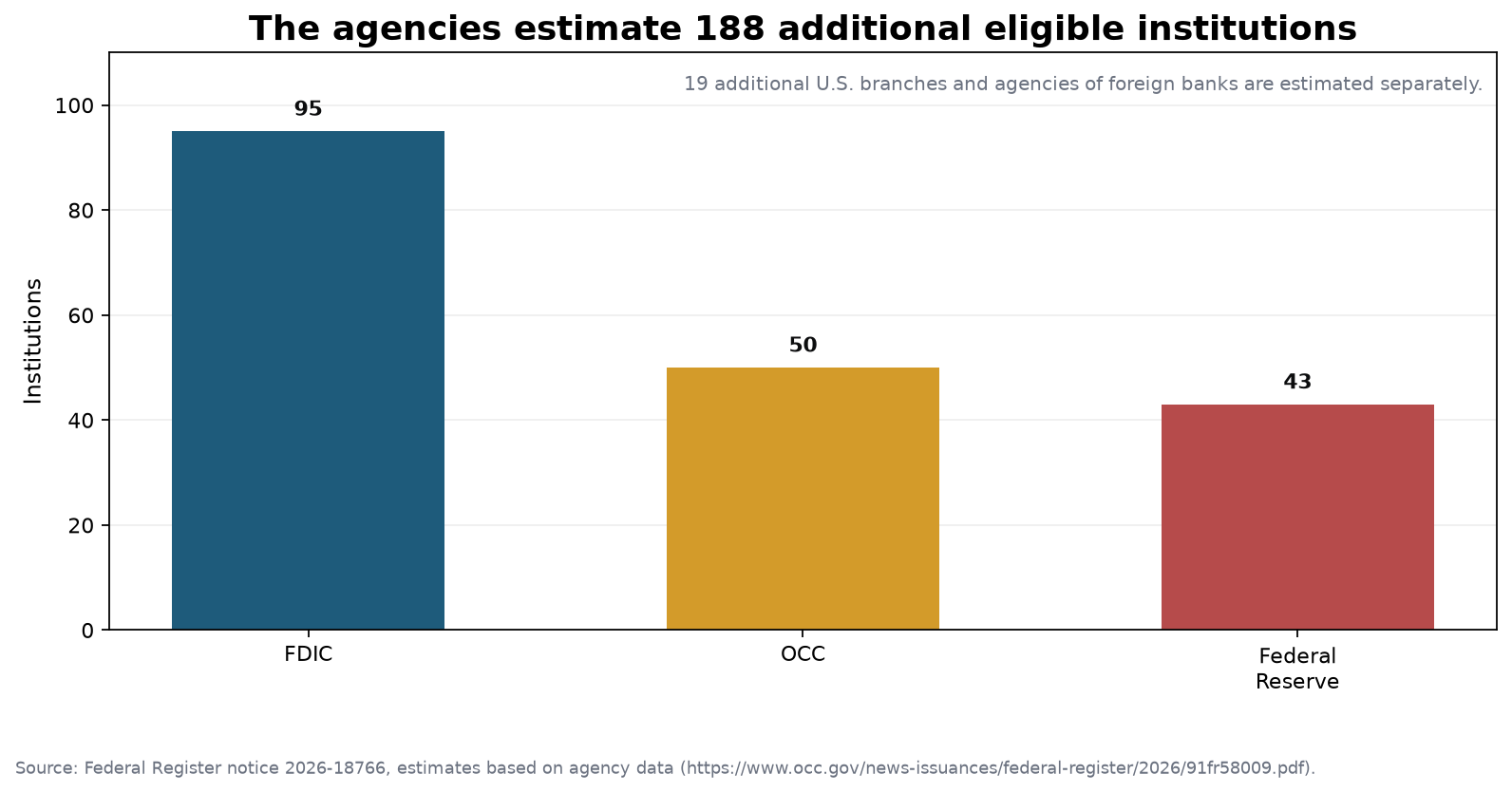
The population is meaningful, but not enormous
The agencies estimate that roughly 188 additional banks and savings associations may be eligible for the 18-month cycle. The estimate breaks down to 95 institutions supervised by the FDIC, 50 supervised by the OCC, and 43 supervised by the Federal Reserve. The agencies estimate that the total number of institutions that may qualify for an extended cycle will be 4,016. They also estimate 19 additional U.S. branches and agencies of foreign banks may qualify under the parallel changes. Federal Register.
Those numbers put a boundary around the story. The rule is large enough to change the compliance calendar for a real group of institutions, but it is not a signal that every bank between $3 billion and $6 billion will suddenly operate with less scrutiny. The estimate is based on agency data and eligibility assumptions, not a promise that each institution will elect or retain the longer cycle.
What disappears, and what does not
But the rule does not create a supervisory vacuum. The agencies say off-site monitoring will continue between scheduled examinations, often using Call Report-based analysis to identify new or increasing risks. They also retain authority to examine an institution more frequently than once every 18 months when necessary or appropriate, including institutions with a “good” composite rating. Federal Register.
The quiet risk is the detection window
Every longer inspection interval creates a longer period in which a new problem could develop before an on-site team sees it. The agencies acknowledge that trade-off. Their answer is that the institutions in scope are small, non-complex, well capitalized, well managed, and monitored off site. The rule therefore shifts the timing of the exam without claiming that the timing has no risk.
That distinction matters for investors and depositors reading the policy signal. Regulatory relief can reduce friction and free resources, but the relief itself is evidence of prior supervisory performance, not an independent measure of franchise quality. A bank earns the longer runway through its condition and ratings. It can lose the runway if those facts change.
Why the comment period is the next catalyst
The comment deadline is October 14. The key questions are whether the eligibility screen is calibrated correctly and whether off-site monitoring can catch deterioration before the next scheduled examination. The interim rule is already effective, so comments test whether the relief should remain in this form.
The bear case
The first risk is that a longer calendar is mistaken for lower underlying risk. The rule does not improve a bank's capital, asset quality, liquidity, governance, or earnings. It changes how often a qualifying institution receives a full-scope on-site exam. A bank that deteriorates between examinations can still become a problem before the next scheduled visit.
The second risk is uneven implementation. Eligibility depends on ratings, capital status, enforcement history, and change-in-control facts that are not identical across institutions. Two banks with similar asset sizes can face different supervisory calendars. That is sensible if the screen is doing its job, but it makes the headline threshold a poor substitute for institution-level analysis.
The constructive read is narrower and more useful. The agencies are updating an outdated size boundary, reducing repetitive exam preparation for a defined population, and preserving a supervisory backstop. The policy is not “banks under $6 billion are safe.” It is “banks under $6 billion that remain well capitalized, well managed, and clean can earn more time between full-scope exams.” That is deregulation with a condition attached, which is usually the kind that survives contact with the operating system.
Know someone tracking market structure like this? Forward this one along.
The Free Markets Report is provided by Lead-Lag Publishing, LLC. All opinions and views mentioned in this report constitute our judgments as of the date of writing and are subject to change at any time. Information within this material is not intended to be used as a primary basis for investment decisions, and should also not be construed as advice meeting the particular needs of any individual situation. The accuracy, completeness, and timeliness of the information contained in this document is not guaranteed. The securities and strategies discussed may be unsuitable for investors depending on their specific financial position and investment objectives. Reproduction of this report without the express written consent of Lead-Lag Publishing, LLC is strictly prohibited. Past performance is not indicative of future results, and current performance may be lower or higher than the performance shown. Neither the information nor any opinion expressed in this report constitutes a solicitation, an offer to buy or sell any securities, or an offer to provide investment advice or services. Nothing in this report shall be construed to be an offer to provide investment advisory services in any jurisdiction in which Lead-Lag Publishing, LLC is not authorized to provide such services. All investments involve risk, including the risk of loss of principal. No representation is being made that any security, account, or strategy will or is likely to achieve results similar to those shown. Investing in securities involves risks, and there is always the potential of losing money when you invest in securities. Before investing, consider your investment objectives, and Lead-Lag Publishing, LLC's charges and expenses. This report is not a prospectus and does not contain all of the information necessary to fully evaluate any security or strategy discussed, including, but not limited to, the risk of adverse effects of related market developments. You should not rely solely on the information contained in this report, and should seek advice based on your situation from a licensed investment professional. Carefully consider the investment objectives, risks, charges and expenses of any investment product before investing. This report may not be copied or distributed without the express written consent of Lead-Lag Publishing, LLC. Any decisions made based on any or all of the information in this writing are the sole responsibility of the user, and the user should exercise caution and take appropriate advice before acting.