FINRA Just Made Trading Fees Vanish for Q4. The Bigger Move Is 2029.
FINRA set its Trading Activity Fee to zero for Q4 2026, but the larger change is a two-year delay to scheduled fee increases. The relief is real, temporary, and concentrated.

FINRA just turned off one of Wall Street's transaction fees for the fourth quarter. The headline is a three-month holiday. The more important signal is that the regulator is learning to use fees as a policy dial, not a permanent ratchet.
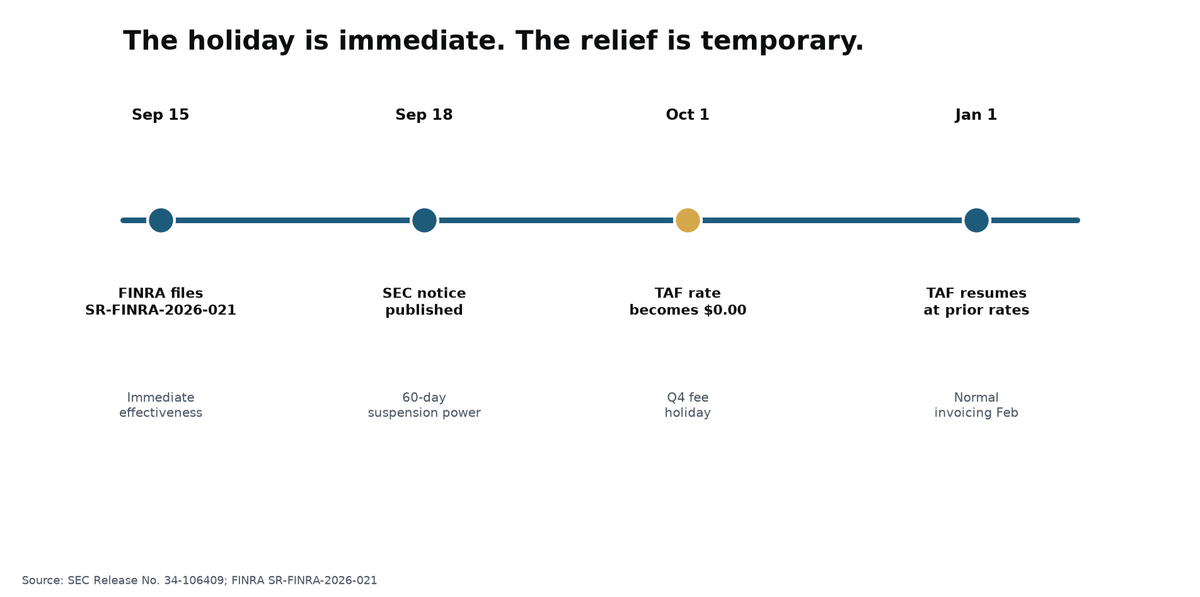
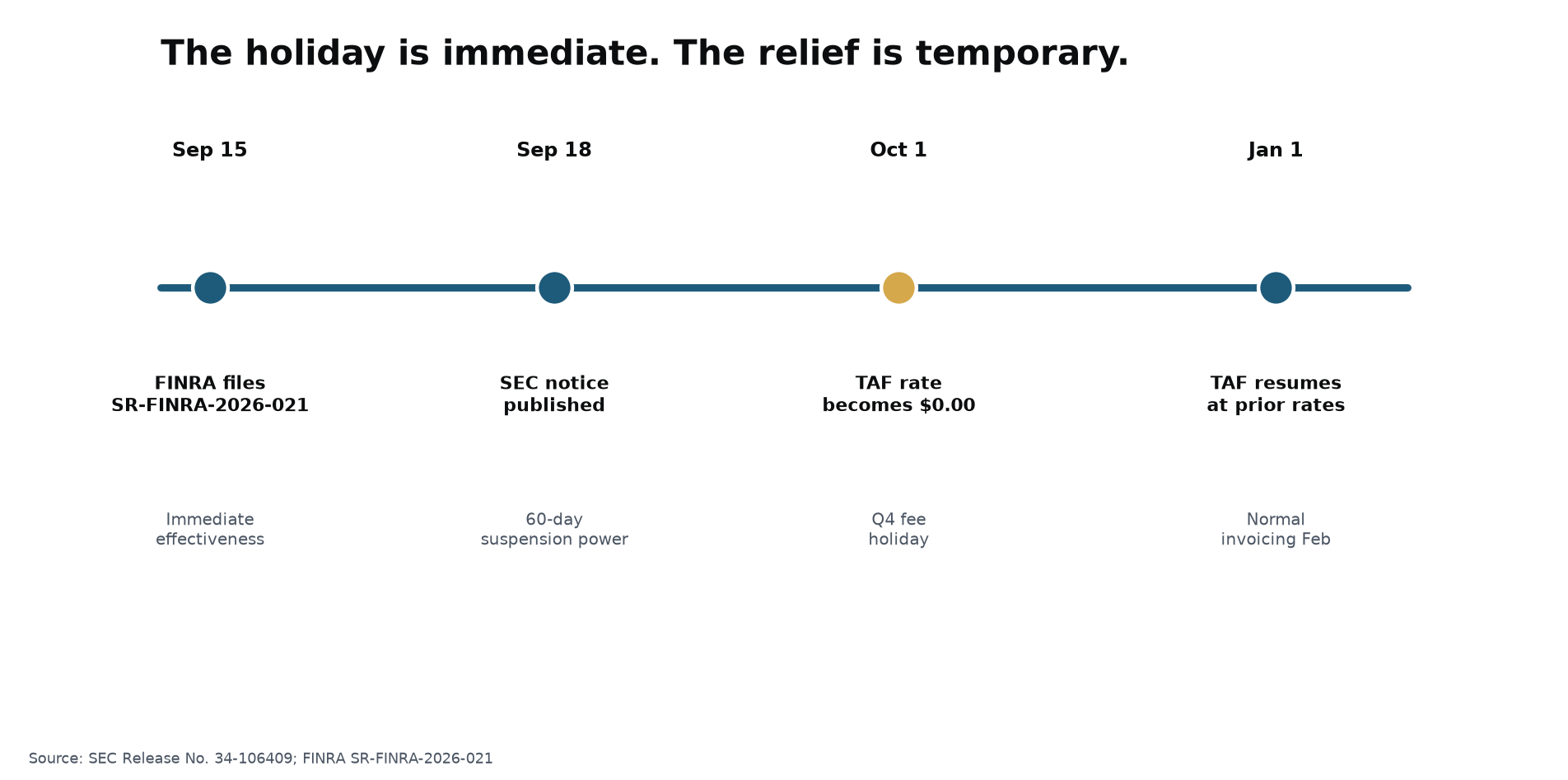
On September 15, 2026, the Financial Industry Regulatory Authority filed a proposed rule change that sets the Trading Activity Fee, or TAF, at $0.00 for transactions from October 1 through December 31. The SEC published its notice on September 18, and the filing became effective immediately under the fee-change provision of the Securities Exchange Act (SEC Release No. 34-106409; FINRA SR-FINRA-2026-021).
Key Highlights
- The TAF rate is set to $0.00 for October, November, and December 2026, with assessment resuming on January 1, 2027 (SEC).
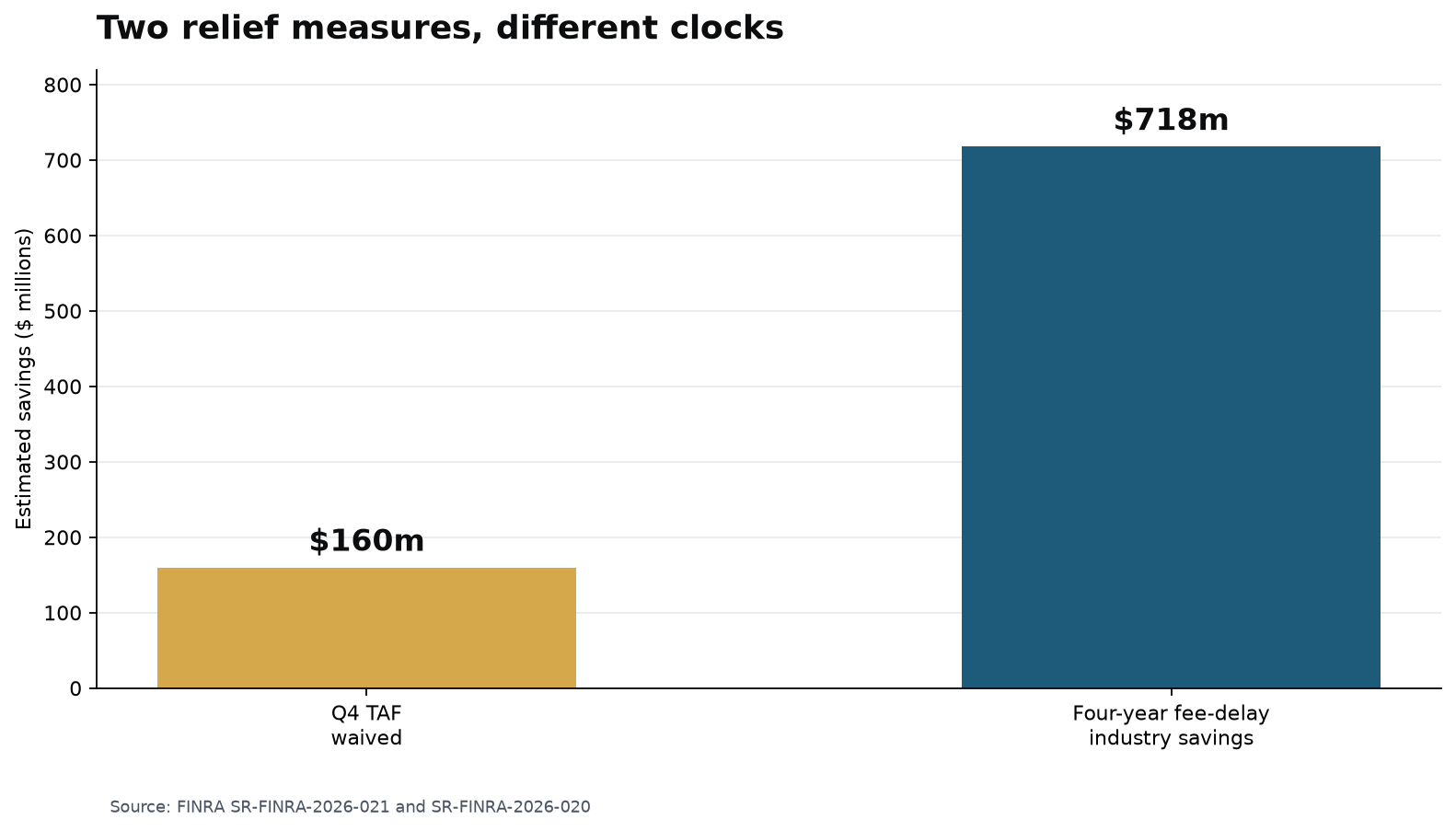
- FINRA estimates that the holiday waives approximately $160 million of fees. Members still report their trading volumes, and normal invoicing for January activity resumes in February 2027 (SEC).
- A separate filing delays previously adopted fee increases by two years. FINRA estimates roughly $718 million of industry savings over that period, with a median four-year savings amount of $5,199 per member (FINRA SR-FINRA-2026-020).
- The economic benefit is not evenly distributed. FINRA's historical analysis says the top third of firms account for about 98% of reported TAF fees, while the middle third accounts for 1.9% and the bottom third 0.1% (SEC).
The Fee Holiday Is Not a Deregulation Victory Lap
It is tempting to read a zero fee as a permanent rollback. The filing says the opposite. FINRA does not change the TAF's scope. Firms remain subject to the existing coverage rules and must continue reporting aggregate monthly trading volumes, even while the invoice shows a zero assessment during the holiday (SEC Release No. 34-106409).
That distinction matters because the fee is not simply a surcharge that disappears from a consumer's brokerage statement. It is a member-level regulatory charge, assessed across covered sales subject to exemptions. Whether any savings reach customers depends on each firm's pricing, business model, and competitive conditions. FINRA says the proposal applies on equal terms to members that otherwise would have been subject to the TAF, but equal eligibility is not equal economic impact (SEC).
The timing is also operational rather than ideological. FINRA says the holiday responds to higher-than-anticipated trading activity and a projection that 2026 TAF revenue would exceed expectations. The organization projected a 2026 TAF budget of $438.6 million and estimates the three-month pause will waive about $160 million (SEC). In other words, this is a revenue-management move that happens to lower the cost of trading for firms during the busiest part of the calendar.
The Bigger Move Is the Two-Year Delay
The fee holiday is the visible gesture. The structural change is SR-FINRA-2026-020, filed alongside it. That proposal keeps 2026 fee rates in place through December 31, 2028 and shifts the already adopted increases out to 2029, 2030, and 2031. FINRA estimates total industry savings over the delay at approximately $718 million, with a median four-year savings amount of $5,199 per member (FINRA).
That is a different kind of relief. The holiday changes a bill for one quarter. The delay changes the planning horizon for three annual budgets. Firms do not need to assume that a fee scheduled for 2027 will hit on that date, and they gain time to absorb a cost structure that FINRA itself says was designed to fund its mission over multiple years. The compromise is easy to understand: relief now, but no promise that the eventual fee architecture goes away.
Independent coverage makes the same point in plainer language. AdvisorHub reports that the delay holds 2026 rates until 2029 and that whether customers receive any benefit depends on individual firm practices and competitive conditions. That caveat is the line between an industry cost reduction and a consumer price cut.
Who Actually Benefits?
FINRA's distribution table supplies the less comfortable part of the story. The top third of firms, ranked by reported TAF fees, generated approximately 98% of those fees in the historical sample. The middle third generated 1.9%, and the remaining third 0.1% (SEC Release No. 34-106409).
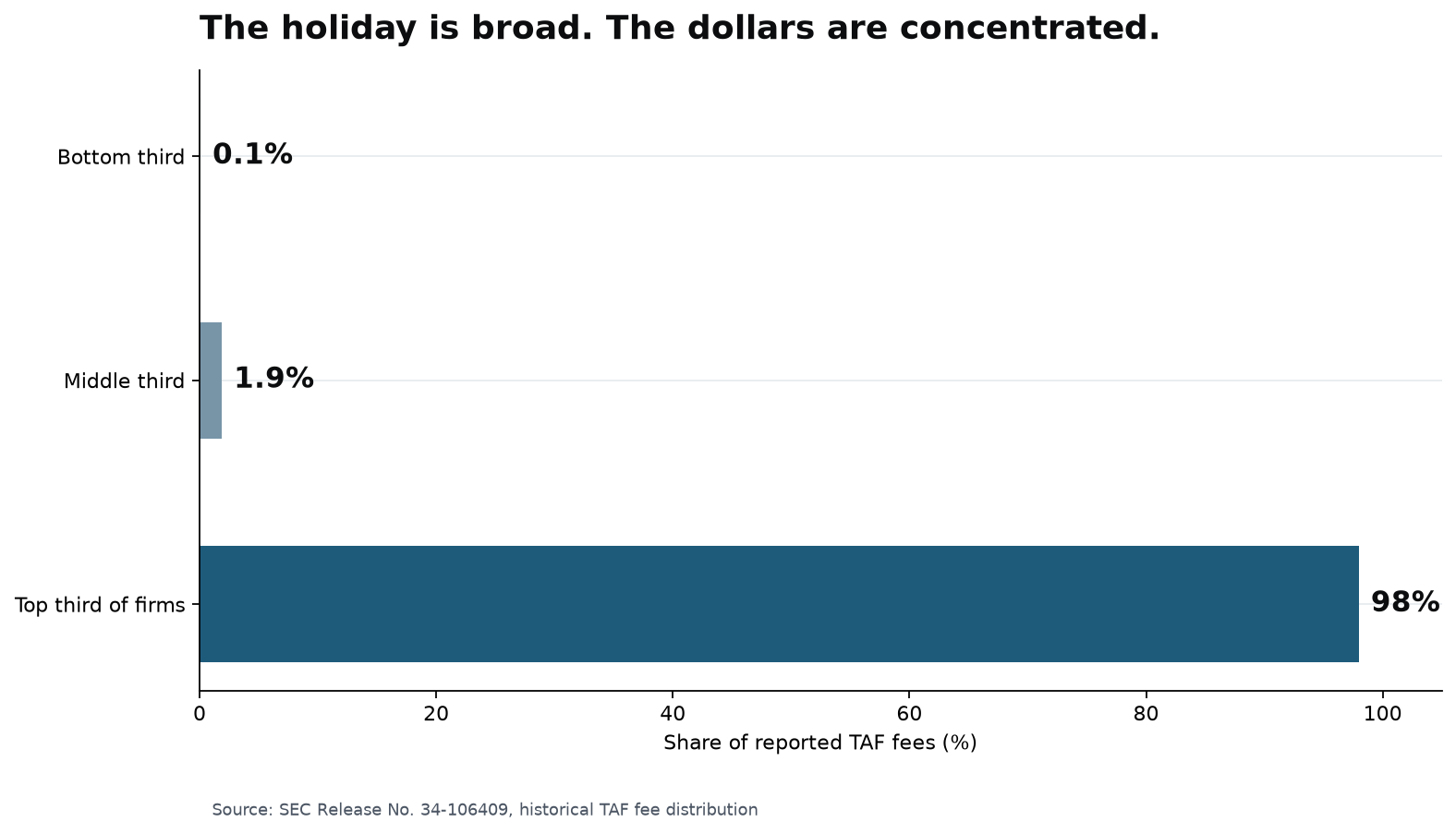
A broad waiver therefore produces a concentrated dollar benefit. That is not a flaw in the filing. It is a reminder that regulatory fee policy can be formally universal while economically narrow. A small broker gets the same rate of zero, but a firm with far more reportable activity saves more dollars. The rule is horizontal in design and vertical in effect.
What to Watch Next
The first watchpoint is January 1. The TAF is scheduled to return to prior rates for January transactions, with normal invoicing in February 2027. The second is the SEC's 60-day suspension authority. The filing is immediately effective, but the Commission may temporarily suspend it within 60 days if it finds suspension necessary or appropriate in the public interest, for investor protection, or to further the Act (SEC).
The third watchpoint is pass-through behavior. The filing itself does not say that brokerages must reduce customer commissions or spreads. The market will decide whether competition turns the member-level saving into a customer-level saving. If it does not, the holiday still improves firm economics, but the consumer-facing story will be smaller than the headline.
The Bottom Line
FINRA's action is a useful test of what deregulation looks like when it arrives as administration rather than repeal. The regulator has not abandoned the fee, removed the reporting system, or rewritten the perimeter. It has paused collection for one quarter, delayed increases for two years, and left the underlying machinery intact.
That is still meaningful. A $160 million fourth-quarter waiver and a projected $718 million multi-year delay are real changes in the cost calendar. But they are not the same as a permanent dismantling of the rulebook. The cleanest read is narrower: FINRA is buying time for its members, and the distribution of that time will be determined by trading volume, competition, and whether January brings the old fee back exactly as scheduled.
Have a regulatory filing we should be tracking? Hit reply.
Related analysis
Read next: The SEC's Crypto Proposal Borrows Reg A+'s $75 Million Playbook.
Read next: The SEC Just Proposed Ending the Shareholder Proposal Rule.
Know someone tracking market structure like this? Forward this one along.
The Free Markets Report is provided by Lead-Lag Publishing, LLC. All opinions and views mentioned in this report constitute our judgments as of the date of writing and are subject to change at any time. Information within this material is not intended to be used as a primary basis for investment decisions, and should also not be construed as advice meeting the particular investment needs of any individual investor. Trading signals produced by The Free Markets Report are independent of other services provided by Lead-Lag Publishing, LLC, or its affiliates, and the positioning of accounts under their management may differ. Please remember that investing involves risk, including loss of principal, and past performance may not be indicative of future results. Lead-Lag Publishing, LLC, its members, officers, employees, and agents expressly disclaim all liability with respect to actions taken based on any or all of the information in this writing.