Basel Endgame Is Dead. The Capital Relief Is Not Where You Think.
Federal Reserve staff estimate the 2026 proposals cut required capital most for the smallest banks, while the largest U.S. bank discloses that its own requirement would rise.

On March 19, 2026, the Federal Reserve, the OCC and the FDIC did something regulators almost never do. They proposed to unwind a rulemaking they had already written and start over. The 2023 Basel III Endgame framework is gone, replaced by three proposals that lower required capital across most of the U.S. banking system. The consensus read was simple: the biggest banks won. The Fed's own staff arithmetic, and one large bank's own securities filing, tell a more specific story about where the capital goes.
Key Highlights
- On March 19, 2026 the Federal Reserve, the OCC and the FDIC issued three proposals replacing the 2023 Basel III Endgame framework and moving the largest banks "from two calculations of risk-based capital requirements to one."
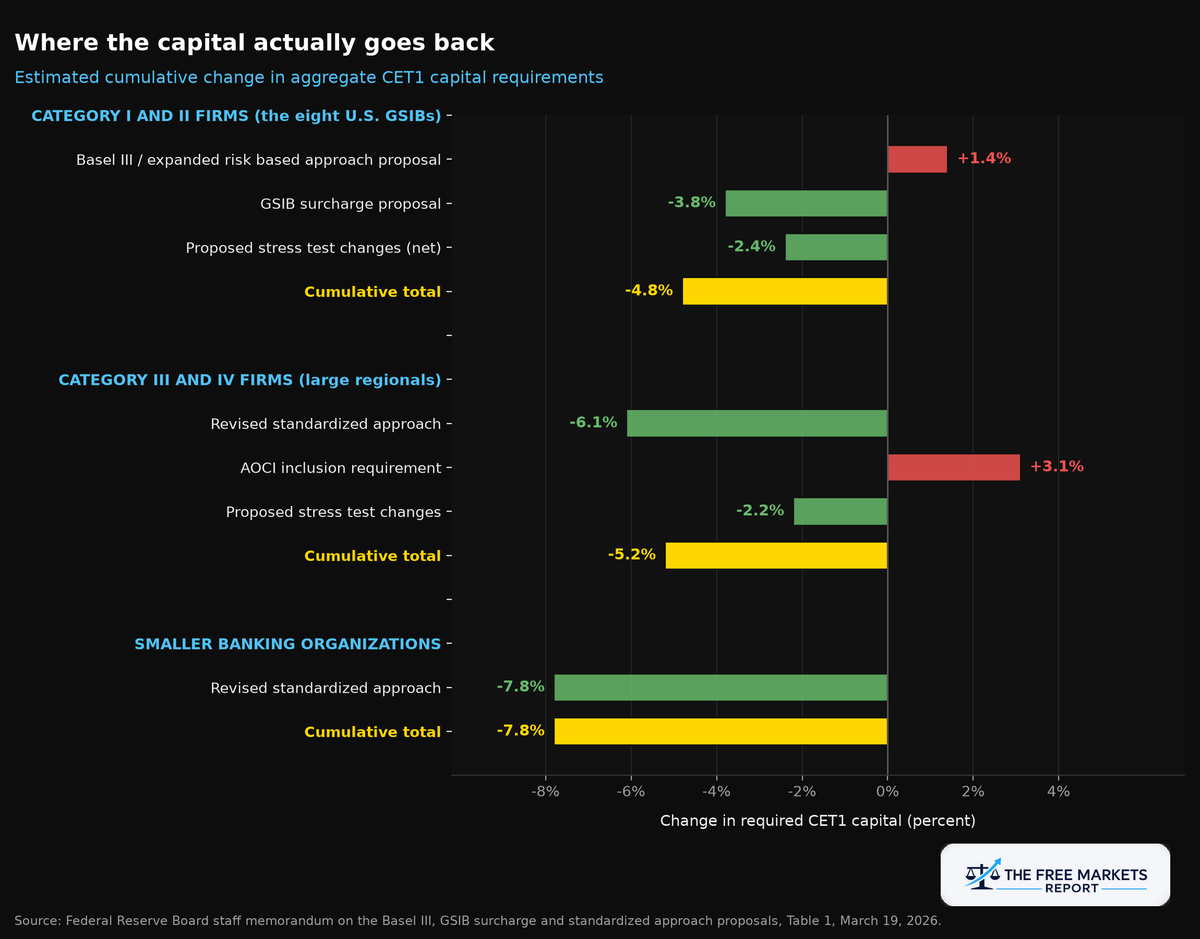
- Fed staff estimate the cumulative change in aggregate CET1 requirements at minus 4.8 percent for Category I and II firms, minus 5.2 percent for Category III and IV firms, and minus 7.8 percent for smaller banks.
- The expanded risk-based approach proposal, by itself, increases Category I and II requirements by 1.4 percent. The headline relief comes from the surcharge proposal and proposed stress test changes.
- JPMorgan Chase disclosed in its March 31, 2026 Form 10-Q that the two re-proposals together "would result in an increase in the Firm's required CET1 capital of approximately 4%."
- Comments closed June 18, 2026. Governor Michelle Bowman said on July 13, 2026 that the agencies are "now evaluating public feedback and working to finalize these rules." No final rule exists yet.
One stack instead of two
The mechanical center of the proposals is the end of the dual-requirement structure. Today the largest banking organizations calculate risk-weighted assets twice, under a standardized approach and an internal-models-based advanced approach, and the binding constraint is whichever is higher. The Federal Reserve described the change plainly: the proposals "would move the largest banks from two calculations of risk-based capital requirements to one."1
That one calculation is the expanded risk-based approach, or ERBA. The standardized approach does not disappear, but its role inverts. Governor Michael Barr, dissenting, noted that the proposal declines to adopt the Basel output floor and instead uses the standardized approach as a cap on the ERBA result rather than a floor beneath it, and that the package contains "over 20 material downward deviations from the Basel III standard."6
Two other changes matter more to mid-sized banks than to money-center institutions. The revised standardized approach removes the threshold-based deduction for mortgage servicing assets, currently required on amounts exceeding 25 percent of CET1, and replaces it with a flat 250 percent risk weight. Category III and IV firms would also have to include most elements of accumulated other comprehensive income in regulatory capital, phased in over five years, with the transition table assuming a January 1, 2027 effective date.7 For a bank with a large servicing book and an underwater securities portfolio, those changes pull in opposite directions.
The GSIB surcharge proposal generated the headlines. It narrows surcharge increments from 50 basis points to 10, requires systemic indicators to be averaged over daily or monthly values rather than quarter-end snapshots, and cuts surcharges by an average of 40 basis points, roughly $23 billion or 10 percent of aggregate surcharge dollars.8
Start with the numbers
The staff memorandum accompanying the March 19 vote contains one table that does more work than most of the coverage. It decomposes the estimated cumulative change in aggregate CET1 requirements by category and rule component.2
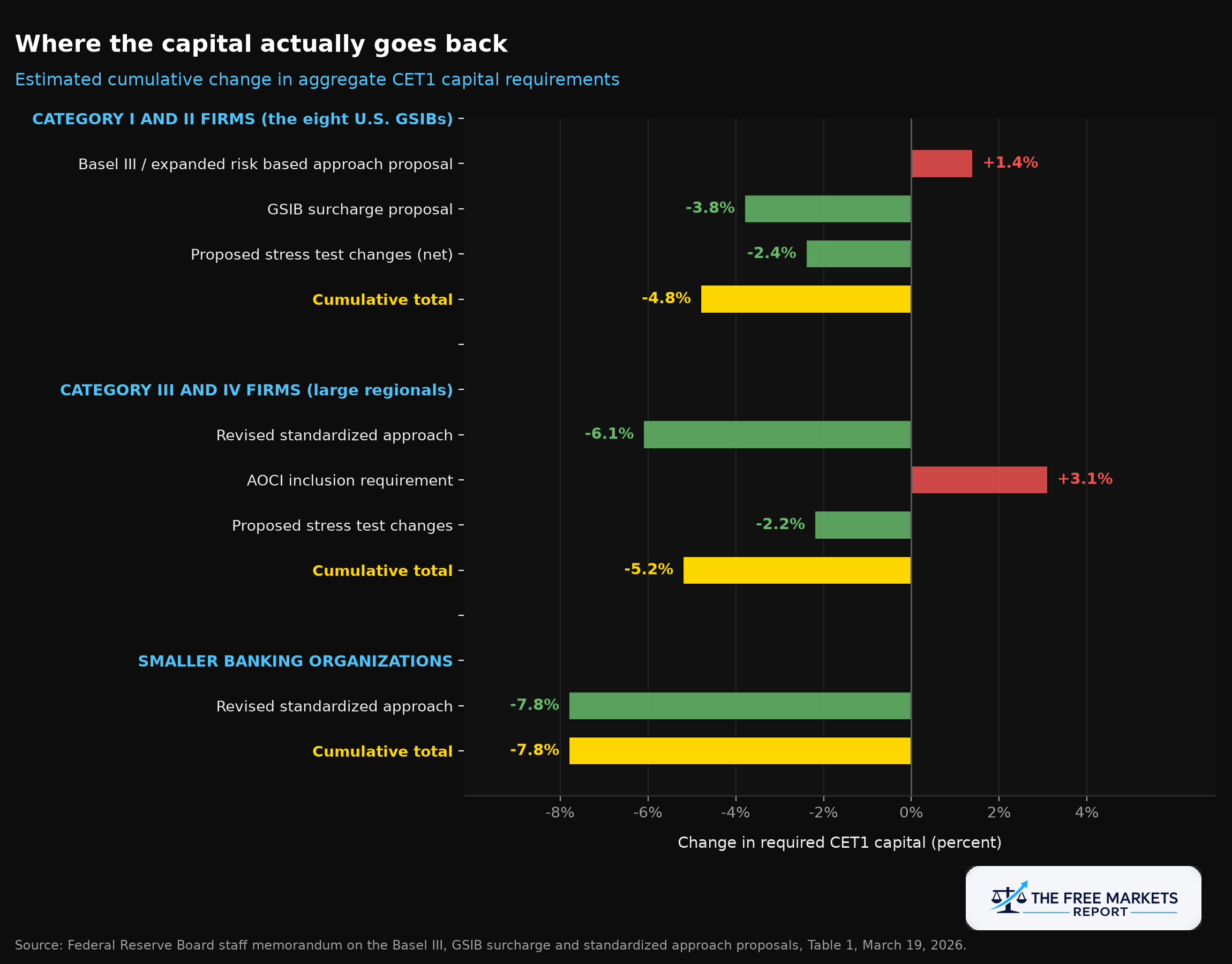
Take those figures apart. Category I and II, minus 4.8 percent: plus 1.4 (Basel III), minus 3.8 (GSIB surcharge), minus 2.4 (stress tests). Category III and IV, minus 5.2 percent: minus 6.1 (standardized approach), plus 3.1 (AOCI), minus 2.2 (stress tests). Smaller banks: one component, minus 7.8 percent.2
Barr's dissent made the distributional point without hedging: "Overall, this is not a proposal targeted to help community banks, but rather a proposal that helps some of the biggest banks in the country."6 He is describing dollars, and on dollars he is right. He valued the surcharge cut alone at $33 billion of CET1 and, with leverage ratio changes included, put the drop in the largest banks' tier 1 requirements at 6.0 percent, or $60 billion.6,9 But dollars and percentages answer different questions. A $60 billion cut across institutions holding roughly 60 percent of U.S. banking assets is a different proportional event than a 7.8 percent cut at a bank with $6 billion of assets.9
The disclosure that complicates the consensus trade
Given a package described as relief for large banks, one would expect the largest bank in the country to tell shareholders its requirement is falling. It told them the opposite.
JPMorgan Chase, in its Form 10-Q for the quarter ended March 31, 2026, disclosed that applying the re-proposal to its positions as of December 31, 2025, "the estimated impact would be an increase to the Firm's required CET1 capital of approximately 6%." The same filing states that its GSIB surcharge would fall from 5.5 percent to 5.2 percent, and that the two proposals together "would result in an increase in the Firm's required CET1 capital of approximately 4%" against the requirement otherwise taking effect January 1, 2028.3
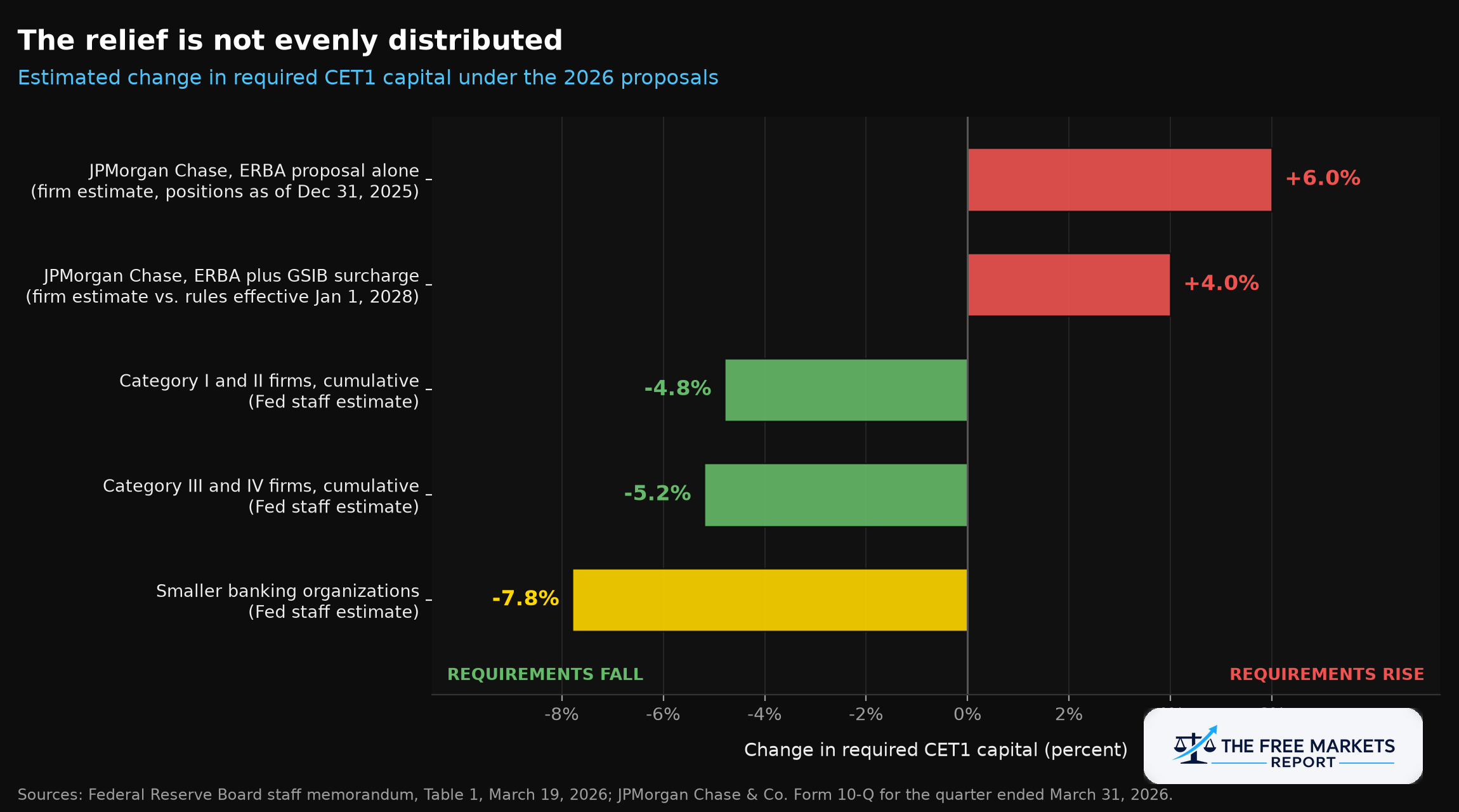
Aggregate estimates conceal dispersion. Category I and II is eight banks with different business mixes, and a minus 4.8 percent average is consistent with outcomes on both sides of zero. The point is not that JPMorgan is disadvantaged. It is that the largest constituent of the "large banks get capital back" story put a contradicting number in a securities filing, while the smaller cohorts show no comparable offset.
What the market has already paid for
Price action since the announcement has favored the opposite cohort. Indexed to March 18, 2026, an equal-weighted basket of the six largest U.S. money-center and broker-dealer GSIBs closed July 27, 2026 at 126.5, against 120.6 for the SPDR S&P Regional Banking ETF and 116.2 for financials broadly.10
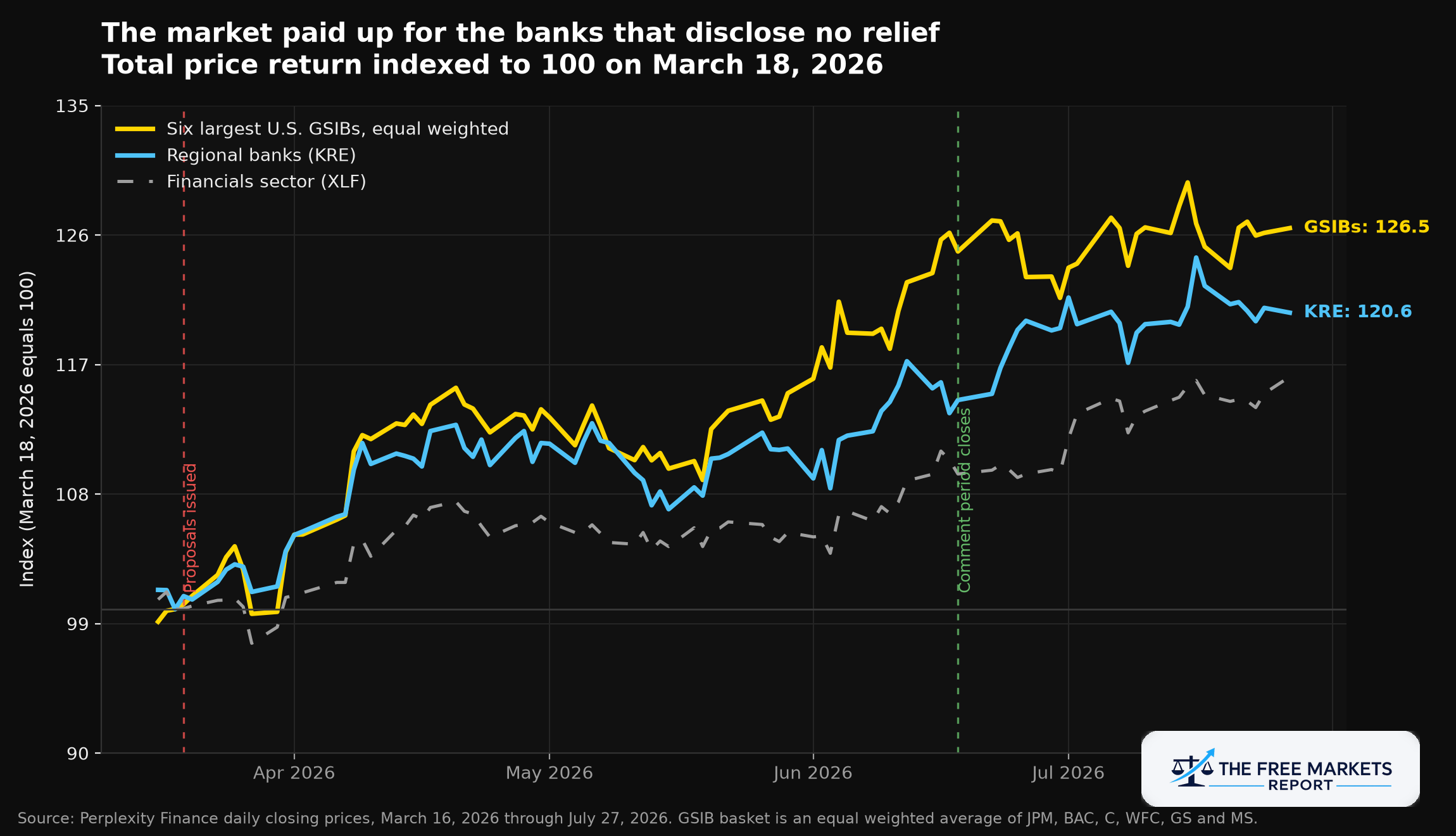
That gap is not an anomaly on its own. Trading and advisory revenue, not capital rules, drive most of the earnings variance in that basket. But the market has not paid a premium for the group the Fed's own table identifies as the largest proportional beneficiary.
Investment Idea
- Sector play: State Street SPDR S&P Regional Banking ETF (KRE)
- Underlying exposure: 159 holdings tracking the S&P Regional Banks Select Industry Index, a modified equal weighted index. Average holding market cap of $7,413 million as of June 30, 2026, no position above roughly 1.5 percent.
- AUM: $4,315.73 million as of July 24, 2026 (State Street fund page).
- Expense ratio: 0.35 percent gross, per the June 30, 2026 fact sheet.
- Deregulatory catalyst: The three capital proposals of March 19, 2026, which Fed staff estimate reduce aggregate CET1 requirements by 5.2 percent for Category III and IV firms and 7.8 percent for smaller firms, versus 4.8 percent for Category I and II firms.
- Performance since catalyst: KRE returned 20.6 percent from the March 18, 2026 close through the July 27, 2026 close, versus 11.7 percent for SPY.
- Why the ETF rather than individual stocks: The relief is a population effect. Credit quality, deposit costs and securities marks vary widely across mid-sized banks, and the AOCI requirement cuts against firms with the largest unrealized losses. A modified equal weighted vehicle spreads the signal across 159 names rather than one balance sheet.
- Key holdings benefiting: Cullen/Frost Bankers (CFR), Home BancShares (HOMB), M&T Bank (MTB), Citizens Financial Group (CFG) and Pinnacle Financial Partners (PNFP), the five largest weights as of July 24, 2026.
- Bear case: See the section below.
- What to watch: The final rule text, specifically whether the AOCI phase-in survives at five years and whether the standardized approach relief survives at the proposed magnitude. Falsification condition: if a final rule adopted on or before June 30, 2027 shows an estimated cumulative CET1 change for Category III and IV firms of zero or worse, rather than minus 5.2 percent, the regulatory basis for this thesis is void regardless of price action.
The Bear Case
First, none of it is law. These are notices of proposed rulemaking. Comments closed June 18, 2026, and Bowman's July 13, 2026 remarks confirm only that the agencies are "evaluating public feedback and working to finalize these rules."4,5 They received substantial adverse comment, including a formal letter from Senate Democrats.11 A final rule can differ materially from a proposal, can slip past 2027 implementation, and can be litigated after adoption.
Second, capital relief is not capital returned. Lower required capital raises the ceiling on distributions; it does not compel them. Boards facing credit normalization, commercial real estate concentrations or funding cost pressure can hold the excess. An American Banker analysis published July 1, 2026 argued exactly this: looser Basel rules do not mechanically produce a shareholder windfall.12
Third, the AOCI change genuinely hurts part of this cohort, adding an estimated 3.1 percent to Category III and IV requirements and offsetting roughly half the standardized approach benefit.2 Banks with the largest unrealized losses absorb most of that, and those losses are not evenly spread across the index. The phase-in softens the timing, not the destination.
There is also a plain market objection: regional banks have already returned 20.6 percent since March 18, 2026. This is not an unnoticed cohort, only one that has lagged a louder one.
The Principle
Regulatory relief is described in aggregate and experienced in distribution. The press release says the largest banks move from two calculations to one. The staff table says the largest proportional beneficiaries are the banks nobody wrote the headline about. The 10-Q says the biggest institution in the country expects its own requirement to rise.
Read the estimate. Then read the filing. When they disagree, the filing carries the legal consequences.
- Board of Governors of the Federal Reserve System, joint press release on proposals to revise capital requirements for large banks, March 19, 2026. federalreserve.gov
- Board of Governors of the Federal Reserve System, staff memorandum to the Board on the Basel III, G-SIB surcharge and standardized approach proposals, Table 1, "Cumulative Change in Aggregate CET1 Capital Requirements," March 19, 2026. federalreserve.gov
- JPMorgan Chase and Co., Form 10-Q for the quarterly period ended March 31, 2026, Capital Risk Management. jpmorganchase.com
- Governor Michelle W. Bowman, speech, July 13, 2026, Board of Governors of the Federal Reserve System. federalreserve.gov
- Federal Register, "Regulatory Capital Rule: Category I and II Banking Organizations," proposed rule, published March 27, 2026, comments due June 18, 2026. federalregister.gov
- Governor Michael S. Barr, statement on proposals to revise capital requirements for large banks, March 19, 2026. federalreserve.gov
- Federal Register, "Regulatory Capital Rules: Regulatory Capital and Standardized Approach for Risk-Weighted Assets," proposed rule, published March 27, 2026. federalregister.gov
- Federal Register, "Regulatory Capital Rule: Regulation Q, Risk-Based Capital Surcharges for Global Systemically Important Bank Holding Companies," proposed rule, published March 27, 2026. federalregister.gov
- Governor Michael S. Barr, speech on bank capital and financial stability, June 6, 2026, Board of Governors of the Federal Reserve System. federalreserve.gov
- Perplexity Finance, daily closing prices for KRE, JPM, BAC, C, WFC, GS, MS, XLF and SPY, March 16, 2026 through July 27, 2026, retrieved July 27, 2026.
- United States Senate, letter from Senate Democrats to the Federal Reserve, OCC and FDIC on the Basel III capital proposals, June 18, 2026. business.cch.com
- American Banker, "Looser Basel capital rules don't mean a windfall for bank shareholders," July 1, 2026. americanbanker.com
- State Street Investment Management, SPDR S&P Regional Banking ETF (KRE) fund page, fact sheet as of June 30, 2026, and daily holdings file as of July 24, 2026. ssga.com
The Free Markets Report is provided by Lead-Lag Publishing, LLC. All opinions and views mentioned in this report constitute our judgments as of the date of writing and are subject to change at any time. Information within this material is not intended to be used as a primary basis for investment decisions, and should also not be construed as advice meeting the particular investment needs of any individual investor. Trading signals produced by The Free Markets Report are independent of other services provided by Lead-Lag Publishing, LLC, or its affiliates, and the positioning of accounts under their management may differ. Please remember that investing involves risk, including loss of principal, and past performance may not be indicative of future results. Lead-Lag Publishing, LLC, its members, officers, directors, and employees expressly disclaim all liability with respect to actions taken based on any or all of the information in this writing.
Related coverage: The CFTC Just Stayed a CME Contract; The SEC Wants 377 Million Envelopes Gone