The SEC Just Proposed Ending the Shareholder Proposal Rule
Rule 14a-8 set the federal floor for investor proposals for decades. The September 16 package would rescind it and hand the question to state law.

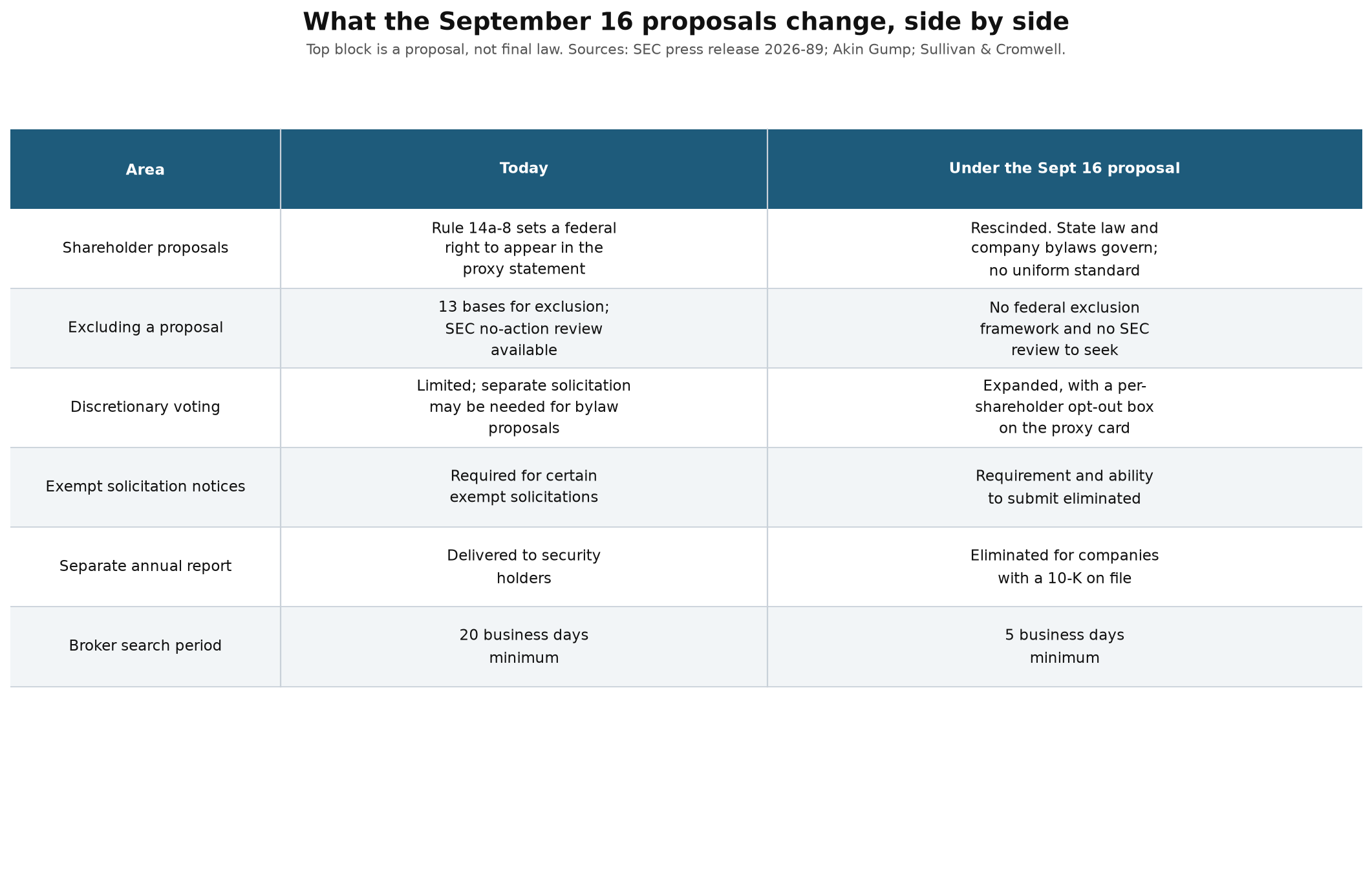
On September 16, the Securities and Exchange Commission proposed something no modern commission has proposed: eliminating the federal shareholder proposal rule outright. Rule 14a-8, first adopted in 1998, is the provision that lets an eligible investor force a proposal into a company's proxy statement and onto its proxy card. The proposal would rescind it in its entirety and hand the question to state corporate law and company bylaws. A companion release would modernize the surrounding proxy solicitation rules in ways that cut several federal filing requirements at the same time.
This is not a technical adjustment. It is the removal of a federal floor that has existed, in evolving form, across the modern era of public markets. And it arrives at the end of a deliberate sequence, not at the start of one.
The proposal came with its own runway
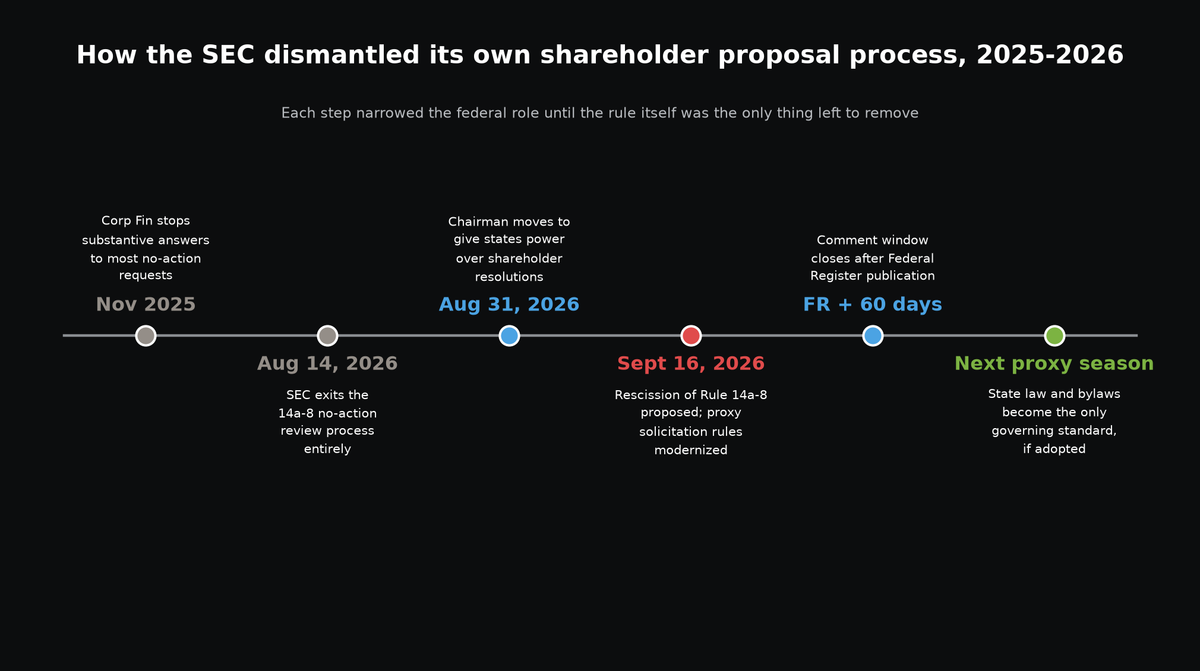
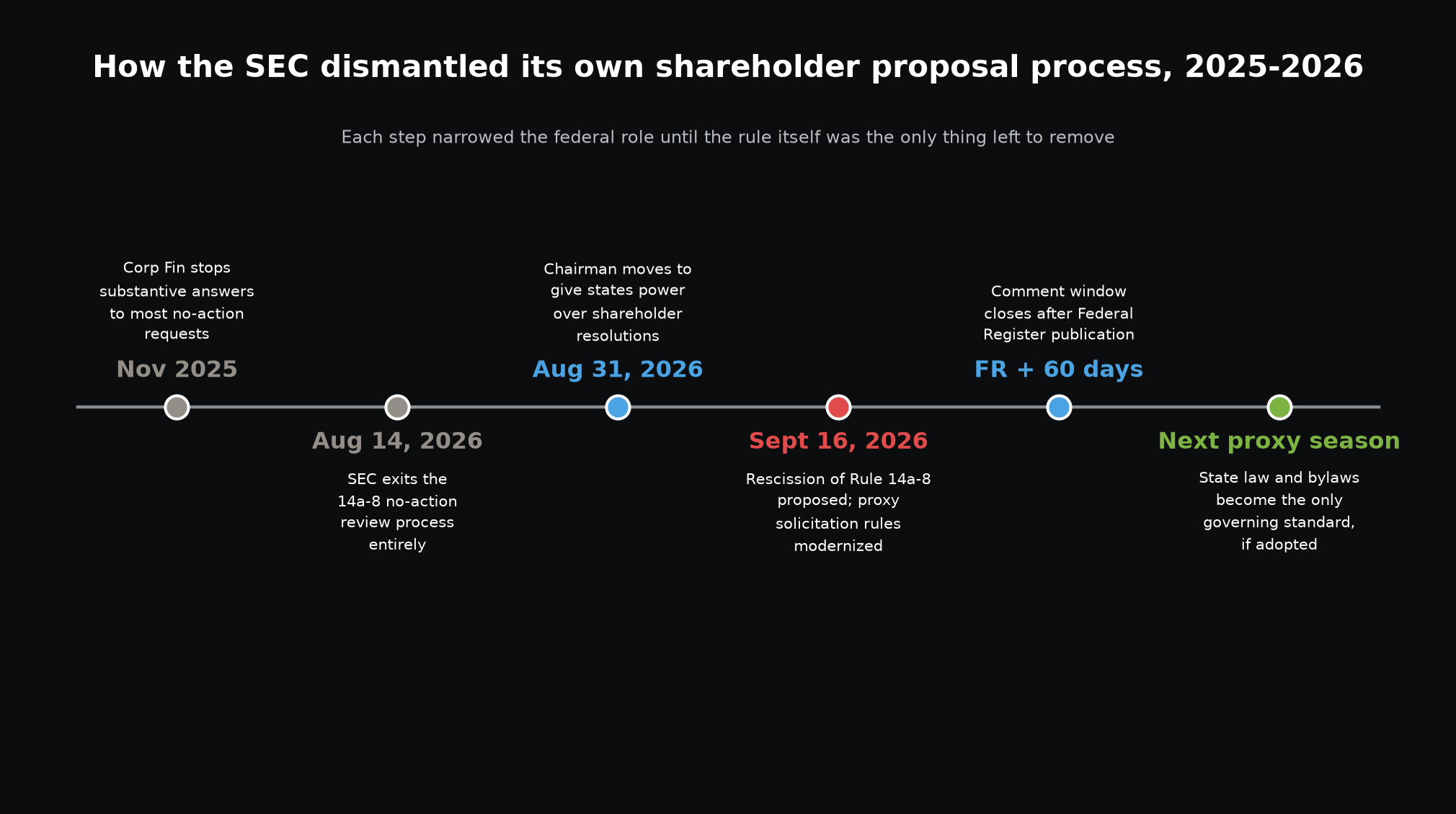
The commission did not reach this point abruptly. In November 2025, the Division of Corporation Finance said it would stop giving substantive answers to most no-action requests. On August 14, 2026, the SEC completed its exit from the Rule 14a-8 review process entirely, no longer responding to no-action requests, no-objection requests, or the exclusion notices companies once litigated before the agency. Two weeks later, the chairman moved to give states power over shareholder resolutions, arguing that Rule 14a-8 oversteps the commission's authority and that shareholder proposal questions belong to state corporate law. The September 16 rescission proposal is the terminus of that sequence: after each federal review layer was peeled away, the rule itself was the only thing left to remove.
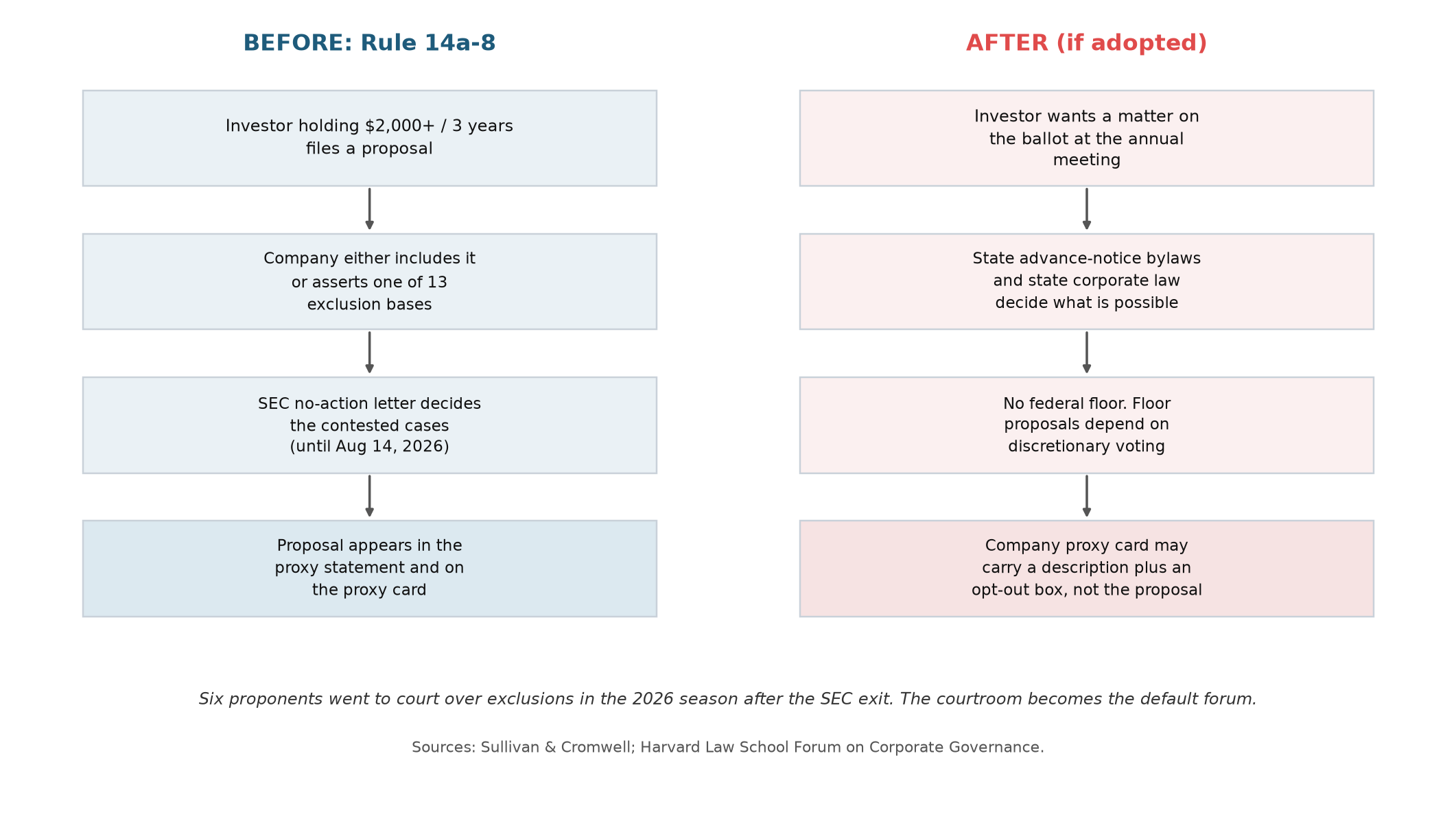
The proposal's architecture matters more than its headline. Rescinding Rule 14a-8 removes the federal right to proxy access for proposals, but the companion amendments to Rule 14a-4 would expand the circumstances in which a company may vote shares at its discretion on proposals presented at a meeting but not included in proxy materials, subject to a per-shareholder opt-out box on the proxy card. Floor proposals survive in theory, governed by state advance-notice bylaws. In practice, an investor's ability to place a matter before shareholders would depend entirely on the corporate law of the state of incorporation and the company's own governing documents, with no uniform national standard and no agency to appeal to. During the 2026 proxy season, six shareholder proponents who disagreed with exclusion determinations resorted to judicial remedies. That becomes the default forum, not the exception.
The solicitation half is real deregulation
The second release, Proxy Solicitation Modernization, proposes narrower but concrete cuts. It would eliminate the requirement to deliver a separate annual report to security holders for companies with a Form 10-K on file, eliminate the delivery deadline for documents incorporated by reference into a proxy statement, eliminate both the requirement and the ability to submit Notices of Exempt Solicitation, and shorten the minimum broker search period from 20 business days to five. Each of these removes an actual filing or delivery obligation. Whatever one makes of the 14a-8 rescission, this half of the package reduces the procedural load on every soliciting company.
The coalition against it is wider than the usual one
The reaction broke a familiar pattern. Ceres, the US Sustainable Investment Forum, the Interfaith Center on Corporate Responsibility, the Shareholder Rights Group, For the Long Term, and New York State Comptroller Thomas DiNapoli jointly petitioned the SEC in July not to rescind the rule, arguing that outright rescission would upset a longstanding balance between investors and their companies. But the opposition extends beyond the environmental and social investing camp. Andrew Poreda of Sage Advisory Services, whose filings do not fit the activist template, framed the rescission as a transfer of power to management rather than a fight about ESG. SOC Investment Group called the proposal shortsighted and a catering to a small minority of companies. When the right to put a question to shareholders is at stake, the constituency defending it turns out to be broader than the constituency that files climate proposals.
There is a serious argument on the other side. Rule 14a-8 review consumed agency resources in a process the commission no longer wishes to referee, and the federal standard sat awkwardly beside state corporate law's traditional governance of shareholder rights. But the counterargument is harder to answer: about 30 percent of retail investors vote their proxies at all, and the rule being rescinded was one of the few federal mechanisms that let an ordinary long-term holder put a governance question in front of every other holder without waging a contested solicitation. Moving that right to state law and bylaws does not distribute it more evenly. It distributes it to wherever each company's incorporation paperwork says it should go.
What to watch
The comment periods run 60 days from Federal Register publication of the proposing releases. Watch three things. First, whether the commission adopts 14a-4's discretionary voting expansion even if 14a-8's rescission stalls, since the former changes the practical leverage at annual meetings regardless of the latter. Second, whether Delaware and other incorporation states respond with advance-notice and proposal-access statutes, which would determine whether the state-law replacement is real or a vacuum. Third, the 2027 proxy season, which would be the first conducted under the new framework if adoption comes early enough. The 2026 season, with six proponents already forced into court, offers the preview.
The Free Markets Report has covered every step of this sequence, from the no-action exit through the states-power move to this proposal. The direction has been consistent. The question now is whether a federal floor that has existed for nearly three decades disappears quietly, or whether the state-level replacement proves it was doing work nothing else wants to do.
Know someone tracking market structure like this? Forward this one along.
The Free Markets Report is provided by Lead-Lag Publishing, LLC. All opinions and views mentioned in this report constitute our judgments as of the date of writing and are subject to change at any time. Information within this material is not intended to be used as a primary basis for investment decisions, and should also not be construed as advice meeting the particular needs of any individual situation. The accuracy, completeness, and timeliness of the information contained in this document is not guaranteed. The securities and strategies discussed may be unsuitable for investors depending on their specific financial position and investment objectives. Reproduction of this report without the express written consent of Lead-Lag Publishing, LLC is strictly prohibited. Past performance is not indicative of future results, and current performance may be lower or higher than the performance shown. Neither the information nor any opinion expressed in this report constitutes a solicitation, an offer to buy or sell any securities, or an offer to provide investment advice or services. Nothing in this report shall be construed to be an offer to provide investment advisory services in any jurisdiction in which Lead-Lag Publishing, LLC is not authorized to provide such services. All investments involve risk, including the risk of loss of principal. No representation is being made that any security, account, or strategy will or is likely to achieve results similar to those shown. Investing in securities involves risks, and there is always the potential of losing money when you invest in securities. Before investing, consider your investment objectives, and Lead-Lag Publishing, LLC's charges and expenses. This report is not a prospectus and does not contain all of the information necessary to fully evaluate any security or strategy discussed, including, but not limited to, the risk of adverse effects of related market developments. You should not rely solely on the information contained in this report, and should seek advice based on your situation from a licensed investment professional. Carefully consider the investment objectives, risks, charges and expenses of any investment product before investing. This report may not be copied or distributed without the express written consent of Lead-Lag Publishing, LLC. Any decisions made based on any or all of the information in this writing are the sole responsibility of the user, and the user should exercise caution and take appropriate advice before acting.