The CFTC Just Stayed a CME Contract. The Precedent Is the Cost.
A 10-barrel WTI futures contract was halted on July 9, CME shares slipped 1.4 percent, and the durable change went almost entirely unremarked.

A 10-barrel WTI futures contract was halted on July 9, CME shares slipped 1.4 percent, and the durable change went almost entirely unremarked.
Key Highlights
- On July 8, 2026, NYMEX self-certified a 10-Barrel West Texas Intermediate Crude Oil Futures contract designed to trade 24 hours a day, seven days a week, including weekends and holidays when the physical crude market is not assessed.
- On July 9, 2026, the CFTC stayed the listing under Commission Regulation 40.2(c), and Chairman Michael S. Selig called the exchange's decision to proceed "wholly inappropriate" while the agency was mid-review.
- The Commission extended its comment period on 24/7 and perpetual futures by 30 days, from July 27 through August 26, 2026, and asked whether weekend trading in a smaller correlated crude contract could influence Monday price formation in the benchmark, "including potentially resulting in crude oil prices reaching negative prices."
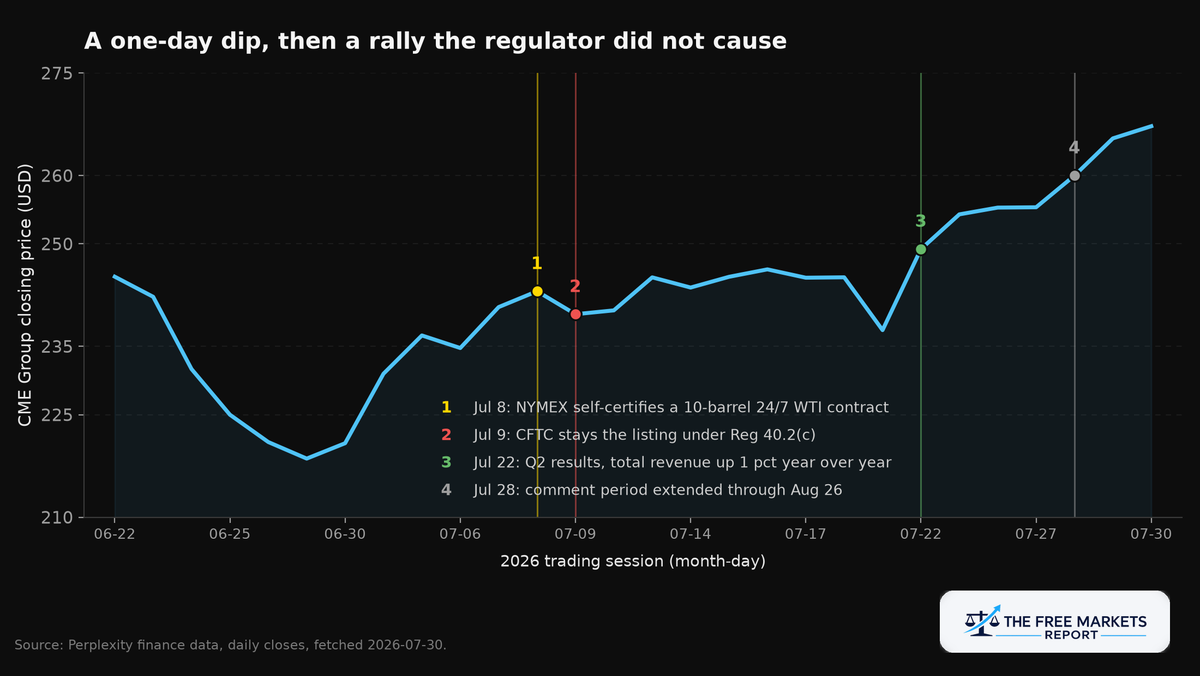
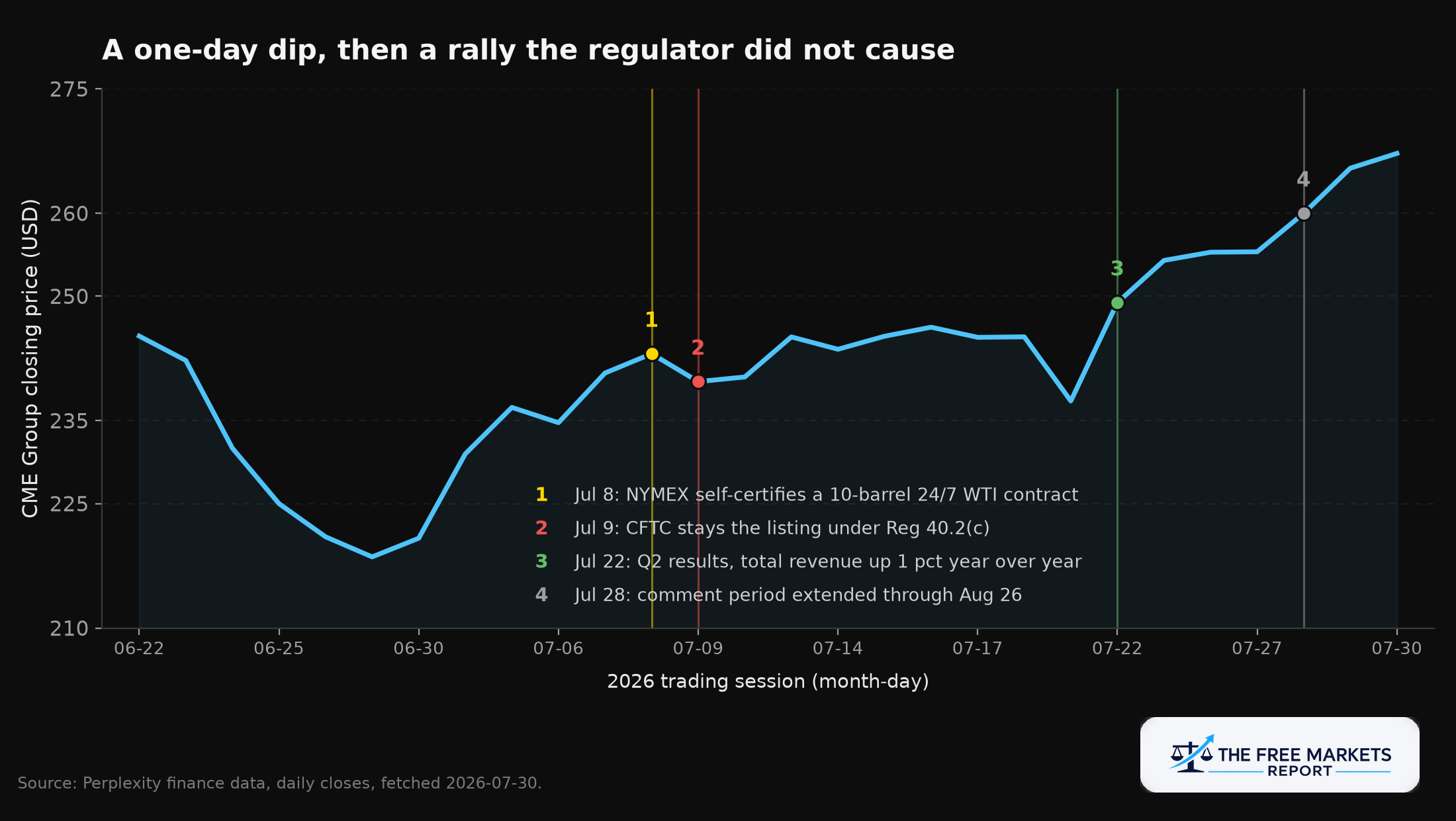
- CME Group (CME) fell 1.4 percent on July 9 and has since risen 11.5 percent to $267.22 through July 30, with a single 5.0 percent session on July 22 around second quarter results doing most of the work.
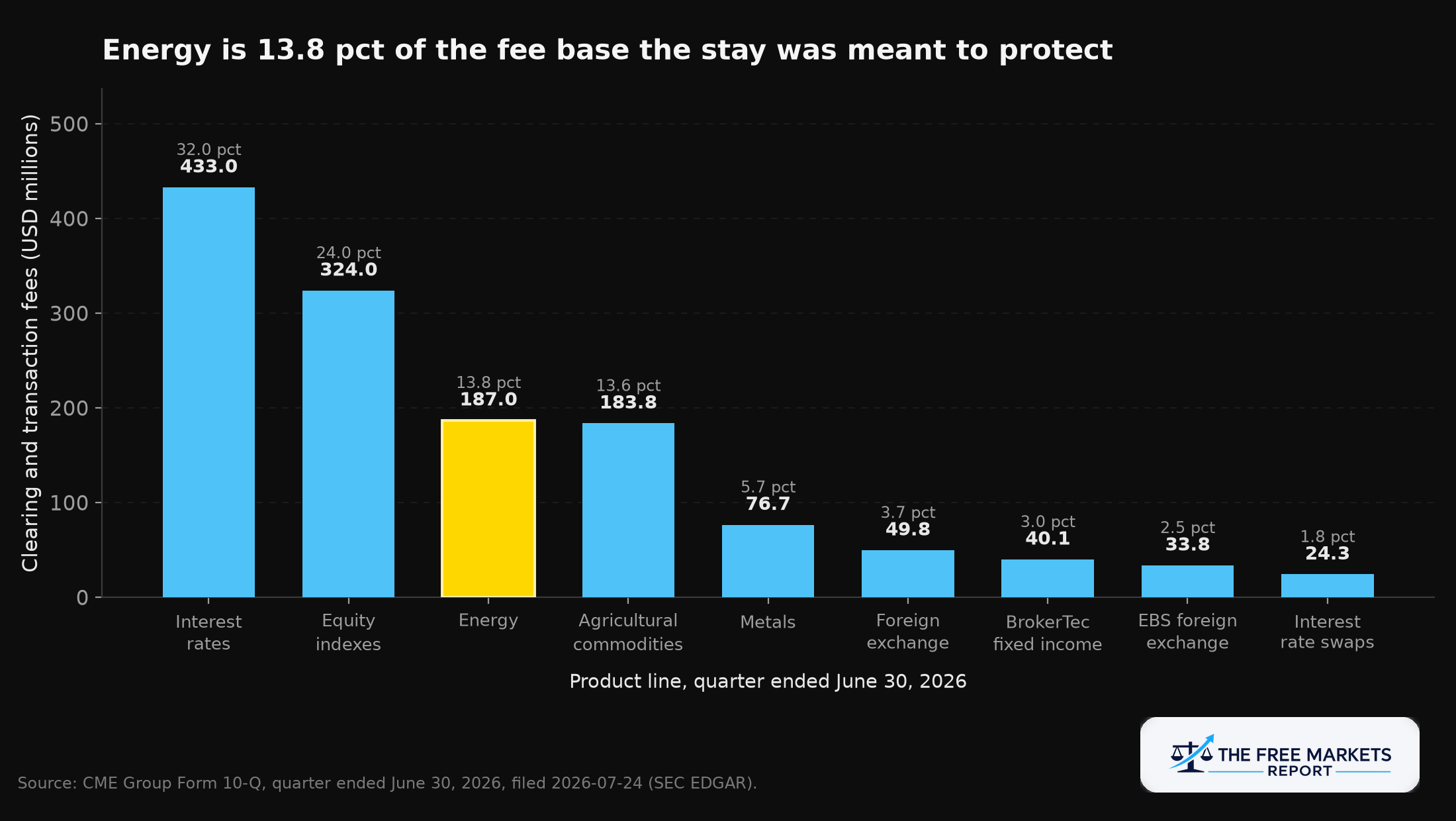
- Energy generated $187.0 million of clearing and transaction fees in the second quarter, 13.8 percent of the $1,352.5 million total and down 14 percent year over year, and the 10-Q filed July 24 does not mention the stayed contract at all.
A regulator stopping one micro futures contract is not a market event. A regulator demonstrating that self-certification is a gate it will close at will is a structural change in how quickly the largest listed derivatives franchise in the world can put new products in front of customers. The market priced the first thing. The second thing is still sitting there, unpriced, with a comment deadline of August 26.
What the Commission actually did
The mechanics matter more than the headline. Under Section 5c(c)(1) of the Commodity Exchange Act, a designated contract market may list a new product by self-certifying that it complies with the Act and Commission regulations. That is the deregulatory default: no approval required, list and go. NYMEX used it on July 8, 2026 for a 24/7 WTI contract sized at 10 barrels, which the Commission characterized as a smaller-scaled contract correlated to the benchmark.1
The next day the Commission stayed it under Regulation 40.2(c). CME had filed simultaneously but separately under both 40.2 and 40.3, the voluntary approval route, and the Commission said it would review the 40.3 submission thoroughly while the stay bars any listing before a compliance determination.2 Selig's statement encouraged exchanges "to work with agency staff to address potential legal issues before seeking to list novel contracts."2
The substance of the concern is benchmark integrity, not retail speculation. The Commission's June 25 request for comment flagged that extended weekend and holiday prices feed benchmark prices "that affect commercial agreements, ETFs, and other derivatives," noted that federal speculative position limits under 17 CFR part 150 apply to core referenced contracts including NYMEX WTI, and restated Core Principle 3, which requires a DCM to list only contracts not readily susceptible to manipulation.5
The financial mechanics say the contract itself was trivial
CME's second quarter 10-Q, filed July 24, 2026, reports total revenues of $1,706.2 million, up 1 percent year over year, an operating margin of 64.9 percent against 66.7 percent, and clearing and transaction fees of $1,352.5 million, down from $1,388.0 million.4 Energy contributed $187.0 million of that, against $217.4 million a year earlier.
The rate story is the tell. Average rate per contract on futures and options was $0.678 in the quarter against $0.690, and the company attributes part of the decline to "an increase in micro contract volume, specifically within equities, energy and metals."4 A 10-barrel crude contract sits at the extreme end of that dilution. Whatever it would have generated in incremental volume, it was not going to move a $1.35 billion quarterly fee line.
Why the precedent is the expensive part
CME's own filing states that "product authorizations from the CFTC have no term limits."4 That is the franchise: a permanent shelf of authorized products, extended continuously by self-certification. The July 9 action does not revoke anything already listed. It establishes that when a novel product intersects an open Commission inquiry, the 40.2 route converts into the 40.3 route, and the timeline moves from one day to whatever the review takes. The comment file does not close until August 26, 2026, and the Commission has asked market participants for detail on operational readiness timelines, sequencing, investments, and staffing changes before it decides anything.1
The Commission has already shown it will move asset class by asset class. It permitted a perpetual contract referencing spot bitcoin in May 2026, then published a policy statement at 91 FR 33160 saying perpetuals on other asset classes, including agricultural and energy, would be evaluated on their own terms.5
Investment Idea: CME Group Inc. (CME)
- Thesis type: Contrarian reversal
- Deregulatory catalyst (reversed): CFTC stay of NYMEX's self-certified 24/7 10-Barrel WTI Crude Oil Futures contract under Commission Regulation 40.2(c), issued July 9, 2026, alongside the request for comment on extending standard futures contracts to 24/7 trading, RIN 3038-AF75, with comments open through August 26, 2026.
- Current price: $267.22 as of July 30, 2026, market capitalization $96.1 billion, trailing price to earnings ratio 22.7, 52 week range $218.31 to $329.16.
- Key financial data: Second quarter 2026 total revenues of $1,706.2 million, up 1 percent, operating margin of 64.9 percent against 66.7 percent, clearing and transaction fees of $1,352.5 million against $1,388.0 million, energy fees of $187.0 million against $217.4 million, and average rate per contract of $0.678 against $0.690.
- Regulatory constraint added: Self-certification under CEA Section 5c(c)(1) is no longer a reliable one-day path for novel products that touch an open Commission inquiry. The 40.2 filing was stayed within 24 hours and rerouted to a 40.3 review with no stated completion date.
- Case for the reversal being underpriced: The regulatory friction is not reflected in the tape. CME closed at $267.22 on July 30, 11.5 percent above its July 9 close, and the single largest session in that window was the 5.0 percent move on July 22 tied to second quarter results. ICE rose 13.9 percent over the same July 8 to July 30 window, so there is no relative discount embedded for CME specifically. The second quarter 10-Q, filed 15 days after the stay, contains no reference to it.
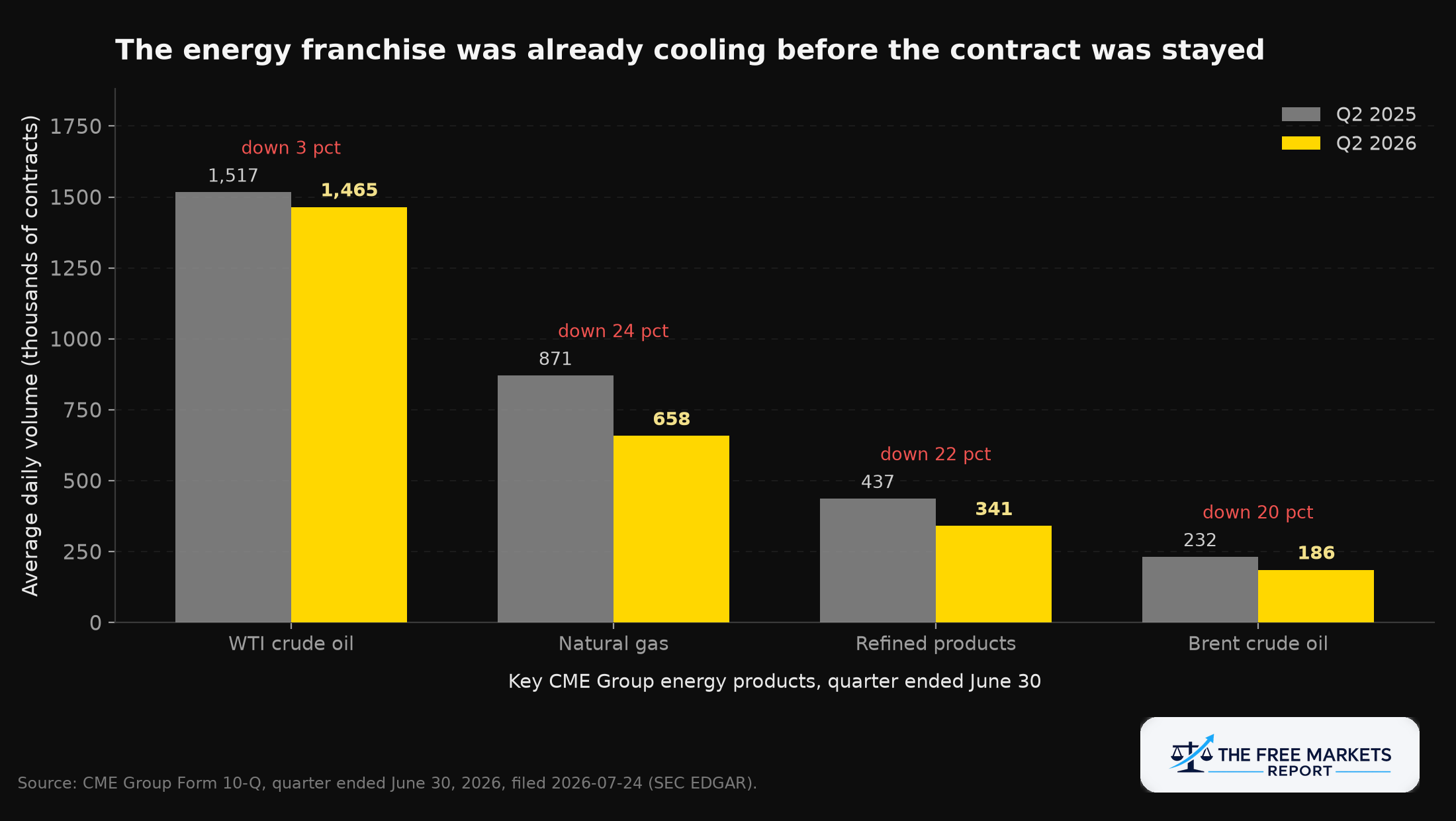
- What to watch, and what falsifies this: The falsification condition is a Commission determination on the 40.3 filing that permits the 24/7 contract to list without material conditions, or a subsequent CME self-certification of a novel product that proceeds unstayed after August 26, 2026. Either would show the July 9 action was product-specific rather than a durable change in the self-certification gate. Also watch whether energy average daily volume, 2,667 thousand contracts in the second quarter and down 13 percent, stabilizes in the third quarter print.
- Time horizon: Event driven, with the August 26, 2026 comment deadline as the first checkpoint.
Bear Case
The strongest argument against this thesis is that the Commission acted to defend CME, not to constrain it. Every concern in the record points at reference-price integrity in the benchmark: weekend prices feeding commercial agreements and ETFs, position limits under part 150 applying to NYMEX WTI, and the explicit worry about a small correlated contract moving prices while the benchmark is closed, up to and including negative prices.1,5 A regulator that stops a 10-barrel product from destabilizing the benchmark contract it references is protecting the fee pool, not shrinking it.
The market reaction supports that reading. A 1.4 percent single session move is noise for a $96 billion company, the recovery has been continuous, and ICE outperformed CME over the identical window, which is what you would not expect if investors thought a general exchange-regulation regime had tightened.3,6 The 10-Q's silence can be read as immateriality rather than complacency.
The volume backdrop cuts both ways too. Energy average daily volume fell 13 percent year over year and aggregate volume fell 1 percent, with total average daily volume of 29,843 thousand contracts.4 If the franchise being defended is cyclically shrinking, the value of any incremental launch permission, and of any friction added to it, is smaller than the regulatory drama suggests.
The Principle
Deregulation is usually described as a stack of rules that get deleted. It is more accurate to describe it as a stack of presumptions, and the most valuable presumption a company can hold is that it may act first and be reviewed later. Self-certification is exactly that presumption, written into statute. The July 9 stay did not delete a rule or add one. It demonstrated that the presumption is conditional, and conditional presumptions carry a lower economic value than unconditional ones even when no dollar of revenue changes hands. That repricing happens slowly, in launch calendars rather than in a single session, which is precisely why a 1.4 percent day is a poor measure of it.
- Commodity Futures Trading Commission, "Request for Comment on the Extension of Standard Futures Contracts to 24/7 Trading and on Perpetual Contracts," 91 FR 47158, published July 28, 2026, RIN 3038-AF75, document 2026-15216. federalregister.gov
- Commodity Futures Trading Commission, Release 9265-26, "CFTC to Stay Self-Certified Contract on 24/7 Trading for Crude Oil Futures," July 9, 2026. cftc.gov
- Perplexity Finance, CME Group Inc. quote and daily closing price history, retrieved July 30, 2026. perplexity.ai/finance
- CME Group Inc., Form 10-Q for the quarterly period ended June 30, 2026, filed July 24, 2026, accession 0001156375-26-000047, SEC EDGAR. sec.gov
- Commodity Futures Trading Commission, "Request for Comment on the Extension of Standard Futures Contracts to 24/7 Trading and on Perpetual Contracts," 91 FR 38334, published June 25, 2026, document 2026-12784. federalregister.gov
- Perplexity Finance, Intercontinental Exchange Inc. quote and daily closing price history, retrieved July 30, 2026. perplexity.ai/finance
Related analysis
Read next: Basel Endgame and bank-capital relief
Read next: The SEC's e-delivery rule
The Free Markets Report is provided by Lead-Lag Publishing, LLC. All opinions and views mentioned in this report constitute our judgments as of the date of writing and are subject to change at any time. Information within this material is not intended to be used as a primary basis for investment decisions, and should also not be construed as advice meeting the particular investment needs of any individual investor. Trading signals produced by The Free Markets Report are independent of other services provided by Lead-Lag Publishing, LLC, or its affiliates, and the positioning of accounts under their management may differ. Please remember that investing involves risk, including loss of principal, and past performance may not be indicative of future results. Lead-Lag Publishing, LLC, its members, officers, directors, and employees expressly disclaim all liability with respect to actions taken based on any or all of the information in this writing.