The SEC Wants 377 Million Envelopes Gone. Somebody Books That Postage.
Regulation E-Delivery would end default paper across every SEC-registered filer, and the $462.6 million a year it saves has to come out of a vendor's revenue line first.

On July 16, 2026, the Securities and Exchange Commission proposed to retire the paper envelope as the default unit of investor communication. Regulation E-Delivery is not a fund rule or a proxy rule. It covers "covered information," essentially anything the federal securities laws require a registrant to deliver, and it reaches issuers, investment advisers and broker-dealers alike. The Commission counted 44,134 covered entities as of December 31, 2025 and expects about 42,000 to use it. The investor question is not whether paper declines. It is who gets paid to print it, and what happens to that company's revenue mix when the mailing stops.
Key Highlights
- The SEC proposed Regulation E-Delivery on July 16, 2026 (Release No. 33-11430, File No. S7-2026-25); comments close September 21, 2026.
- It would let issuers, advisers and broker-dealers deliver essentially all required disclosure electronically by default, rescind Rule 30e-3, and amend Regulations 14A and 14C and Rule 14d-5.
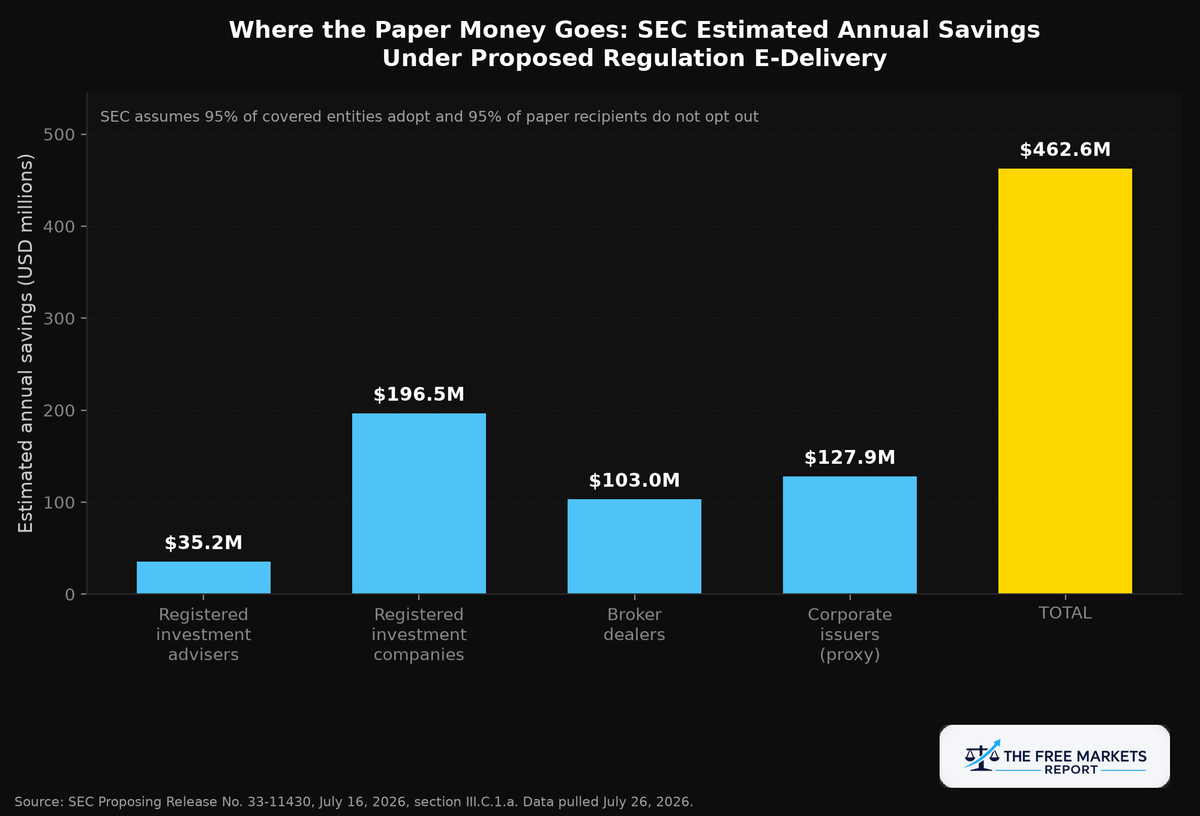
- The SEC estimates $462.6 million of annual paper, printing and postage savings against 377 million physical mailings a year across roughly 42,000 covered entities.
- Donnelley Financial Solutions (DFIN) books that postage today: print and distribution was $110.3 million of FY2025 net sales, and its 10-K credits regulatory change with accelerating its shift into software.
- The counterargument sits in the latest filing: DFIN print and distribution net sales rose year over year in Q1 2026, to $43.7 million from $40.0 million.
From One Fund Rule to Every Filer
The Free Markets Report covered the front edge of this on July 22, when the operative question was Rule 30e-3 and notice-and-access economics for fund shareholder reports.3 This is the escalation. Rule 30e-3 was adopted in 2018, then narrowed in 2022 to exclude funds registered on Form N-1A, leaving it applicable only to closed-end funds and insurance company separate accounts.4 Under this proposal it disappears entirely, subject to a one-year transition, because a general electronic delivery regime makes a narrow fund-specific workaround redundant.4
The mechanics are plain. A covered entity may deliver electronically by default once three conditions are met: the recipient provided an electronic address, the entity gave prominent disclosure, and the recipient has not opted out.5 Paper stays free on request, personal financial information requires a statement of availability with a link, and existing paper recipients must receive two paper transition notices first.5 The proposal also exempts covered entities from E-SIGN Act consumer consent requirements for covered information, the legal knot that made affirmative-consent e-delivery unworkable at scale for two decades.5 Regulations 14A and 14C and Rule 14d-5 get amended to match, so proxy and tender offer dissemination moves under the same roof.5
One point gets lost in the coverage: the rule permits default electronic delivery, it does not mandate it.5 Adoption is a business decision, which is why the entire economic analysis rests on an assumption rather than a requirement.
Start With the Numbers
The SEC's own economic analysis puts aggregate annual savings on paper, printing and postage at $462.6 million: $35.2 million for registered investment advisers, $196.5 million for registered investment companies, $103.0 million for broker-dealers, and $127.9 million for corporate issuer proxy distribution.6
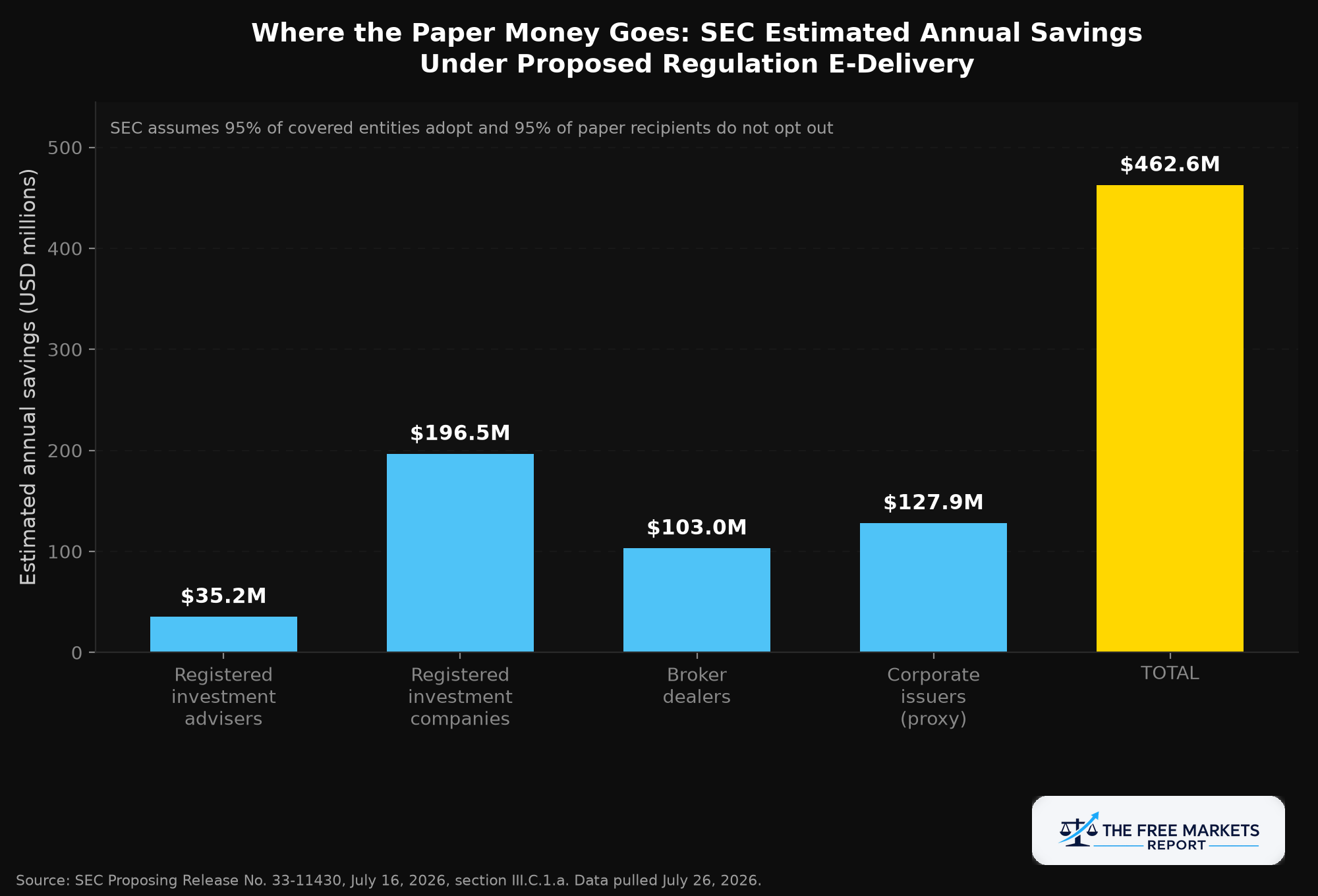
Those savings are not free. The Commission estimates $511 million of initial one-time costs, $426 million of annual costs in year one and $209 million a year thereafter, including $27 million a year of preference management fees.7 Over 2026 to 2035, present value benefits run $4,008 million at a 3 percent discount rate against $2,534 million of costs.8 The savings estimate also assumes 95 percent of covered entities adopt and 95 percent of recipients do not opt out, a 0.9025 factor applied to the whole paper base.9 Every number in the release is an assumption stacked on an adoption rate the rule itself does not require. Industry math runs higher: the Investment Company Institute told the Commission in November 2025 that an e-delivery framework would save funds and shareholders $589 million to $797 million a year, and $3 billion to $4 billion over five years.10
The physical base is what makes those dollars real.
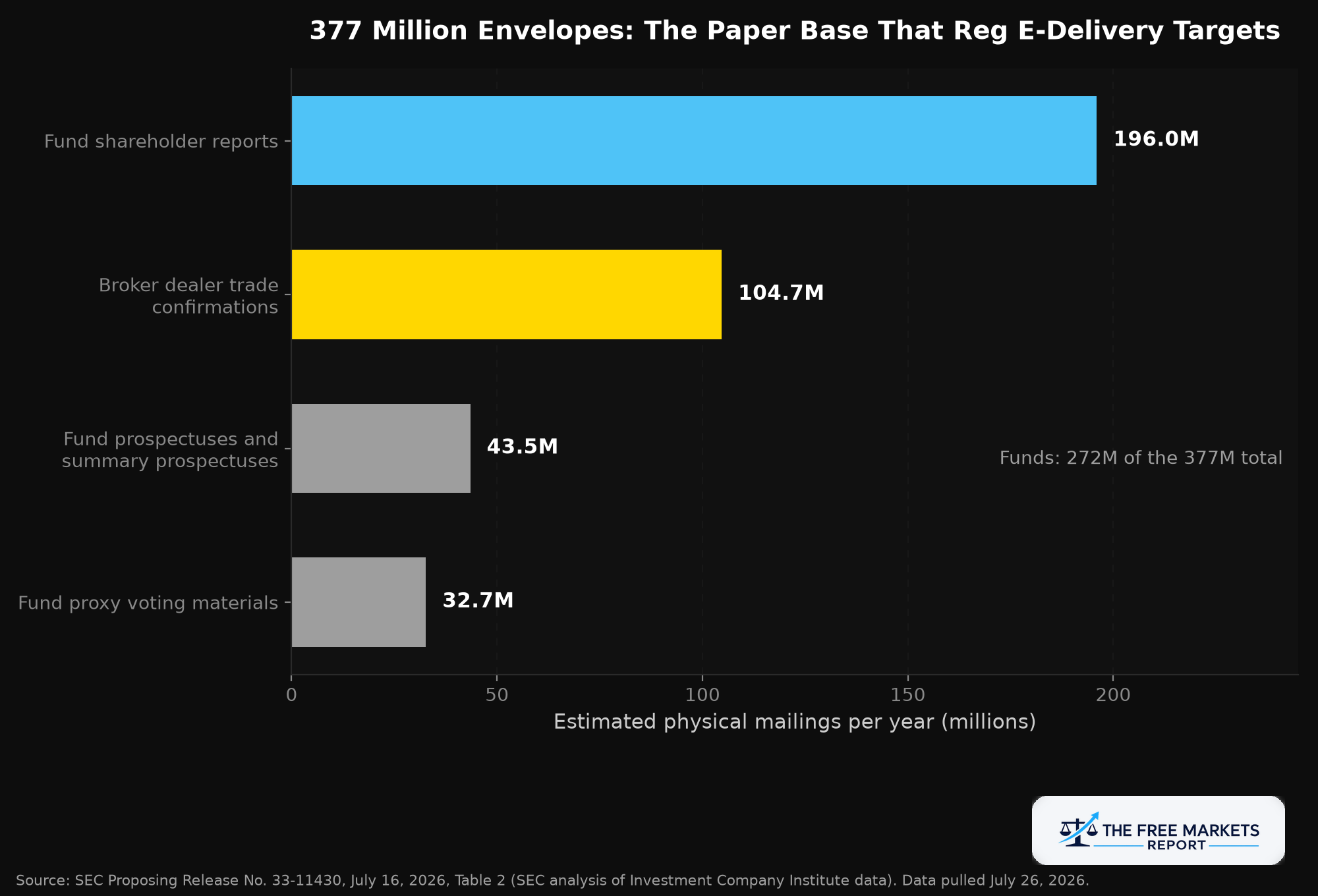
The Commission was not subtle about intent. Chairman Paul Atkins said in March that the paper default "ought to be a relic, not a standard."11 The release cites 2025 proxy season postage at $3.05 per full set.12 The direction of travel is not ambiguous.
Somebody Books That Postage as Revenue
Donnelley Financial Solutions (DFIN) sits on the other side of the fund envelope. It runs proxy and shareholder report composition and print and mail management for mutual funds, variable annuities and closed-end funds, alongside the compliance software those same clients file with. FY2025 net sales were $767.0 million: software solutions $358.4 million, tech-enabled services $298.3 million, print and distribution $110.3 million.13
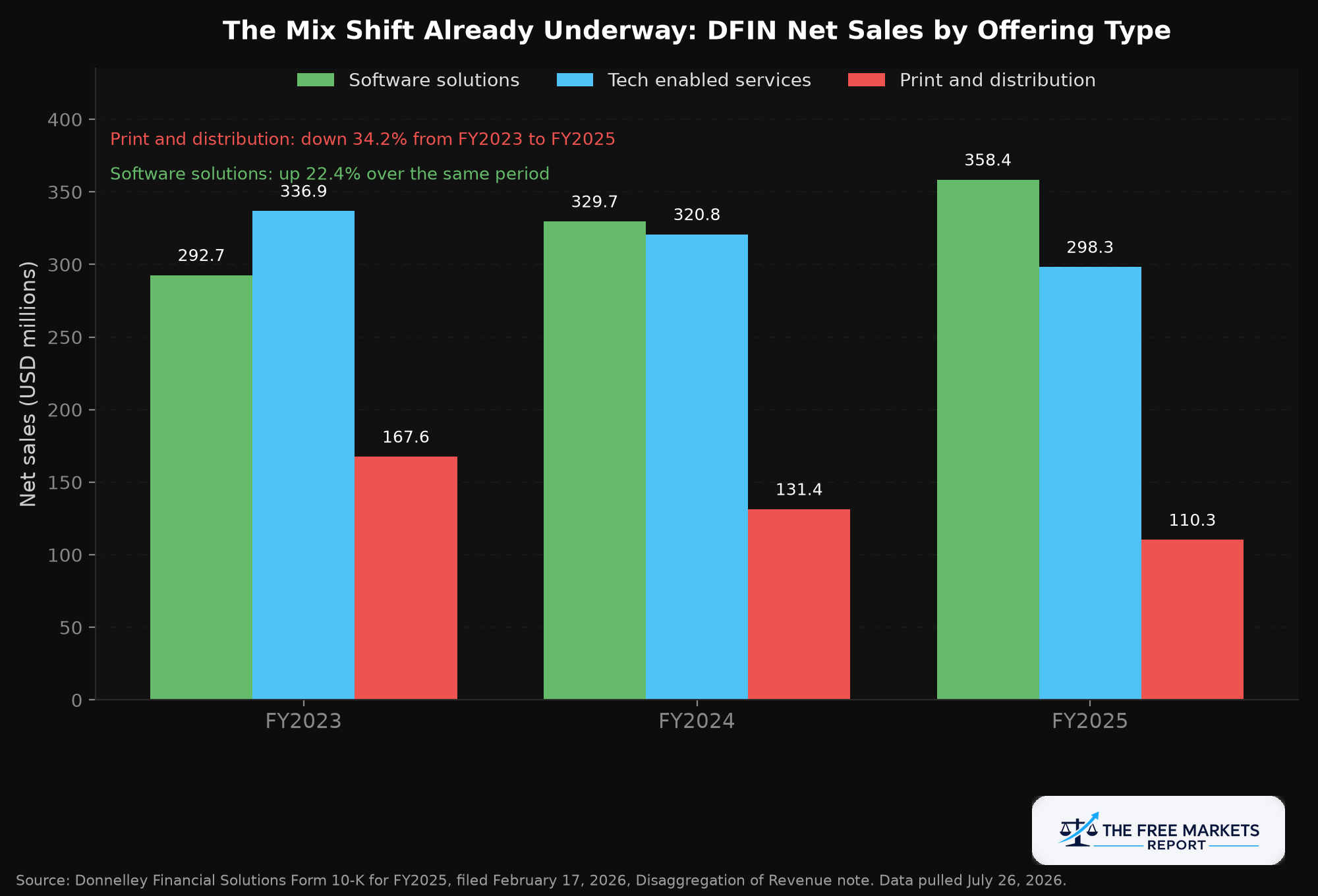
Print and distribution fell 34.2 percent from $167.6 million in FY2023 to $110.3 million in FY2025, while software solutions rose 22.4 percent over the same period.13 Print is now 14.4 percent of net sales, against 21.0 percent two years ago.13 The piece the proposal actually touches is smaller still: print revenue inside the Investment Companies compliance and communications business ran $77.1 million in 2023, $59.7 million in 2024 and $45.7 million in 2025, about 6.0 percent of FY2025 net sales.13 The directly exposed revenue line is roughly one sixteenth of the company, and it has already been shrinking at a double-digit annual rate without any help from the SEC.
The company says it plainly in its own filing. Regulatory changes, per the FY2025 10-K, "have enabled the Company to offer new value-added functionality and services, leverage its domain expertise and accelerate its transition from print and distribution to software solutions."13 That is management calling regulatory disruption a tailwind for the higher-margin half of the business, in a document it can be sued over.
The Case for Skepticism
The textbook expectation is that a proposal like this drives print revenue down immediately. The latest filing shows the opposite: DFIN print and distribution net sales rose to $43.7 million in Q1 2026 from $40.0 million, driven by Capital Markets print at $29.5 million against $24.1 million, even as Investment Companies print fell to $14.2 million from $15.9 million.14 Print is not decaying on a clean curve, and capital markets activity can add paper faster than fund communications sheds it.
Second, this is a proposal. Comments close September 21, 2026, adoption is not scheduled, and the Commission has reversed itself here before, narrowing Rule 30e-3 in 2022 four years after adopting it.4 Third, the mix shift has coincided with a shrinking top line: net sales went $797.2 million in FY2023, $781.9 million in FY2024, $767.0 million in FY2025.13 A faster print runoff subtracts revenue on a known schedule while software growth stays a forecast. Fourth, print contracts anchor the relationships that carry software attach rates, and the $27 million a year of preference management fees may accrue to platform intermediaries rather than document vendors.7
The falsification condition is specific. If DFIN reports FY2026 software solutions net sales below the FY2025 figure of $358.4 million, or if consolidated print and distribution revenue rises year over year in three consecutive quarters through Q1 2027, the acceleration thesis is wrong: print runoff would be a capital markets volume story, not a delivery-rule story.
Investment Idea
- Company: Donnelley Financial Solutions (DFIN)
- Thesis type: Second-order beneficiary (mix-shift accelerator, not a paper-loss story)
- Deregulatory catalyst: SEC proposed Regulation E-Delivery, Release No. 33-11430, File No. S7-2026-25, issued July 16, 2026, comments close September 21, 2026; includes rescission of Rule 30e-3.1,2
- Current price: $48.26, last close per exchange quote data pulled July 26, 2026, against a 52 week range of $36.11 to $65.78; approximately $1.21 billion market capitalization on 24,982,375 shares outstanding.15
- Key financial data: FY2025 net sales $767.0 million, software solutions $358.4 million (46.7 percent of sales), print and distribution $110.3 million (14.4 percent), Investment Companies print $45.7 million (6.0 percent).13
- Regulatory constraint removed: The default paper mandate; the SEC estimates $196.5 million of annual savings for registered investment companies alone, against 272 million fund mailings a year.6,16
- Bull case: The regulatory change creates a structural tailwind for the software half of a business that already draws 46.7 percent of sales from software and is embedded with the same fund clients who capture the savings.13 Management states in its 10-K that regulatory change accelerates the print-to-software transition, so the proposal compresses a multi-year mix shift while removing the lowest-margin revenue first.13
- Bear case: Print and distribution revenue rose year over year in Q1 2026, so the runoff is not linear and capital markets volumes can offset fund declines.14 Total net sales have declined in each of the last two fiscal years, meaning the mix shift so far has not produced growth, and the rule is a proposal that the Commission is free to modify, delay or drop.13,4
- What to watch: Second quarter 2026 results on July 30, 2026, specifically the print and distribution line and the Investment Companies print disclosure.15 Then the comment file after September 21, 2026, for whether fund complexes commit to adoption near the SEC's 95 percent assumption.9
- Time horizon: 18 to 36 months, given the comment deadline, an unscheduled adoption date and a one-year transition on the Rule 30e-3 rescission.2
The Principle
Regulatory cost savings are never destroyed. They move. When a rule removes $462.6 million a year of printing and postage from the securities industry, that money leaves one company's revenue line and reappears in another's operating margin.
Find the vendor. Read the segment disclosure. The mix shift is the trade, not the headline.
- SEC, "Electronic Delivery of Information Under the Federal Securities Laws," File No. S7-2026-25, Release No. 33-11430, July 16, 2026. sec.gov
- SEC, Proposing Release No. 33-11430, economic analysis, covered entity counts and transition provisions. sec.gov
- The Free Markets Report, "The SEC Just Flipped the Default on Paper Mail. Broadridge Is the Trade.", July 22, 2026. freemarketsreport.com
- SEC, Proposing Release No. 33-11430, section II.F.1 (proposed rescission of Rule 30e-3; 2022 amendment excluding Form N-1A registrants). sec.gov
- SEC, "Fact Sheet: Electronic Delivery of Information Under the Federal Securities Laws," Release No. 33-11430, July 16, 2026. sec.gov
- SEC, Proposing Release No. 33-11430, section III.C.1.a, aggregate monetized benefit estimates by covered entity type. sec.gov
- SEC, Proposing Release No. 33-11430, Table 4, aggregate monetized cost estimates by source. sec.gov
- SEC, Proposing Release No. 33-11430, present value of benefits and costs, 2026 to 2035, at 3 percent and 7 percent discount rates. sec.gov
- SEC, Proposing Release No. 33-11430, adoption and opt-out assumptions used in the economic analysis. sec.gov
- Investment Company Institute, letter to the SEC on electronic delivery framework recommendations, November 18, 2025. ici.org
- Paul S. Atkins, "Prepared Remarks Before SEC Speaks," March 19, 2026. sec.gov
- SEC, Proposing Release No. 33-11430, citing 2025 proxy season per-unit printing and postage data. sec.gov
- Donnelley Financial Solutions, Form 10-K for fiscal year 2025, filed February 17, 2026, Disaggregation of Revenue note and business description. sec.gov
- Donnelley Financial Solutions, Form 10-Q for the quarter ended March 31, 2026, Disaggregation of Revenue note. sec.gov
- Nasdaq market activity quote and events data for DFIN, pulled July 26, 2026; share count from the Form 10-Q cover page. nasdaq.com
- SEC, Proposing Release No. 33-11430, Table 2, estimated annual physical document volumes for funds and broker-dealers. sec.gov
The Free Markets Report is provided by Lead-Lag Publishing, LLC. All opinions and views mentioned in this report constitute our judgments as of the date of writing and are subject to change at any time. Information within this material is not intended to be used as a primary basis for investment decisions, and should also not be construed as advice meeting the particular investment needs of any individual investor. Trading signals produced by The Free Markets Report are independent of other services provided by Lead-Lag Publishing, LLC, or its affiliates, and the positioning of accounts under their management may differ. Please remember that investing involves risk, including loss of principal, and past performance may not be indicative of future results. Lead-Lag Publishing, LLC, its members, officers, directors, and employees expressly disclaim all liability with respect to actions taken based on any or all of the information in this writing.