The FCC Just Erased a Cap Congress Wrote Into Law
The 39 percent national TV ownership cap died quietly on a Thursday, 55 days after the vote that killed it.

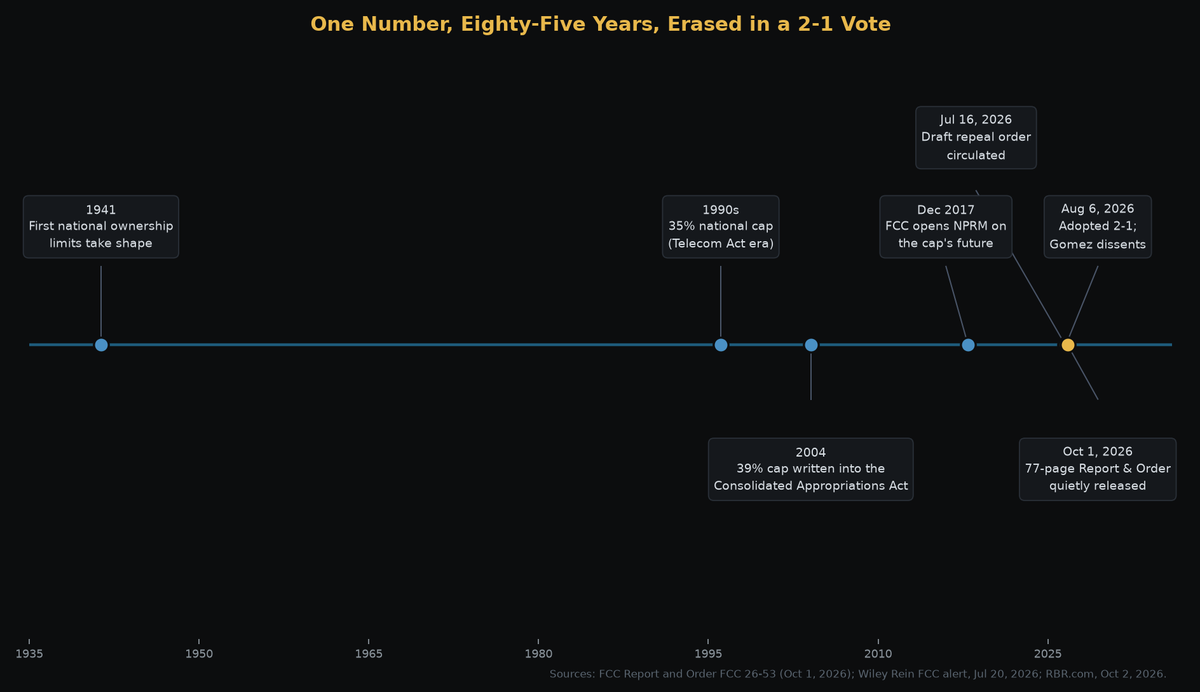
On Thursday, October 1, the FCC quietly posted a 77-page Report and Order to its website and eliminated the national television ownership cap, the 39 percent limit on how many American TV households a single company's stations can reach. The vote had happened two months earlier, on August 6, when the commission adopted the order 2-1 along party lines: Chairman Brendan Carr and Commissioner Olivia Trusty in the majority, Commissioner Anna Gomez dissenting. The release of the written order is what makes it real. The quiet Thursday posting, 55 days after the vote, is the moment the cap stopped being a rule and became a court case waiting to happen.
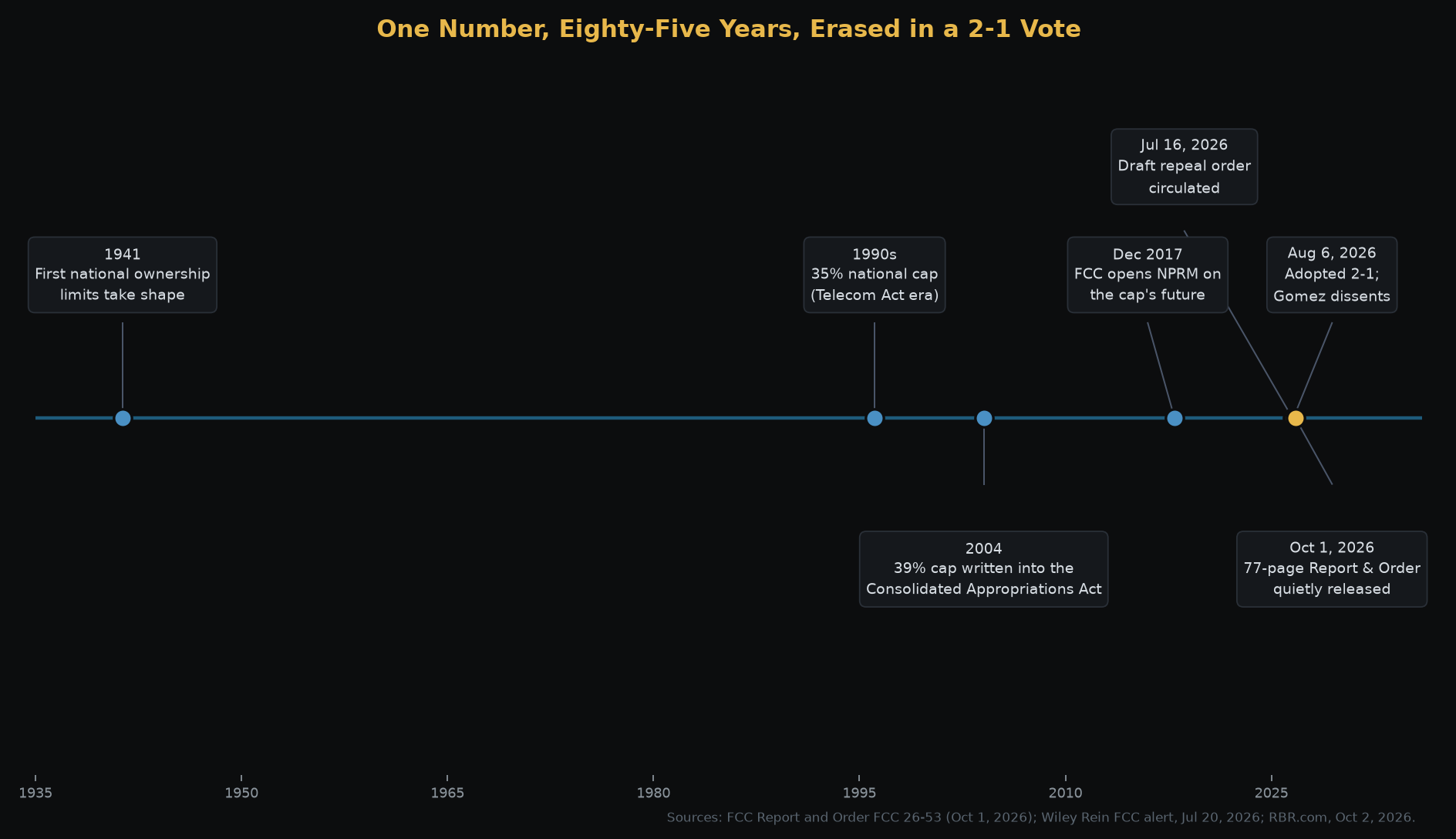
The number itself has a long biography. National ownership limits date to 1941 in various forms. Congress set a 35 percent reach limit in the 1990s, then wrote the current 39 percent figure into the Consolidated Appropriations Act of 2004, where it sat unchanged for more than two decades, partly because it was codified in federal law. The FCC opened a rulemaking on the cap's future in December 2017, let the proceeding sit for the better part of nine years, circulated a draft repeal order on July 16 of this year, and adopted it three weeks later. Eighty-five years of ownership restraint, erased by a 2-1 vote.
What the Order Actually Does
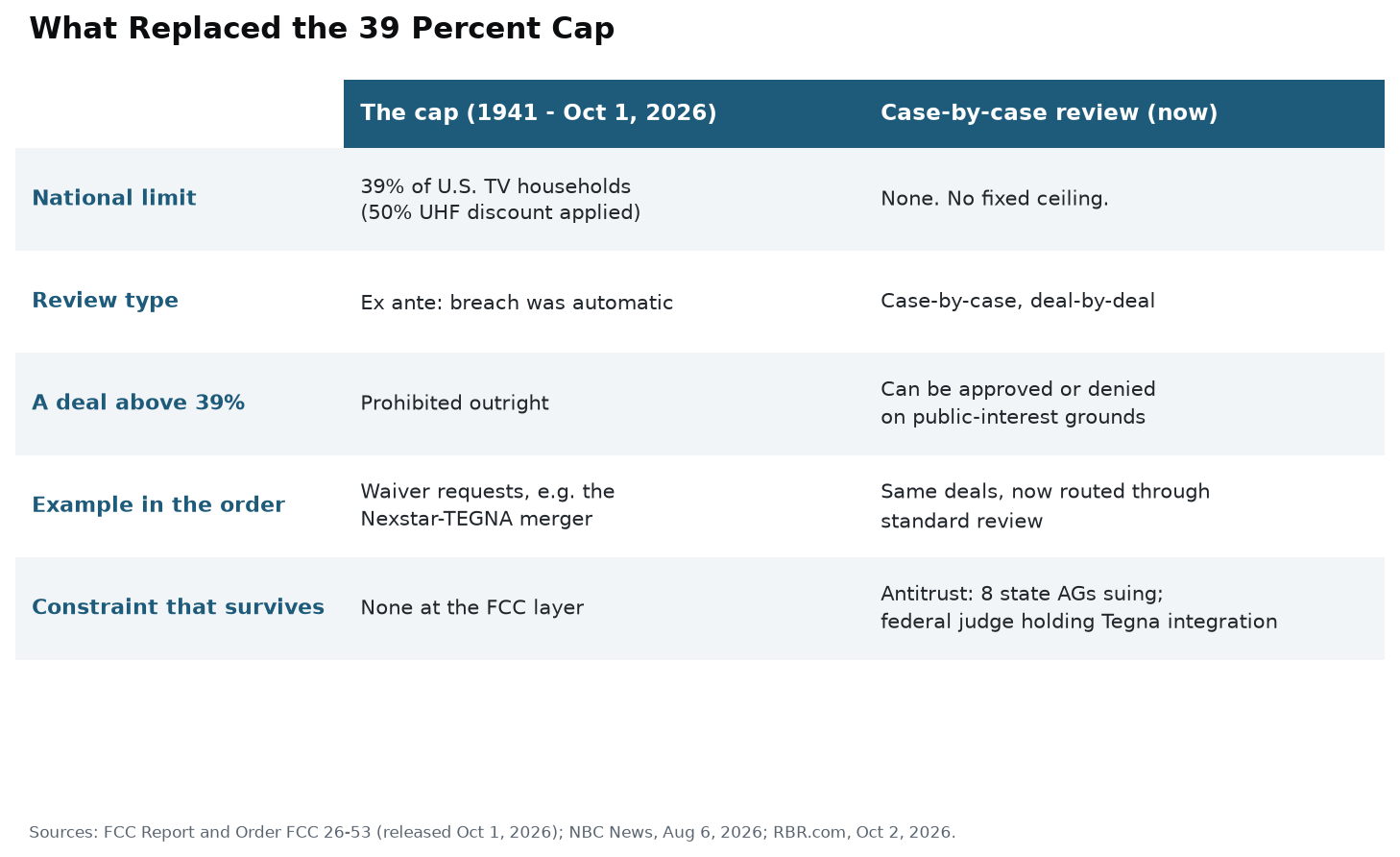
Three things, and the third is the one worth watching. First, the order repeals the 39 percent national audience reach cap, which limited any single company from owning commercial broadcast stations that together reach more than 39 percent of U.S. television households, applying a 50 percent discount for UHF stations. Second, it replaces that fixed, ex ante ceiling with individualized, case-by-case review: under the new regime, the commission says, a transaction that exceeds 39 percent reach "could be denied if they do not serve the public interest, or could be approved if they do."
Third, and this is the part buried in the middle of the document rather than in the headlines, the order cites the recent merger between Nexstar Media and TEGNA as exactly the kind of deal the old rule forced into ad hoc waivers, and the new regime handles through standard review. The agency did not just delete a number. It wrote the template for the next round of consolidation into its own order.
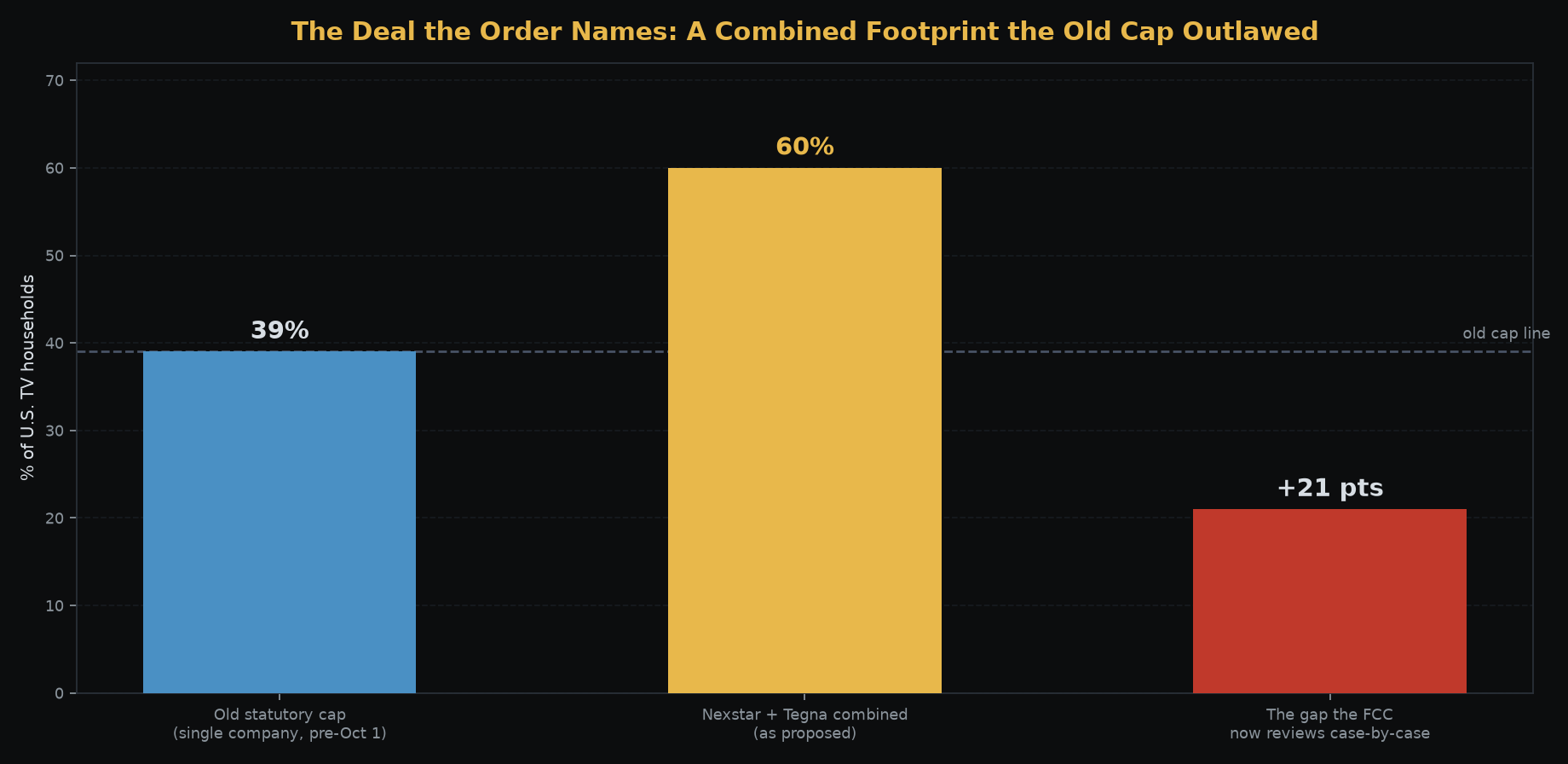
That template matters because the biggest deal in broadcast is already sitting inside it. Nexstar is seeking to acquire TEGNA in a $6.2 billion transaction that would give the combined company reach of at least 60 percent of U.S. households, more than half again the old cap. In March, Chairman Carr said the purchase had been exempted from the 39 percent rule on a stand-alone basis. Eight state attorneys general have filed an antitrust lawsuit over the deal, and a federal judge has put the transaction on hold. The FCC's new case-by-case regime now has to coexist with that litigation, and nobody knows yet what case-by-case means when the first case is already in court.
The Authority Question
The legal fight was staged before the order was even released. The commission's position, as laid out in the draft order, is that it adopted and repeatedly modified the cap under Sections 154(i) and 303(r) of the Communications Act, and that the 2004 appropriations act directed the FCC to "modify" its rules to set the cap at 39 percent, a power to modify that includes the power to keep modifying. The dissent's position is shorter. Gomez wrote that the elimination is "unlawful on its face," that "Congress set this cap in federal law, and only Congress can change it," and that the action "undermines our core public interest principles of localism, viewpoint diversity and competition."
Both positions are now part of the public record, which is exactly what a future plaintiff needs. When the ownership cap repeal reaches the courts, and Gomez's dissent reads like the first draft of that complaint, the question will be whether an appropriations rider's instruction to set a cap at 39 percent binds the agency at 39 percent forever, or merely authorized the 2004 figure as one point on a dial the FCC controls. The FCC has argued the latter on a bipartisan basis before, though with bipartisan dissent. The courts have never had to settle it, because until last Thursday no commission had ever deleted the number outright.
There is precedent for the fight itself, just not for its outcome. The earlier 35 percent limit produced its own litigation in Fox Television Stations v. FCC, a case the commission cites in the new order. Ownership rules have been contested at every revision since the 1990s, and the cap's survival from 2004 through four administrations is itself evidence of how durable statutory numbers are once they are written into an appropriations act. The difference this time is that the repeal is not a revision. It is a deletion, which leaves nothing for the agency to fall back to if the courts disagree with its reading of the word "modify."
What Comes Next
Chairman Carr's argument for repeal is a competition argument: that the cap "will provide essential relief for local broadcasters by restoring a healthy counterbalance to the growing leverage of national programmers," and that scale lets broadcasters "attract the capital and advertising revenue needed to sustain and produce trusted and community-focused news." The broadcast industry has made that case for years as streaming platforms consolidated national audiences without any reach constraint at all.
The counterweight is not gone, though. It moved. The constraint that used to live in the FCC's rulebook now lives in antitrust law, which is where the Nexstar-TEGNA fight is already being waged by eight state attorneys general, and in Gomez's promised legal challenge to the agency's authority itself. A broadcaster that could never reach more than 39 percent of the country under the old rule now has no FCC ceiling, but faces a merger-review regime where every deal above the old cap gets an individualized look, a longer clock, and a plaintiff pool.
The deregulatory direction is clear and the order is final on its face. What changed this week is not just that a limit disappeared. It is that the limit was replaced by discretion: agency discretion in Washington, judicial discretion wherever Gomez's argument lands, and antitrust discretion in the courthouse that is already holding the industry's biggest deal. For investors in station groups, the cap's disappearance is the beginning of the negotiation, not the end of it.
For dealmakers, the practical read is straightforward. The elimination sets the stage for more corporate consolidation in an industry that has spent two decades managing around a hard ceiling, and every large station group now has cap math that did not work in September working in October. But the first transactions will define the review regime, and the first transaction is contested. The Nexstar-TEGNA integration, already paused by a federal judge and opposed by eight states, is simultaneously the reason the cap died and the test of what replaced it. Watch the twin California cases for the answer to the only question that matters to the next acquirer: whether case-by-case review means a faster road for big combinations, or just a longer one with more lawyers.
Know someone tracking market structure like this? Forward this one along.
The Free Markets Report is provided by Lead-Lag Publishing, LLC. All opinions and views mentioned in this report constitute our judgments as of the date of writing and are subject to change at any time. Information within this material is not intended to be used as a primary basis for investment decisions and should also not be construed as advice meeting the particular investment needs of any individual investor. Trading signals produced by The Free Markets Report are independent of other services provided by Lead-Lag Publishing, LLC or its affiliates, and positioning of accounts under their management may differ. Please remember that investing involves risk, including loss of principal, and past performance may not be indicative of future results. Lead-Lag Publishing, LLC, its members, officers, directors and employees expressly disclaim all liability in respect to actions taken based on any or all of the information on this writing.