Two Circuits Just Disagreed About What a Swap Is. The Prediction Market Is 1-For-3.
The Sixth Circuit narrowed the CEA swap definition and let Ohio and Tennessee regulate Kalshi's sports contracts. The Third Circuit said the opposite. The circuit split now points at the Supreme Court.

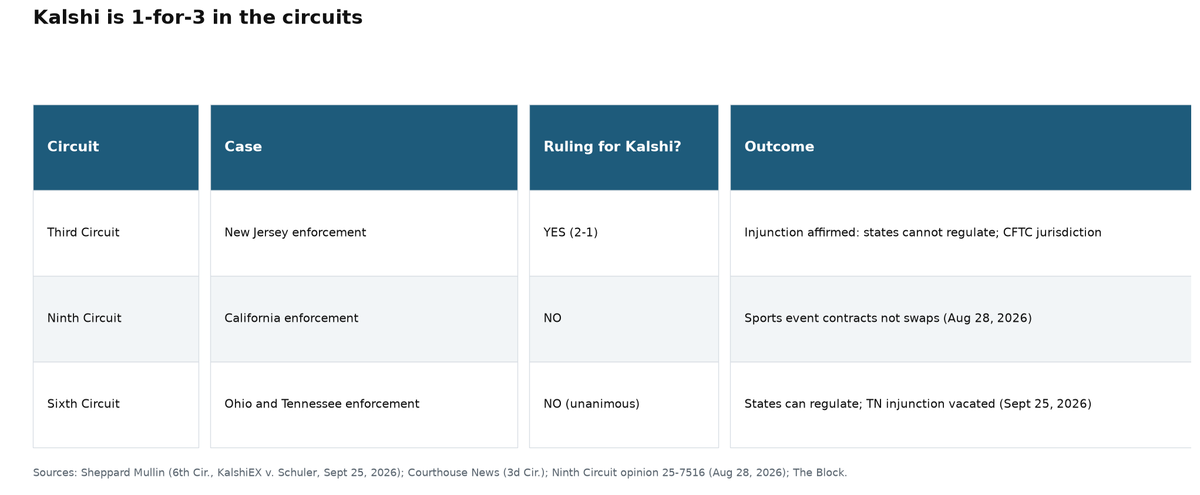
A prediction market is either a federally regulated derivatives exchange or an offshore sportsbook with better fonts, and two federal appeals courts now formally disagree about which. On September 25, the Sixth Circuit ruled in KalshiEX LLC v. Schuler that Ohio and Tennessee can enforce their sports-gambling laws against Kalshi's event contracts, vacating the injunction that had protected it in Tennessee and upholding the denial of one in Ohio. The platform is now one for three in the circuit courts, and the same statute has produced opposite definitions of a swap.
What the Sixth Circuit held
The unanimous panel's reasoning ran through the Commodity Exchange Act. Kalshi's defense is that its sports contracts are swaps, and that swaps sit inside the CFTC's exclusive federal jurisdiction, where state gambling law cannot reach. The Sixth Circuit narrowed the swap definition and held Kalshi had not shown its sports event contracts qualify, with the panel pointing to Kalshi's own earlier concession that the contracts have no inherent economic significance, per The Block's account of the ruling. If the contracts are not swaps, there is no federal preemption, and state sports-betting law applies at full force.
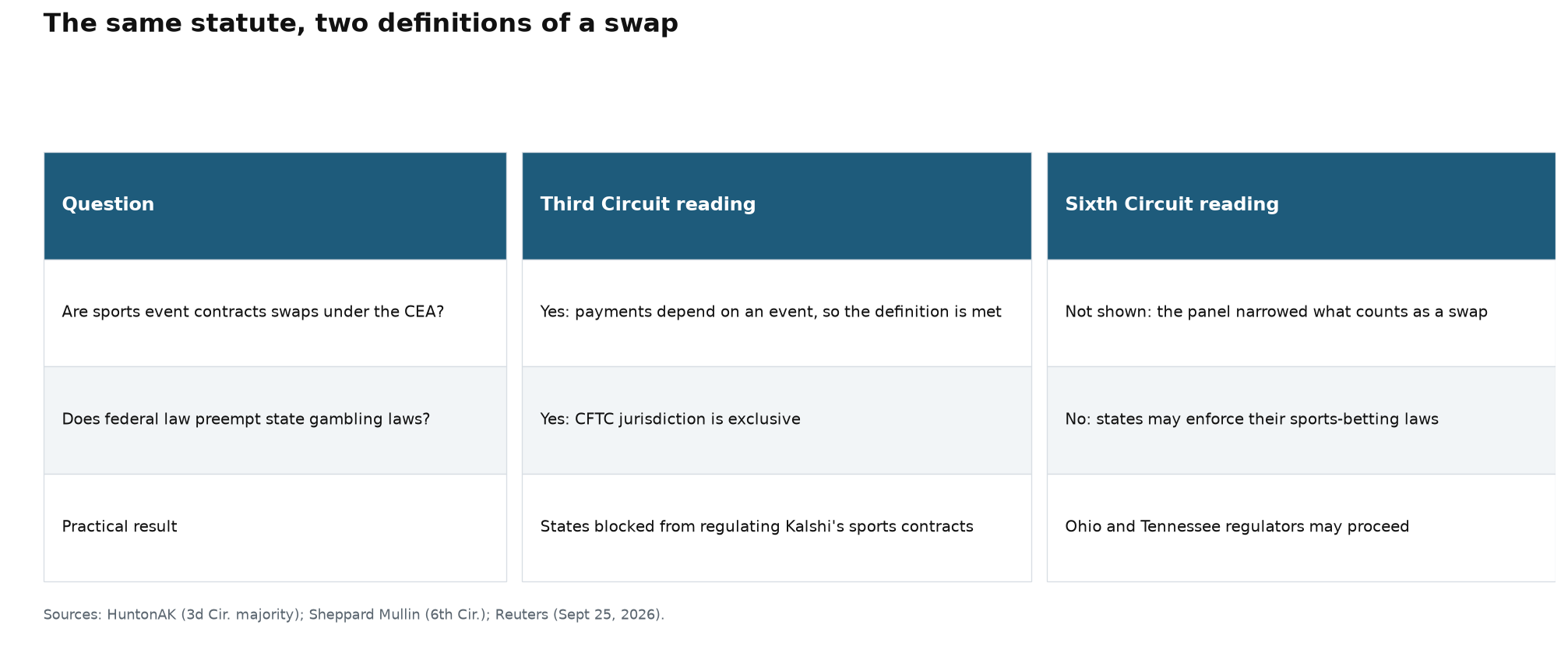
The injunction outcomes were the practical teeth: the middle district of Tennessee's injunction was vacated, and Ohio's denial of an injunction stood. Regulators in both states can now proceed against the platform's sports contracts. The contracts keep trading elsewhere under other courts' injunctions, which is how a federal jurisdictional question becomes a state-by-state patchwork in real time.
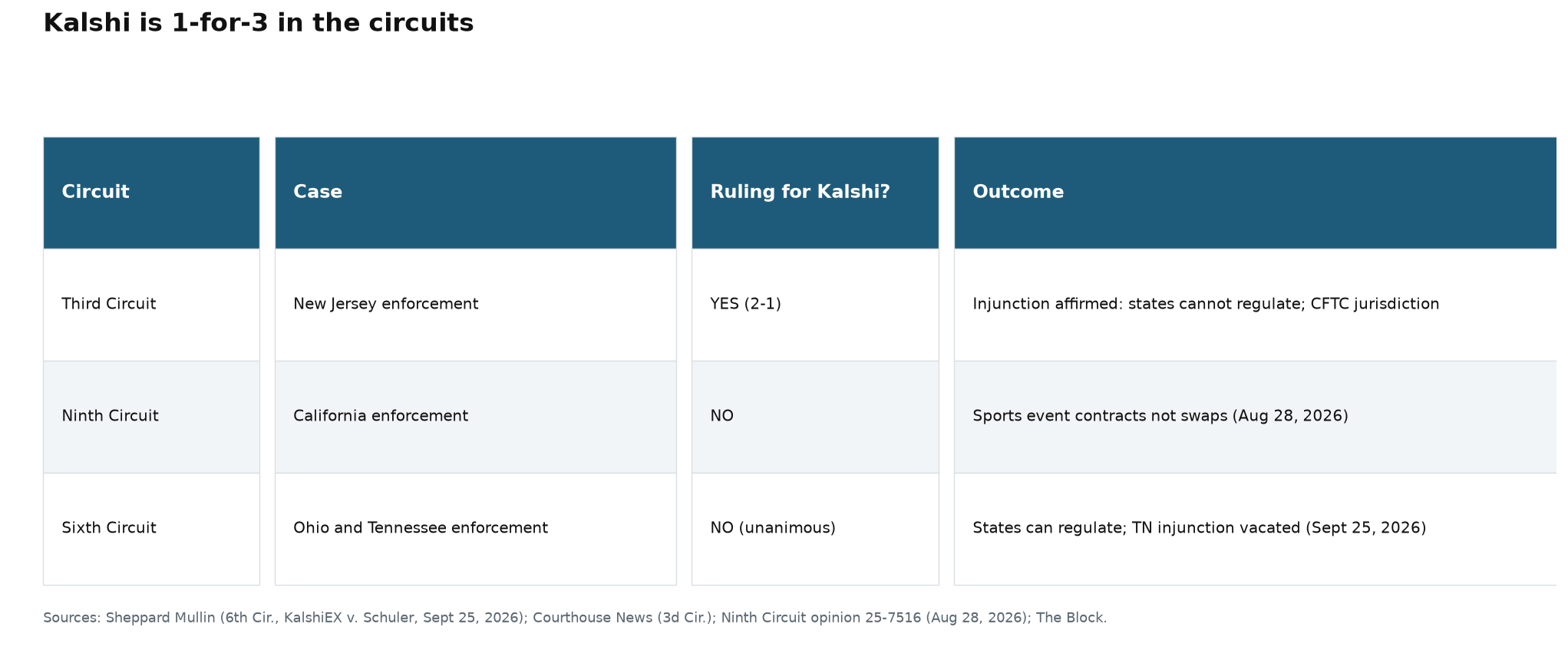
The split, in one table
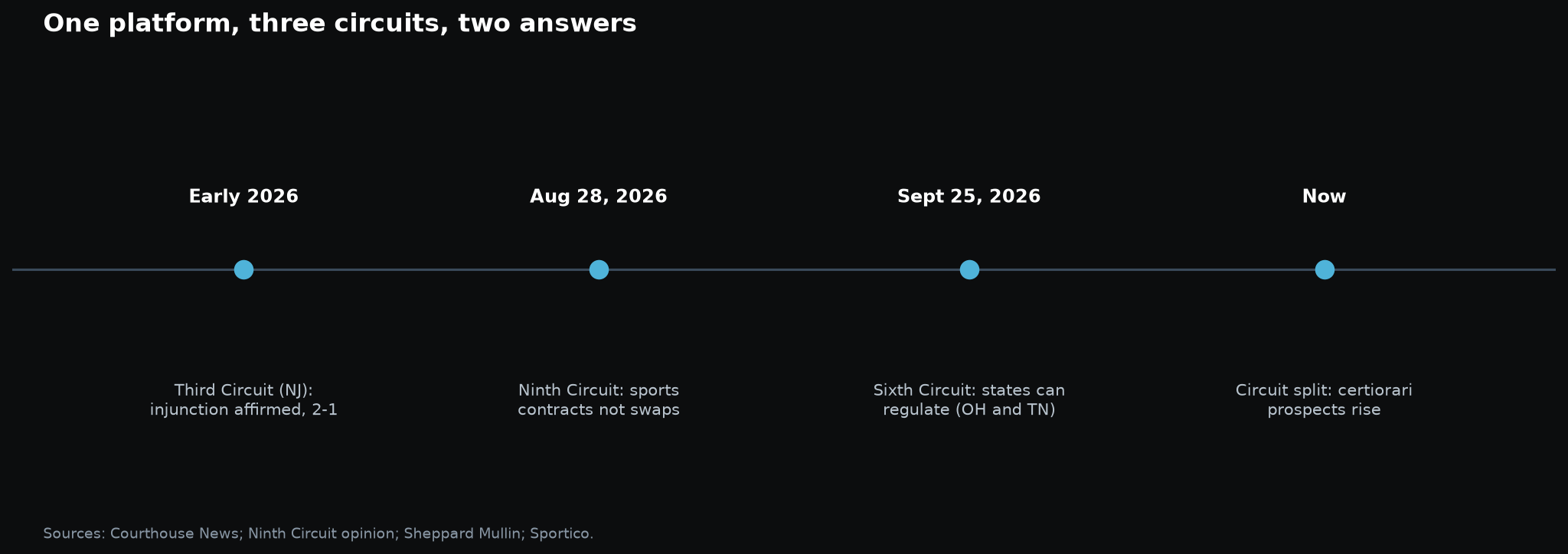
The Third Circuit went the other way earlier this year, affirming 2-1 that New Jersey could not enforce its gambling laws against Kalshi because the sports contracts satisfy the CEA's swap definition, payments being dependent on the occurrence of an event. The Ninth Circuit had already ruled against the platform in August, finding sports event contracts not swaps under the statute. Three circuits, one platform, two answers.
Why this is a market-structure story, not a betting story
The commercial question under all of this is where federal derivatives jurisdiction ends. Event contracts have been the fastest-growing corner of retail finance, precisely because they borrowed the machinery of a regulated futures exchange: CFTC registration, a designated contract market, central clearing conventions. The courts are now deciding whether that machinery actually confers the legal status it was built to resemble. If sports contracts are not swaps, then the swap definition has a boundary, and everything outside it is state gambling law, state consumer protection, and fifty different enforcement regimes.
For the exchanges themselves, the Sixth Circuit's reasoning is the dangerous kind, because it narrows the swap definition rather than just deciding one case. A narrowed definition reaches past sports contracts toward every event market whose payout is not tethered to an underlying economic exposure. Prediction markets built their growth on the assumption that the CEA's definition was broad. One circuit has now said it is not, and a second agreed.
What to watch
Three checkpoints. First, the certiorari petition: Sportico assessed the Supreme Court review likelihood as rising after the split hardened, and a genuine circuit split on a federal jurisdictional statute is the classic cert case. Second, what the CFTC itself does: the agency's own view of its jurisdiction is now in tension across circuits, and regulators do not sit out fights over their own authority. Third, the state enforcement wave: with Tennessee's injunction vacated, the first state enforcement action against a CFTC-registered exchange's listed contracts becomes the test of what the ruling actually means on the ground.
The takeaway is the one this report keeps finding at the bottom of deregulation fights. The boundary between federal and state jurisdiction was drawn for markets that no longer exist, and when the statute is ambiguous, the courts are drawing it one circuit at a time. Few understand this.
Know someone tracking market structure like this? Forward this one along.
The Free Markets Report is provided by Lead-Lag Publishing, LLC. All opinions and views mentioned in this report constitute our judgments as of the date of writing and are subject to change at any time. Information within this material is not intended to be used as a primary basis for investment decisions and should also not be construed as advice meeting the particular investment needs of any individual situation. The accuracy, completeness, and timeliness of the information contained in this document is not guaranteed. The securities and strategies discussed may be unsuitable for investors depending on their specific financial position and investment objectives. Reproduction of this report without the express written consent of Lead-Lag Publishing, LLC is strictly prohibited. Past performance is not indicative of future results, and current performance may be lower or higher than the performance shown. Neither the information nor any opinion expressed in this report constitutes a solicitation, an offer to buy or sell any securities, or an offer to provide investment advice or services. Nothing in this report shall be construed to be an offer to provide investment advisory services in any jurisdiction in which Lead-Lag Publishing, LLC is not authorized to provide such services. All investments involve risk, including the risk of loss of principal. No representation is being made that any security, account, or strategy covered by or is likely to achieve results similar to those shown. Investing in securities involves risks, and there is always the potential of losing money when you invest in securities. Before investing, consider your investment objectives, and Lead-Lag Publishing, LLC's charges and expenses. This report is not a prospectus and does not contain all of the information necessary to fully evaluate any security or strategy discussed, including, but not limited to, the risk of adverse effects of related market developments. You should not rely solely on the information contained in this report, and should seek advice based on your situation from a licensed investment professional. Carefully consider the investment objectives, risks, charges and expenses of any investment product before investing. This report may not be copied or distributed without the express written consent of Lead-Lag Publishing, LLC. Any decisions made based on any or all of the information in this writing are the sole responsibility of the user, and the user should exercise caution and take appropriate advice before acting.