The Treasury Just Killed Its Two Biggest Crypto Surveillance Rules
FinCEN withdrew the unhosted wallet reporting rule after six years of limbo and the Section 311 mixing designation with it. The gates stay open wider, the surveillance towers stay unmanned, and the BSA skeleton still stands.

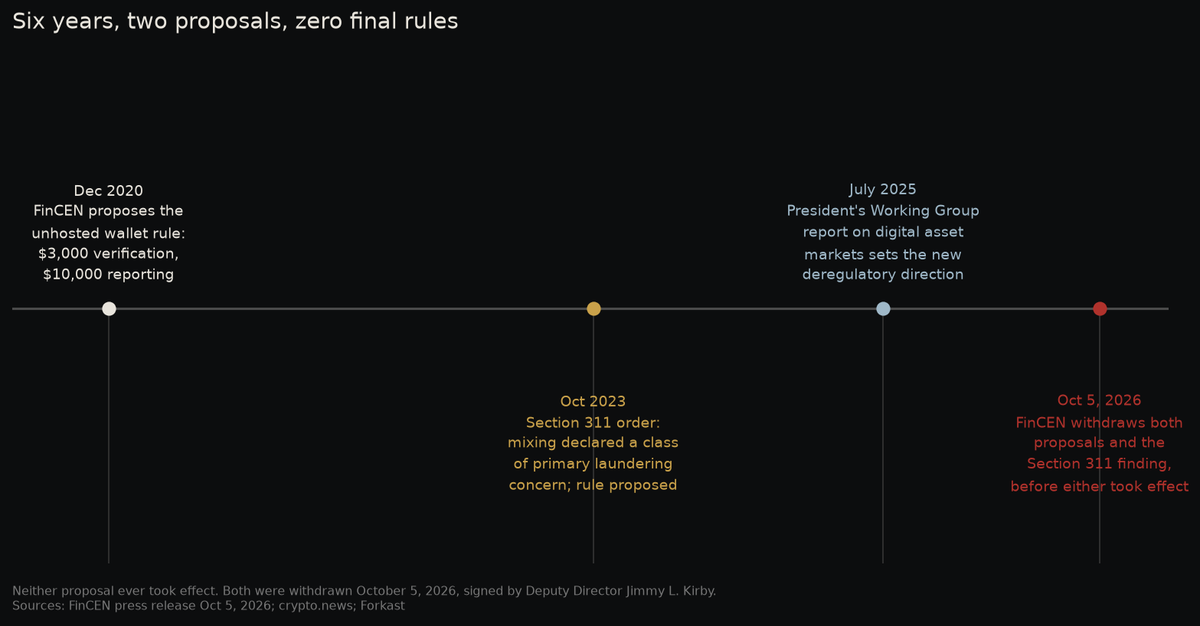
KEY HIGHLIGHTS
- The action: FinCEN on Sunday withdrew its unhosted wallet reporting proposal (December 2020) and its CVC mixing proposal (October 2023), plus the Section 311 finding behind the mixing rule, per the FinCEN announcement and crypto.news.
- What died: The wallet rule would have required banks and money services businesses to verify identity above $3,000 and report transfers above $10,000 to or from self-custody wallets, per Coinpedia.
- The weapon: The mixing rule used Section 311 of the USA PATRIOT Act to classify all mixing transactions as a class of primary money laundering concern, per The Block.
- The timing: Withdrawal notices filed for public inspection October 5, formal Federal Register publication October 6 (notices 2026-20429 and 2026-20430), signed by Deputy Director Jimmy L. Kirby, per Forkast.
- The duration: The wallet proposal sat unresolved for nearly six years and drew thousands of public comments without ever being finalized, per Forkast.
Sunday afternoon is where financial regulators bury news they want noticed but not examined. On Sunday, October 5, the Financial Crimes Enforcement Network filed two withdrawal notices for public inspection at the Federal Register: one killing the proposed unhosted wallet reporting rule that had hung over the crypto industry since December 2020, and one killing the convertible virtual currency mixing rule proposed in October 2023, along with the Section 311 finding that classified international mixing as a class of transactions of primary money laundering concern. The formal publication lands today, October 6. Neither proposed rule had ever taken effect. Neither now ever will.
The significance is easy to overstate in both directions. This is not the abolition of crypto surveillance: the Bank Secrecy Act obligations that already bind banks and money services businesses are untouched, and the Travel Rule for transfers between institutions still stands. But it is also not routine housekeeping. Two of the most contested surveillance proposals in the modern history of financial regulation, one of them armed with the Patriot Act's most sweeping designation authority, are now formally dead. What separates the two readings is worth working through, because the withdrawal tells you as much about how this administration regulates as it does about crypto.
THE RULE THAT NEVER GREW UP
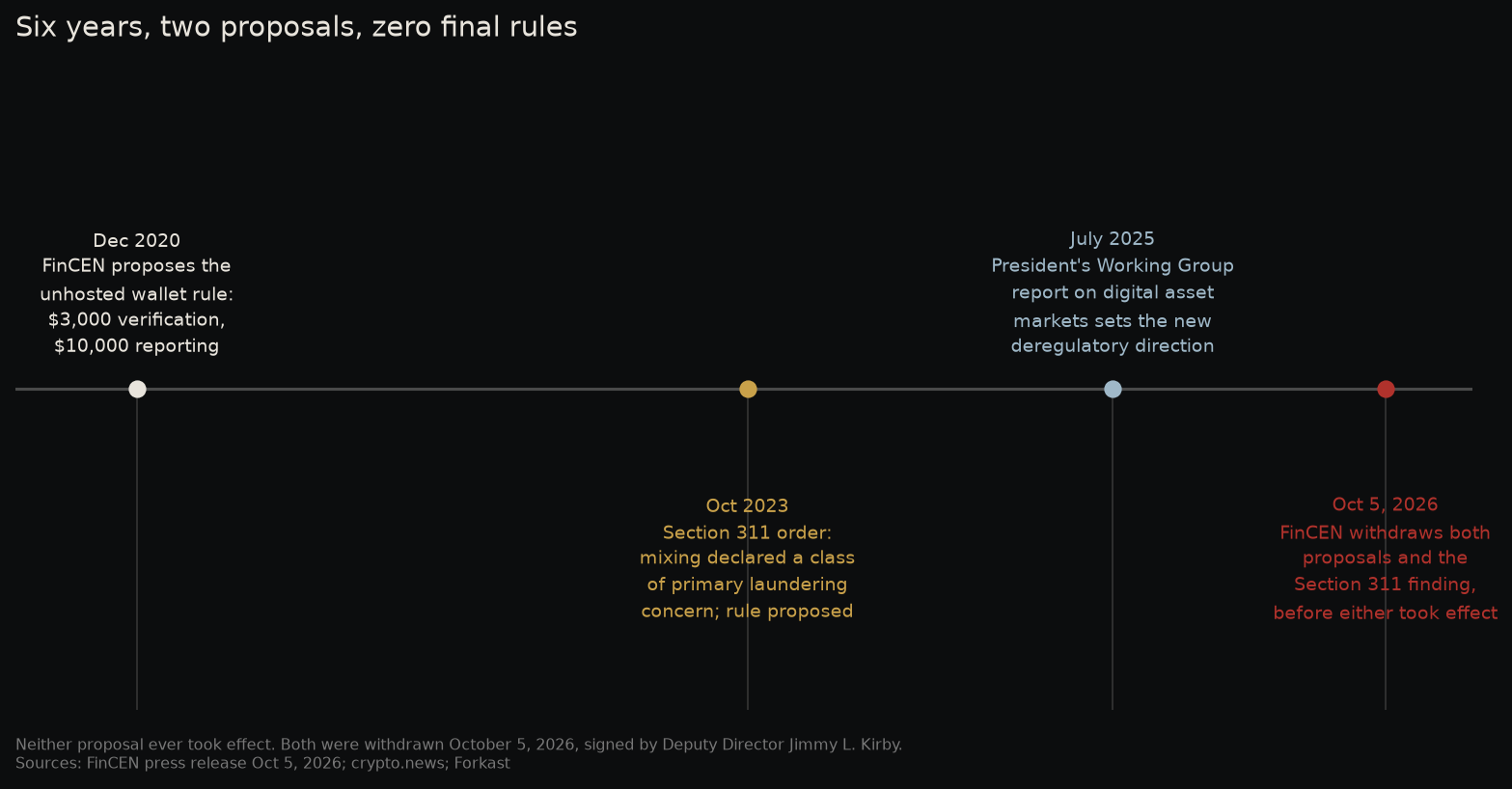
The unhosted wallet proposal was born on December 23, 2020, in the final weeks of the first Trump administration's Treasury. Its architecture was straightforward: banks and money services businesses handling certain convertible virtual currency transfers involving wallets outside regulated financial institutions, including self-custody wallets, would have kept transaction and counterparty records, verified their customer's identity for transfers exceeding $3,000, and reported transactions to FinCEN when they exceeded $10,000. The reporting threshold aggregated transfers over a 24-hour window, which meant the $10,000 line applied not to single transactions but to a customer's total activity across a day.
The proposal drew thousands of public comments and then, nothing. It sat unresolved through a change of administration, a change of enforcement philosophy, and nearly six years of technological change in the wallet ecosystem. That stasis was itself a policy choice: FinCEN never finalized the rule, but it never withdrew it either, leaving the industry to build under a rule that could be revived at any moment. Sunday's withdrawal ends that limbo in the deregulatory direction. As crypto.news reported, both withdrawal notices cite the July 2025 report from the President's Working Group on Digital Asset Markets, the document that set the current administration's digital asset direction, and FinCEN framed the action as ensuring regulations are "fit-for-purpose" as part of the administration's deregulatory agenda, per the ABA Banking Journal.
The ABA Banking Journal's summary of the withdrawal language is worth reading twice. FinCEN said it had considered the comments submitted in response to the proposals and was withdrawing them as part of the Trump administration's deregulatory agenda and ongoing efforts to ensure digital asset regulations are fit-for-purpose. The phrase does the work of a hundred pages of analysis: the rules were not withdrawn because they were unworkable, or because the comments revealed a fatal flaw, though many commenters argued exactly that for six years. They were withdrawn because the policy preference of the agency changed.
The verification burden deserves its own paragraph, because it is where the rule would have bitten hardest. A $3,000 identity verification requirement is trivial for an exchange with an onboarded customer. It is anything but trivial for the counterparty side of the transfer: the rule would have required institutions to collect and verify information about the person on the other end of a self-custody transfer, a person who by definition has no relationship with the institution doing the verifying. Commenters across six years of the file described the practical result: institutions would have either de-banked self-custody activity entirely, which for many was the quiet goal, or built an identity-collection apparatus aimed at people who are not their customers. FinCEN's withdrawal notice does not say which of those outcomes it now considers off-policy, only that the rule will not issue.
The December 23, 2020 date matters more than it looks. A rule proposed in the last weeks of an administration, just before a transition, is a rule proposed by people who will not be there to defend it. The wallet proposal spent its entire life as a document whose authors had already left the building, which is one reason it never moved: every subsequent Treasury inherited it as a question rather than a project. Sunday's withdrawal finally closes an open file that three different Treasury leaderships declined to either finish or kill. There is a lesson in that for anyone tracking rulemaking arcs: an unresolved proposal is not a neutral state, it is a standing threat to the regulated, and six years of limbo carried its own compliance cost without producing a single page of final rule.
There is also a number worth pinning for scale. The $10,000 reporting threshold is the same threshold that governs currency transaction reports for physical cash under the Bank Secrecy Act, a statute written in 1970 when $10,000 was a far larger sum than it is now. Layering a 1970s-era dollar figure onto a 2020s technology guaranteed exactly what happened: a rule that would have swept in ordinary retail activity, aggregated daily, rather than the institutional flows its drafters pointed to. The threshold was never indexed, and the six years of comments said so repeatedly.
THE MIXING CASE, REVERSED
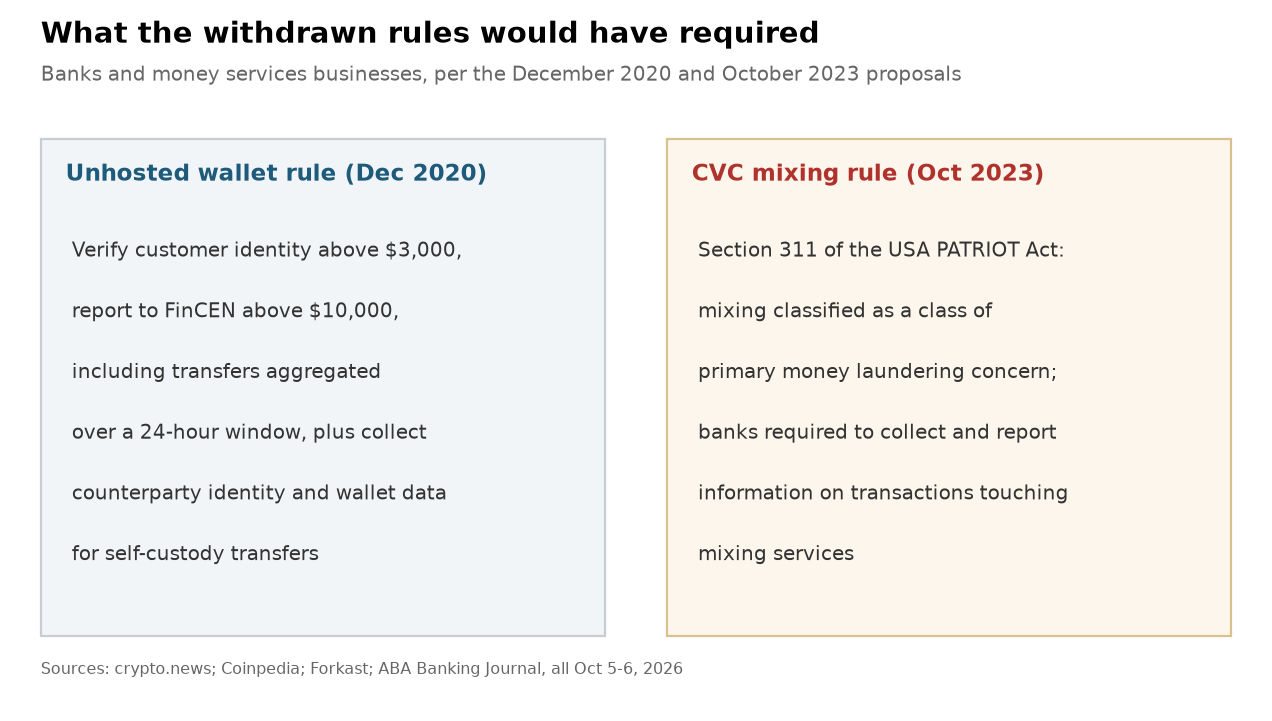
The second withdrawal is the more consequential one. In October 2023, FinCEN issued a finding under Section 311 of the USA PATRIOT Act that international convertible virtual currency mixing constituted a class of transactions of primary money laundering concern, and proposed a rule requiring financial institutions to collect and report information on transactions touching mixing services. Section 311 is not an ordinary rulemaking tool. It is the authority the Treasury used to effectively cut institutions and jurisdictions out of the dollar system, and applying it to an entire category of transactions, rather than to a specific entity or jurisdiction, was an expansion of the statute's reach that alarmed not just the crypto industry but bank compliance departments, who would have had to identify and police mixing exposure across every customer relationship.
Forkast's reporting on the withdrawal captures what FinCEN itself conceded: the agency said the mixer proposal's expansive definition of CVC mixing risked chilling legitimate activity and imposing heavy compliance burdens. That is a striking concession. Chilling legitimate activity is precisely the effect the industry warned about when the proposal was issued in 2023, and the withdrawal notice now concedes the point. The finding that mixing is a class of primary laundering concern is withdrawn along with the rule, which removes the predicate for any future enforcement action premised on the finding itself.
The Section 311 mechanism itself deserves explanation for readers who do not live in the Bank Secrecy Act. When FinCEN designates a class of transactions as being of primary money laundering concern, it gains authority to require domestic financial institutions to take special measures against that class: additional recordkeeping, reporting, or in the extreme, prohibition of accounts and transactions. The statute was built to isolate rogue jurisdictions and shell banks, named entities that regulators could specify with precision. Applying it to a category of transactions defined by technology rather than by entity meant that every bank in the country would have had to build detection for a behavior, mixing, that exists as a design property of the asset rather than as a service one chooses to use. That breadth is what the withdrawal now concedes was too much.
The Digital Chamber, an industry group that opposed both proposals, welcomed the withdrawal as removing regulatory pressure around self-custodial wallets, per Coinpedia. That pressure was not hypothetical. The mixing finding gave examiners a basis to treat any customer touching a mixing service as presumptively suspect, and the wallet rule would have made self-custody the single most surveilled corner of the financial system per dollar moved.
WHAT STILL STANDS
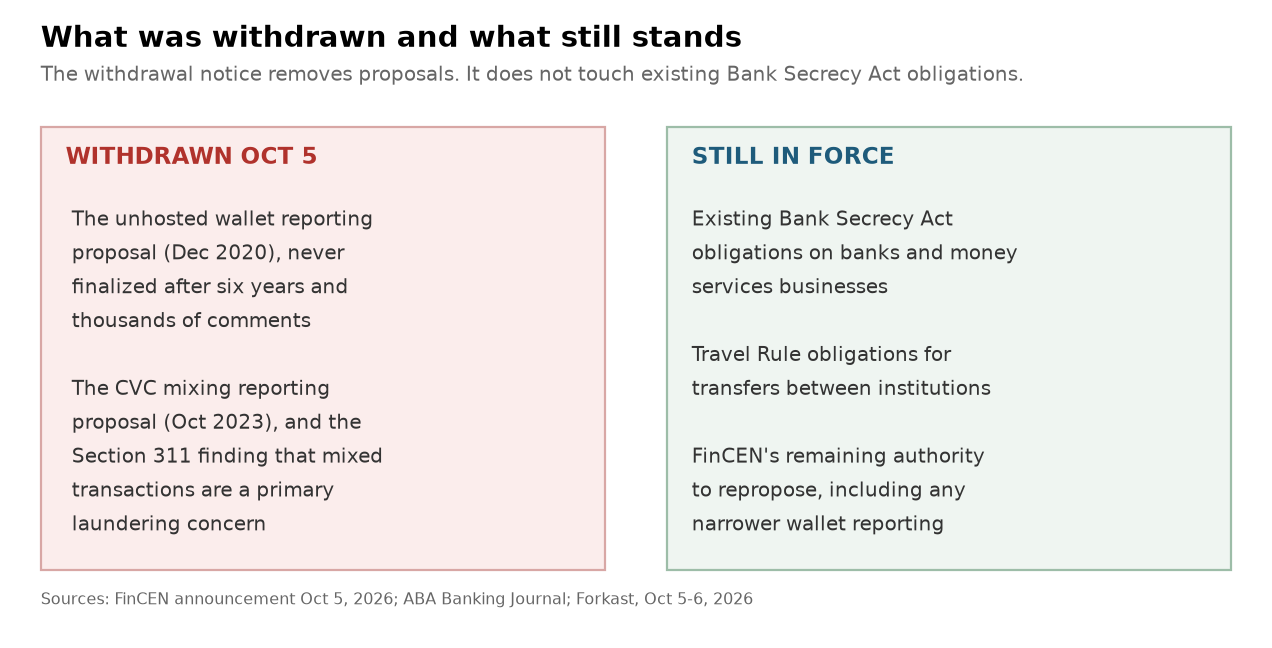
The line between what died Sunday and what survived is the line between proposal and statute. The Bank Secrecy Act's existing requirements for banks and money services businesses remain fully in force: registration, suspicious activity reporting, currency transaction reporting, customer identification programs. The Travel Rule, which requires certain information to travel with certain funds transfers between institutions, still applies. What is gone is the attempt to extend that surveillance architecture to self-custody wallets and mixing services through new rulemaking.
There is also a forward-looking reading that matters for market participants. The withdrawal notices, signed by Deputy Director Jimmy L. Kirby, withdraw these proposals. They do not bind FinCEN against proposing again. An agency that says its digital asset regulations should be fit-for-purpose may repropose a narrower wallet reporting rule with a higher threshold, or a targeted mixing rule aimed at specific services rather than the entire category. The Sunday action removes the limbo, but it also removes the specific text that the industry spent six years learning to live without. Whatever comes next starts from a blank page, and the industry's comment-file arguments from 2020 through 2023 are now history rather than live briefs.
One more structural note. The withdrawal was executed by notice rather than by superseding rulemaking, which means the proposals are dead but the record is intact. Six years of comments on the wallet rule, including detailed privacy analyses from banks, civil liberties organizations and industry groups, now sit in the docket as a public resource. If FinCEN ever reproposes in this space, that record is the starting point, and any new proposal will have to grapple with the same objections the old one never answered. The industry spent six years building the brief. The brief survives the case.
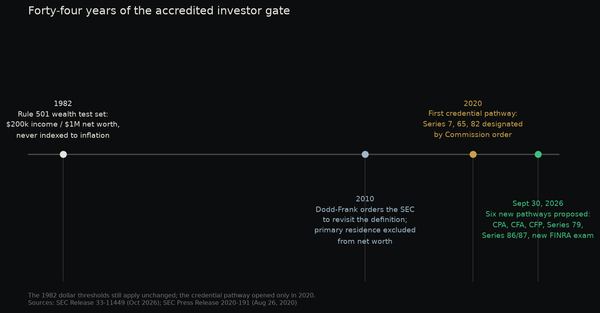
For the market structure this publication tracks, the pattern is now unmistakable. The SEC proposed six new knowledge-based pathways past the accredited investor gate last week. FinCEN withdrew the two most contested surveillance proposals in its digital asset file this week. Both moves run the same direction: the credential notices lower a barrier to entry, and the FinCEN withdrawals raise a barrier to enforcement. The gate architecture of the American capital markets is being rebuilt with the gates open wider and the surveillance towers unmanned, and it is all happening through existing statutory authority, order by order and notice by notice, rather than through new legislation.
Notice also what this does to the compliance industry. Six years of comment drafting, privacy analyses and coalition building were an industry of their own, and the withdrawal converts that work from advocacy into archive. Bank compliance departments that scoped mixing-detection projects now hold stranded plans. Examiners who built questions around the proposals will retire them. The cost side of deregulation is rarely zero, and some of it lands on the people whose job it was to prepare for rules that will never come.
The 10-year Treasury yield closed Monday at 5.31 percent, its highest level since 2002, per etf.net's market notes. Capital that flows through open gates still has to clear that hurdle. Deregulation changes who can invest and what compliance costs; it does not repeal the risk-free rate.
Know someone tracking market structure like this? Forward this one along.
The Free Markets Report is provided by Lead-Lag Publishing, LLC. All opinions and views mentioned in this report constitute our judgments as of the date of writing and are subject to change at any time. Information within this material is not intended to be used as a primary basis for investment decisions and should also not be construed as advice meeting the particular investment needs of any individual investor. Trading signals produced by the Free Markets Report are independent of other services provided by Lead-Lag Publishing, LLC or its affiliates, and positioning of accounts under their management may differ. Please remember that investing involves risk, including loss of principal, and past performance may not be indicative of future results. Lead-Lag Publishing, LLC, its members, officers, directors and employees expressly disclaim all liability in respect to actions taken based on any or all of the information on this writing.