The Tariff Wall Got Rebuilt Under a Different Statute
At 12:01 a.m. on July 24, a 10 percent global import surcharge expired and a forced labor tariff on 60 economies took its place, and the annex decides who pays.

At 12:01 a.m. on July 24, a 10 percent global import surcharge expired and a forced labor tariff on 60 economies took its place, and the annex decides who pays.
Key Highlights
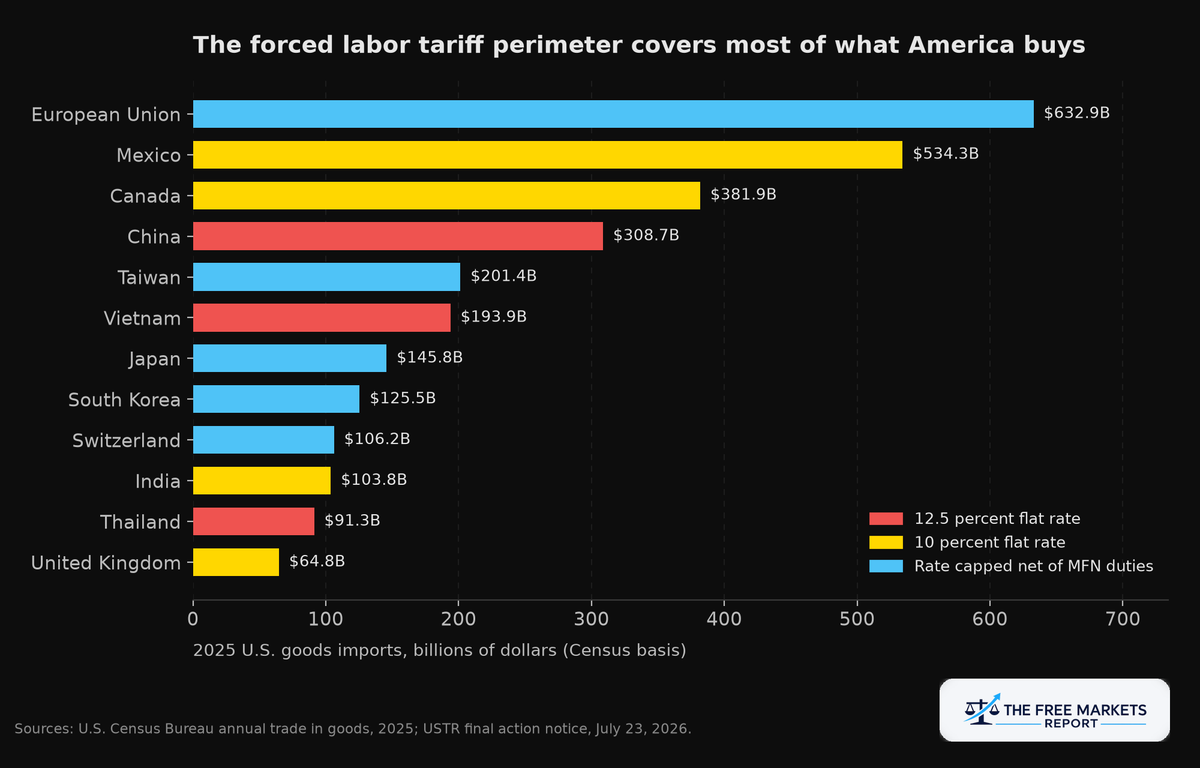
- USTR issued a final action on July 23, 2026 across 60 Section 301 forced labor investigations, taxing all products of each investigated economy except as the annexes provide: 10 percent for 17 economies including India, Indonesia and the United Kingdom, 12.5 percent for the rest including China, Vietnam and Thailand, with net of most favored nation caps for the European Union, Taiwan, Japan, Korea and Switzerland.
- The duties took effect at 12:01 a.m. eastern daylight time on July 24, 2026, the same minute the temporary 10 percent Section 122 surcharge was scheduled to lapse under its 150 day clock.
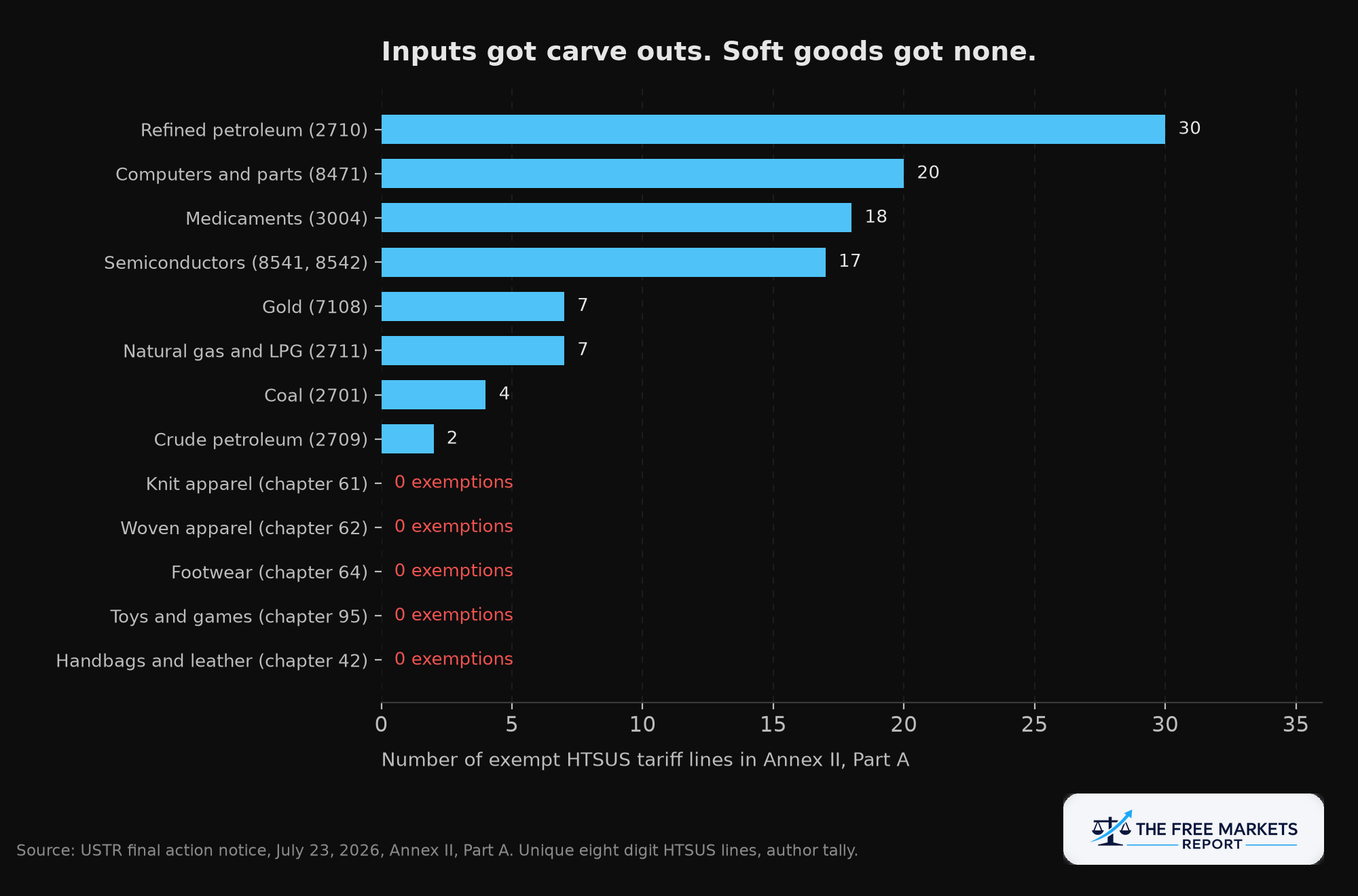
- Annex II exempts 2,116 tariff lines for goods of any investigated economy: petroleum, coal, gas, semiconductors, computers, phones, medicaments. It exempts zero lines in apparel, footwear, handbags or toys.
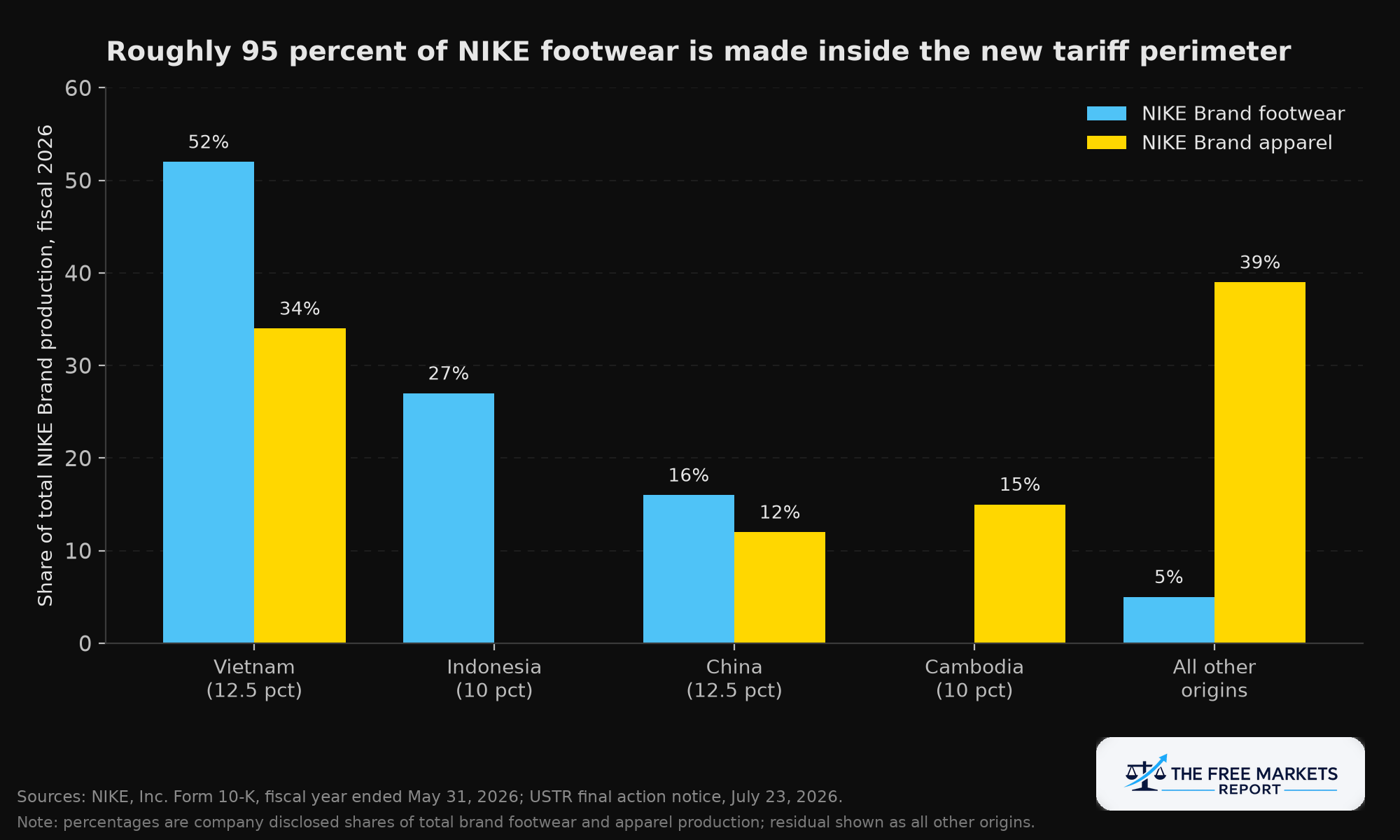
- NIKE disclosed in its fiscal 2026 Form 10-K that Vietnam, Indonesia and China factories made approximately 52 percent, 27 percent and 16 percent of total NIKE Brand footwear.
The Supreme Court took away a tariff statute in February. It did not take away tariffs. On February 20, 2026, the Court held in Learning Resources, Inc. v. Trump that the International Emergency Economic Powers Act does not authorize the President to impose tariffs.4 Five months later the same policy runs on different statutory rails, at similar rates, with a longer legal shelf life.
What USTR actually did
USTR published its notice of determination and final action on July 23, 2026, covering 60 investigations initiated March 12, 2026 under Section 301 of the Trade Act of 1974.1 The subject was not currency or digital services taxes. It was forced labor. USTR found 54 economies had failed both to impose and to enforce import prohibitions on goods made with forced labor, and six more had prohibitions they failed to enforce effectively.1
The action is blunt. Duties apply to all products of each investigated economy, subject only to the annex carve outs, and the rate falls to zero where existing most favored nation duties already meet a cap.1
Start with the process record: more than 1,600 written comments and a three day hearing on July 7, 8 and 9, 2026 with more than 100 witnesses.1 The notice is also self implementing: Annex I modifies chapter 99 of the Harmonized Tariff Schedule directly, inserting country headings 9903.05.20 through 9903.05.84 and a new U.S. note 52, effective 12:01 a.m. eastern daylight time on July 24, 2026.1
The timing is the actual story
In February, after the Supreme Court ruling, the administration invoked Section 122 of the Trade Act of 1974 and proclaimed a temporary 10 percent ad valorem surcharge on all articles imported into the United States, effective 12:01 a.m. eastern standard time on February 24, 2026.2 Section 122 carries a hard constraint: no more than 150 days unless Congress extends it. The proclamation set its terminal date at 12:01 a.m. eastern daylight time on July 24, 2026.2 The Section 301 forced labor duties took effect at 12:01 a.m. eastern daylight time on July 24, 2026.1 Same minute.
The expected outcome after February was a step down in the effective tariff rate as emergency authority lapsed. What the documents show is a handoff, from a statute with a 150 day fuse to one with no expiration date and a completed investigative record behind it. Justice Kavanaugh, dissenting in February, wrote that the holding meant "the President checked the wrong statutory box by relying on IEEPA rather than another statute," and listed Section 122 and Section 301 among the boxes still available.4 That reads now as description rather than prediction.
The annex is the policy
A tariff on everything is a tariff on nothing in particular. The exemption list decides the incidence. Annex II, Part A exempts tariff lines for goods of any investigated economy. Counting unique eight digit numbers there gives 2,116 exempt lines.1
What made the list: crude petroleum, 30 lines of refined products, coal, gas, 17 semiconductor lines, 20 computer and parts lines, network equipment, 18 medicament lines, gold.1 Separate exclusion headings remove goods already carrying Section 232 duties on steel, aluminum, copper, autos, wood and semiconductor articles, plus Canadian and Mexican goods entering free under the USMCA.1 Inputs, energy, electronics and anything already tariffed elsewhere got relief.
Now what did not. Chapters 61 knit apparel, 62 woven apparel, 64 footwear, 42 handbags, 95 toys: zero each.1 The only soft goods relief runs through Part O, covering textile and apparel goods of Jordan, El Salvador or Guatemala entering free under CAFTA-DR, and through planned tariff rate quotas for Bangladesh, Cambodia, Indonesia and Malaysia that a separate notice will establish later for an initial three years. Until then the 10 percent rate applies.1
USTR denied most exemption requests because the goods were inputs or consumer goods rather than raw materials, writing that while "it is possible that costs will increase," higher costs for a particular company or sector are unlikely to cause economy wide disruptions.1 Read that as a sector selection signal.
Where the incidence lands
Soft goods importers cannot substitute their way out quickly. Vietnam, China, Indonesia, Cambodia, Bangladesh, Sri Lanka, India and Thailand all sit inside the perimeter.
NIKE, Inc. put the arithmetic in writing nine days before the notice landed. Its Form 10-K for the fiscal year ended May 31, 2026, filed July 15, 2026, discloses that factories in Vietnam, Indonesia and China made approximately 52 percent, 27 percent and 16 percent of total NIKE Brand footwear in fiscal 2026, and that Vietnam, Cambodia and China made approximately 34 percent, 15 percent and 12 percent of total NIKE Brand apparel.3 Add them: roughly 95 percent of brand footwear sits in three covered economies.
The same filing quantifies what the prior regime cost. NIKE recognized a benefit of $986 million in cost of sales in the fourth quarter of fiscal 2026 for recovery of IEEPA tariffs paid, after deeming recovery probable following the Supreme Court ruling, and had received $302 million of it by May 31, 2026.3 That is an audited measure of comparable tariff exposure. The refund arrives in fiscal 2027. So does the replacement duty.
Investment Idea: NIKE, Inc. (NKE)
- Thesis type: Contrarian reversal
- Regulatory catalyst: USTR Section 301 final action effective July 24, 2026, imposing 10 percent duties on Indonesian and Cambodian goods and 12.5 percent on Vietnamese and Chinese goods, with zero Annex II exemptions for chapter 61, 62 or 64.
- Current price: $43.22 as of the July 29, 2026 session, market capitalization $63.96 billion, 52 week range $40.00 to $80.17.
- Key financial data: Fiscal 2026 revenues of $46,398 million, gross margin of 42.9 percent, diluted earnings per share of $2.10.
- Regulatory constraint imposed: New duties on origins representing approximately 95 percent of disclosed NIKE Brand footwear production and 61 percent of disclosed apparel production, with no annex exemption for footwear or apparel.
- Case for the exposure thesis: Sourcing concentration of this magnitude is a multi year fixed asset problem, not a purchasing decision. The company operated 95 finished goods footwear factories across 11 countries as of May 31, 2026, with four contract manufacturers each above 10 percent of production. At a 42.9 percent gross margin there is no obvious cushion that does not surface in price or margin.
- Bear case for the exposure thesis: The duty is levied on customs value, not retail price, so gross exposure is a fraction of the $26,487 million fiscal 2026 cost of sales. The $986 million IEEPA recovery is a real fiscal 2027 cash inflow partially offsetting the new duty in the transition year. USTR retains authority to revisit rates, and the planned tariff rate quotas could remove duties on covered goods once established.
- What to watch, and what falsifies this: If NIKE's next quarterly report, for the quarter ending August 31, 2026, shows gross margin at or above 42.9 percent with no disclosed Section 301 duty drag, the incidence thesis is wrong and suppliers are absorbing the cost upstream. A Federal Register notice establishing the tariff rate quotas at commercially meaningful volumes would also weaken it.
- Time horizon: Event driven through the first two fiscal 2027 reports.
Bear Case
The strongest counterargument comes from the notice itself. The net of most favored nation caps mean zero incremental duty where existing rates already meet the cap, shrinking covered value relative to the $632.9 billion, $201.4 billion and $145.8 billion of 2025 imports from the European Union, Taiwan and Japan.6 Canadian and Mexican goods entering free under the USMCA are excluded outright, and those two supplied $534.3 billion and $381.9 billion of 2025 imports.1,6
Section 232 goods are also excluded, so steel, aluminum, copper, autos and wood carry no incremental Section 301 duty.1 Six economies, Cambodia, Guatemala, Honduras, India, Sri Lanka and Trinidad and Tobago, imposed forced labor import prohibitions after USTR's June 5 proposal, and Jordan committed to do so through an Agreement on Reciprocal Trade, a live path to rate relief through compliance.1 Section 301 actions also remain subject to judicial review, so the durability advantage over IEEPA is a matter of degree, not certainty.
The Principle
Regulatory risk is rarely about whether a policy survives. It is about which statute the policy migrates into, and what that statute's procedure does to the timeline. IEEPA was fast and fragile. Section 122 expired by design. Section 301 required an investigation, a comment docket, a hearing and a determination, and that record produces durability. Markets priced February as a repeal. The documents show a transfer. The exemption annex, not the rate table, is where the money moves, and the annex says the burden lands on the goods with no domestic industry left to protect.
- Office of the United States Trade Representative, "Notice of Determination and Final Action," Section 301 investigations of economies' failure to impose or effectively enforce prohibitions on importation of goods made with forced labor, Docket Nos. USTR-2026-0265 and USTR-2026-0266, July 23, 2026. ustr.gov
- Proclamation, "Imposing a Temporary Import Surcharge To Address Fundamental International Payments Problems," Federal Register, published February 25, 2026. federalregister.gov
- NIKE, Inc., Form 10-K for the fiscal year ended May 31, 2026, filed July 15, 2026. sec.gov
- Learning Resources, Inc. v. Trump, No. 24-1287, decided February 20, 2026, slip opinion, Kavanaugh, J., dissenting. supremecourt.gov
- Perplexity Finance real time market data for NKE, quote timestamped July 29, 2026 at 20:00 UTC, retrieved July 29, 2026. perplexity.ai/finance
- U.S. Census Bureau, Foreign Trade, "Trade in Goods with" country series, 2025 annual totals, retrieved July 29, 2026. census.gov
Related analysis
Read next: The Canadian-whisky tariff
Read next: The swarf export clause
The Free Markets Report is provided by Lead-Lag Publishing, LLC. All opinions and views mentioned in this report constitute our judgments as of the date of writing and are subject to change at any time. Information within this material is not intended to be used as a primary basis for investment decisions, and should also not be construed as advice meeting the particular investment needs of any individual investor. Trading signals produced by The Free Markets Report are independent of other services provided by Lead-Lag Publishing, LLC, or its affiliates, and the positioning of accounts under their management may differ. Please remember that investing involves risk, including loss of principal, and past performance may not be indicative of future results. Lead-Lag Publishing, LLC, its members, officers, directors, and employees expressly disclaim all liability with respect to actions taken based on any or all of the information in this writing.