Washington Reaches Back to 1930 to Tax Canadian Whisky
A statute dormant for nearly a century puts a 50% duty on Canadian alcoholic beverages starting August 19, and the most exposed listed shares have barely moved.

The rarest thing in trade policy is a statute nobody has used. Section 338 of the Tariff Act of 1930 sat unused for decades, and on July 20 it became the authority for a 50% duty on Canadian beer, wine, and whisky. The rate is not the interesting part. The interesting part is that the most exposed listed company had already published a tariff estimate assuming this could not happen, and its shares moved about 1% afterward.
Key Highlights
- On July 20, 2026, the President signed three proclamations under Section 338 of the Tariff Act of 1930, adding a 50% ad valorem duty on separate lists of Canadian goods, effective August 19.
- Annex II collects the duty under new HTSUS heading 9903.03.12, covering beer, wine, spirits, wooden tableware, paper, and ice hockey equipment.
- The duties apply regardless of USMCA origin, exempt goods already under Section 232 actions, and cover nearly $20 billion of imports, about 5.2% of 2025 U.S. imports from Canada.
- Diageo plc, whose Crown Royal whisky is distilled in Canada, said in its fiscal 2025 Form 20-F that its roughly $200 million annualised tariff estimate assumed Canadian spirits imports "remain exempt" under USMCA.
What the proclamation actually says
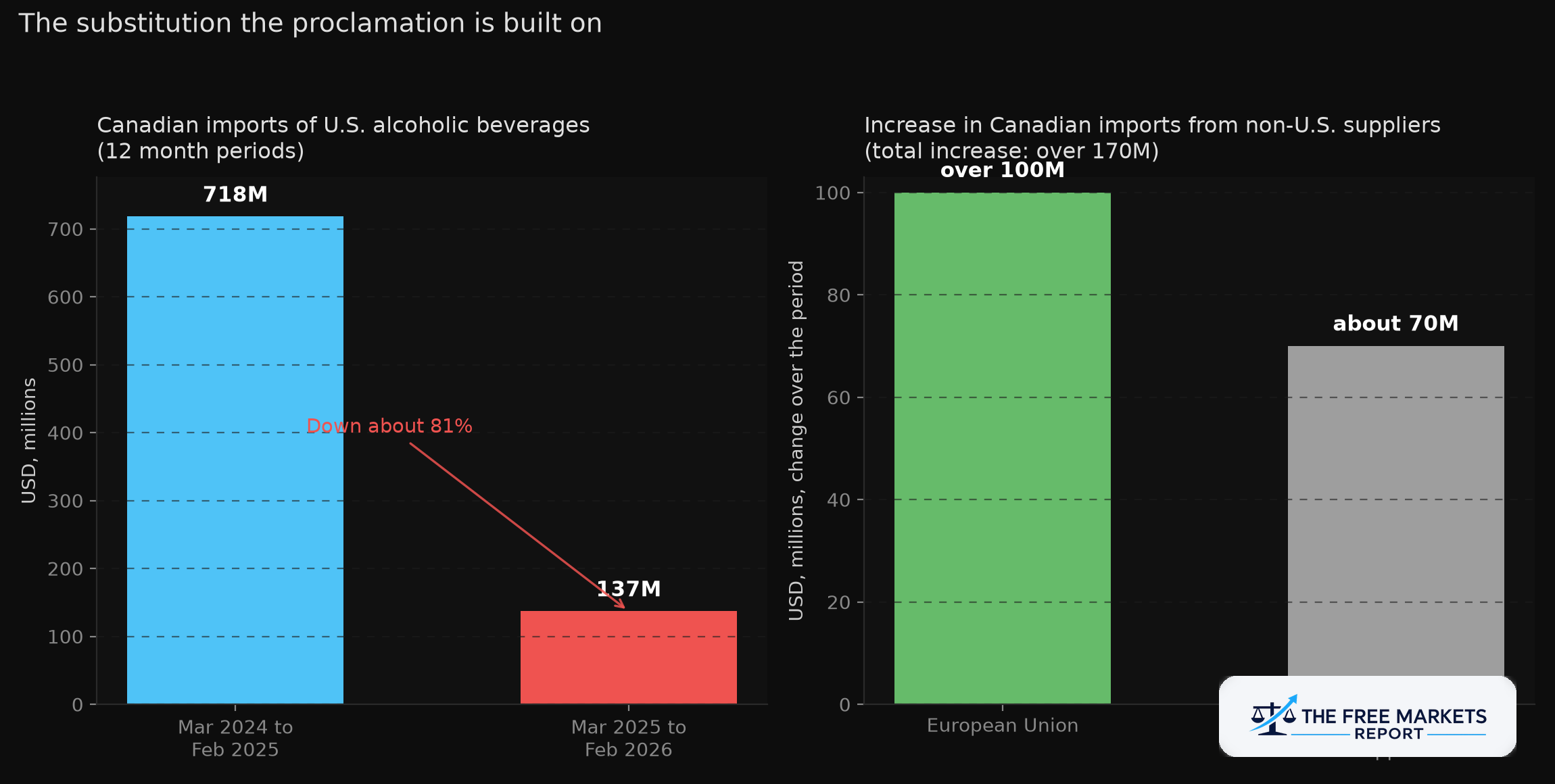
The document is narrower than the coverage suggests. It finds that beginning in March 2025 every Canadian province and territory halted the purchase, distribution, or retailing of U.S. alcoholic beverages, citing the Liquor Control Board of Ontario's March 4, 2025 decision to stop purchasing U.S. products, and notes that only Alberta and Saskatchewan reversed course, in June 2025.1 On that record it invokes Section 338, which permits duties of up to 50% to offset discrimination against U.S. commerce and requires 30 days before taking effect.1,4
Annex II is where the money is. The duty attaches under heading 9903.03.12 and reaches beer, wine, cider, ethyl alcohol, brandy, whiskies, rum, gin, vodka, and liqueurs, plus wooden tableware, paper, and ice hockey sticks.2 Two features matter most to importers: USMCA compliant goods receive no exemption, and the duty is additive to the general rates in chapters 1 through 97.2,3
The market is pricing the off ramp
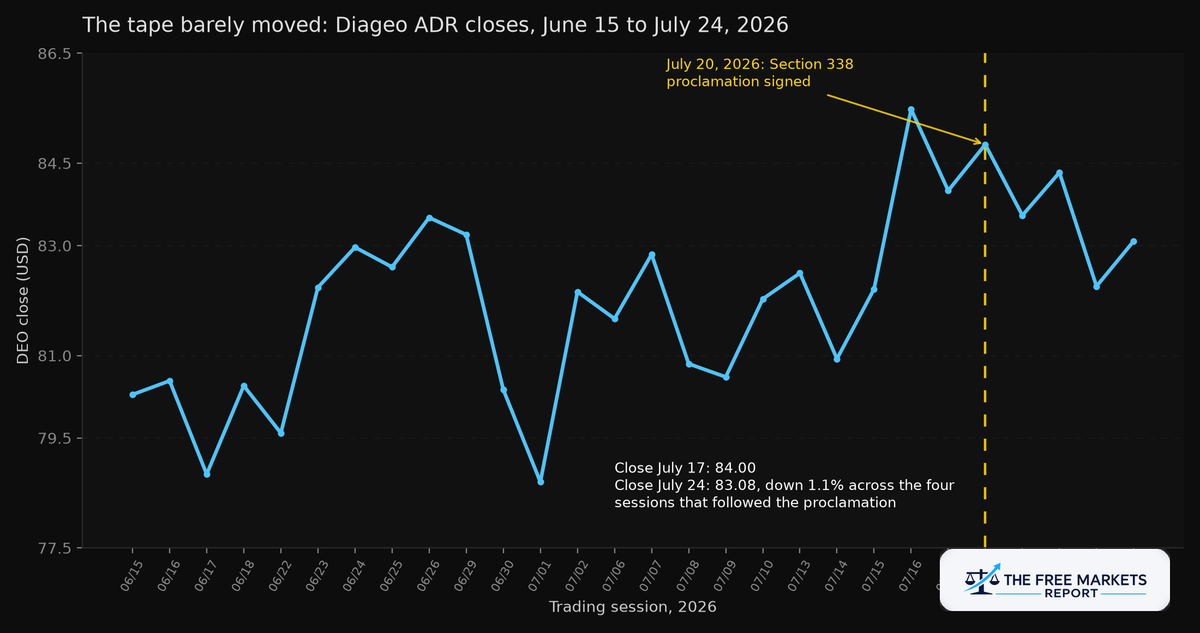
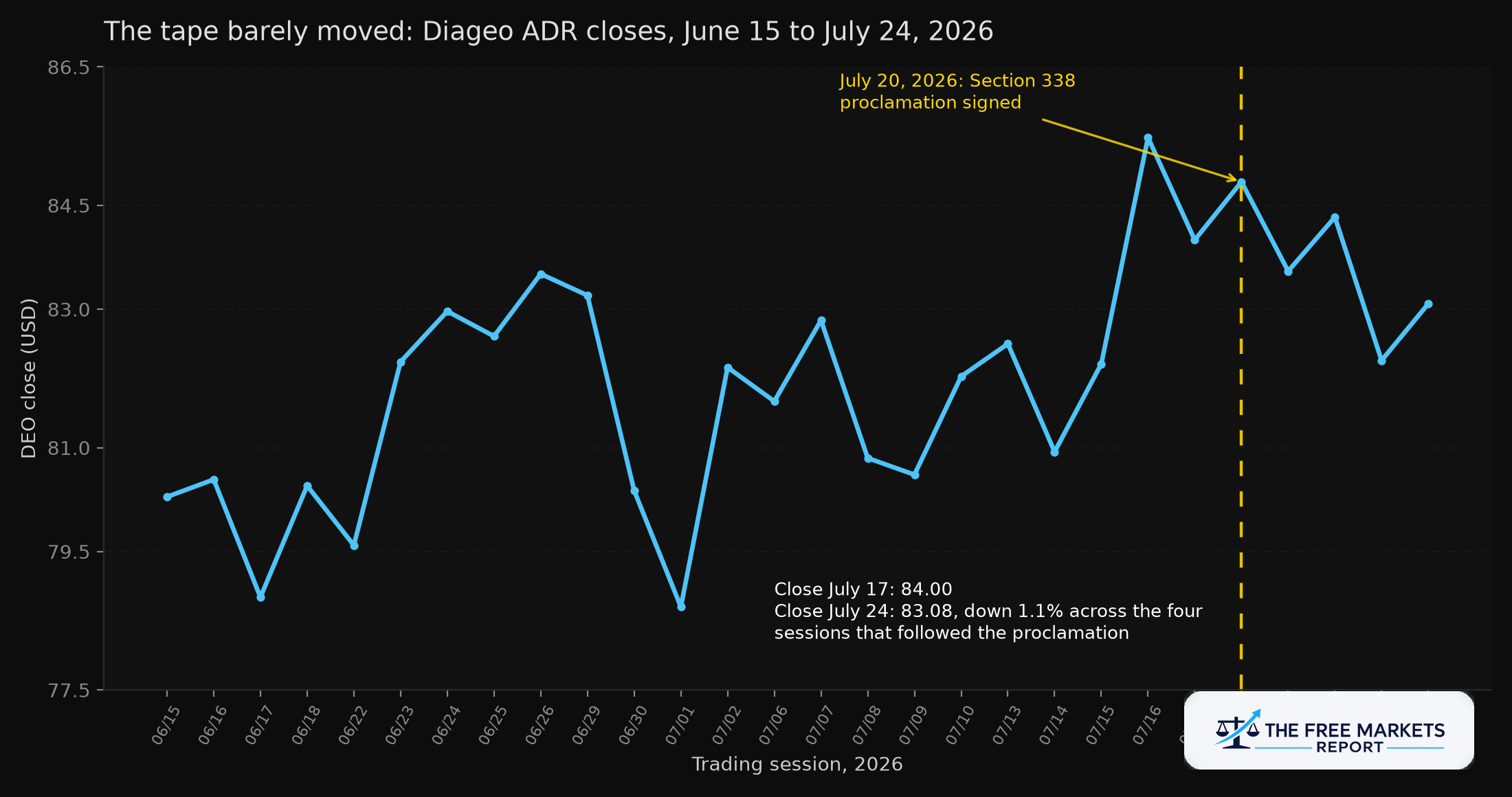
Start with the numbers. Diageo's ADR closed at 84.00 on July 17, the last session before the proclamation, and at 83.08 on July 24, a 1.1% decline inside a thirty day range spanning 78.70 to 85.48.6 That is noise. The reflexive read is that the market missed the action. The more defensible read is that it understood the statute. Section 338 lets the President suspend, revoke, or amend the duty at will, and within 48 hours Prime Minister Mark Carney said the two leaders had agreed to intensify negotiations, adding that provinces should lift their alcohol bans only as part of a broader agreement.1,7 The 30 day runway is a negotiation window, not an accident of drafting.
Where the financial mechanics point
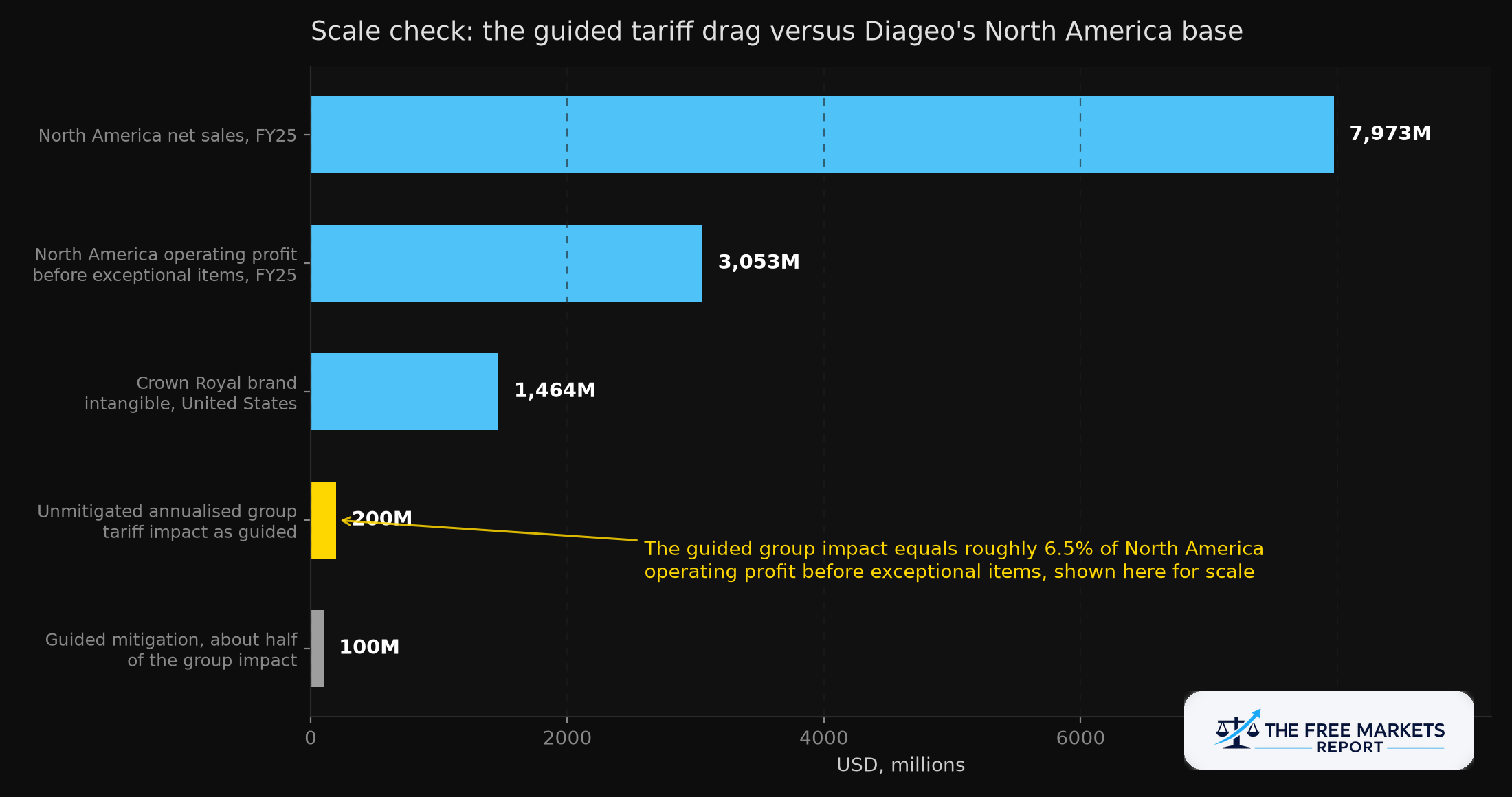
Diageo is the cleanest listed expression of this because it published the assumption the proclamation breaks. In its fiscal 2025 Form 20-F it put the unmitigated annualised impact of then current tariffs at about $200 million, assuming 10% on UK imports, 15% on European imports, and that "Mexican and Canadian spirits imports into the US remain exempt" under USMCA, with around half expected to be mitigated.5 The proclamation voids the Canadian leg of that assumption 13 days before fiscal 2026 preliminary results on August 6, 2026.8
Three offsets sit against it. The duty is ad valorem on entered value, and Diageo said in early 2026 that it would close its Amherstburg, Ontario bottling plant and move U.S. market bottling closer to U.S. consumers.9 Bulk spirit imported for domestic bottling carries a lower entered value than finished cased goods, shrinking the taxable base. Crown Royal grew organic net sales 3% in fiscal 2025, so the pricing base is intact.5 And the scale is bounded, as Figure 3 shows.
Investment Idea
- Company: Diageo plc (DEO)
- Thesis type: Second order regulatory exposure, where the disclosed assumption changed, not the business
- Regulatory catalyst: The July 20, 2026 Section 338 proclamation, a 50% duty under HTSUS 9903.03.12 effective August 191,2
- Current price: $83.08 at the July 24, 2026 close, market capitalisation about $46.2 billion, 52 week range $72.45 to $116.416
- Key financial data: Fiscal 2025 group net sales $20,245 million; North America net sales $7,973 million and segment operating profit $3,053 million before exceptional items, a 38.3% margin; guided tariff impact about $200 million5
- Regulatory assumption removed: The USMCA exemption for Canadian spirits, named explicitly in the company's tariff guidance5
- Structural support: The duty taxes entered value, so relocating U.S. market bottling lowers the dutiable base, and Section 338 duties are revocable at any time1,9
- Bear case: Canadian provinces have shown no intention of restocking U.S. product. British Columbia's premier said there is "not a chance in hell" that U.S. alcohol returns to provincial shelves, removing the concession the duty is designed to extract.7 Section 338 permits escalation and is untested in court, so the outcome range is wide. Canada exported about $945 million of spirits to the United States in 2025, most of it whiskey and liqueurs that sit inside Annex II.10
- What to watch: The August 6 results and whether the $200 million estimate is restated; the Customs and Border Protection implementing notice; any negotiated withdrawal before August 191,8
- Time horizon: Event driven through August 19, disclosure catalyst August 6
What to watch next
The broader tell is legal. Section 338 became the instrument of choice only after the Supreme Court held in February 2026 that the International Emergency Economic Powers Act does not authorise tariffs, and after the Court of International Trade voided the Section 122 surcharge in May 2026.11 Each substitution narrows the authority.
The historical base rate for duties imposed as leverage rather than protection is that they get traded away, not collected, and that is what the four session price action is expressing. The durable question is not the rate but the entered value. Firms that can lower the dutiable base by moving finishing work inside the border keep more margin than firms whose product is finished before it crosses. Regulation that taxes a border is a structural tailwind for whoever controls the last step before it.
- The White House, "Imposing Additional Duties to Offset Canadian Discrimination Against the Commerce of the United States with Respect to Alcoholic Beverages," July 20, 2026. whitehouse.gov
- The White House, Annex II to the proclamation on Canadian alcoholic beverages (HTSUS subheading list, heading 9903.03.12), July 20, 2026. whitehouse.gov
- The White House, "Fact Sheet: President Donald J. Trump Imposes Additional Tariffs on Canada," July 2026. whitehouse.gov
- Reuters, "US imposes new 50% tariffs on $20 billion worth of Canadian products," July 20, 2026. reuters.com
- Diageo plc, Form 20-F for the fiscal year ended 30 June 2025. diageo.com
- Perplexity Finance market data, Diageo plc (DEO) daily closes and quote, pulled July 25, 2026. perplexity.ai/finance/DEO
- Reuters, "Carney says he will intensify trade talks with Trump; most premiers pledge to keep US alcohol bans," July 21, 2026. wtvbam.com
- Diageo plc, investor results calendar. diageo.com
- BBC News, "Crown Royal whisky plant to close in Ontario," January 14, 2026. bbc.com
- The Globe and Mail, "Spirits makers say Trump tariffs are an existential threat," July 22, 2026. theglobeandmail.com
- Thomson Reuters, "U.S. tariff authorities after IEEPA: What's left in 2026," July 7, 2026. tax.thomsonreuters.com
The Free Markets Report is provided by Lead-Lag Publishing, LLC. All opinions and views mentioned in this report constitute our judgments as of the date of writing and are subject to change at any time. Information within this material is not intended to be used as a primary basis for investment decisions, and should also not be construed as advice meeting the particular investment needs of any individual investor. Trading signals produced by The Free Markets Report are independent of other services provided by Lead-Lag Publishing, LLC, or its affiliates, and the positioning of accounts under their management may differ. Please remember that investing involves risk, including loss of principal, and past performance may not be indicative of future results. Lead-Lag Publishing, LLC, its members, officers, directors, and employees expressly disclaim all liability with respect to actions taken based on any or all of the information in this writing.