The Swarf Clause: Washington Moves To Keep America's Scrap At Home
A July 30 determination under the Defense Production Act clears the way for Commerce to restrict exports of black mass, dead magnets and swarf. It restricts nothing yet.

A July 30 determination under the Defense Production Act clears the way for Commerce to restrict exports of black mass, dead magnets and swarf. It restricts nothing yet.
Key Highlights
- A July 30, 2026 determination under Section 101 of the Defense Production Act covers black mass, end-of-life rare earth magnets, swarf and other critical mineral scrap.
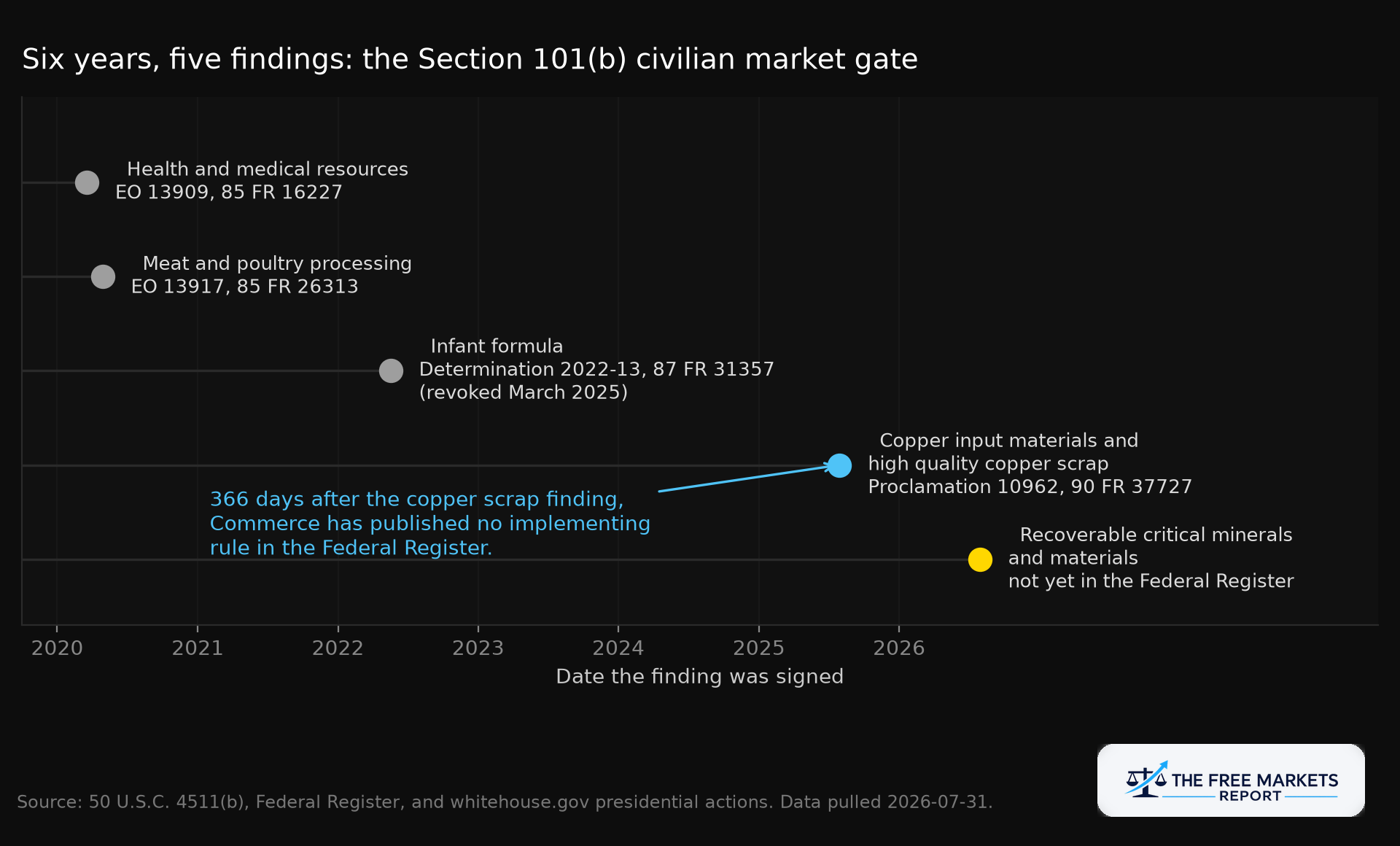
- Copper scrap is carved out as "already covered under Proclamation 10962 of July 30, 2025," which carried the identical Section 101(b) finding a year earlier to the day.
- The determination grants the Secretary of Commerce the authority to institute export restrictions on those materials.
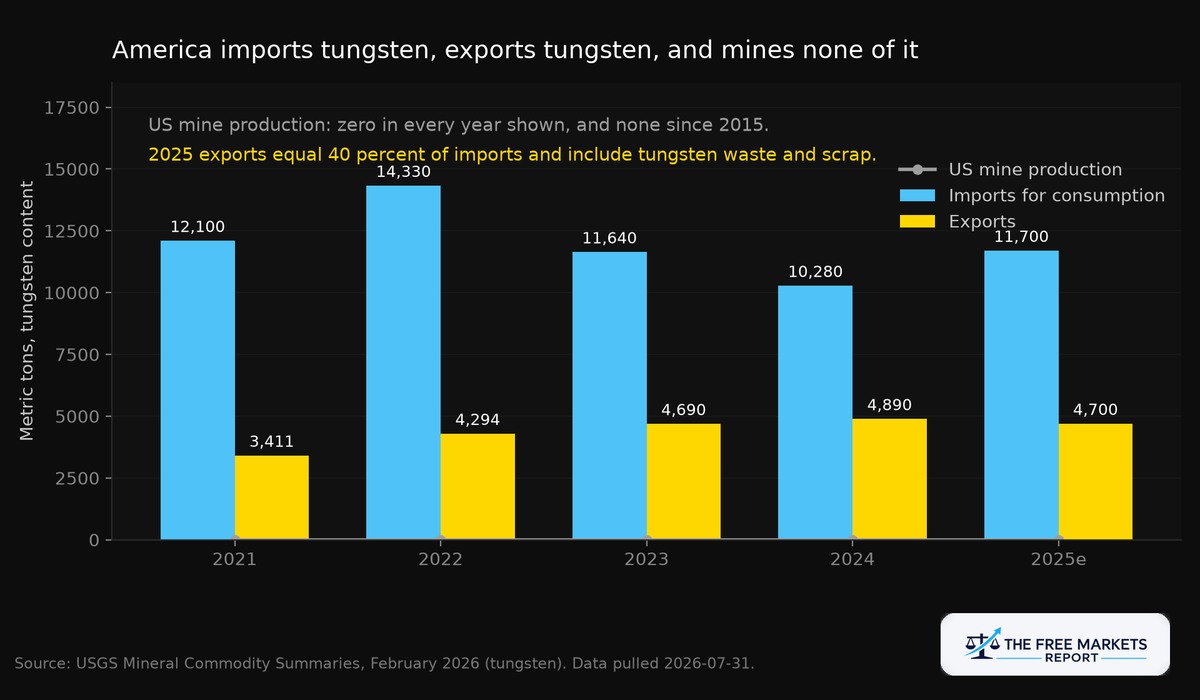
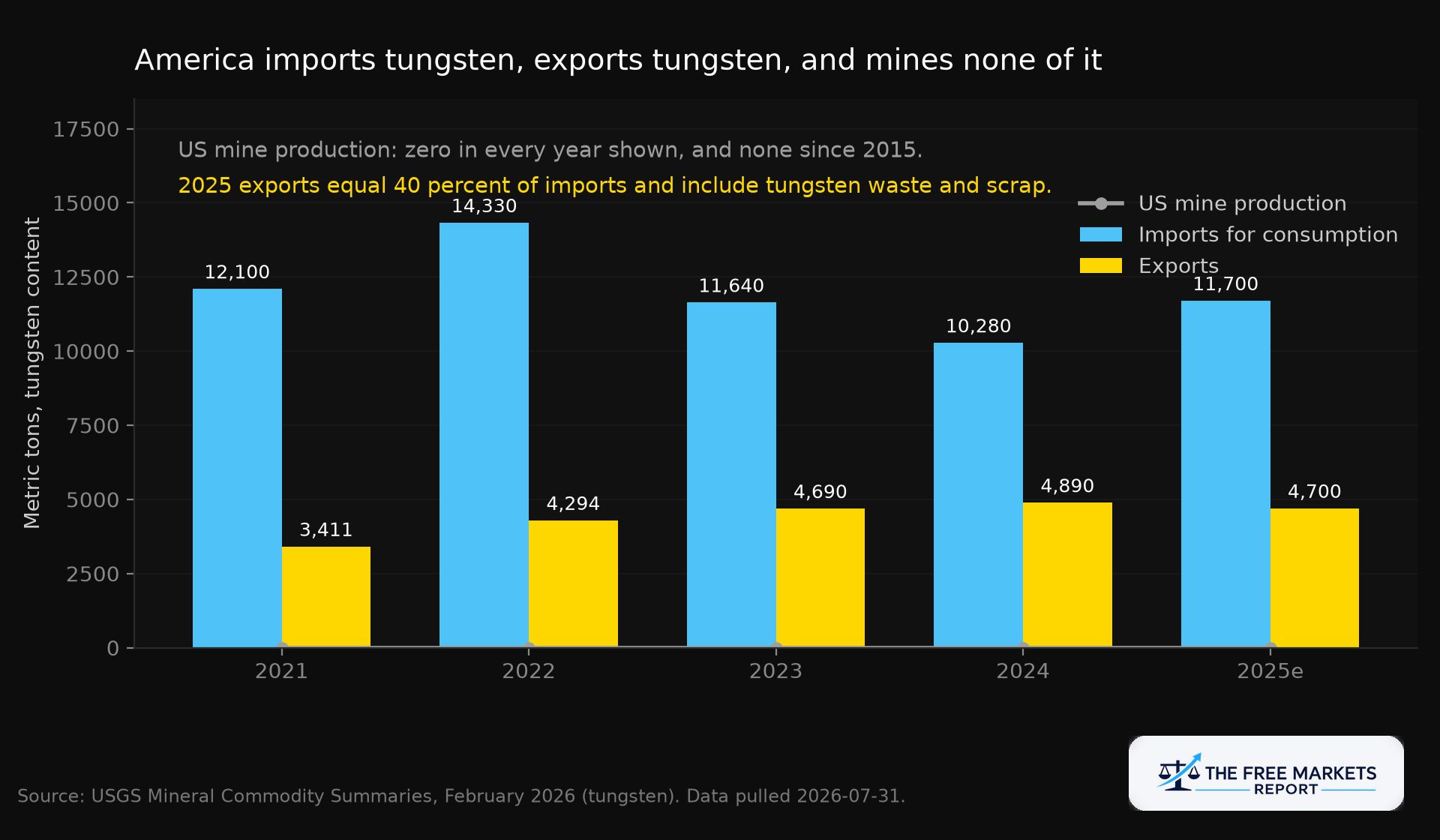
- Tungsten is the sharpest case: no US commercial mining since 2015, yet an estimated 4,700 tons of contained tungsten exported in 2025, including waste and scrap.
- Pace is the risk. Only one Federal Register document since August 2025 mentions the copper "domestic sales requirement," and it is Proclamation 10962 itself.
Swarf is the grit that comes off a cutting tool. It is grey, oily and worthless looking, and until this week it was one of the least regulated commodities leaving American ports. On July 30, 2026 it acquired its own clause in a presidential determination invoking a statute written for the Korean War. The document bans no shipment. It removes the last legal obstacle between the Commerce Department and the power to tell an American recycler where its output may go.
What the Determination Actually Says
The instrument is a memorandum to the Secretary of Commerce under Section 101 of the Defense Production Act of 1950, codified at 50 U.S.C. 4511. Section 2(a) covers black mass, end-of-life rare earth permanent magnets or other goods that have fully completed the manufacturing process, swarf, and other waste and scrap containing critical minerals, with copper scrap carved out by name. Section 2(b) pulls the underlying mineral definitions from Executive Order 14241, 50 U.S.C. 98h-3 and Section 7002(a)(2) of the Energy Act of 2020, plus anything else the Secretary designates.1
Section 3(a) is the operative sentence. It makes the two findings that 50 U.S.C. 4511(b) requires before the allocation power can touch the civilian economy: that the materials are scarce and critical materials essential to the national defense, and that defense requirements cannot be met without significant dislocation of normal civilian distribution to a degree creating appreciable hardship.3 Section 3(b) hands implementation to Commerce under Executive Order 13603 and directs publication in the Federal Register.
Those findings are the whole point. Everything else is scope.
Why Tungsten Is the Test Case
Reuters, citing two White House officials, reported that the order targets tungsten and battery black mass, and that Commerce may use it to block exports of electronic waste running at nearly 33,000 metric tons a month by the Basel Action Network's count.13 The tungsten arithmetic explains that choice.
The United States has not mined tungsten commercially since 2015, and net import reliance has exceeded half of apparent consumption in every year since 2021. Roughly 60 percent of domestic consumption goes into cemented carbide parts, and only seven US companies convert concentrate, oxide or scrap into powder.8 In a country with no mine, scrap is not a waste stream. It is the ore body.
Price has already moved without any of this. USGS records Rotterdam 65 percent concentrate rising from roughly $266 to $551 per metric ton unit during 2025, and ammonium paratungstate from $331 to $675, after China's February 2025 export controls on selected tungsten items.8
The Company Whose Raw Material Is Literally Scrap
Kennametal Inc. (KMT) has made tungsten carbide tooling since 1938. Its fiscal 2025 Form 10-K states plainly that its major metallurgical raw materials consist of tungsten ore concentrates and scrap carbide, and that its internal tungsten recycling capability provides access to additional sources of tungsten.9 Its US metallurgical powder plants sit in Alabama, Nevada and North Carolina.
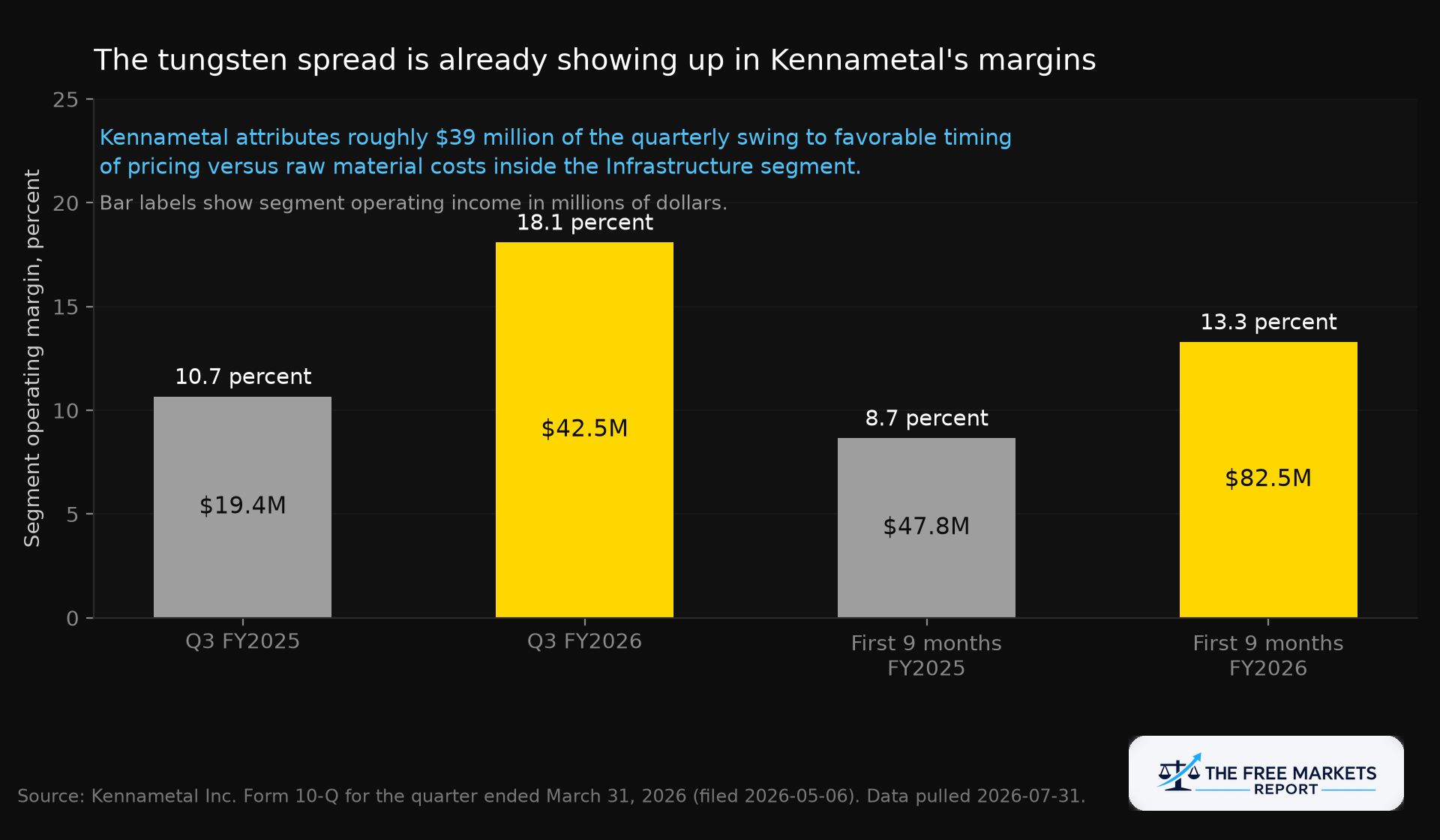
The income statement already shows what a widening spread between input costs and tool pricing does. In the March 2026 quarter sales reached $592.6 million against $486.4 million, operating income $79.4 million against $44.1 million, and diluted earnings per share $0.75 against $0.41. Management attributes the swing to the favorable timing of pricing compared to raw material costs of approximately $39 million within the Infrastructure segment.10
The mechanism is unglamorous. A rule keeping carbide swarf and dead tooling onshore enlarges the domestic pool of the exact input Kennametal converts, when the alternative is imported concentrate priced off a Rotterdam quote that doubled last year.
Not the Magnet Waiver Order
The determination is frequently conflated with an executive order signed ten days earlier, covered in our July 21 report on the Pentagon's magnet loophole closure.13 They are legally unrelated. The July 20, 2026 order tightens the conditions under which defense contractors can obtain waivers from domestic sourcing rules, working on the procurement side of the ledger against a January 1, 2027 deadline for the defense industry to stop purchasing Chinese minerals.
The July 30 determination is an allocation authority aimed at the civilian market. Under 15 CFR 700.33(b), a directive can require a person to stop or reduce production of an item, to prohibit the use of selected materials, or to divert the use of materials, services, or facilities from one purpose to another, and willful violation is a crime under 15 CFR 700.74(a).4 One mechanism narrows who may supply a defense contract. The other reaches into a commercial recycler's shipping decisions. Conflating them badly misstates who is exposed.
Investment Idea: Kennametal Inc. (KMT)
- Thesis type: Second-order beneficiary
- Deregulatory catalyst: The July 30, 2026 determination under Section 101 of the Defense Production Act, which makes the 50 U.S.C. 4511(b) findings for black mass, end-of-life magnets, swarf and other critical mineral scrap and directs Commerce to implement restrictions under Executive Order 13603.
- Current price: $33.97 following the July 31, 2026 session, up 1.95 percent, market capitalization approximately $2.59 billion, trailing price to earnings about 17.7, 52 week range $17.62 to $43.81.
- Key financial data: Fiscal 2025 sales of $1,966.8 million with Infrastructure at $747.2 million. Third quarter fiscal 2026 sales of $592.6 million, operating income of $79.4 million at a 13.4 percent margin, diluted EPS of $0.75, Infrastructure margin 18.1 percent against 10.7 percent. Quarterly dividend of $0.20 declared July 28, 2026, payable August 25, 2026.
- Regulatory constraint removed: The findings lift the statutory bar in 50 U.S.C. 4511(b), and the matching condition in 15 CFR 700.32, that has kept Commerce from issuing allocation directives reaching general civilian distribution of carbide swarf and other tungsten bearing scrap.
- Case for the exposure thesis: If Commerce issues a directive keeping carbide swarf and end-of-life tooling inside the United States, domestic converters gain a larger and cheaper feedstock pool while the imported alternative stays priced off a Rotterdam quote that roughly doubled during 2025. Kennametal has already shown the sensitivity, turning a favorable input-cost-versus-price spread of about $39 million into a 740 basis point year over year gain in Infrastructure margin in one quarter.
- Bear case for the exposure thesis: The determination restricts nothing on its own, and the copper finding has produced no implementing rule in 366 days. Roughly 60 percent of fiscal 2025 revenue is non-US and the company holds a Bolivian tungsten concentrate operation, so a US-only scrap restriction is not a clean positive. The margin gain is explicitly timing of pricing versus raw material costs, a spread that can compress.
- What to watch, and what falsifies this: Publication in the Federal Register, then any Bureau of Industry and Security or Defense Priorities and Allocations System notice naming swarf, black mass or tungsten waste and scrap. On the company side, whether Infrastructure holds a mid-teens operating margin once the timing benefit annualizes. If neither materializes within the time horizon below, the thesis is wrong.
- Time horizon: 6 to 18 months, event driven on any first implementing rule.
Bear Case
The determination restricts nothing, and the precedent for how long nothing can last is unusually precise.
Proclamation 10962, signed July 30, 2025, made the identical Section 101(b) finding for copper input materials and high quality copper scrap, and Commerce's June 30, 2025 Section 232 report had already recommended a phased 25 percent domestic sales requirement plus export controls on that scrap.5 A Federal Register search for that phrase across everything published since August 1, 2025 returns one document, the proclamation itself.6 Three hundred sixty six days on, no implementing rule exists. The new determination was itself unpublished and not on public inspection as of July 31, 2026, with no implementation date recorded.7,15
Three further reasons for restraint. The allocation power is not an export control statute; a literal export license lives in the Export Administration Regulations, unamended for this purpose, and 15 CFR 700.31 requires Commerce to build a written plan including an evaluation of civilian market impact before acting.4 The pure play recyclers are ambiguous beneficiaries: American Battery Technology Company (ABAT) reported March 2026 quarter revenue of $7.8 million against $1.0 million, crediting higher market prices for black mass and mixed metals byproducts, against a $33.8 million quarterly net loss.12 A company that markets black mass into the open market is not obviously helped by a rule shrinking its addressable market. And roughly 60 percent of Kennametal's fiscal 2025 revenue came from outside the United States, with a tungsten concentrate operation in La Paz, Bolivia, so a US scrap restriction cuts across its own network.9
The Principle
A presidential finding is not a rule. It is the removal of a reason a rule cannot be written.
Markets routinely price the finding as though it were the rule, which is how a document changing no obligation moves a share price. The discipline is to hold both facts at once: the legal precondition genuinely fell on July 30, 2026, and copper has sat on the far side of the same open gate for a year with nothing walking through. The companies worth studying are those whose economics improve even if Commerce never acts, because their raw material was already scarce. Scarcity does the work. Policy only decides how fast.
- The White House, "Presidential Determination Pursuant to Section 101 of the Defense Production Act of 1950, as Amended, on Recoverable Critical Minerals and Materials," July 30, 2026. whitehouse.gov
- The White House, "Fact Sheet: President Donald J. Trump Delegates Defense Production Act Authority With Respect to Recoverable Critical Minerals and Materials That Are Essential to Our National Defense," July 30, 2026. whitehouse.gov
- 50 U.S.C. 4511, "Priority in contracts and orders," Office of the Law Revision Counsel, United States Code, retrieved July 31, 2026. uscode.house.gov
- 15 CFR Part 700, Defense Priorities and Allocations System, sections 700.30 through 700.34 and 700.74, eCFR text as of July 30, 2026. ecfr.gov
- Proclamation 10962, "Adjusting Imports of Copper Into the United States," signed July 30, 2025, 90 FR 37727, published August 5, 2025. federalregister.gov
- Federal Register API query, documents containing the phrase "domestic sales requirement" published on or after August 1, 2025, run July 31, 2026, one result returned. federalregister.gov
- Federal Register public inspection desk, current documents, checked July 31, 2026, no entry for the Recoverable Critical Minerals and Materials determination. federalregister.gov
- US Geological Survey, Mineral Commodity Summaries, February 2026, tungsten chapter. pubs.usgs.gov
- Kennametal Inc., Form 10-K for the fiscal year ended June 30, 2025, filed August 12, 2025, SEC EDGAR. sec.gov
- Kennametal Inc., Form 10-Q for the quarterly period ended March 31, 2026, filed May 6, 2026, SEC EDGAR. sec.gov
- Kennametal Inc., Form 8-K reporting board actions taken July 28, 2026, SEC EDGAR. sec.gov
- American Battery Technology Company, Form 10-Q for the quarterly period ended March 31, 2026, filed May 11, 2026, SEC EDGAR. sec.gov
- Reuters, "Trump orders restrictions on export of critical minerals scrap, White House officials say," July 30, 2026. reuters.com
- Perplexity Finance, Kennametal Inc. quote, market capitalization, trailing price to earnings and 52 week range, retrieved July 31, 2026. perplexity.ai/finance
- Global Trade Alert, "United States of America: US administration authorises export restrictions on recoverable critical minerals and materials," implementation date recorded as none, retrieved July 31, 2026. globaltradealert.org
Related analysis
Read next: The Pentagon's magnet-loophole deadline
Read next: The tariff wall rebuilt under a different statute
The Free Markets Report is provided by Lead-Lag Publishing, LLC. All opinions and views mentioned in this report constitute our judgments as of the date of writing and are subject to change at any time. Information within this material is not intended to be used as a primary basis for investment decisions, and should also not be construed as advice meeting the particular investment needs of any individual investor. Trading signals produced by The Free Markets Report are independent of other services provided by Lead-Lag Publishing, LLC, or its affiliates, and the positioning of accounts under their management may differ. Please remember that investing involves risk, including loss of principal, and past performance may not be indicative of future results. Lead-Lag Publishing, LLC, its members, officers, directors, and employees expressly disclaim all liability with respect to actions taken based on any or all of the information in this writing.