The Pentagon Just Set an Expiration Date on China's Magnet Loophole
A new executive order tightens waivers for six critical defense materials starting January 1, 2027, and MP Materials is the only US producer standing at the center of it.

Key Highlights
- On July 20, 2026, the White House signed an executive order restricting waiver issuance under 10 U.S.C. 4872(c)(1) for six covered materials starting January 1, 2027.
- The six covered materials are samarium-cobalt magnets, neodymium-iron-boron (NdFeB) magnets, tungsten metal powder, tungsten heavy alloy, tantalum metals and alloys, and molybdenum.
- Contractors must build an "indentured Bill of Materials" mapping these supply chains, with guidance due within 180 days and implementing regulations 90 days after that.
- MP Materials (MP) is the only US company producing NdFeB magnet materials at scale, backed by a $400 million DoD equity stake and a $110/kg price floor on its output.
- China controls roughly 90% of global rare-earth magnet processing capacity and roughly 80% of tungsten supply, the exact concentration the new deadline targets.
The magnet inside a jet engine's actuator does not care which political party signed the paperwork that let it come from a Chinese-linked supplier. It cares whether it is there when Lockheed Martin (LMT) needs to build the part. On July 20, 2026, the White House signed an executive order that puts a hard date on how much longer that magnet is allowed to keep coming from where it currently comes from.
A Wartime-Era Statute Gets a 2027 Deadline
The order is titled "Securing America's Defense Supply Chains and Ensuring Domestic Acquisition of Critical Materials." Its operative mechanism sits in Section 2(a): waivers issued under 10 U.S.C. 4872(c)(1) for "covered materials" will no longer be available starting January 1, 2027, except where a contractor has an approved mitigation plan on file. That is a specific, dated legal trigger, not a general call for "buying American."
Section 4872 defines six covered materials: samarium-cobalt magnets, neodymium-iron-boron magnets, tungsten metal powder, tungsten heavy alloy, tantalum metals and alloys, and molybdenum. It names four "covered nations": North Korea, China, Russia, and Iran. This is a distinct provision from 10 U.S.C. 4871, the specialty metals restriction covering steel, titanium, and nickel-cobalt alloys, and from the Berry Amendment (10 U.S.C. 4862), governing textiles and food. The order invokes only 4872.
One clarification matters for how new this actually is. The January 1, 2027 date is not new. A DFARS final rule issued in May 2024, implementing Section 844 of the FY2021 NDAA as extended by Section 854 of the FY2024 NDAA, already set January 1, 2027 as the date the underlying sourcing restriction expands from "melted or produced" to the full upstream chain, mined, refined, separated, melted, or produced, for these same six materials. What this order adds is narrower and more specific: Section 2(a) closes the waiver pathway under 10 U.S.C. 4872(c)(1) and (e) on that same date, so a contractor that could previously get an exception by showing compliant material was unavailable now needs an approved mitigation plan instead. The deadline was already coming. This order removes one of the ways around it.
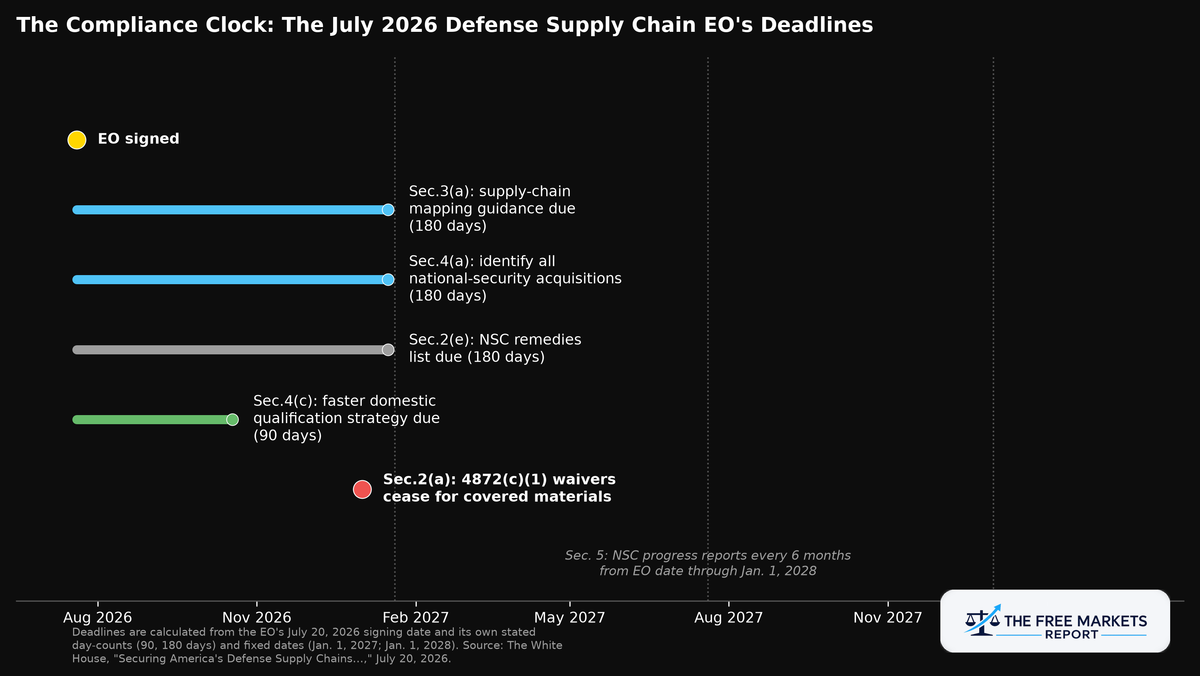
Start with the mechanics, because they are what actually changes contractor behavior. Section 3(a) directs the Department of War, the order's terminology for Defense, to issue supply-chain mapping guidance within 180 days, with implementing regulations 90 days after that. Section 4(a) requires an assessment of domestic sourcing alternatives within 180 days, and Section 4(c) requires a faster qualification pathway for new suppliers within 90 days. Section 5 requires National Security Council reporting every six months through January 1, 2028. Contractors must produce an "indentured Bill of Materials," a supplier-by-supplier map tied to corrective-action timelines.
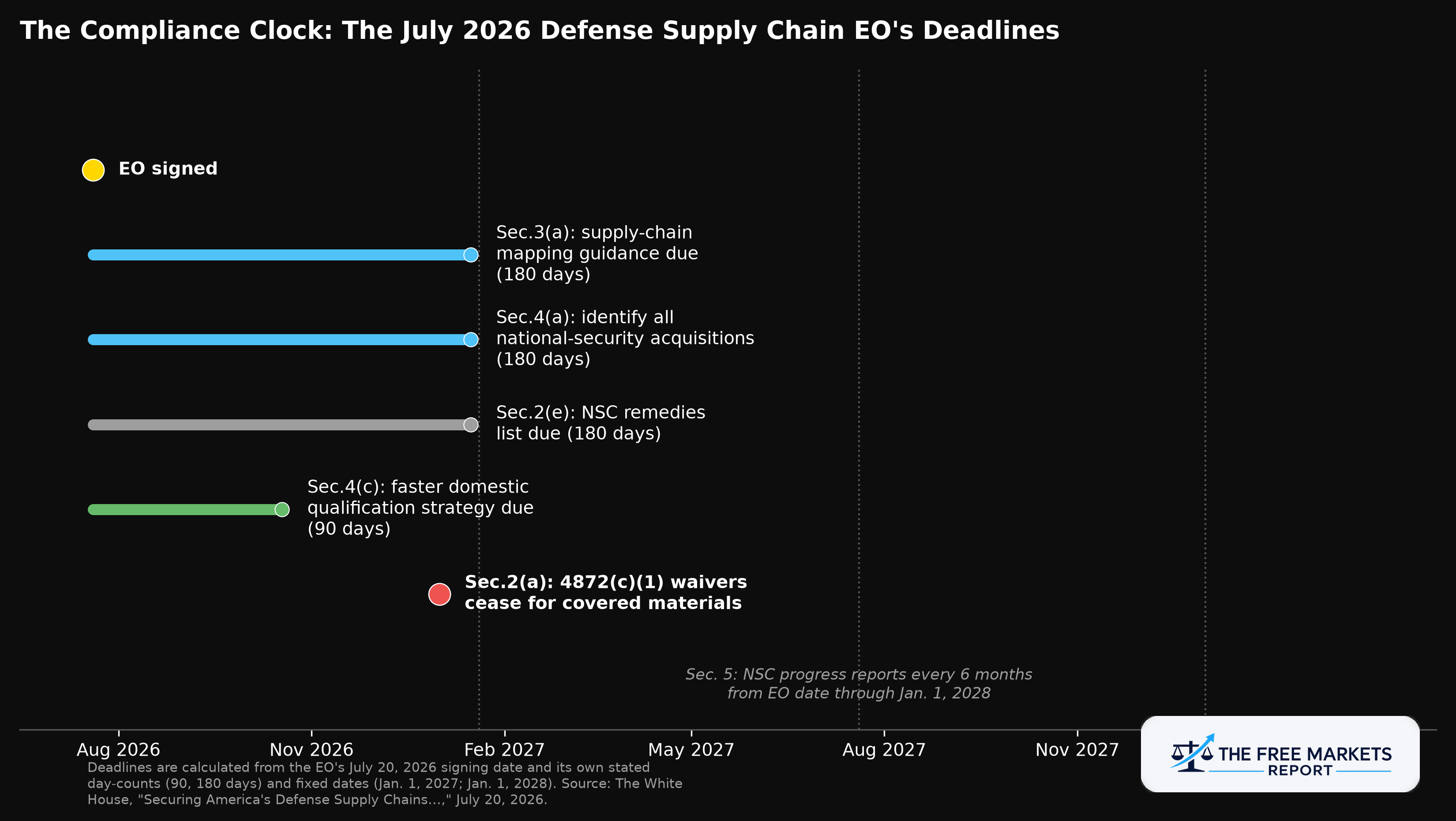
Figure 1: The order compresses four separate deadlines, ranging from 90 days to 18 months, into a single compliance calendar that ends with the January 1, 2027 waiver cutoff. Source: White House, "Securing America's Defense Supply Chains and Ensuring Domestic Acquisition of Critical Materials," July 20, 2026.
Why the Waiver Mattered in the First Place
Waivers under Section 4872(c)(1) exist because the alternative, for years, was not viable. The United States has not mined tantalum domestically since 1959. Tungsten concentration is starker still: China accounts for roughly 80% of global tungsten supply. For neodymium-iron-boron and samarium-cobalt magnets, the concentration is on the processing side. China controls an estimated 90% of global rare-earth magnet processing capacity, meaning even non-Chinese mined material often still passes through Chinese refining before reaching a US defense contractor.
That is the constraint this order targets. Waivers under 4872(c)(1) let contractors keep buying from covered nations while domestic capacity caught up. Ending that path on a fixed date, with a mitigation-plan exception as the only escape valve, converts open-ended tolerance into a forcing function with a real deadline.
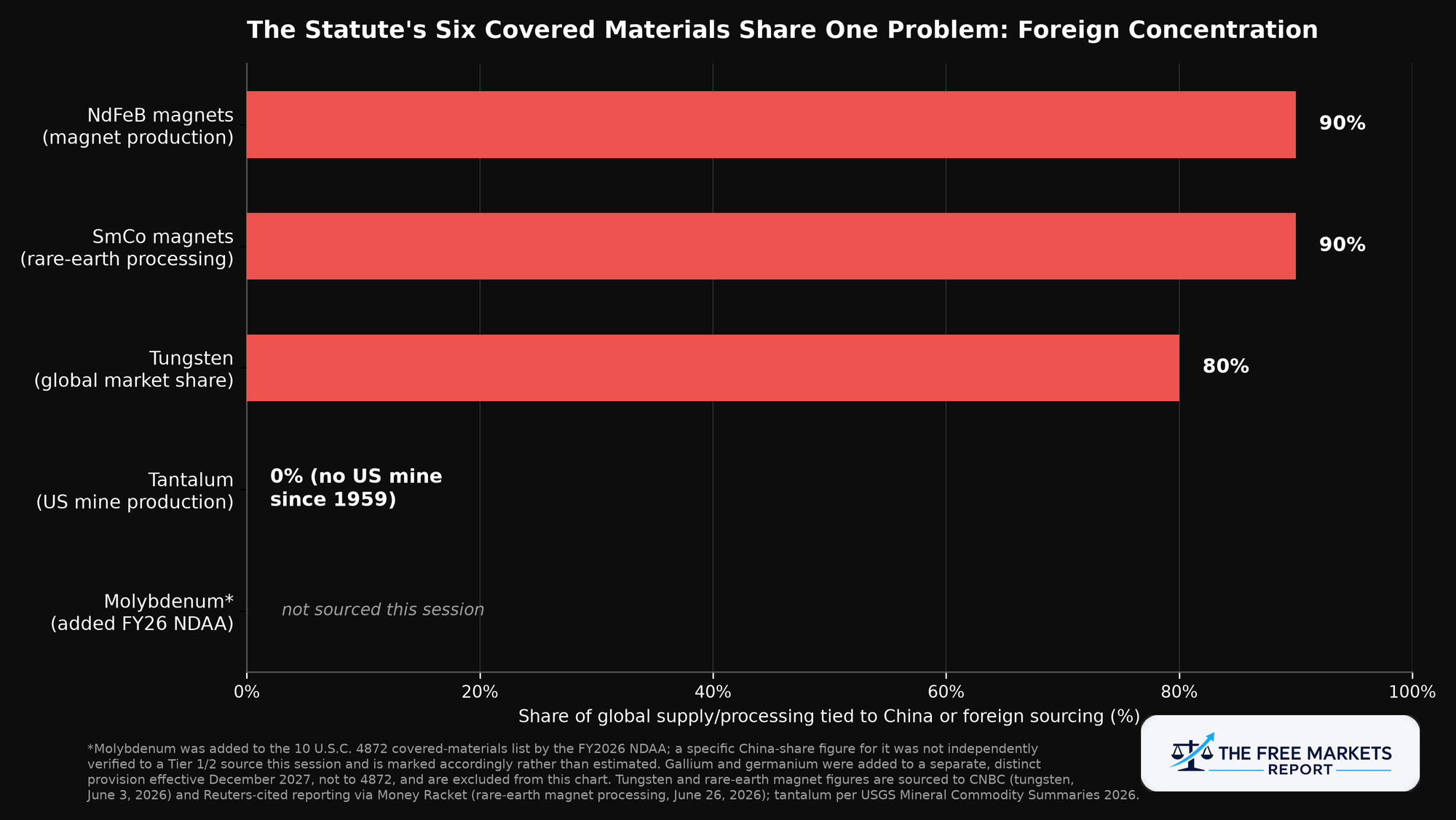
Figure 2: Four of the six materials under 10 U.S.C. 4872 have no meaningful US production base at all; the order's compliance clock runs against that reality. Source: CNBC reporting on Pentagon tungsten assessments; USGS Mineral Commodity Summaries 2026; Money Racket analysis of rare-earth magnet processing concentration.
The Company Already Betting on This Exact Deadline
MP Materials (MP) is the only US company mining rare earths and processing them into finished NdFeB magnets at commercial scale, placing it directly inside the statute's covered-materials list. In July 2025, the Department of Defense took a $400 million equity stake in MP as Series A preferred stock, paired with a $1 billion JPMorgan-arranged loan. The same partnership set a $110-per-kilogram price floor for neodymium-praseodymium oxide, roughly double prevailing Chinese pricing, under a 10-year offtake agreement.
MP has kept building downstream capacity since. In February 2026, the company selected a site in Northlake, Texas for its "10X" magnet manufacturing facility, a $1.25 billion buildout. The company is not a speculative bet on future policy. It is already the counterparty the Department of Defense chose before this order existed.
As of July 21, 2026, MP traded at $46.30, up 1.31% on the day, with a market cap of approximately $8.24 billion. The 52-week range runs from $43.82 to $100.25, so shares sit near the bottom of that band despite the DoD partnership. Over the trailing year, MP is up approximately 45% on a weekly-close basis, from $31.84 in early July 2025 to $46.30 today.
The Case for Skepticism
The consensus read on a defense-supply-chain executive order is that it is an unambiguous, immediate win for the named domestic beneficiary. The primary source does not fully support that read. The order's own text builds in an exception: contractors with an approved mitigation plan can continue receiving waivers past January 1, 2027. The deadline's practical bite depends on how strictly the Department of War defines an acceptable mitigation plan, a determination not yet public and not due until the 180-day guidance is issued.
Execution risk sits on the domestic side too. MP's finished-magnet buildout is multi-year, and the Texas facility is not yet in commercial production. Tantalum has had zero domestic mining capacity since 1959; this order changes only the incentive to find an alternative, not the fact itself. Molybdenum is a partial exception worth naming honestly: unlike the other five materials, the US has meaningful domestic molybdenum production, and this analysis found no fresh sourcing data indicating acute contractor exposure there, so that gap is disclosed rather than filled with an estimate.
Political and legal reversal risk applies too. Executive orders can be amended by subsequent administrations, and the DFARS rule tied to this statute, referenced in secondary sources as DFARS 252.225-7052, has itself been amended repeatedly as Congress expanded the covered-materials list. The falsification condition is specific: if the 180-day mapping guidance defines mitigation plans broadly enough that covered-nation sourcing continues largely unchanged, the forcing-function thesis fails regardless of what the order's text says today.
Investment Idea
INVESTMENT IDEA: MP Materials Corp. (MP)
Thesis type: Primary beneficiary
Deregulatory catalyst: The July 20, 2026 order tightens waivers under 10 U.S.C. 4872(c)(1) for NdFeB and SmCo magnets, the two categories where MP is the only vertically integrated US producer.
Current price: $46.30 as of July 21, 2026 (after-hours).
Key financial data: $400 million DoD Series A Preferred equity stake plus $1 billion JPMorgan loan facility (July 2025); 10-year offtake at a $110/kg neodymium-praseodymium price floor, roughly double contemporaneous Chinese pricing; $1.25 billion Texas "10X" magnet facility (February 2026).
Regulatory constraint removed: The waiver pathway allowing contractors to keep sourcing NdFeB and SmCo magnets from covered nations closes January 1, 2027 absent an approved mitigation plan.
Bull case: If the 180-day guidance defines mitigation plans narrowly, primes with Chinese-linked magnet exposure, including Lockheed Martin (LMT) and RTX Corp. (RTX), face a real qualification deadline, and MP is the only company with mined feedstock and finished-magnet capacity already under construction domestically. The government's price floor and equity stake backstop MP's realized pricing regardless of spot rare-earth moves.
Bear case: A loosely defined exception could let covered-nation sourcing continue in practice, and MP's Texas facility is not yet in commercial production, so the supply gap may persist past January 2027 regardless of the statute's text. MP shares are already up roughly 45% over the trailing year and sit well below their 52-week high of $100.25, showing the market has rewarded the DoD partnership while staying skeptical of further upside.
What to watch: Publication of the Section 3(a) supply-chain mapping guidance, due by roughly mid-January 2027, and whether it narrows or broadens the mitigation-plan exception.
Time horizon: 18-36 months, tied to the January 2027 waiver cutoff and the multi-year manufacturing buildout.
Sector context: ITA (iShares U.S. Aerospace & Defense ETF) and REMX (VanEck Rare Earth and Strategic Metals ETF) offer diversified exposure. ITA traded at $229.74, market cap roughly $14.39 billion, up roughly 23% over the trailing year. REMX traded at $71.95, up 3.01% on the day and roughly 72% over the trailing year, showing the sector re-rated meaningfully before this order existed.
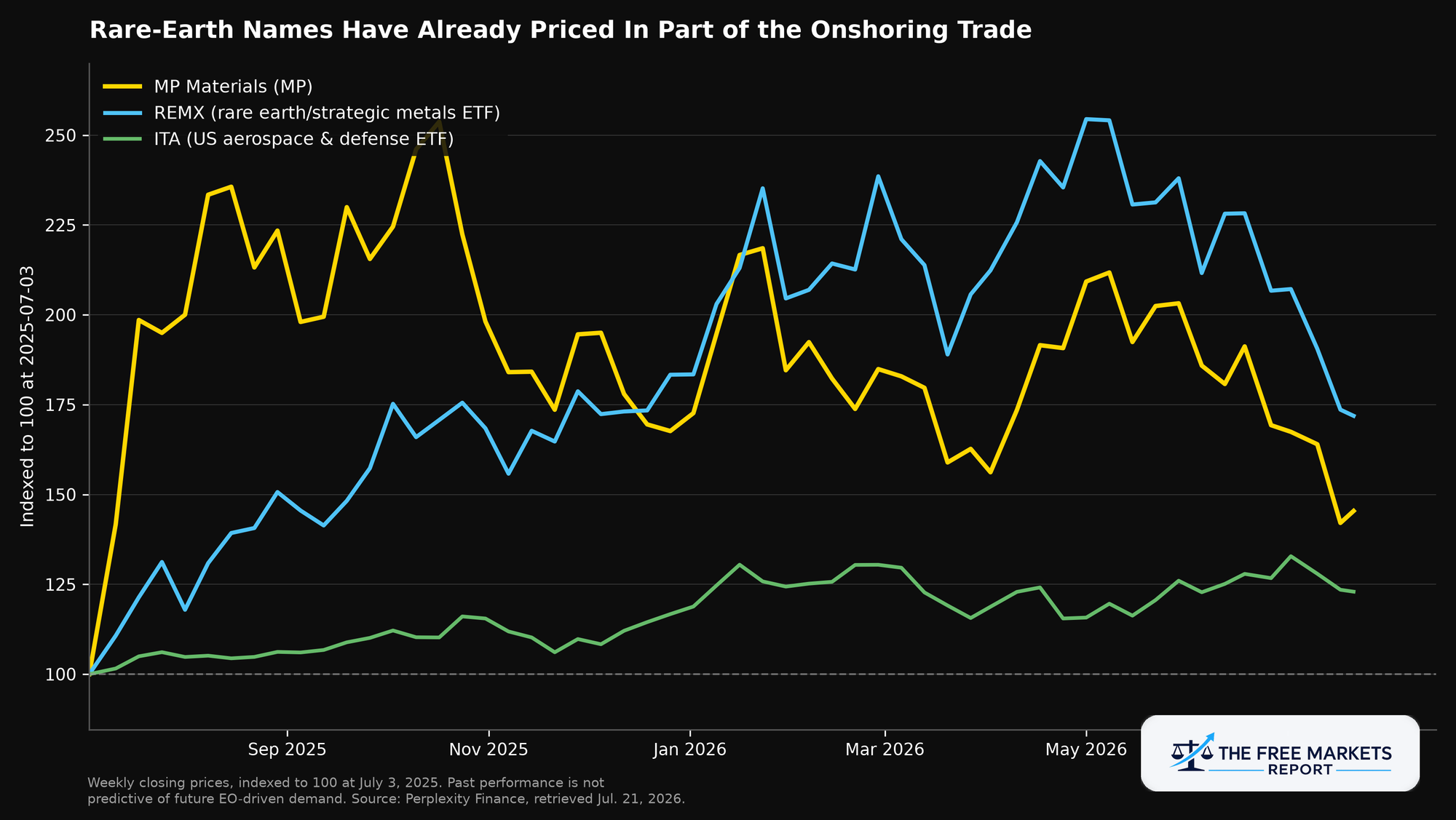
Figure 3: Indexed to 100 as of July 3, 2025, REMX's roughly 72% trailing one-year gain and MP's roughly 45% gain both outpaced ITA's roughly 23% gain, suggesting the market priced a rare-earth security premium well before this specific executive order existed. Source: Perplexity Finance historical pricing data, weekly closes, July 3, 2025 to July 21, 2026.
The Principle
A waiver deadline is not a subsidy. It is a forcing function with a date attached, and forcing functions only work if the exception clause underneath them is narrow. The market has already priced the rare-earth security story once, before this order existed. What remains to price is not whether Washington wants a domestic magnet supply chain. It is whether January 2027's guidance forces one into existence, or gives the old sourcing pattern a new form to file.
The Free Markets Report is provided by Lead-Lag Publishing, LLC. All opinions and views mentioned in this report constitute our judgments as of the date of writing and are subject to change at any time. Information within this material is not intended to be used as a primary basis for investment decisions, and should also not be construed as advice meeting the particular investment needs of any individual investor. Trading signals produced by The Free Markets Report are independent of other services provided by Lead-Lag Publishing, LLC, or its affiliates, and the positioning of accounts under their management may differ. Please remember that investing involves risk, including loss of principal, and past performance may not be indicative of future results. Lead-Lag Publishing, LLC, its members, officers, directors, and employees expressly disclaim all liability with respect to actions taken based on any or all of the information in this writing.
Footnotes
- The White House, "Securing America's Defense Supply Chains and Ensuring Domestic Acquisition of Critical Materials," Executive Order, July 20, 2026. https://www.whitehouse.gov/presidential-actions/2026/07/securing-americas-defense-supply-chains-and-ensuring-domestic-acquisition-of-critical-materials/
- 10 U.S.C. § 4872, "covered material" and "covered nation" definitions. U.S. House Office of the Law Revision Counsel. https://uscode.house.gov/view.xhtml?req=granuleid:USC-prelim-title10-section4872&num=0&edition=prelim ; corroborating: Pillsbury Law, "FY2026 NDAA Sourcing Restrictions: Critical Minerals & Advanced Batteries," February 17, 2026. https://www.pillsburylaw.com/en/news-and-insights/fy2026-ndaa-sourcing-restrictions-critical-minerals-advanced-batteries.html
- MP Materials Corp. company and DoD partnership overview: Reuters, "MP Materials partners with Department of Defense to boost US rare earth magnet supply," July 10, 2025. https://www.reuters.com/business/mp-materials-partners-with-department-defense-boost-us-rare-earth-magnet-supply-2025-07-10/
- Federation of American Scientists, "Unpacking the DoD and MP Materials Partnership," July 15, 2025. https://fas.org/publication/unpacking-dod-and-mp-partnership/
- Money Racket, "Rare Earth Export Curbs and Defense Primes' Exposure," June 26, 2026. https://moneyracket.com/article/rare-earth-export-curbs-defense-primes-exposure/
- CNBC, "China holds leverage over the US with control of tungsten, a metal used in weapons," June 3, 2026. https://www.cnbc.com/2026/06/03/china-metals-national-security-defense-weapons-supply-tungsten.html
- Wikipedia, "Berry Amendment" (10 U.S.C. § 4862), for statutory distinction from 10 U.S.C. § 4872. https://en.wikipedia.org/wiki/Berry_Amendment ; Congressional Research Service, "Defense Primer: The Berry Amendment," IF11226. https://www.congress.gov/crs_external_products/IF/PDF/IF11226/IF11226.2.pdf
- U.S. Geological Survey, Mineral Commodity Summaries 2026, Tantalum. https://pubs.usgs.gov/periodicals/mcs2026/mcs2026-tantalum.pdf
- Reuters, "MP Materials partners with Department of Defense to boost US rare earth magnet supply," July 10, 2025 (price floor and offtake terms). https://www.reuters.com/business/mp-materials-partners-with-department-defense-boost-us-rare-earth-magnet-supply-2025-07-10/
- CNBC, "MP Materials selects Texas for rare earth magnet manufacturing site," February 26, 2026. https://www.cnbc.com/2026/02/26/mp-materials-selects-texas-for-rare-earth-magnet-manufacturing-site.html
- Perplexity Finance, real-time quote data for MP, ITA, REMX, LMT, RTX, fetched July 21, 2026 (after-hours).
- Perplexity Finance, weekly historical OHLCV closing price data for MP, ITA, REMX, July 3, 2025 to July 21, 2026, fetched July 21, 2026.
- Federal Register, "Defense Federal Acquisition Regulation Supplement: Restriction on Certain Metal Products (DFARS Case 2021-D015)," final rule, May 30, 2024, implementing Section 844 of the NDAA for FY2021 (Pub. L. 116-283) as extended by Section 854 of the NDAA for FY2024, setting January 1, 2027 as the effective date for the expanded "mined, refined, separated" restriction under DFARS 252.225-7052. https://www.federalregister.gov/documents/2024/05/30/2024-11513/defense-federal-acquisition-regulation-supplement-restriction-on-certain-metal-products-dfars-case ; corroborating: Crowell & Moring, "DoD Expands Restrictions on Supply Chain for Certain Magnets, Tantalum, and Tungsten," June 21, 2024. https://www.crowell.com/en/insights/client-alerts/dod-expands-restrictions-on-supply-chain-for-certain-magnets-tantalum-and-tungsten