The SEC Just Flipped the Default on Paper Mail. Broadridge Is the Trade.
A new SEC proposal would make electronic delivery the default for investor disclosures, and the biggest financial mechanics run through one printing and mailing company.

Key Highlights
- The SEC proposed Regulation E-Delivery on July 16, 2026 (File No. S7-2026-25), published it in the Federal Register on July 21, and opened a comment period running through September 21, 2026.
- The rule would let issuers, funds, broker-dealers, and advisers deliver prospectuses, shareholder reports, proxy materials, trade confirmations, Form CRS, and adviser brochures electronically by default, without first getting investors to opt in.
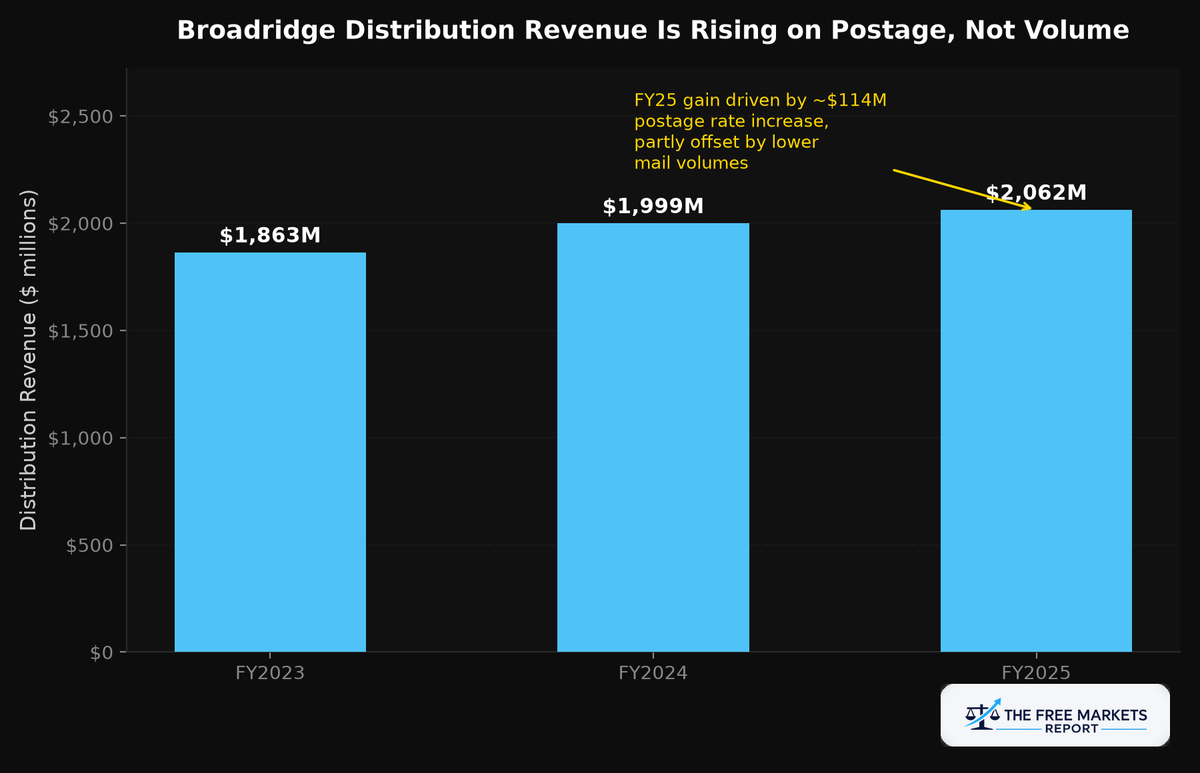
- Broadridge Financial Solutions (BR) runs the infrastructure behind most of that paper: its Distribution segment posted $2,062.0 million in revenue in fiscal 2025, up from $1,863.1 million in fiscal 2023, with the FY2025 gain driven almost entirely by a postage rate increase, not more mail volume.
- Broadridge management told analysts on its April 30, 2026 earnings call that it has already digitized nearly 90% of proxy and mutual fund communications and expects the shift to be "broadly neutral" to recurring revenue and earnings.
- The rule is a proposal, not a final mandate: it carries a 60-day effective date after any adoption plus a two-year transition period before current paper-default guidance is actually rescinded.
The SEC wants to stop treating paper as the default and start treating it as the exception. On July 16, 2026, the Commission proposed Regulation E-Delivery, a rule that would let issuers, investment companies, broker-dealers, and investment advisers satisfy most federal securities-law delivery requirements electronically, without first collecting an investor's affirmative consent to go paperless. The rule flips roughly three decades of guidance-based practice, in which electronic delivery required a documented opt-in, into an opt-out framework where paper becomes the thing investors have to request.
What the rule actually does. Filed as S7-2026-25 and published in the Federal Register on July 21, the proposal covers fund and issuer prospectuses, fund shareholder reports, proxy statements, trade confirmations, Form CRS disclosures, and Form ADV Part 2 brochures. It excludes narrower categories, like Regulation Crowdfunding materials and disclosures required solely under state or SRO rules. Investors currently on paper get two notices before any transition: one flagging the switch, one confirming their right to opt back into paper. SEC Chairman Paul Atkins put it bluntly: "In an age of artificial intelligence and blockchain technology, a default to paper delivery should be a relic, not a standard." The Commission's own survey found nearly 80% of investors prefer some form of e-delivery for documents without personal financial information, and about 63% prefer it even with such information included.
The proposal also rescinds Rule 30e-3, the existing notice-and-access alternative for fund shareholder-report transmission. That rule already lost its biggest constituency in 2022, when the SEC excluded open-end mutual funds and ETFs from relying on it, so today's rescission targets its narrower remaining base, closed-end funds, unit investment trusts, and certain insurance separate accounts, on the order of roughly 700 funds per the SEC's own most recent estimate, not the broader retail fund universe. Commissioner Hester Peirce noted the rule still requires paper requests be honored within three business days and preserves a two-year lookback window, so the framework demotes paper rather than eliminating it.
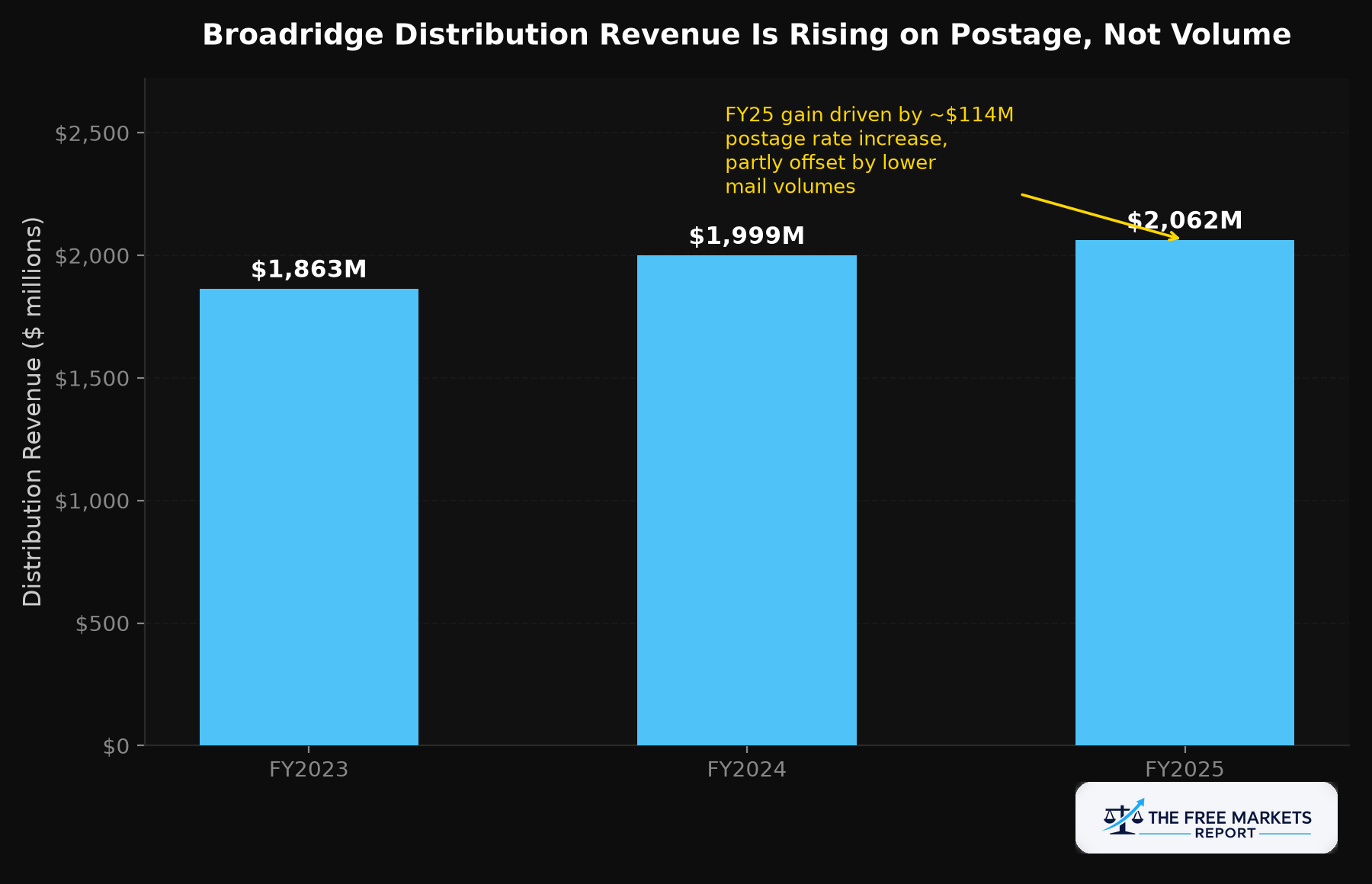
Figure 1: Broadridge's physical-mail Distribution revenue has grown for three straight fiscal years, but the FY2025 increase came almost entirely from a roughly $114 million postage rate hike, not more mail. Source: Broadridge FY2025 Form 10-K, filed Aug. 5, 2025.
The financial mechanics run through one company. Broadridge Financial Solutions is the largest processor of proxy, prospectus, and shareholder-communication mail in the country, running seven automated fulfillment facilities across North America. Its Investor Communication Solutions segment generated $5,113.0 million in fiscal 2025, roughly 74% of the company's $6,889.1 million in total revenue, with Distribution revenue of $2,062.0 million embedded inside that figure. Broadridge stock traded at $144.12 this week, giving the company a market capitalization near $16.67 billion and a price-to-earnings ratio of 15.38, against fiscal 2025 net income of $839.5 million and a net margin of roughly 12.0%.
Broadridge has already told the market what it thinks this means. On its April 30, 2026 earnings call, management said it has digitized nearly 90% of proxy and mutual fund communications, that a shift to a digital default would primarily hit "low to no margin distribution revenue," and that the net impact should be "broadly neutral." New services, like tailored shareholder reports, are expected to more than offset lost mailing revenue, with only a "modest impact" to recurring revenue growth over the next 12 to 18 months.
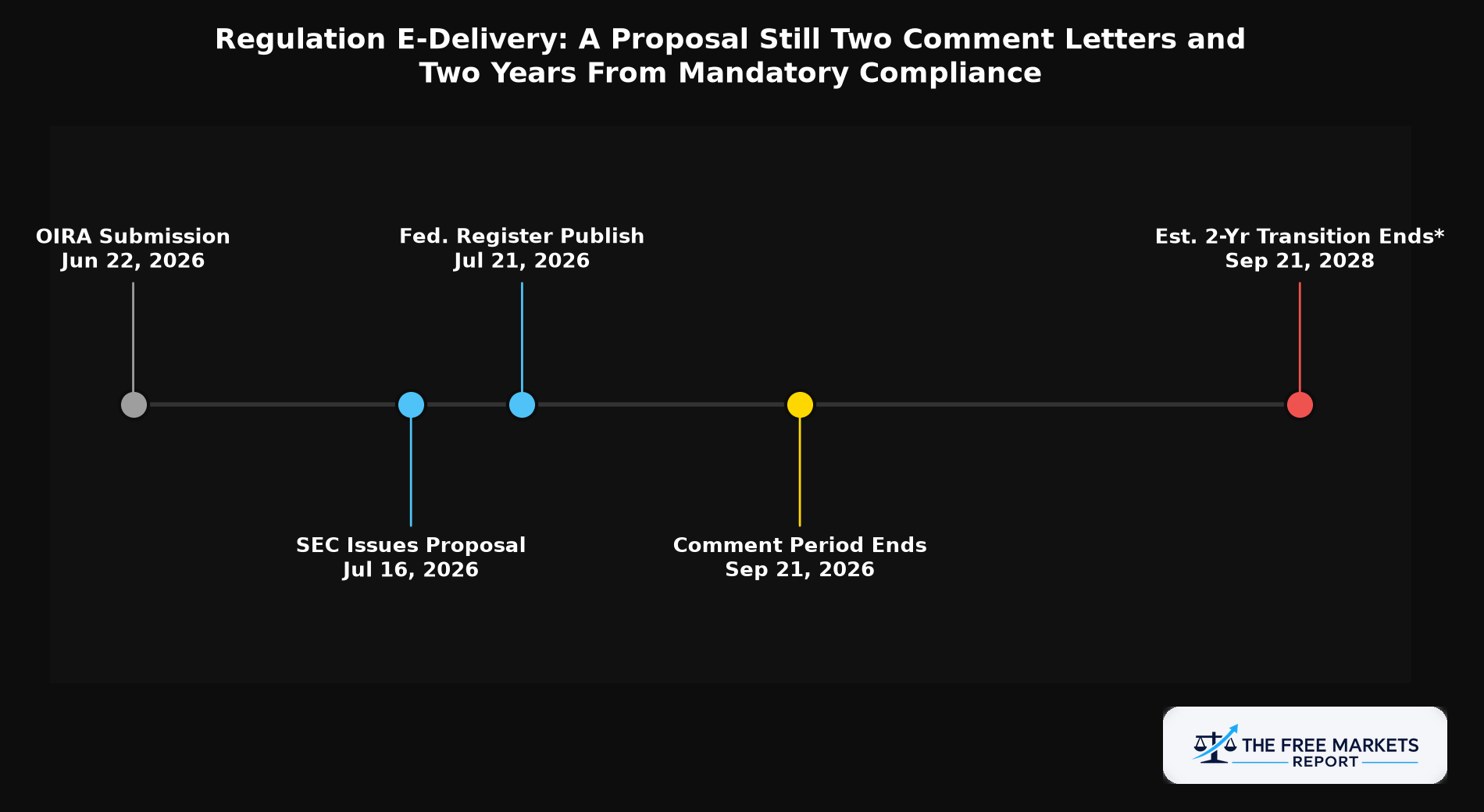
Figure 2: Today's SEC action is a proposal, not a final rule. The comment deadline is step one of a process with a 60-day effective date after adoption and a two-year transition period before current guidance is rescinded. Source: SEC.gov Rulemaking Activity; Morgan Lewis client alert, July 17, 2026.
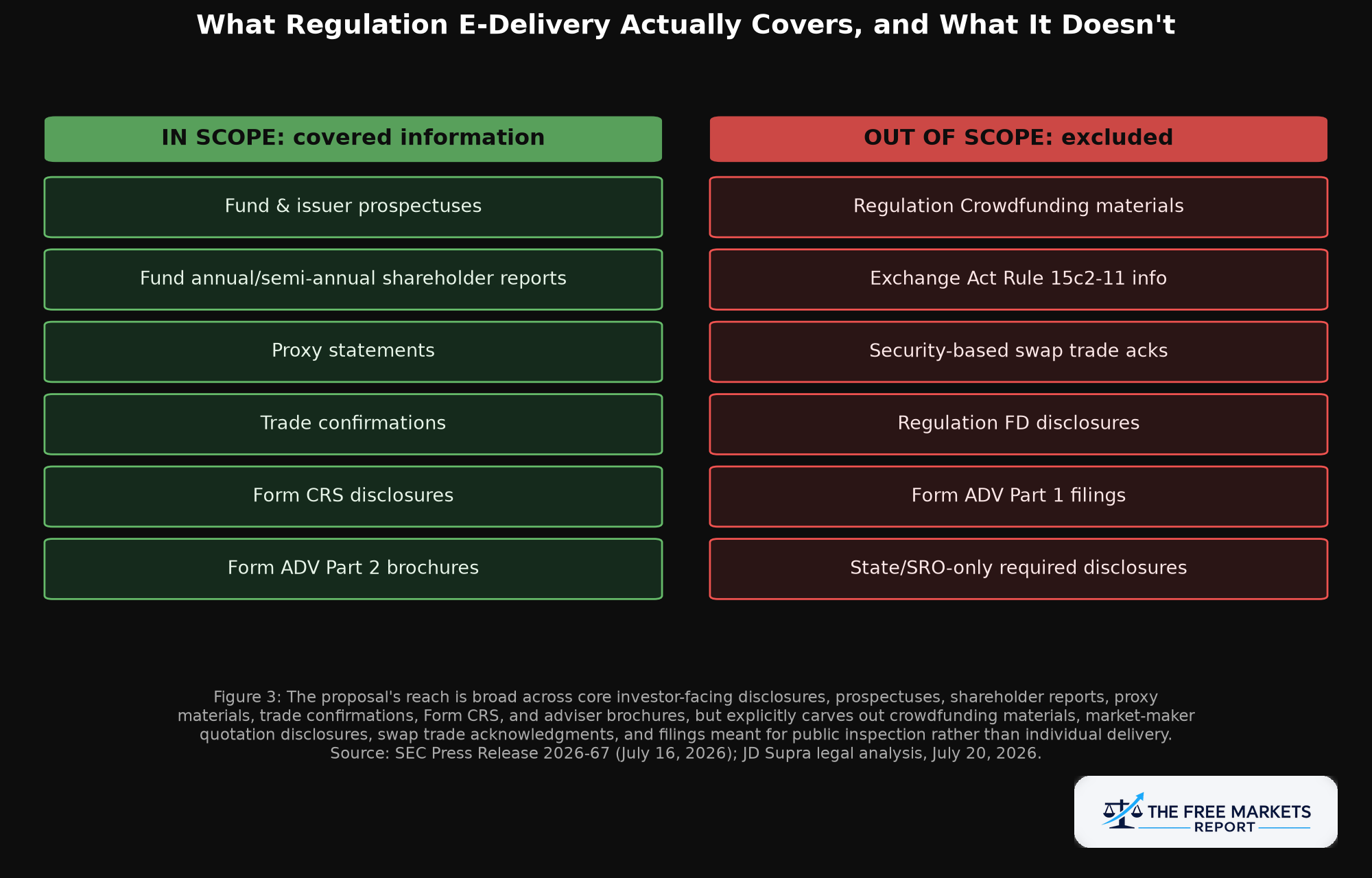
Figure 3: The proposal's reach spans core investor disclosures but excludes crowdfunding materials, market-maker quotation disclosures, and filings meant for public inspection rather than individual delivery. Source: SEC Press Release 2026-67; JD Supra legal analysis, July 20, 2026.
Bear Case. This is not a clean bearish setup. Broadridge itself calls the impact "broadly neutral," and the company has spent years building the digital infrastructure this rule would reward. But the bear case is not zero. AARP has a documented record of opposing e-delivery defaults on senior tech-access and cybersecurity grounds, and the Consumer Federation of America has flagged email click-through rates in financial services running near 1%, an argument that digital "delivery" does not reliably translate into investors actually seeing disclosures. If the final rule keeps the current design's generous paper-request rights and long lookback windows, some of the postage-driven revenue Broadridge has enjoyed could persist longer than a headline reading of "e-delivery becomes default" suggests. Distribution revenue grew even as volumes fell, on postage costs a slower transition would keep flowing through the P&L for years.
INVESTMENT IDEA: Broadridge Financial Solutions (BR)
- Thesis type: Company spotlight, deregulatory tailwind on a business-model transition
- Deregulatory catalyst: Proposed SEC Regulation E-Delivery (S7-2026-25)
- Current price: $144.12 as of July 22, 2026 (after-hours)
- Key financial data: FY2025 revenue $6,889.1 million; Distribution revenue $2,062.0 million; net income $839.5 million; net margin 12.0%; P/E 15.38; dividend yield ~3.0%
- Regulatory constraint removed: The opt-in consent requirement for e-delivery, which has preserved postage-linked Distribution revenue as a durable, low-margin line item
- Bull case: Nearly 90% of proxy and fund communications are already digitized, positioning Broadridge to capture higher-margin digital services, a tailwind management calls broadly neutral to positive.
- Bear case: Distribution revenue is rising, not falling, on postage rates, so the transition benefit looks gradual; comment-period pushback could soften the timeline.
- What to watch: Comment letters filed before September 21, 2026, and Broadridge's next two Distribution-revenue prints.
- Time horizon: 12 to 24 months, aligned with the comment period and disclosed transition window
The bigger principle. Deregulation does not always mean removing a rule outright; sometimes it means removing a default that has quietly subsidized an entire industry's business model. Paper delivery has been the default for federal securities disclosures for decades, and an entire fulfillment infrastructure has been built around that default surviving. When a regulator flips a default like this one, the companies best positioned are not the ones fighting the change, but the ones that already built the alternative before the rule required it.
The Free Markets Report is provided by Lead-Lag Publishing, LLC. All opinions and views mentioned in this report constitute our judgments as of the date of writing and are subject to change at any time. Information within this material is not intended to be used as a primary basis for investment decisions, and should also not be construed as advice meeting the particular investment needs of any individual investor. Trading signals produced by The Free Markets Report are independent of other services provided by Lead-Lag Publishing, LLC, or its affiliates, and the positioning of accounts under their management may differ. Please remember that investing involves risk, including loss of principal, and past performance may not be indicative of future results. Lead-Lag Publishing, LLC, its members, officers, directors, and employees expressly disclaim all liability with respect to actions taken based on any or all of the information in this writing.
Footnotes
- SEC.gov, "Regulation E-Delivery," File No. S7-2026-25, Rulemaking Activity, https://www.sec.gov/rules-regulations/2026/07/s7-2026-25
- SEC Press Release 2026-67, "SEC Proposes New E-Delivery Approach to Make Information More Readily Accessible and Useful for Investors," July 16, 2026, https://www.sec.gov/newsroom/press-releases/2026-67-sec-proposes-new-e-delivery-approach-make-information-more-readily-accessible-useful-investors
- Broadridge Financial Solutions, FY2025 Form 10-K, filed August 5, 2025, https://s203.q4cdn.com/209299927/files/doc_financials/2025/q4/Broadridge-FY25-Form-10-K-Final-Filed-with-SEC-Aug-5-2025.pdf
- Broadridge Financial Solutions Q3 FY2026 earnings call transcript, The Motley Fool, April 30, 2026, https://www.fool.com/earnings/call-transcripts/2026/04/30/broadridge-br-q3-2026-earnings-transcript/
- Morgan Lewis, "SEC Proposes Regulation E-Delivery to Modernize Electronic Communications," July 17, 2026, https://www.morganlewis.com/pubs/2026/07/sec-proposes-regulation-e-delivery-to-modernize-electronic-communications
- JD Supra, "SEC Proposed Rule: Electronic Delivery," July 20, 2026, https://www.jdsupra.com/legalnews/sec-proposed-rule-electronic-delivery-4726365/
- SEC Press Release 2026-67, July 16, 2026, https://www.sec.gov/newsroom/press-releases/2026-67-sec-proposes-new-e-delivery-approach-make-information-more-readily-accessible-useful-investors
- SEC Commissioner Mark T. Uyeda, Statement on Proposed Regulation E-Delivery, July 16, 2026, https://www.sec.gov/newsroom/speeches-statements/uyeda-statement-proposed-regulation-e-delivery-071626
- Debevoise & Plimpton, "From Opt-In to Opt-Out: The SEC's Proposed Regulation E," July 21, 2026, https://www.debevoise.com/insights/publications/2026/07/from-opt-in-to-opt-out-secs-proposed-regulation-e
- SEC Commissioner Hester Peirce, "Paper Taper" Statement on Proposed Regulation E-Delivery, July 16, 2026, https://www.sec.gov/newsroom/speeches-statements/peirce-paper-taper-statement-proposed-regulation-e-delivery-071626
- Broadridge Financial Solutions, FY2025 Form 10-K, filed August 5, 2025, https://s203.q4cdn.com/209299927/files/doc_financials/2025/q4/Broadridge-FY25-Form-10-K-Final-Filed-with-SEC-Aug-5-2025.pdf
- Perplexity Finance real-time quote and company financials data, BR, July 22, 2026
- Printing Impressions, "Printing United Alliance Opposes Legislation Making E-Delivery the Default," July 13, 2023, https://www.piworld.com/article/printing-united-alliance-opposes-legislation-making-e-delivery-the-default/; AARP comment letter to FINRA, July 14, 2025, https://www.finra.org/sites/default/files/NoticeComment/AARP%20FINRA%20Comment%20Letter%207-14-25.pdf