The EPA Just Repealed Its Power Plant Rules. Then It Went Further.
The finalized repeal kills the 2024 carbon standards. The companion proposal aims at the authority itself.

On September 14, 2026, EPA Administrator Lee Zeldin signed the final Partial Repeal of the Carbon Pollution Standards for fossil fuel-fired power plants, the agency's own name for the largest power sector deregulatory action in U.S. history. The signing was announced not in Washington but at the G20 Energy Abundance Ministerial in Houston, and it arrived in two pieces: a completed repeal of the 2024 rule's core mandates, and a companion proposal to rescind every remaining greenhouse gas standard for power plants on the theory that the Clean Air Act never authorized them in the first place.
The first piece is a policy reversal. The second is a claim about the limits of an agency's own statute, and if it survives, it forecloses not just this rule but its successors. EPA announcement. National Law Review analysis.
Key Highlights
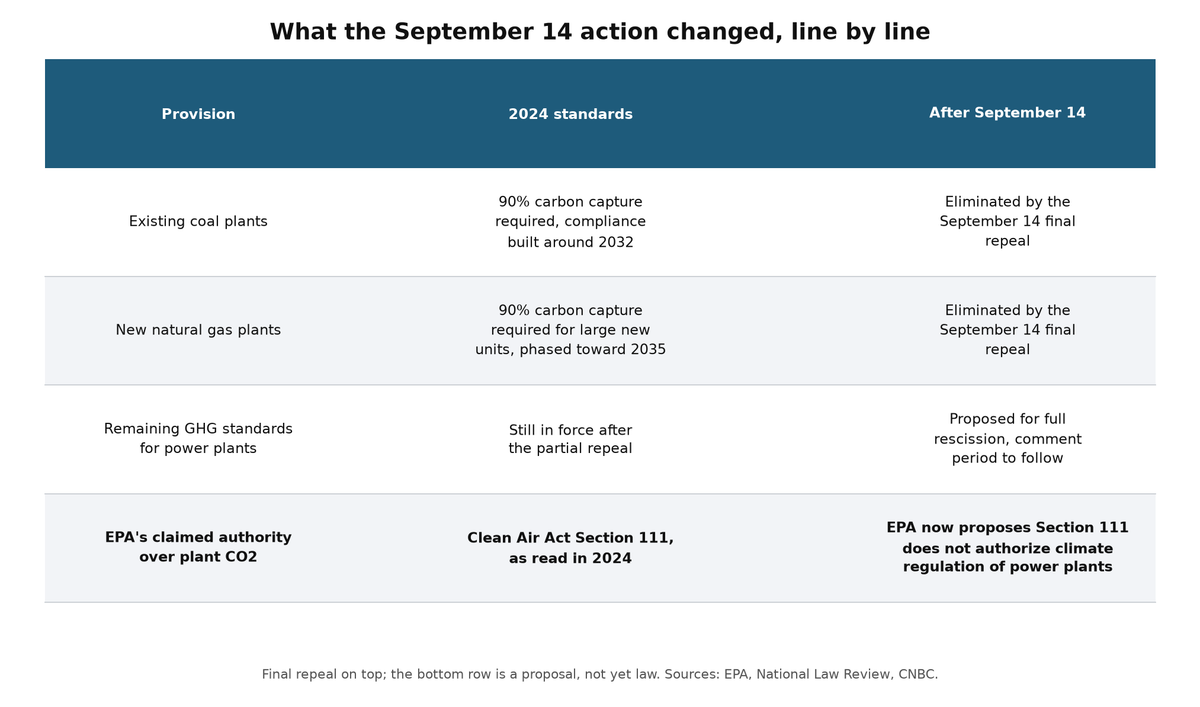
- The finalized repeal eliminates the 2024 standards that required existing coal plants and new large natural gas plants to control roughly 90% of their carbon dioxide emissions, deadlines built around 2032 for coal and 2035 for new gas. CNBC.
- EPA pegs the savings at more than $300 billion, with the American Action Forum citing $310 billion in direct compliance costs eliminated and a present-value estimate of roughly $160 billion across 2026-2047 at a 3% discount rate. EPA. American Action Forum. Earth.com.
- The companion proposal would rescind all remaining greenhouse gas standards for power plants, with EPA asserting that Clean Air Act Section 111 "does not authorize the EPA to regulate emissions from power plants in response to global climate change concerns." EPA rule page.
- The rule takes effect soon after publication in the Federal Register and is expected to face immediate legal challenges, with power plants the largest U.S. industrial contributor to climate change. Politico.
The market question is not whether coal plants get a reprieve. Most of the fleet was retiring on economics long before the compliance deadlines arrived. The question is what the second document does to the legal architecture every future administration would need to regulate utility carbon at all.
Get the next one first. Free, daily, one email when a new regulatory catalyst breaks. Subscribe free.
Two Documents Left Houston. Only One Is Final.
The final rule repeals most provisions of the 2024 Carbon Pollution Standards, the Biden-era rule finalized on April 24, 2024 that set emissions limits for existing coal-fired and new natural gas-fired plants based on carbon capture systems. EPA 2024 release. Zeldin assailed "the unlawful Biden administration's 2024" standards at the Houston announcement. Houston Public Media.
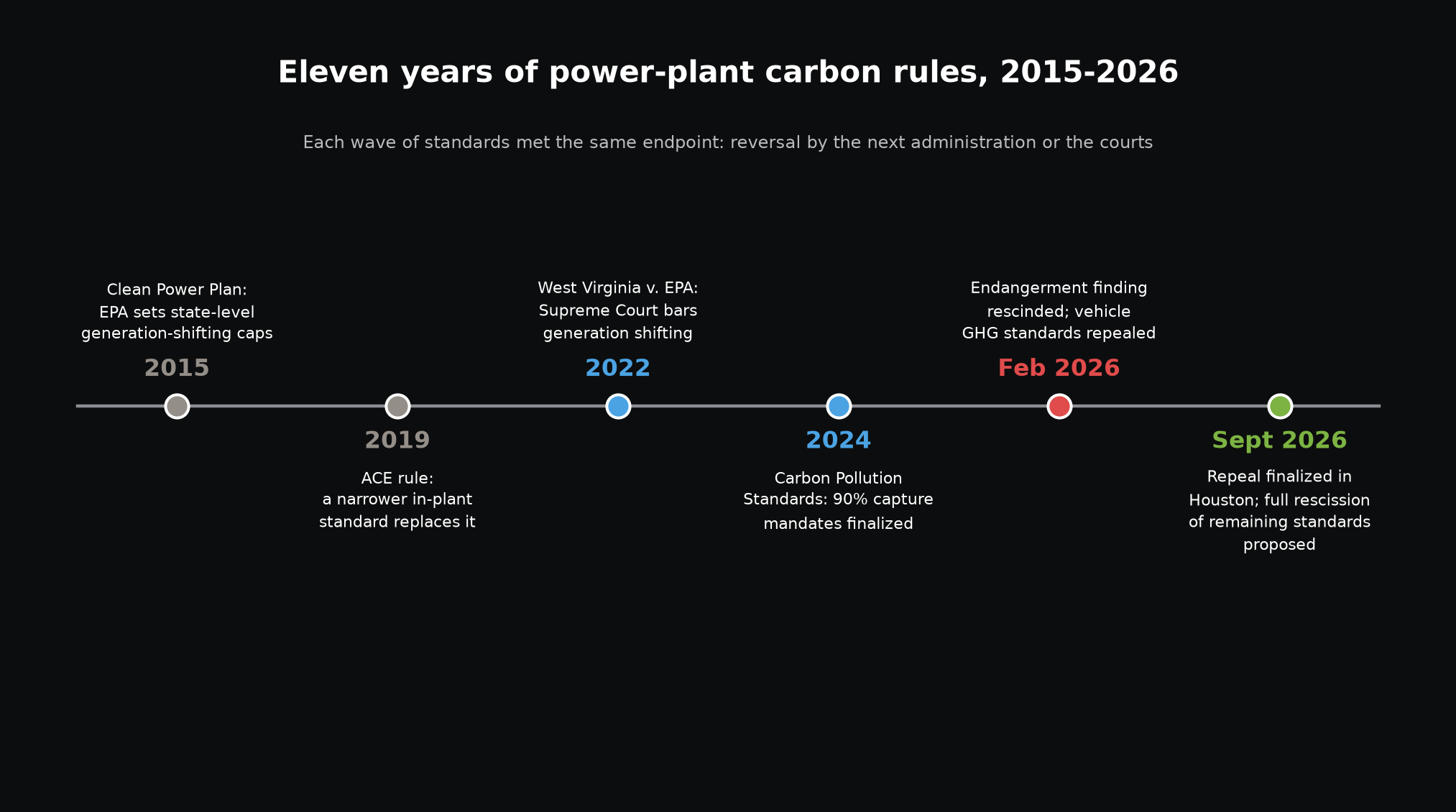
The proposal is the more ambitious artifact. Where the final rule deletes the 2024 standards, the proposal deletes the premise. EPA's own supplemental text states that "we propose that CAA section 111 does not authorize the EPA to regulate emissions from power plants in response to global climate change concerns." EPA. The June 2025 proposal to rescind standards under Sections 111(b) and 111(d) is the vehicle, and the final vehicle rule rescinding the 2009 endangerment finding, signed in February, supplies the reasoning EPA now recycles for the power sector. Haynes Boone.
Three Numbers, One Rule, Three Different Stories
The economics of the repeal depend on which EPA you ask. The signing EPA says the action delivers over $300 billion in cost savings, and the American Action Forum's tally of the regulatory accounting puts direct compliance costs at $310 billion. The same agency's discounted stream, per its own present-value analysis as reported, runs to about $160 billion across 2026 through 2047 at a 3% discount rate. And the EPA of April 2024, defending the rule it had just finalized, had estimated the standards would cost on the order of $9.6 to $19 billion. EPA. AAF. Earth.com.
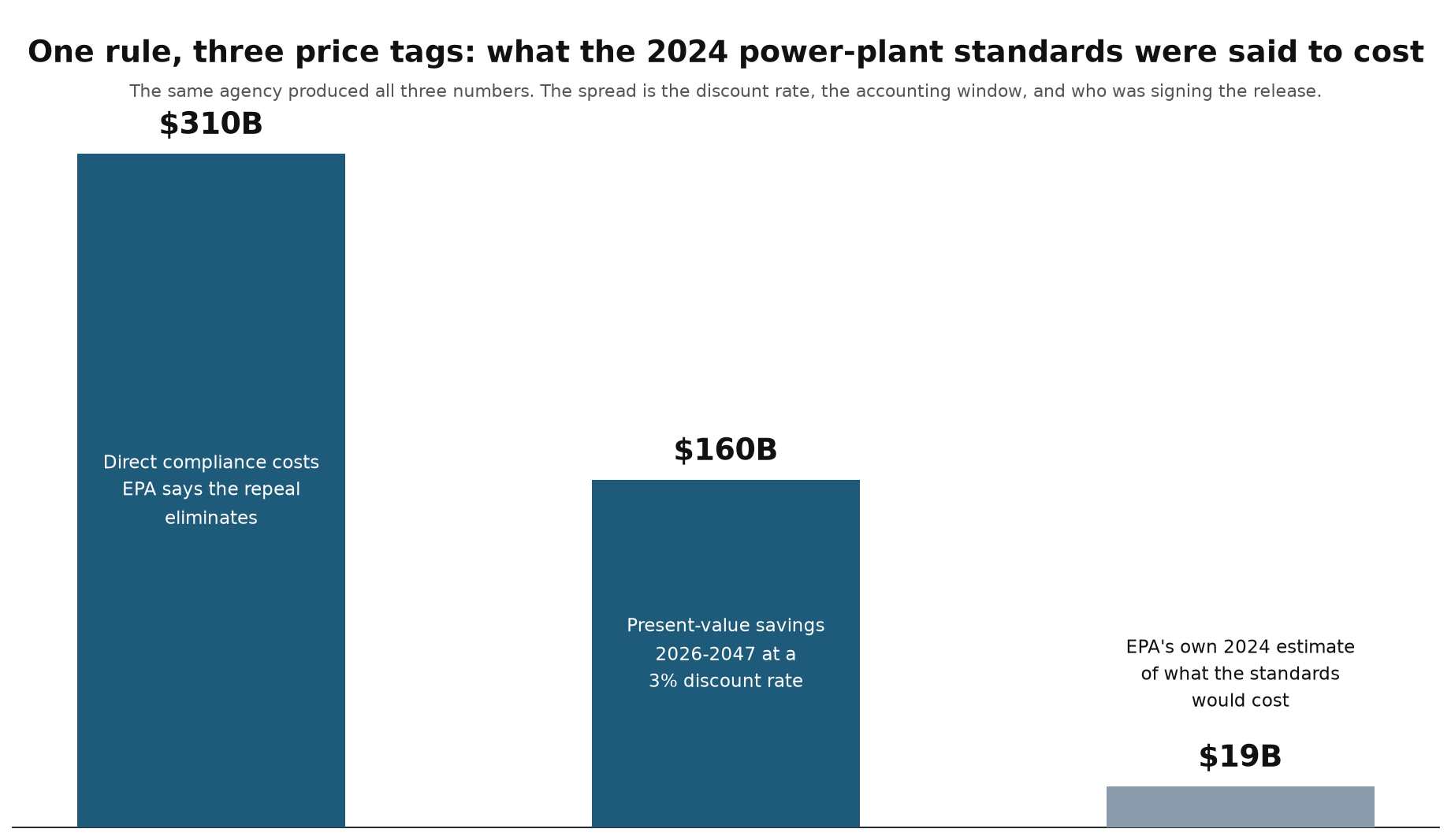
A cost estimate that swings by a factor of sixteen depending on the administration writing it is not a measurement. It is an argument. Investors pricing utilities should treat every regulatory cost figure in this space the way they treat a company's own adjusted earnings: as advocacy with decimal points.
The Mandates, Line by Line
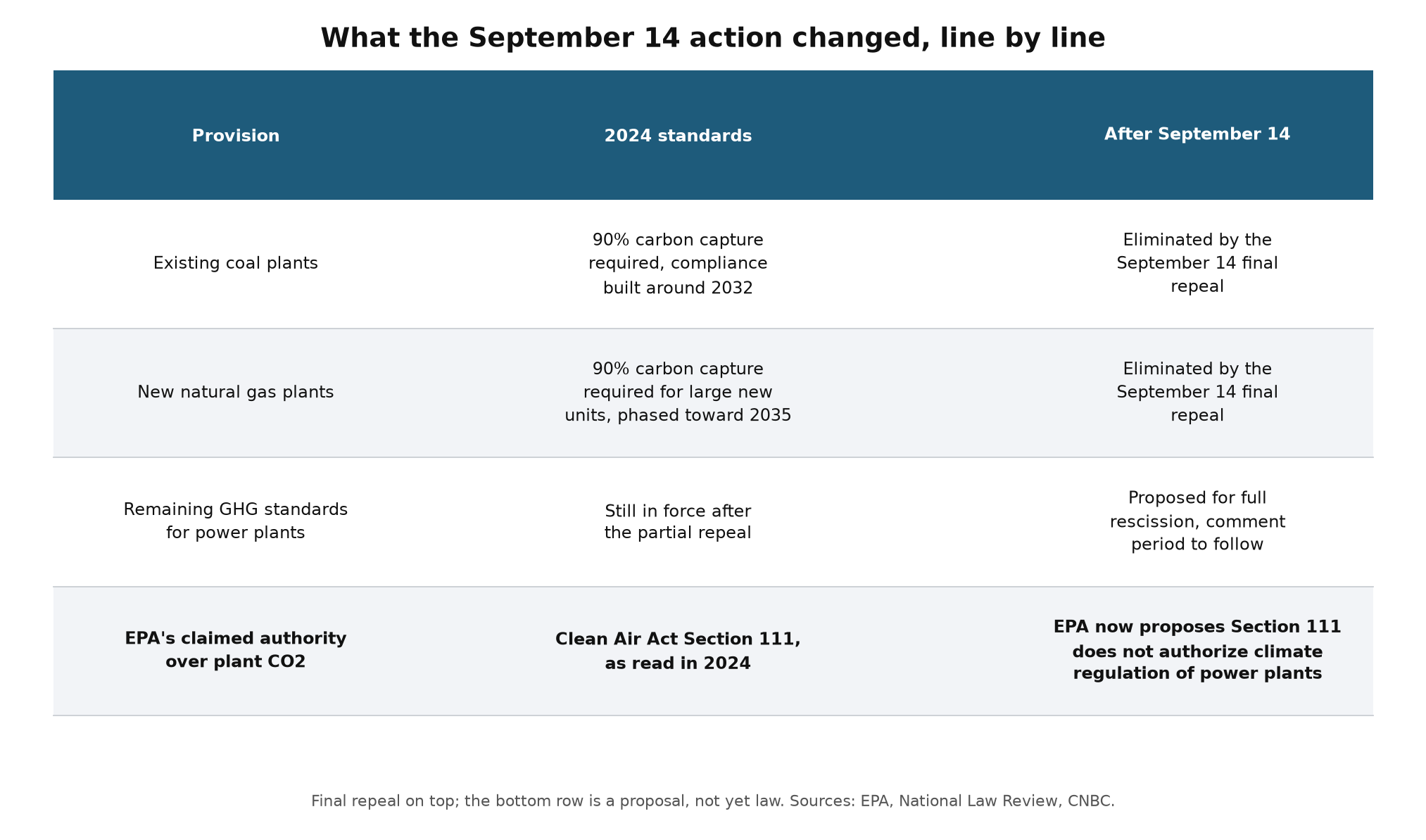
The structure matters for what survives challenge. A targeted repeal of specific standards is the version legal analysts expect the Supreme Court to tolerate, if it ever gets there. TD Cowen's read, as reported by Axios, is that the Court would likely be receptive to a targeted repeal of the 2024 rules but far less receptive to a wholesale reinterpretation of what the Clean Air Act permits. Axios. The 2022 precedent is explicit: in West Virginia v. EPA, six justices held that Section 111(d) did not grant EPA authority to devise emissions caps based on generation shifting. Supreme Court opinion.
The Repeal That Complicates Its Own Defense
The least appreciated consequence is internal to the administration's own litigation strategy. EPA's reversal weakens the argument that the Clean Air Act occupies the field of climate regulation, which is precisely the preemption argument oil companies are pressing against state and municipal climate damage suits. The test case, Suncor Energy v. County Commissioners of Boulder County, is scheduled for oral argument at the Supreme Court on October 5, three weeks after the EPA filing. Sierra Club attorney Andres Restrepo observed that the agency's move "substantially weakens" the oil companies' preemption argument, and Politico notes the rollback may undercut the legal theory the administration itself relies on to block state-court climate claims. Axios. Politico.
Deregulation usually lowers the stakes for the industries it touches. This one splits them: utilities shed compliance costs, while the refiners and producers defending state-court suits lose the federal preemption shield that a muscular Clean Air Act was quietly providing.
The Bear Case
The legal durability of the repeal is weaker than its announcement. The final rule takes effect after Federal Register publication and faces immediate challenges from states and environmental groups, the same coalition that sued over the earlier endangerment finding rescission, with three dozen states and local governments challenging that reversal in March. BBC. The proposal's broad statutory claim is the kind of position that invites a court to reassert congressional purpose, and the major questions doctrine that enabled West Virginia cuts against expansive readings in both directions. An agency arguing it has no authority today makes it easier for a successor to argue it has all of it tomorrow, and the regulatory pendulum, as Axios notes, remains in motion absent legislation. Nothing in the September 14 action lowers the physical or legal risk of the next turn of that pendulum. Axios.
The permanent fact in this filing is not the repeal of a rule but the reinterpretation of a statute, and statutes are harder to repeal. The 2024 standards died by signature, the same way the 2015 Clean Power Plan died by litigation and the 2019 replacement died by court. What has never happened, in eleven years of this cycle, is an EPA succeeding at arguing it lacks the power to try again. If the October 5 argument and the appellate challenges go badly, the Houston announcement will read as the high-water mark of statutory retreat. If they go well, every coal and gas asset in the country just lost the only regulatory cost line its future valuations carried, and the next Green New Deal, in whatever form it arrives, will have to build its authority from the ground the Supreme Court left standing. Few understand this.
Have a regulatory filing we should be tracking? Hit reply.
Related analysis
Read next: DOE Orders a Dead Coal Plant Back to Life for the Sixth Time.
Read next: Trump's Wartime Powers Come for Energy.
Know someone tracking market structure like this? Forward this one along.
The Free Markets Report is provided by Lead-Lag Publishing, LLC. All opinions and views mentioned in this report constitute our judgments as of the date of writing and are subject to change at any time. Information within this material is not intended to be used as a primary basis for investment decisions, and should also not be construed as advice meeting the particular investment needs of any individual investor. Trading signals produced by The Free Markets Report are independent of other services provided by Lead-Lag Publishing, LLC, or its affiliates, and the positioning of accounts under their management may differ. Please remember that investing involves risk, including loss of principal, and past performance may not be indicative of future results. Lead-Lag Publishing, LLC, its members, officers, employees, and agents expressly disclaim all liability with respect to actions taken based on any or all of the information in this writing.