Trump's Wartime Powers Come for Energy: What the DPA Means for Pipelines and Portfolios
Five presidential determinations invoking the Defense Production Act signal a fundamental shift in how Washington views energy infrastructure — and who profits from it.

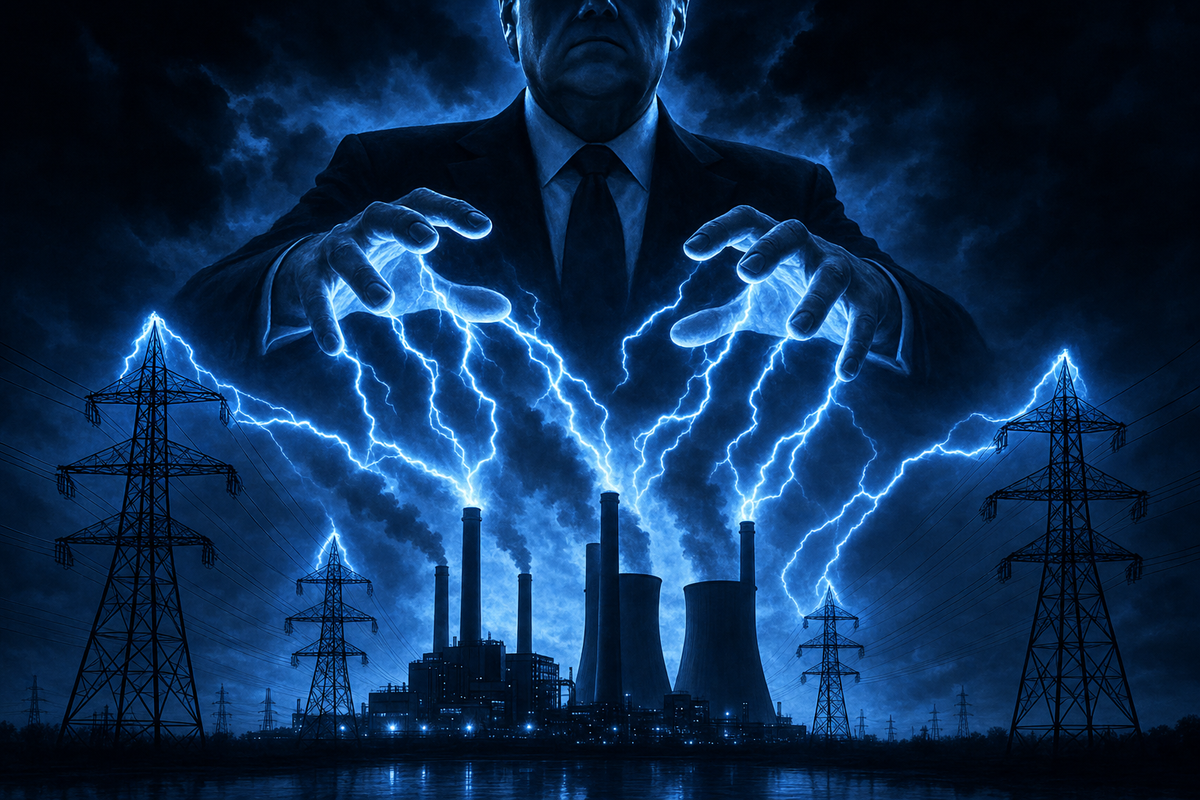
On the afternoon of April 20, 2026, five presidential memoranda landed in the inbox of Energy Secretary Chris Wright. Each one invoked Section 303 of the Defense Production Act of 1950 — the same wartime law that Franklin Roosevelt used to commandeer factories for rifles and Sherman tanks. Trump's target was different: pipelines. Transformers. LNG terminals. Coal stockpiles. The message from the White House was unambiguous: America's energy infrastructure is now a matter of national defense, and normal market forces are not moving fast enough to fix it.
The question for investors is not whether this is constitutionally sound — that fight will be settled in federal court. The question is what happens to capital flows when the U.S. government formally declares that an entire set of physical infrastructure assets are essential to national security, and authorizes the Treasury of the United States to backstop their development.
That is a very different kind of regulatory environment. And it has very specific implications for a set of publicly traded companies that most equity investors have barely touched.A
A Wartime Law, a Peacetime Problem
The Defense Production Act has been invoked many times since 1950, but rarely with this breadth. President Biden used it in June 2022 to address transformer shortages — with limited near-term results. Trump's April 20 invocations go further, formally classifying as “industrial resources, materials, or critical technology items essential to the national defense”: domestic petroleum production, refining, and logistics; natural gas transmission, processing, storage, and LNG capacity; coal supply chains and baseload power generation; grid infrastructure including transformers, high-voltage transmission components, substations, and grid-supporting equipment; and large-scale energy infrastructure broadly defined.[1]In each memorandum, the President found that without presidential action, domestic industry cannot provide these capabilities in a timely manner due to “financing risks, regulatory delays, and market barriers.”[2] He invoked Section 303(a)(7) to waive the standard procedural requirements of Sections 303(a)(1) through (a)(6) — the guardrails that normally slow DPA deployment.The practical result: the Secretary of Energy is now authorized to make purchases, issue purchase commitments, provide loan guarantees, and deploy other financial instruments across all five categories. That authorization does not self-execute — the DOE still has to decide how to deploy it — but it represents a formally declared federal backstop for assets that previously relied entirely on private capital markets.
Five Determinations, One Overarching Message
The memoranda do not exist in isolation. They are explicitly linked to Executive Order 14156, which Trump signed on January 20, 2025, declaring a National Energy Emergency. They are also designed to channel funding that Congress already appropriated through a separate mechanism: the July 2025 budget reconciliation law, known colloquially as the “One Big BeautifThat legislation created the DOE Energy Dominance Financing program — a replacement for the Inflation Reduction Act's Energy Infrastructure Reinvestment program — with $200 billion in appropriated loan authority through 2028, prioritizing projects that increase U.S. energy supplies and boost power generation capacity.[3] Separately, the same law expanded the Department of Defense's Office of Strategic Capital loan authority by $100 billion for critical minerals production and related projects.[4]The April 20 DPA determinations are the mechanism by which that money can now be deployed more rapidly, and to a broader set of projects, than the normal DOE loan program structure would allow. Think of it as the executive branch installing a firehose on a garden-hose valve.For industries that have struggled with permitting delays, long-lead-time equipment, and financing gaps — LNG developers, pipeline builders, transformer manufacturers, coal operators trying to extend plant life — this is a material change in the risk equation.ul Bill.”
Follow the Money: Which Companies Stand to Benefit
The midstream sector is the most obvious first-order beneficiary. Kinder Morgan (KMI), the largest natural gas pipeline operator in the United States, had $3.4 billion in discretionary capital expenditures planned for 2026, the vast majority tied to natural gas pipeline expansion, with projected Adjusted EBITDA of nearly $8.7 billion — a 4% increase over 2025 guidance.[5] Under the DPA framework, projects that previously faced permitting or financing headwinds become candidates for federal purchase commitments or credit enhancements that de-risk early-stage development costs.
Williams Companies (WMB) and Energy Transfer (ET) occupy similar positions. Midstream names operate as fee-based toll collectors — revenues largely insulated from commodity price movements — which makes them structurally attractive when the federal government signals it wants more gas infrastructure built, not less. MPLX (MPLX), the midstream arm of Marathon Petroleum, earmarked $2.4 billion for growth projects in 2026 alone, including the Secretariat natural gas processing facility and two new pipelines — Bay Runner and Blackcomb — both expected to come online in 2026.[6] Projects of this scale, now potentially eligible for federal backstop financing or offtake commitments, represent a meaningful re-rating catalyst.
The grid infrastructure story is less talked about but may carry more long-term structural weight. The DPA memorandum on grid equipment explicitly named transformer backlogs as a national security liability. According to the National Electrical Manufacturers Association (NEMA), distribution transformer backlogs are currently running a year or more — roughly twice the historical lead time — though some recent improvements have been seen.[7] Companies like Eaton (ETN) and Hitachi Energy have already announced investments in domestic transformer manufacturing capacity.[8] A federal purchase commitment or long-term DOD contract for grid equipment would be transformational for domestic manufacturers in a market where the demand curve is structurally rising due to AI data center load growth.
The Case for Skepticism — and Why It Matters for Investors
The contrarian view is not frivolous. Critics from both environmental groups and fiscal analysts have raised objections investors should internalize.
First, the money is limited. For Fiscal Year 2026, approximately $323 million in actual DPA appropriated funds remains available, according to Jean Su of the Center for Biological Diversity — a fraction of what large-scale energy infrastructure requires.[9] The $200 billion DOE loan authority and $100 billion DOD expansion are real programs, but they require separate disbursement decisions and project-by-project approvals. There is no blank check.
Second, legal risk is real. The Center for Biological Diversity called the April 20 actions "unlawful," and Public Citizen — calling them a "wish-list for the oil, gas and coal industries" — hinted at a forthcoming lawsuit.[11] The waiver of standard DPA procedural requirements under Section 303(a)(7) is novel in this context; a federal court could enjoin specific uses of the authority pending resolution.
Third, oil and gas companies themselves are not exactly rushing to the trough. As S&P Global reported, major upstream producers largely expressed skepticism of further output growth in their late 2025 and 2026 earnings calls, focused instead on cost-cutting and efficiency.[10] The EIA currently forecasts U.S. crude production averaging 13.5 million barrels per day at the end of 2026, rising to 13.9 million b/d in 2027 — already at record highs that suggest incremental federal encouragement may produce marginal supply effects rather than structural step-changes.[10]
The DPA's prior use in this administration is instructive. In March 2026, the DOE used emergency authority to direct TransAlta to keep Unit 2 of the Centralia Generating Station in Washington operational — a coal plant that had been scheduled to close in 2025.[11] That kind of targeted intervention suggests the administration's implementation will be selective, not sweeping. Not every pipeline project becomes a DPA winner; the companies best positioned are those with shovel-ready projects, strong balance sheets, and the legal and regulatory relationships to navigate what remains a complex federal procurement environment.
Conclusion: Defense Posture as Energy Market Catalyst
The April 20, 2026 Defense Production Act invocations represent something genuinely new in U.S. energy policy: a formal declaration that the physical infrastructure of fossil fuel production and transmission is a national defense asset, with federal financial authority now explicitly deployed in its service.
Whether that posture survives legal challenge is uncertain. Whether it produces near-term supply surges is also uncertain. What is less uncertain is the directional signal it sends to capital markets: that the regulatory environment for midstream energy, grid infrastructure, and LNG development has fundamentally shifted in favor of build-out. Companies with large existing pipeline networks, contracted capacity, and active capex programs are structurally better positioned than they were two years ago.
The government has put its balance sheet behind the pipe. That, by itself, changes the math.
— Michael A. Gayed, CFA
Footnotes
- White House, DPA Grid Infrastructure Determination, Apr. 20, 2026. whitehouse.gov/presidential-actions
- White House, DPA Large-Scale Energy Determination, Apr. 20, 2026. govping.com/trump-determination-energy-infrastructure
- S&P Global/Platts, Apr. 21, 2026. spglobal.com/energy/042126-dpa-energy-supplies
- Ibid.
- Energies Media, Mar. 25, 2026. energiesmedia.com/kinder-morgan-pipeline
- Motley Fool/Yahoo Finance, Apr. 18, 2026. finance.yahoo.com/sectors/energy/articles/3-under-radar-energy-stocks
- Utility Dive, Apr. 22, 2026. utilitydive.com/transformer-shortage-818159
- Ibid. (Eaton/Hitachi).
- Ibid. (Jean Su, Center for Biological Diversity).
- S&P Global/EIA, op. cit.
- Ibid. (TransAlta/Centralia; CBD; Public Citizen).
The Free Markets Report is provided by Lead-Lag Publishing, LLC. All opinions and views mentioned in this report constitute our judgments as of the date of writing and are subject to change at any time. Information within this material is not intended to be used as a primary basis for investment decisions, and should also not be construed as advice meeting the particular investment needs of any individual investor. Trading signals produced by The Free Markets Report are independent of other services provided by Lead-Lag Publishing, LLC, or its affiliates, and the positioning of accounts under their management may differ. Please remember that investing involves risk, including loss of principal, and past performance may not be indicative of future results. Lead-Lag Publishing, LLC, its members, officers, directors, and employees expressly disclaim all liability with respect to actions taken based on any or all of the information in this writing.