The CFTC Just Handed Its Crypto Rules to the White House
Congress stalled on the Clarity Act, so the CFTC is taking crypto market structure through the other door: executive review. The submission starts a 90-day clock, not a framework.

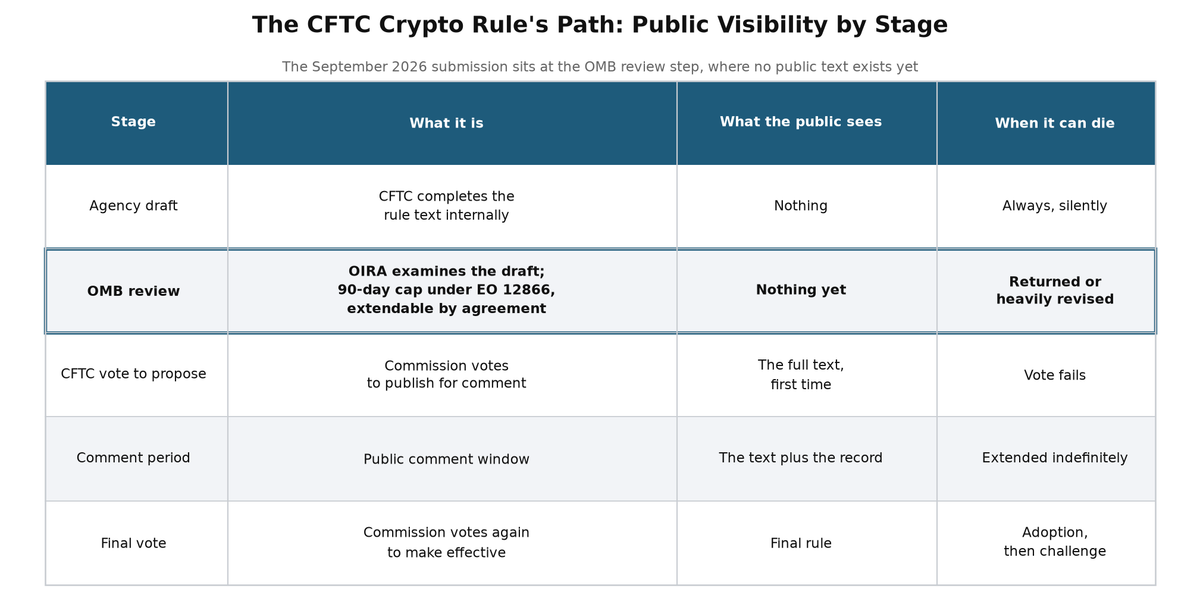
On September 17, 2026, the Commodity Futures Trading Commission did something it has rarely done with crypto: it handed a full draft rulemaking to the White House. The submission of its crypto market structure rules to the Office of Management and Budget, first reported after the Senate's failure to pass the Clarity Act, moves the framework question onto the executive review track, with no public text, a 90-day review ceiling, and a process that outlasts the news cycle (CoinDesk).
Key Highlights
- The CFTC sent its draft crypto market structure rules to OMB on Thursday, the standard stop for significant rulemakings before an agency votes. The review period is capped at 90 days under Executive Order 12866, extendable by agreement (CoinDesk; reginfo.gov).
- The filing follows the Senate's failure to pass the Clarity Act, the market structure bill that would have written crypto's agency boundaries into statute. The CFTC is now building the framework through rulemaking while that legislation sits (CoinDesk).
- The same week, the SEC issued its innovation exemption, a five-year path for qualifying platforms to offer onchain trading of tokenized stocks without registering as securities exchanges (CoinDesk).
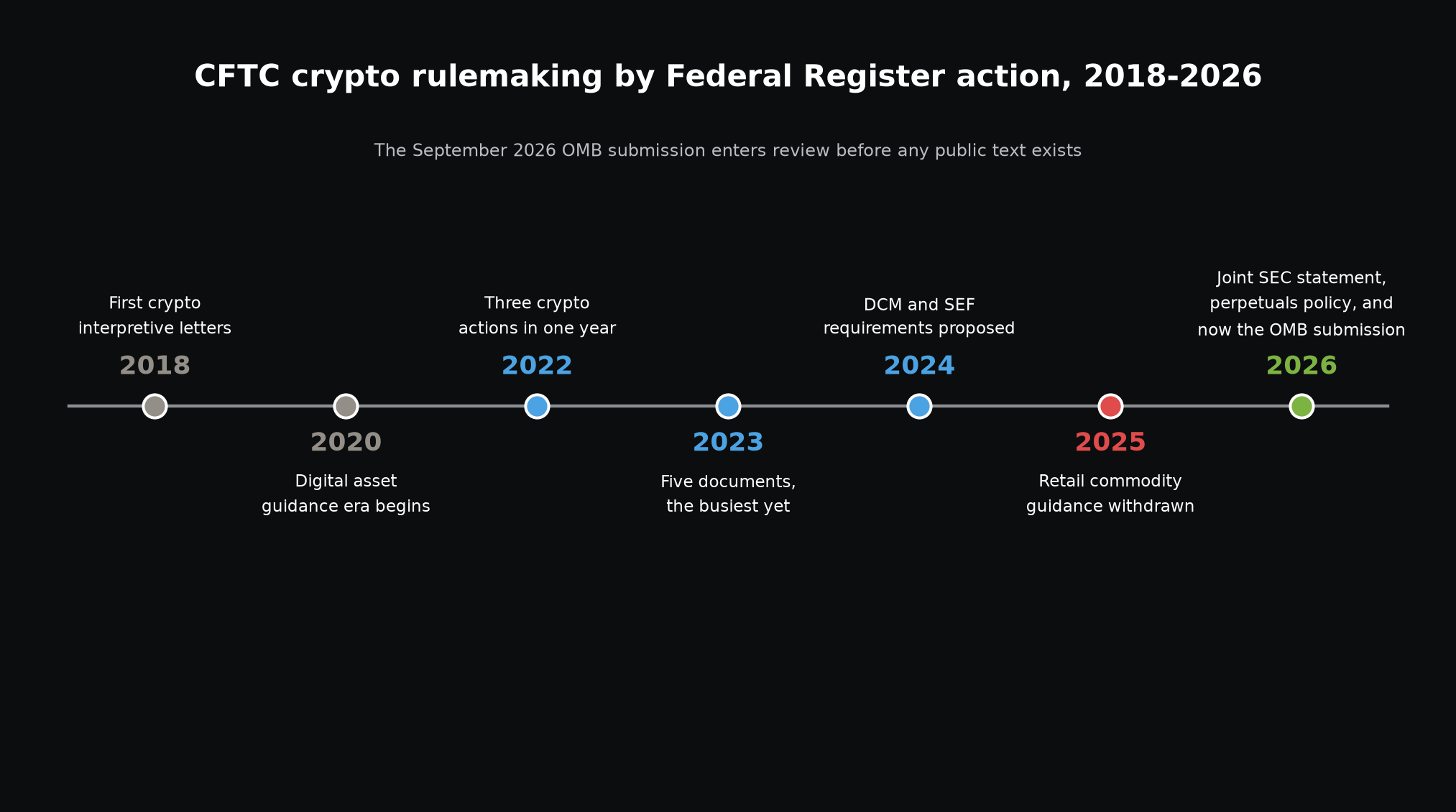
- CFTC documents mentioning crypto in the Federal Register: one in 2018, three in 2022, five in each of 2023 and 2024, one in 2025, and five already in 2026 through mid-September (Federal Register API).
- Three of this year's actions are already public: a joint SEC statement on applying federal securities laws to certain crypto assets (Federal Register 2026-05635), a policy statement on listing perpetual contracts (Federal Register 2026-11020), and the December 2025 withdrawal of interpretive guidance on retail commodity transactions in digital assets (Federal Register 2025-22872).
A 90-Day Clock, Not a Framework
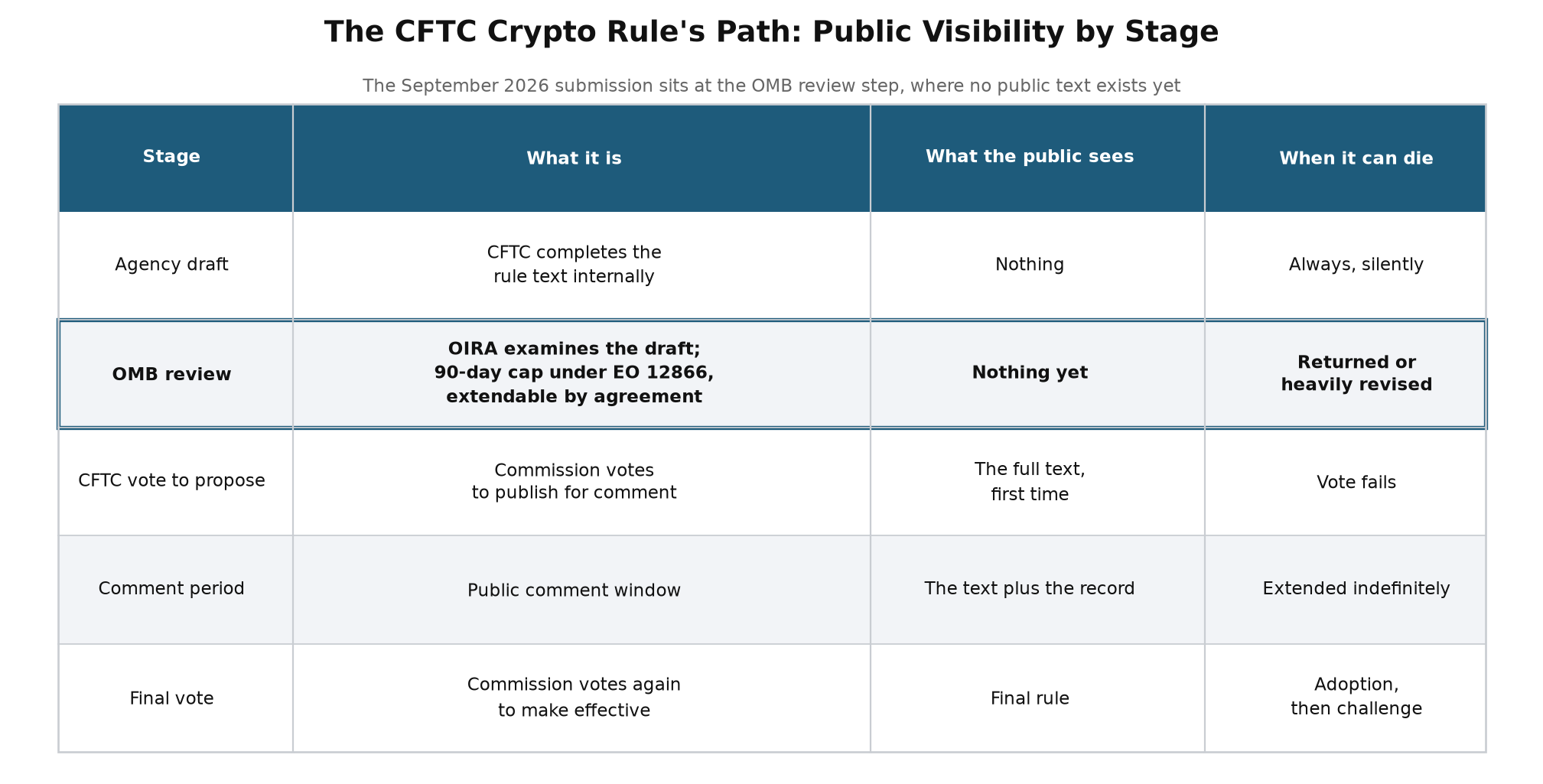
What the CFTC filed is a draft, and the review it entered is the one Executive Order 12866 has required of significant rulemakings since 1993: the Office of Information and Regulatory Affairs inside OMB examines the draft before the agency votes, and that review period is limited to 90 days (reginfo.gov). After clearance, the sequence is a CFTC vote to propose, a public comment window, and a second vote before anything becomes effective (CoinDesk).
The practical effect is a change of calendar. The crypto market structure timeline no longer runs on the Senate floor schedule, where the Clarity Act just failed; it runs on the White House regulatory review schedule. That is slower than a statute but faster than a stalled Congress, and it is the same track every significant financial rule of the past three decades has traveled.
Get the next one first. Free, daily, one email when a new regulatory catalyst breaks. Subscribe free.
The Clarity Act Stalled. The Rulemaking Didn't.
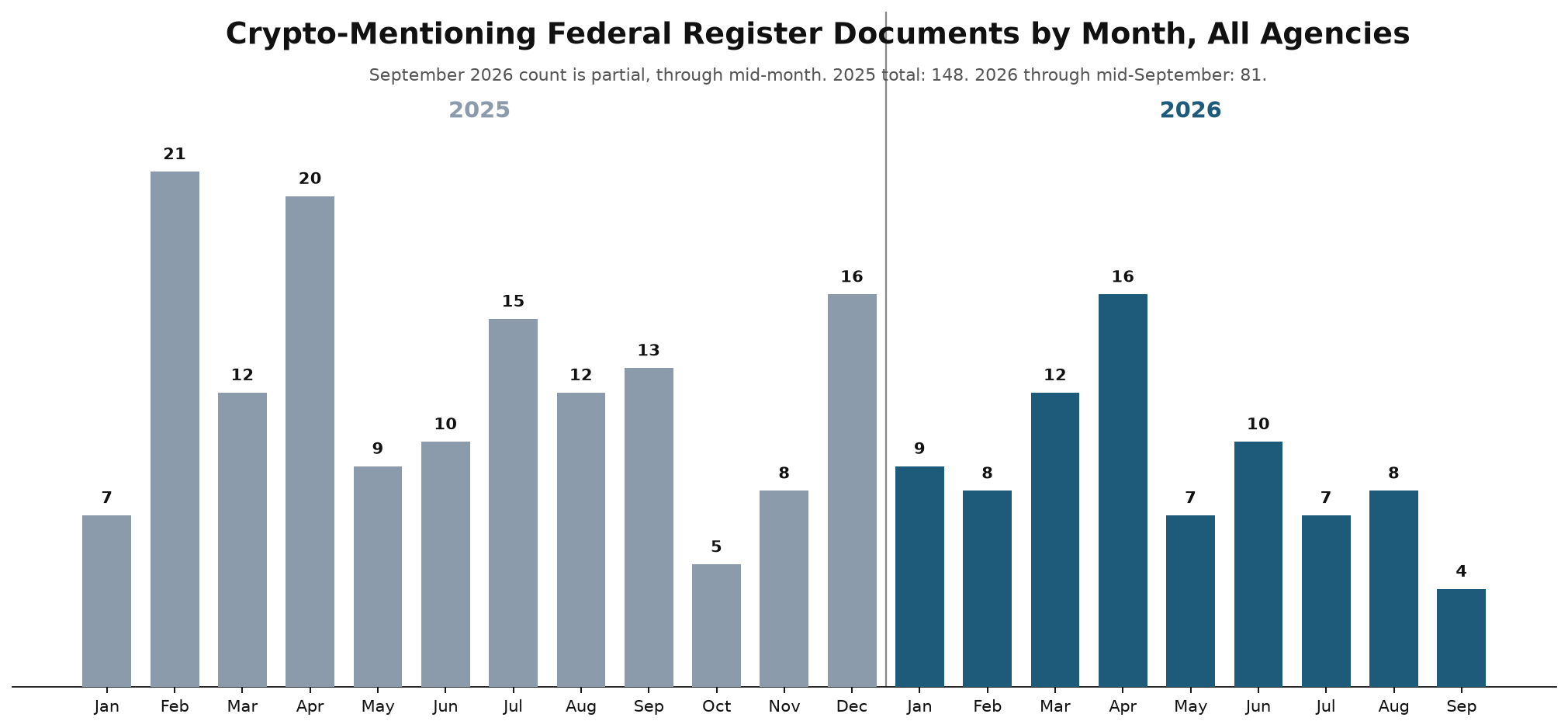
The filing lands on an accelerating baseline. For the CFTC specifically, crypto-mentioning Federal Register documents went from one in 2018 and three in 2022 to five in each of 2023 and 2024, dropped to one in 2025, and have already returned to five in the first eight and a half months of 2026 (Federal Register API). Across all federal agencies, documents mentioning crypto totaled 148 in 2025 and have reached 81 in 2026 through mid-September (Federal Register API).
The 2026 actions read as a sequence, not a scatter. March's joint SEC statement drew the jurisdictional boundary the Clarity Act was meant to draw by statute (Federal Register 2026-05635). June's perpetual contracts policy statement opened the door to US-listed perpetual futures (Federal Register 2026-11020). And December 2025's withdrawal of the retail commodity guidance cleared away the old interpretation that had treated certain retail digital asset transactions as regulated commodity transactions (Federal Register 2025-22872). Each step narrowed or clarified the perimeter. The OMB submission is the first that aims to rebuild it wholesale.
The SEC moved on the same calendar. Its innovation exemption, issued the same week as the CFTC filing, gives qualifying platforms a five-year path to offer onchain trading of tokenized stocks without registering as securities exchanges (CoinDesk). Two agencies, two doors, one direction. The difference between the paths is durability: a statute binds future agencies, while a rule can be withdrawn as readily as the December 2025 retail commodity guidance was.
What to Watch
The signal that matters is not the CFTC's calendar but OMB's. When the draft clears review, the text becomes public for the first time, and every question this report cannot answer today, what the rules would require of exchanges, custody, and listed products, moves from speculation to comment-period material. An OIRA return with major revisions, a Clarity Act revival in the interim, or a withdrawal like the one in December 2025 would each change the read. This is a process story until the text exists, and the process has a clock on it.
Bear Case
This is a submission, not a rule. Nothing changes for market participants until OMB clears the draft, the CFTC votes to propose, the comment period runs, and the Commission votes again, and the 90-day review ceiling is extendable by agreement, which in practice means reviews run as long as the revisions take (reginfo.gov). Second, the Clarity Act is stalled, not dead. If it passes while the rulemaking is in review, the statute supersedes whatever the CFTC has built, and the rule becomes scaffolding around a settlement that already exists in law. Third, nothing in the filing is public. Every characterization of what the rules would require is guesswork until the text publishes, and drafts have died in OIRA review before.
The vehicle, not the verdict, is the story. Congress could not pass a market structure statute, so the framework is being built in the medium Congress does not control: agency rulemaking under executive review. The CFTC has spent 2026 laying the perimeter piece by piece, and the OMB filing is the first move to assemble it into a whole. The bet the submission makes is that a rule can do a statute's job. The December 2025 withdrawal is the standing reminder of how fast a rule can be undone when the next agency changes its mind.
Have a regulatory filing we should be tracking? Hit reply.
Related analysis
Read next: The SEC's Crypto Proposal Borrows Reg A+'s $75 Million Playbook.
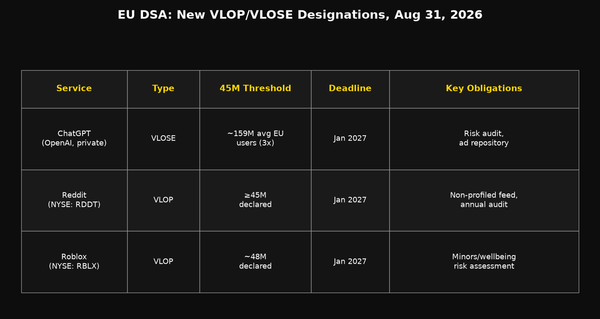
Read next: EU Names ChatGPT, Reddit, and Roblox to Its Toughest Rulebook.
Know someone tracking market structure like this? Forward this one along. The Free Markets Report is provided by Lead-Lag Publishing, LLC. All opinions and views mentioned in this report constitute our judgments as of the date of writing and are subject to change at any time. Information within this material is not intended to be used as a primary basis for investment decisions, and should also not be construed as advice meeting the particular investment needs of any individual investor. Trading signals produced by The Free Markets Report are independent of other services provided by Lead-Lag Publishing, LLC, or its affiliates, and the positioning of accounts under their management may differ. Please remember that investing involves risk, including loss of principal, and past performance may not be indicative of future results. Lead-Lag Publishing, LLC, its members, officers, employees, and agents expressly disclaim all liability with respect to actions taken based on any or all of the information in this writing.