NHTSA Just Told Truck Engine Makers: We Never Had Authority Over You
NHTSA says it never had legal authority to set fuel economy standards for truck engines, only for vehicles. The rule change is real; the relief is not, yet.

On August 31, 2026, the National Highway Traffic Safety Administration published an interpretive rule concluding that the statute governing its commercial truck fuel economy program never gave it the authority to set standalone fuel-economy standards for engines, only for complete vehicles (Federal Register 2026-17756). The rule does not change any existing standard today. It sets up the legal groundwork for a separate rulemaking that will, and tells manufacturers how NHTSA will enforce the program in the meantime.
Key Highlights
- NHTSA's interpretive rule, effective August 31, 2026, holds that the Energy Independence and Security Act of 2007 authorizes fuel economy standards for medium- and heavy-duty (MDHD) vehicles but no comparable authority to regulate engines as a standalone category, unlike the Clean Air Act's explicit grant to EPA (Federal Register 2026-17756).
- The rule leans on the D.C. Circuit's 2021 ruling in Truck Trailer Manufacturers Association v. EPA, which struck down a related NHTSA/EPA standard for trailers, and on the Supreme Court's 2024 Loper Bright decision ending Chevron deference (Federal Register 2026-17756).
- NHTSA is explicit that this interpretation "does not change existing standards or any rights or obligations under the MDHD program" today; it is the predicate for a future notice-and-comment rulemaking (Federal Register 2026-17756).
- Cummins' most recent 10-K discloses $127 million in banked fuel-consumption compliance credits as of December 31, 2025, and flags a June 2025 NHTSA interpretive rule as already questioning the credit-trading framework those credits depend on (Cummins Inc. 2025 Form 10-K).
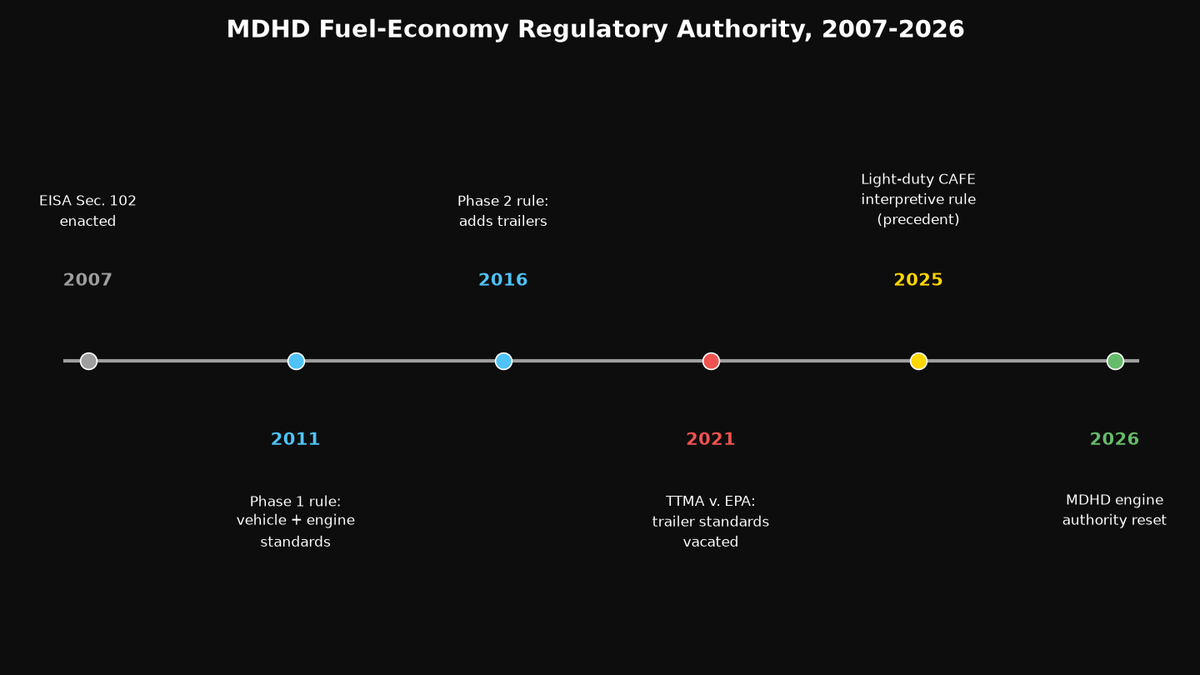
NHTSA's authority traces to Section 102 of the Energy Independence and Security Act of 2007, codified at 49 U.S.C. 32902(b)(1)(C) and (k), which directs NHTSA to set average fuel economy standards for MDHD vehicles (10,000+ pounds gross vehicle weight) and a "work truck" category (8,500 to 10,000 pounds), with at least four model years of lead time before any new standard bites (Federal Register 2026-17756). For fifteen years NHTSA read that grant more broadly: its 2011 Phase 1 rule (joint with EPA) set vehicle standards plus standalone engine standards for tractors and vocational vehicles from model year 2016, and its 2016 Phase 2 rule raised stringency and added trailer standards from model year 2021 (Federal Register 2026-17756).
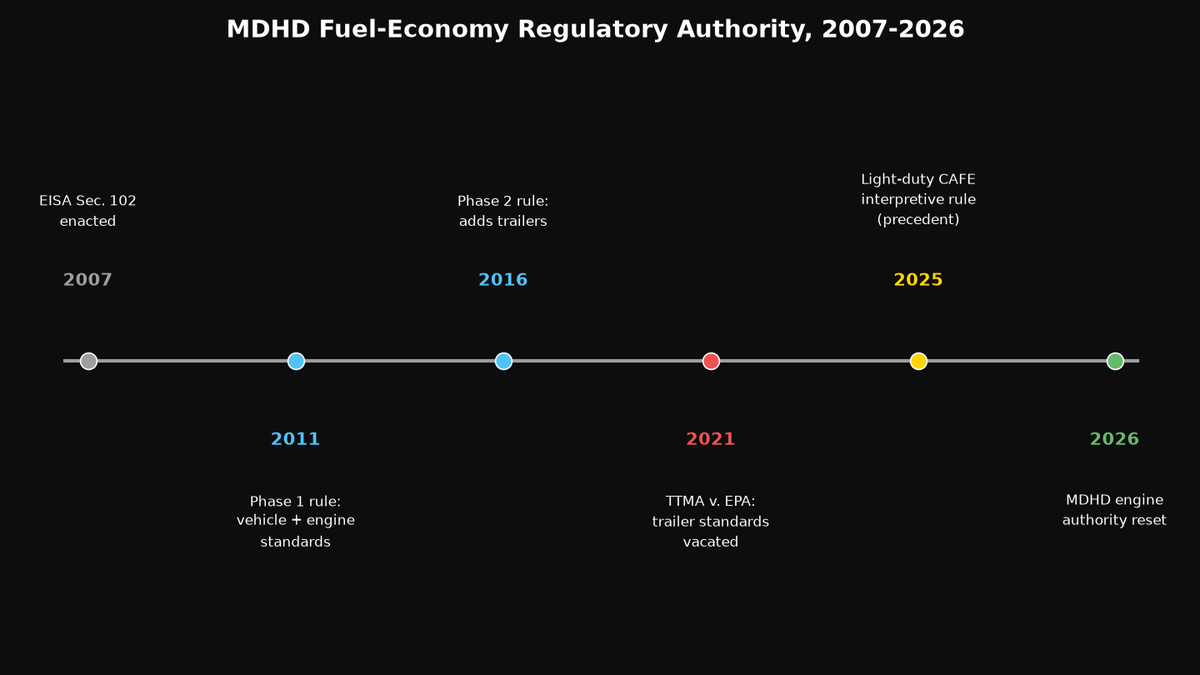
From a 2007 statutory grant to two joint rulemakings, a court reversal on trailers, and now an interpretive rule narrowing NHTSA's read of its own authority to engines. Source: Federal Register 2026-17756.
The trailer piece of Phase 2 did not survive judicial review. In 2021, the D.C. Circuit held in Truck Trailer Manufacturers Association v. EPA that NHTSA and EPA exceeded their authority regulating trailers as "vehicles," reasoning a trailer has no motor and "motorless vehicles use no fuel," and rejecting the agencies' fallback theory that they could regulate only "significant" components as atextual (Federal Register 2026-17756). NHTSA's new rule extends that logic to engines: an engine, like a trailer, is a component of a vehicle rather than the vehicle itself, so Section 102 authorizes NHTSA to regulate the vehicle, not its parts (Federal Register 2026-17756). It also leans on the Supreme Court's post-Chevron Loper Bright decision, which requires courts to find a statute's single best meaning, and draws a direct textual contrast: the Clean Air Act explicitly names "new motor vehicle engines" among what EPA may regulate, while the EISA provision governing NHTSA never uses the word "engine" (Federal Register 2026-17756). As NHTSA puts it: "EPA is not a fuel economy regulator, and NHTSA is not an environmental regulator" (Federal Register 2026-17756).
Regulatory resets like this one move markets before the underlying rulemaking is even proposed. Get the next interpretive rule, rescission, or reset the morning it publishes, free. Subscribe free.
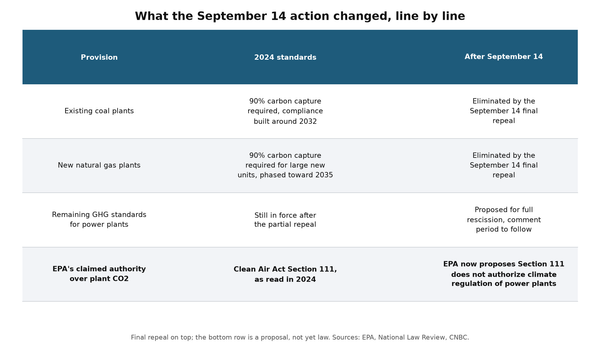
That EPA/NHTSA distinction matters because the two agencies' truck authority has always run on separate tracks. EPA's Clean Air Act authority produced its own heavy-duty rule, finalized December 2022 and effective model year 2027, tightening nitrogen oxide and particulate limits, with amendments proposed in July 2026 (EPA final rule and related materials; Federal Register 2026-17756). Separately, EPA's 2024 Phase 3 greenhouse gas rule phases in carbon dioxide cuts of up to 60 percent for vocational vehicles and 40 percent for tractors by model year 2032 (EPA GHG Phase 3 rule). NHTSA's footnotes note EPA separately rescinded its underlying GHG endangerment finding as of February 2026, on climate-science grounds, not for lack of authority (Federal Register 2026-17756). NHTSA's rule leaves that EPA track untouched; it narrows only what NHTSA can require at the engine level, for fuel economy, not emissions.
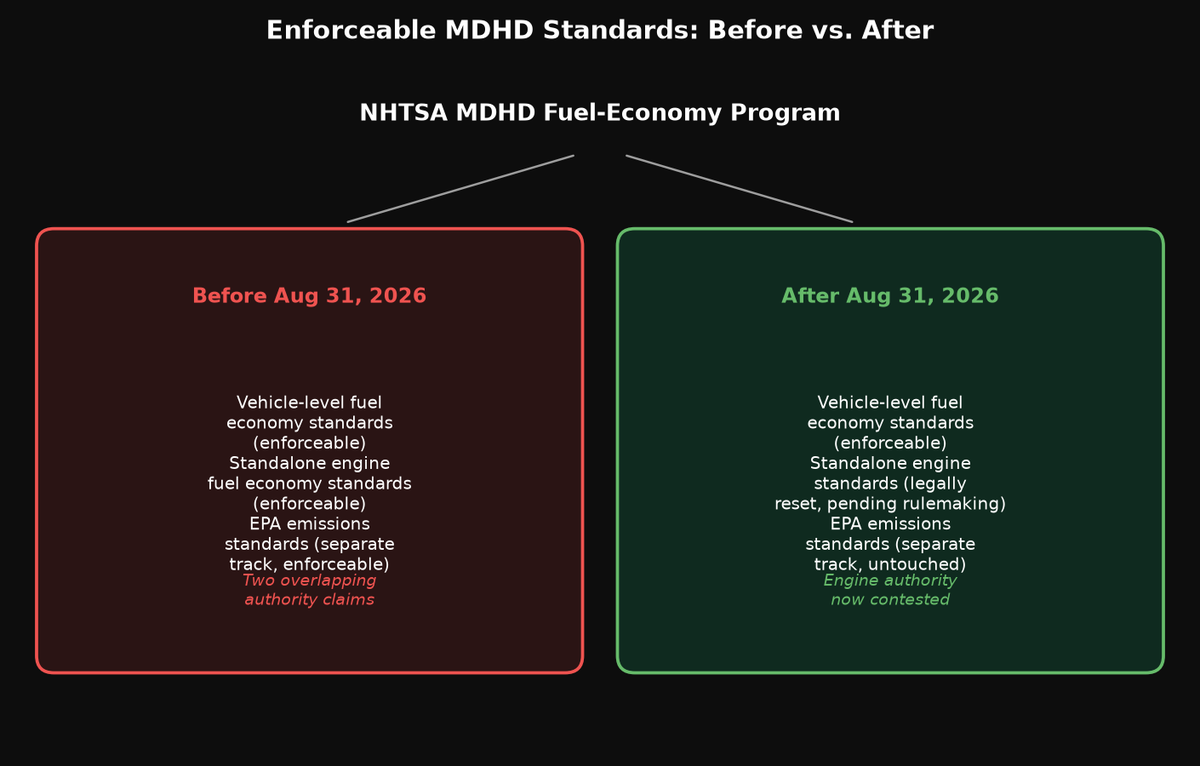
Standalone engine fuel-economy standards move from enforceable to legally contested; vehicle-level standards are unaffected; EPA's separate emissions authority is untouched either way. Source: Federal Register 2026-17756; NHTSA press release.
NHTSA is direct about the limits of today's action: "this interpretation does not change existing standards or any rights or obligations under the MDHD program. Instead, this interpretation lays the groundwork for notice-and-comment rulemaking to reset the agency's regulatory program," and pending that rulemaking, enforcement will follow the new interpretation (Federal Register 2026-17756). Administrator Jonathan Morrison frames the rationale in market terms: "American innovators, not Big Government, know how best to design vehicle engines" (NHTSA press release). This is the same two-step NHTSA ran on the light-duty side in June 2025 with a comparable CAFE interpretive rule that this MDHD version cites as precedent (Federal Register 2026-17756).
Bear Case
NHTSA's own language is the strongest bear case here: nothing changes today, and no manufacturer has a lower compliance bill this model year because of this rule. The substantive reset happens, if it happens, in a future rulemaking that has not been proposed, has no published timeline, and is subject to the statute's own four-model-year lead time and three-model-year stability requirements before any new standard could take effect (Federal Register 2026-17756). This interpretive rule was also issued without notice-and-comment under the APA's interpretive-rule exemption, a procedural shortcut that invites litigation, and a future administration could simply issue its own interpretive rule reverting to the pre-2026 reading, since interpretive rules carry less procedural inertia than final rules (Federal Register 2026-17756).
The EPA-side complication is real too. EPA's separate Clean Air Act authority, the 2023 NOx rule effective model year 2027 and the 2024 GHG Phase 3 standards through model year 2032, is untouched, so manufacturers still build compliant engines regardless of NHTSA's decision (EPA final rule and related materials; EPA GHG Phase 3 rule). Cummins' 10-K frames the nearer-term risk as the reverse of a windfall: it holds $127 million in banked compliance credits, and if NHTSA and EPA both finalize rules eliminating the credit-trading framework, it "could be required to incur a non-cash expense up to the value of our existing credits" (Cummins Inc. 2025 Form 10-K). A cleaner compliance regime is not automatically a cheaper one.
Investment Idea
Thesis type: Sector-exposure watch, not a single-name call. The rule creates regulatory optionality for truck and engine manufacturers, not a realized cost cut, and the size and timing of relief depend on a rulemaking not yet proposed.
Deregulatory catalyst: NHTSA's August 31, 2026 interpretive rule narrowing its fuel-economy authority to vehicles rather than standalone engines, following the same template as its June 2025 light-duty CAFE interpretive rule (Federal Register 2026-17756).
Who has disclosed real exposure: Cummins Inc. (NYSE: CMI), the largest independent heavy-duty engine maker supplying PACCAR, Daimler Truck, and other OEMs, closed at $564.85 on August 28, 2026, market cap near $77.8 billion (Yahoo Finance). Its 10-K states "our engines are subject to extensive statutory and regulatory requirements governing emissions, including greenhouse gas (GHG) standards set by the EPA and fuel consumption standards set by... (NHTSA)," and flags NHTSA's June 2025 interpretive rule as already "questioning the current regulatory framework of allowing credits as a compliance vehicle," against $127 million of compliance credits on the balance sheet at year-end 2025 (Cummins Inc. 2025 Form 10-K). PACCAR Inc. (NASDAQ: PCAR) discloses similar, less NHTSA-specific exposure, citing EPA's fuel-efficiency and GHG standards for MDHD engines as a primary compliance-cost driver (PACCAR SEC filing).
What is priced and what to watch: Neither filing attaches a value to this specific rule, both treating NHTSA/EPA truck regulation as an ongoing cost risk, consistent with NHTSA's own statement that nothing changes today (Cummins Inc. 2025 Form 10-K; Federal Register 2026-17756). Watch for a proposed MDHD rulemaking, any legal challenge to the interpretive rule, and whether EPA's own proposed GHG rescission advances, since Cummins ties its $127 million credit exposure to both agencies' rules finalizing together (Cummins Inc. 2025 Form 10-K).
Time horizon: Multi-quarter to multi-year. NHTSA's four-model-year lead-time and three-model-year stability rule means any new standard could not bind before roughly model year 2030 or 2031 (Federal Register 2026-17756).
The mechanics here are not really about trucks. They are about how far an agency can stretch a plain-language grant of authority before it decides, on its own, that it stretched too far. NHTSA answered that question for itself this time. The next answer belongs to whoever writes the actual rulemaking, and to whichever companies still hold the compliance credits when it lands.
What do you think: does narrowing engine-level fuel economy authority actually lower costs for truck buyers, or does EPA's separate emissions track absorb whatever NHTSA gives back? Reply and let us know.
Related Analysis
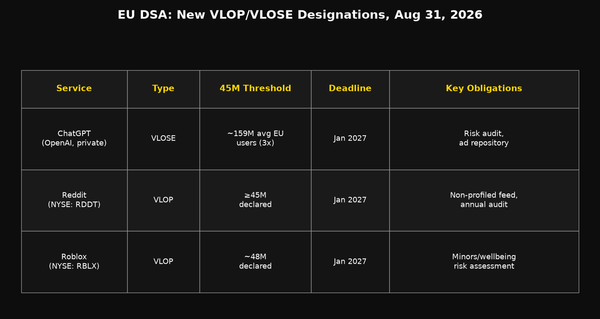
- EU Names ChatGPT, Reddit, and Roblox to Its Toughest Rulebook
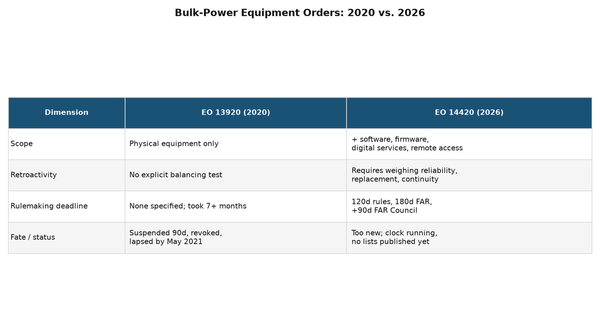
- The U.S. Tried This Grid Equipment Ban Before. It Didn't Stick.
Know someone who tracks trucking, industrials, or regulatory policy? Forward this one along.
The Free Markets Report is provided by Lead-Lag Publishing, LLC. All opinions and views mentioned in this report constitute our judgments as of the date of writing and are subject to change at any time. Information within this material is not intended to be used as a primary basis for investment decisions, and should also not be construed as advice meeting the particular investment needs of any individual investor. Trading signals produced by The Free Markets Report are independent of other services provided by Lead-Lag Publishing, LLC, or its affiliates, and the positioning of accounts under their management may differ. Please remember that investing involves risk, including loss of principal, and past performance may not be indicative of future results. Lead-Lag Publishing, LLC, its members, officers, directors, and employees expressly disclaim all liability with respect to actions taken based on any or all of the information in this writing.