Pennsylvania Turns Data Centers Into a Permitting Bargain
EO 2026-05 doesn't ban a single project. It builds a two-track system where speed is the reward and cost-shifting is the price.

On August 18, 2026, Pennsylvania Governor Josh Shapiro signed Executive Order 2026-05, "Protecting Pennsylvania Consumers from Data Center Impacts," effective immediately. The order does not block data centers; it restructures how DEP reviews permits for any project over 25 MW peak demand, and links the state's sales-tax exemption on data-center equipment to a new compliance framework, the GRID Requirements. This is a mechanism story, not a moratorium story.
Key Highlights
- Stricter DEP review provisions apply to data-center projects with peak demand over 25 MW (PA EO 2026-05 PDF).
- The order recites over 100 proposed data-center facilities in Pennsylvania, with DEP permit applications tied to 20 of them and 14 locations holding active Department of Revenue exemption certificates as of the effective date (PA EO 2026-05 PDF).
- DEP must build a template Consent Order and Agreement (COA) incorporating the GRID Requirements; developers must notify DEP, attend a pre-application meeting, and execute a project-specific COA before rolling review can begin (PA EO 2026-05 PDF).
- Sales-and-use tax exemption applicants under the Computer Data Center Equipment Exemption Program must comply with GRID Requirements for applications on or after August 18, 2026 (PA EO 2026-05 PDF).
- The Special Counsel for Energy Affordability must push for data-center-borne PJM reliability backstop and interconnection costs and curtailment priority ahead of other customers, referencing FERC dockets ER26-3380-000 and ER26-3515-000 (PA EO 2026-05 PDF).
The Two-Track Permitting System: Carrot, Not Just Stick
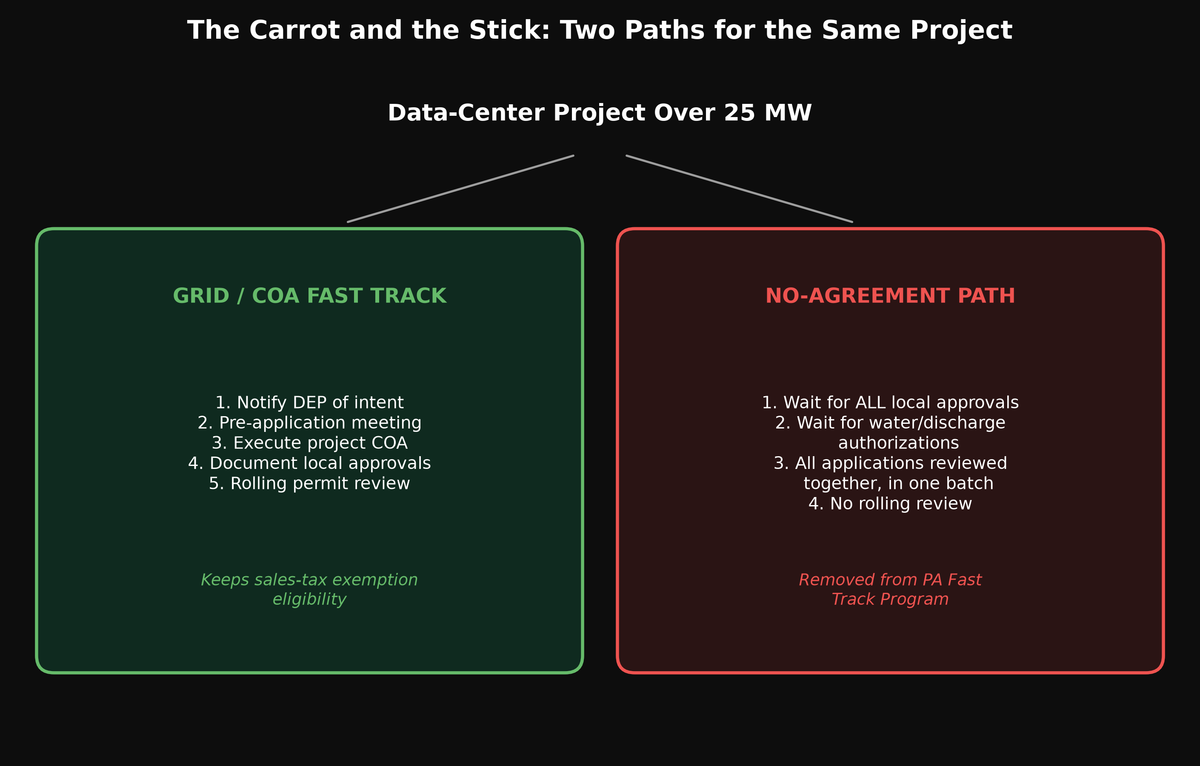
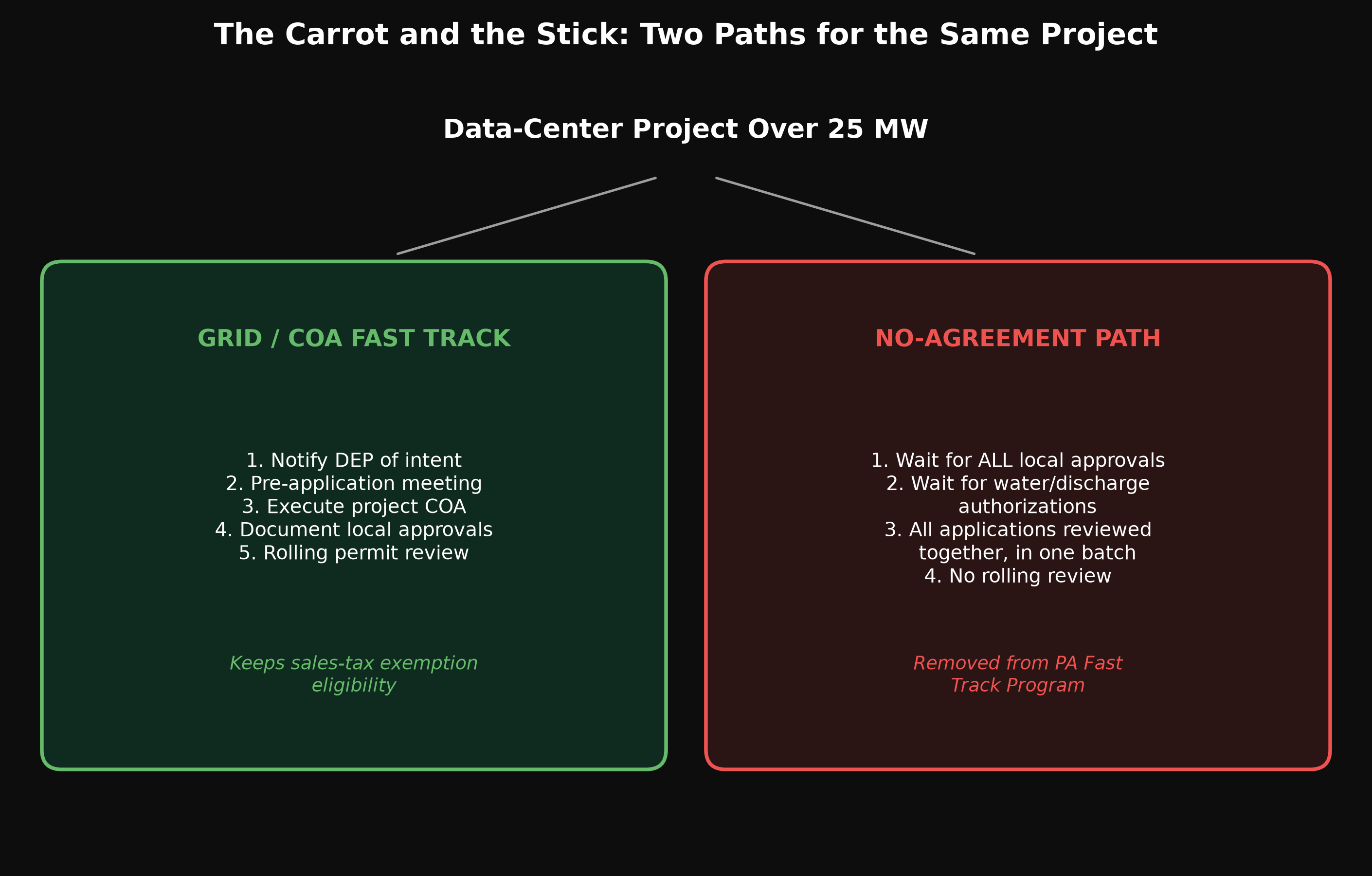
The core mechanism in EO 2026-05 is a fork in the road, not a wall. For any project over 25 MW, DEP must build a template Consent Order and Agreement (COA) baking in the GRID Requirements; any applicant wanting the fast lane must notify DEP of intent to comply, attend a pre-application meeting, and execute a project-specific COA before rolling review begins (PA EO 2026-05 PDF). Only after documenting local-plan consistency and securing all required local approvals can DEP issue qualifying permits on a rolling basis (PA EO 2026-05 PDF; PA Governor's press release).
The alternative track is deliberately worse. For projects over 25 MW skipping the COA, DEP cannot begin review until local approvals plus any water-withdrawal or wastewater-discharge authorizations are already secured, permits cannot issue on a rolling basis, and every required application must be reviewed together in one batch (PA EO 2026-05 PDF). Layer on the removal of every existing data-center project from the general PA Permit Fast Track Program, with data centers no longer eligible going forward (PA EO 2026-05 PDF; PA Governor's press release), and the message is clear: the generic fast track is gone, and speed now runs through GRID compliance specifically. That is carrot-and-stick, not a ban. The historical base rate here is that sophisticated developers take the carrot, since speed carries real financial value in a capital-intensive, lead-time-sensitive business.
Cost Allocation and the Tax Exemption as Compliance Levers
The order extends the same logic to money. The Department of Revenue must update the Computer Data Center Equipment Exemption Program Guidelines so applicants for the sales-and-use tax exemption on or after August 18, 2026 must comply with GRID Requirements to receive it, converting a previously unconditional tax benefit into a conditional one (PA EO 2026-05 PDF). Fourteen locations held active exemption certificates under that program as of signing, indicating how many existing operators now have a stake in the rewrite (PA EO 2026-05 PDF).
Get the next one first. Free, daily, one email when a new regulatory catalyst breaks. Subscribe free.
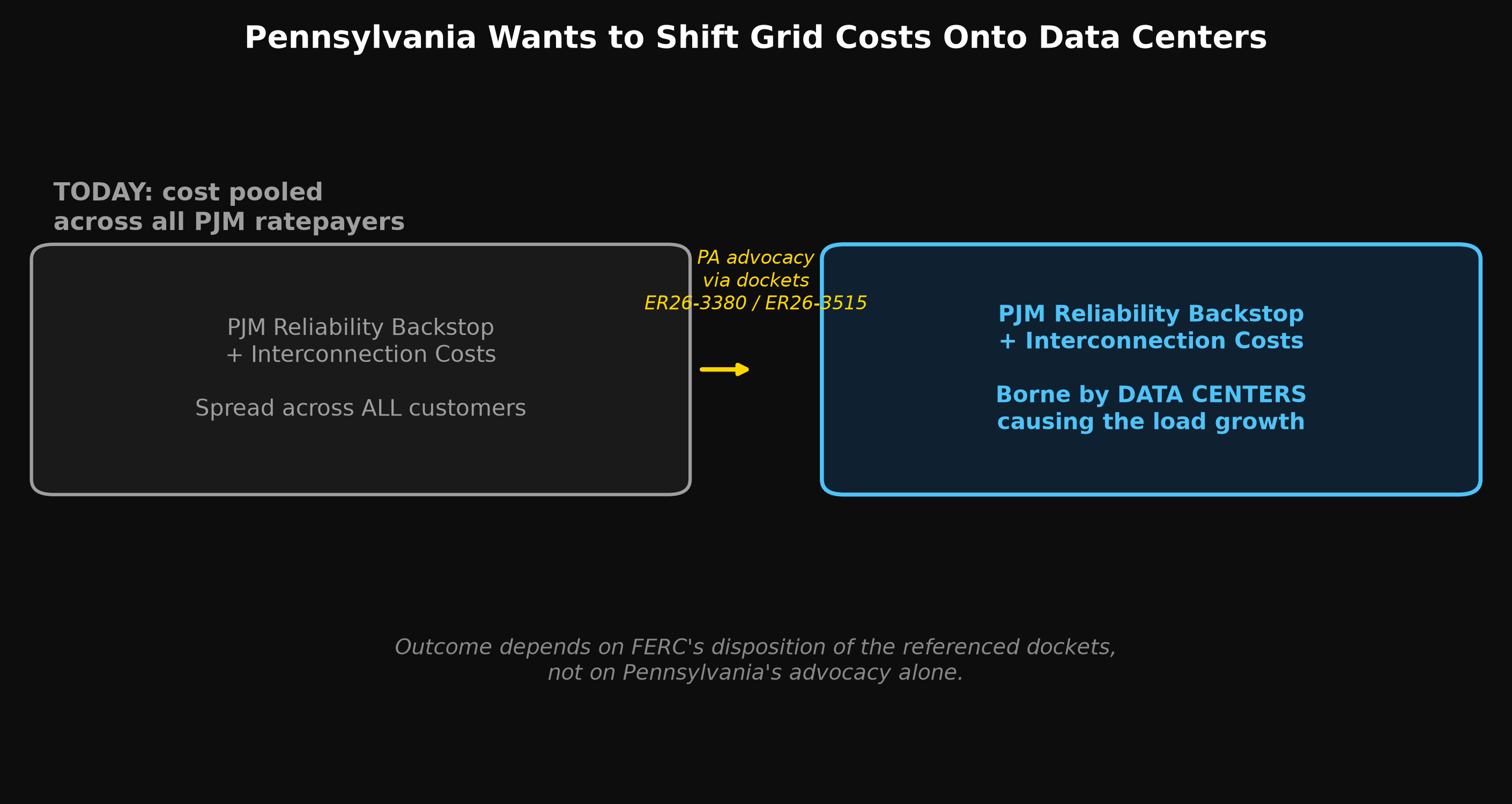
The more consequential piece sits with the Special Counsel for Energy Affordability, directed to push the Public Utility Commission, and through it the cost-allocation framework pending at FERC in dockets ER26-3380-000 and ER26-3515-000, so that data-center customers, not the broader ratepayer base, absorb PJM reliability backstop auction costs and utility interconnection costs tied to their own load growth (PA EO 2026-05 PDF). The order also directs curtailing data centers ahead of other customers during specified grid emergencies, unless a data center has secured its own incremental capacity (PA EO 2026-05 PDF). The financial mechanics suggest a straightforward internalization play: shift the marginal grid cost of data-center growth onto the entities causing it, pending FERC's disposition of those dockets, outside Pennsylvania's control.
The Disclosure Regime: a Rolling Census, Not a One-Time Snapshot
Starting July 1, 2027, and every July 1 after, DEP must require operating data centers to file annual reports covering energy use, natural-gas use, peak load, water use, efficiency measures, environmental protection measures, on-site and off-site generation, waste-heat recovery, projected future demand, and public-water-system information (PA EO 2026-05 PDF). That is a recurring obligation, not a one-off filing. It converts the sector from something tracked episodically, through permit filings and press releases, into something tracked annually with standardized categories, a structural shift in how much visibility the state, and the market, has into build-out plans, water stress, and grid impact going forward.
Bear Case / Counterargument
The order's own text limits how much weight it can bear. EO 2026-05 states it must be implemented consistent with applicable law, cannot contravene or supersede state or federal law, and creates no enforceable substantive or procedural right for any party (PA EO 2026-05 PDF). That is standard boilerplate, but not incidental: the two-track permitting system, tax-exemption conditioning, and cost-allocation push are only as real as the DEP guidance, template COA language, and PUC rulemaking that implement them, none of which exists yet.
There is also a real economic-development tradeoff unresolved here. If Pennsylvania shifts PJM backstop and interconnection costs onto data centers while other PJM states do not, Pennsylvania becomes comparatively more expensive to site in. Developers weigh delivered power cost and speed to energization heavily; a state internalizing more grid cost onto the developer, even if fairer to ratepayers, looks less competitive against jurisdictions that haven't made the same move. The order does not resolve how Pennsylvania stays competitive as its cost structure diverges from lighter-touch states.
Finally, the headline figures, over 100 proposed facilities, 20 with DEP permit applications, 14 with active exemption certificates, are dated recitals tied to the signing date, not a live census (PA EO 2026-05 PDF). Treating them as a current pipeline snapshot would be a mistake; they justify why the order was issued when it was, nothing more.
Investment Idea
This is a policy-mechanism story, not a stock call, and no company is named in the order or this analysis. Three research categories are worth tracking as this framework moves from order to implementing guidance, with the caveat that the effect cuts both ways depending on where a business sits in the value chain.
Category 1: Pennsylvania-exposed data-center developers. Firms with projects over 25 MW in the Commonwealth face a real choice between the GRID/COA fast track and the slower no-agreement path, plus a tax exemption no longer unconditional. This is a genuine cost and speed headwind for developers with meaningful Pennsylvania concentration.
Category 2: Utilities operating in PJM territory with Pennsylvania load. If FERC dockets ER26-3380-000 and ER26-3515-000 resolve toward shifting backstop auction and interconnection costs onto data centers, utilities serving large PJM data-center load could see a more favorable cost-recovery posture, though this depends entirely on FERC, not Pennsylvania's advocacy alone.
Category 3: Grid-interconnection and power-infrastructure equipment suppliers. A permitting regime built on consent agreements, documented local approvals, and mandatory annual disclosure of peak load, generation, and waste-heat data is a structural tailwind for businesses helping document, monitor, and report interconnection and capacity data, the plumbing behind compliance.
Catalyst: Publication of DEP's template Consent Order and Agreement and the GRID standards it incorporates; FERC action in dockets ER26-3380-000 and ER26-3515-000; the first annual disclosure cycle beginning July 1, 2027.
Risk: The no-enforceable-rights language means implementation could stall administratively; multi-state competition could make Pennsylvania's cost-shifting approach a disadvantage rather than a model other states copy; FERC could resolve the referenced dockets in a way that doesn't track Pennsylvania's advocacy at all.
Principle
States are increasingly reaching for permitting speed and cost-allocation levers, rather than outright bans, to manage a growth sector popular with capital and unpopular with ratepayers at once. Pennsylvania didn't say no to data centers. It built a system where saying yes to disclosure, cost internalization, and local approval gets a faster permit, and saying no gets a slower, batch-reviewed one, with the tax exemption pulled into the same logic. That structural design, the mechanics of what triggers the fast lane versus the slow lane, is usually where the investable signal lives, well before the headline "regulation" framing catches up.
Watching a state-level data-center policy fight we're missing? Hit reply.
Related analysis
Read next: NOAA's TMC Seabed Filing Clears a Box, Not a Permit
Read next: The UK Just Renewed a Steel Tariff Nobody Noticed
The Free Markets Report is provided by Lead-Lag Publishing, LLC. All opinions and views mentioned in this report constitute our judgments as of the date of writing and are subject to change at any time. Information within this material is not intended to be used as a primary basis for investment decisions, and should also not be construed as advice meeting the particular investment needs of any individual investor. Trading signals produced by The Free Markets Report are independent of other services provided by Lead-Lag Publishing, LLC, or its affiliates, and the positioning of accounts under their management may differ. Please remember that investing involves risk, including loss of principal, and past performance may not be indicative of future results. Lead-Lag Publishing, LLC, its members, officers, directors, and employees expressly disclaim all liability with respect to actions taken based on any or all of the information in this writing.
Know someone who should be reading this?
One deregulation story and one stock idea, every day, free. Send it to someone who thinks markets work better than mandates.