Britain Just Deleted Its Infrastructure Consultation Rulebook
On July 24, 2026, six sections of the Planning Act 2008 vanished, and the longest stage of the UK's infrastructure consenting process lost its statutory floor.

On July 24, 2026, six sections of the Planning Act 2008 vanished, and the longest stage of the UK's infrastructure consenting process lost its statutory floor.
Key Highlights
- Section 5 of the Planning and Infrastructure Act 2025 omits six provisions of the Planning Act 2008, sections 42, 43, 44, 45, 47 and 49, the entire statutory pre-application consultation architecture for Nationally Significant Infrastructure Projects (NSIPs).
- It took effect on July 24, 2026 under regulation 3 of the Commencement No. 4 Regulations, which also commenced sections 4, 6, 7, 8, 9 and 11.
- The Planning Inspectorate confirmed on July 27, 2026 that it is stripping references to "the obsolete statutory requirement for applicants to carry out pre-application consultation" from its advice pages, and withdrew guidance on consultation reports plus Advice Notes 7 and 9.
- Government arithmetic values it at up to 12 months of saved pre-application time and over £1 billion across the pipeline, from a National Infrastructure Commission estimate that delay costs roughly £1.5 million per project per month.
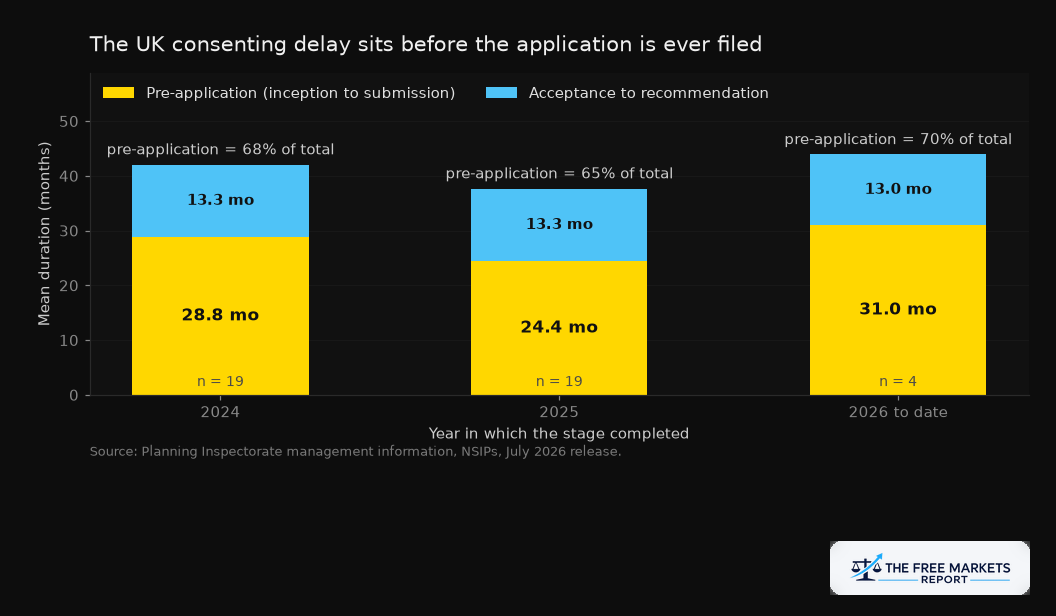
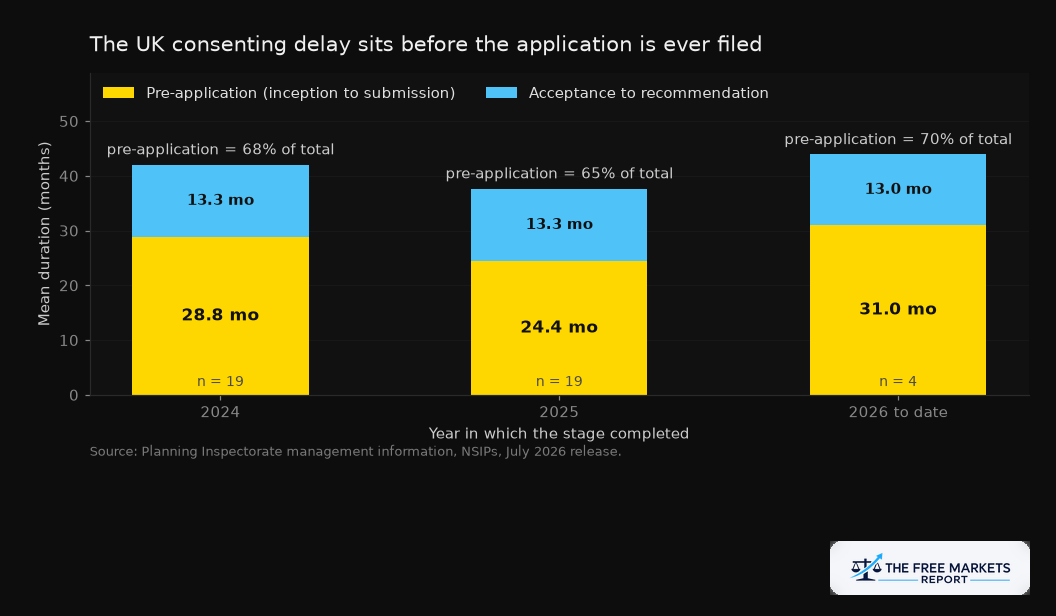
- Pre-application consumed a mean of 2.58 years for projects reaching submission in 2026 to date, against 12.96 months for all post-submission stages combined.
Most deregulation removes a cost. This one removes a calendar. The distinction matters more than it sounds, because in UK infrastructure the calendar is the cost, and the entity that captures the saving is not the one that lobbied loudest but the one with the most unsubmitted applications sitting in the queue on the day the rule died.
What actually got deleted
The text is unusually blunt for a planning statute. Section 5 of the Planning and Infrastructure Act 2025, which received Royal Assent on December 18, 2025 as chapter 34, instructs: "Omit the following sections of the Planning Act 2008," then lists section 42 (duty to consult), section 43 (local authorities), section 44 (categories of consultee), section 45 (consultation timetable), section 47 (duty to consult the local community) and section 49 (duty to take account of responses).1
That is not streamlining. It is removal of the legal obligation itself, along with the duty to demonstrate that responses were considered. The statutory Statement of Community Consultation, the preliminary environmental information report and the consultation report have no statutory basis after commencement.
Commencement came through regulation 3 of the Commencement No. 4 and Transitional Provisions Regulations 2026, made June 16, 2026, which brought sections 4, 5, 6, 7, 8, 9 and 11 into force on July 24, 2026.2 Section 7 rewrote the acceptance test in section 55, replacing consultation compliance with a narrower checklist covering the application's form and contents, the applicant's approach to the surviving section 48 publicity duty, and regard to Inspectorate advice, and it requires the Secretary of State to publish reasons for refusing acceptance.7 Section 9 changed how the examining authority is constituted, and applies to every application assessed on or after commencement.8
Three days later the Planning Inspectorate confirmed the amendments "came into force on 24 July 2026" and that advice pages were being updated to remove the now obsolete consultation requirement. It withdrew its advice on the consultation report, its advice on section 53 rights of entry, and Advice Notes 7 and 9, with remaining environmental pages to be revised during August 2026 and the 2024 pre-application prospectus not updated until summer 2027.3
The savings claim is a schedule claim
The government's number is £1 billion and up to 12 months, and both figures come from one chain of reasoning. A written answer to Parliament sets out the derivation: the National Infrastructure Commission estimates delay costs a project around £1.5 million per month, so 12 months saved is roughly £18 million per project, which across the expected pipeline exceeds £1 billion.5 The July 3, 2026 announcement repeated the framing and added that onshore wind under the Town and Country Planning regime was freed from mandatory pre-application consultation for the first time since 2015.4
That is a claim about time, not spending. Nothing in section 5 reduces the capital cost of a substation or a cable route. It compresses the period during which capital is committed but not yet earning a regulated return, and for a rate-regulated network operator that compression is the prize.
Inspectorate management information shows why. For projects reaching submission in 2026 to date, mean pre-application duration was 2.58 years, up from 2.03 years in 2025 and 2.40 years in 2024, while post-submission stages barely moved: 4.70 months to the start of examination, 5.31 months of examination, and 2.95 months to recommendation.6
The queue tells you who collects
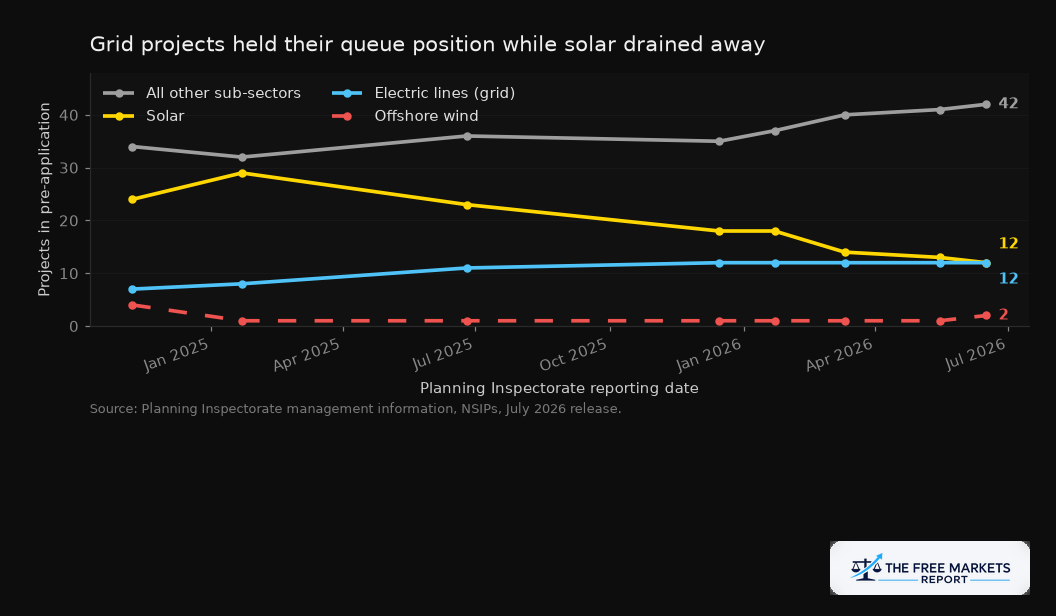
A rule change only pays if you have applications yet to file. The Inspectorate's register, downloaded July 28, 2026, lists 68 projects at pre-application, of which 28 are generating stations and 14 are electric lines.9
Nine of those 14 electric line projects list a National Grid group company as applicant: seven under National Grid Electricity Transmission, including North Humber to High Marnham, Grimsby to Walpole, Chesterfield to Willington, Eastern Green Link 3 and 4, Eastern Green Link 5 and Weston Marsh to East Leicestershire, plus the LionLink interconnector and a cross border connection in England. Every one carries an anticipated submission date between the fourth quarter of 2026 and 2028, so every one is now governed by the post July 24 regime.9
The regulatory backdrop compounds it. Ofgem's RIIO-3 Final Determinations of December 4, 2025, covering April 2026 to March 2031, approved £28.7 billion of upfront investment across electricity and gas networks, including £10.7 billion of baseline electricity transmission funding, and stated that "over £70bn of investment may be required" in transmission across the period with at least £44 billion already committed.10 Consenting speed is the binding constraint on converting allowance into regulated asset base.
Investment Idea
- Company: National Grid plc (NGG)
- Thesis type: Primary beneficiary
- Deregulatory catalyst: Section 5 of the Planning and Infrastructure Act 2025, commenced July 24, 2026, omitting the Planning Act 2008 pre-application consultation duties in sections 42, 43, 44, 45, 47 and 49 for NSIPs.
- Current price: $80.86 (as of July 28, 2026, Perplexity Finance real-time quote, market capitalization $81.3 billion, trailing P/E 18.4)
- Key financial data: FY26 capital investment of £11,576 million, up 21.3 percent, underlying operating profit of £5,680 million and underlying EPS of 78.0 pence per the company's full year 2025/26 disclosure, net debt of £44.2 billion at March 31, 2026, and at least £70 billion of capital investment planned to FY31, around £31 billion in UK Electricity Transmission.
- Regulatory constraint removed: Statutory pre-application consultation, valued by government at up to 12 months per project and roughly £18 million per project using the National Infrastructure Commission's £1.5 million per month delay cost.
- Bull case: National Grid entities are the applicant on nine of the 14 electric line projects in pre-application, all with submission dates after commencement, so the schedule compression lands on the largest unfiled pipeline in the register. Management itself noted in the FY26 results that the Act "includes measures to streamline planning for our infrastructure projects." Faster consent pulls forward regulated asset base growth against the roughly £31 billion UK transmission programme and shortens the window of unremunerated development spend.
- Bear case: The reform removes a statutory duty, not the political economy behind it. Common law consultation obligations and the surviving section 46 and section 48 duties still apply, and the amendments carry no transitional provisions, so live schemes face judgment calls rather than clean relief. Net debt of £44.2 billion and a step up to roughly £13 billion of FY27 capital investment also mean the equity story remains a funding story first.
- What to watch: Whether the nine National Grid electric line projects actually file on their stated submission dates, and whether mean pre-application duration in the Inspectorate's next management information release turns down from 2.58 years.
- Time horizon: 18 to 36 months
The market has not treated this as an event. National Grid's ADR closed at $80.86 on July 28, 2026 against $82.30 on July 24, down about 1.8 percent, while the iShares MSCI United Kingdom ETF rose about 1.3 percent.15 Procedural deregulation rarely reprices on the day it commences, which is why it pays to read the statute.
Bear Case
The honest counterargument is that objections do not disappear when the duty to solicit them does. They relocate.
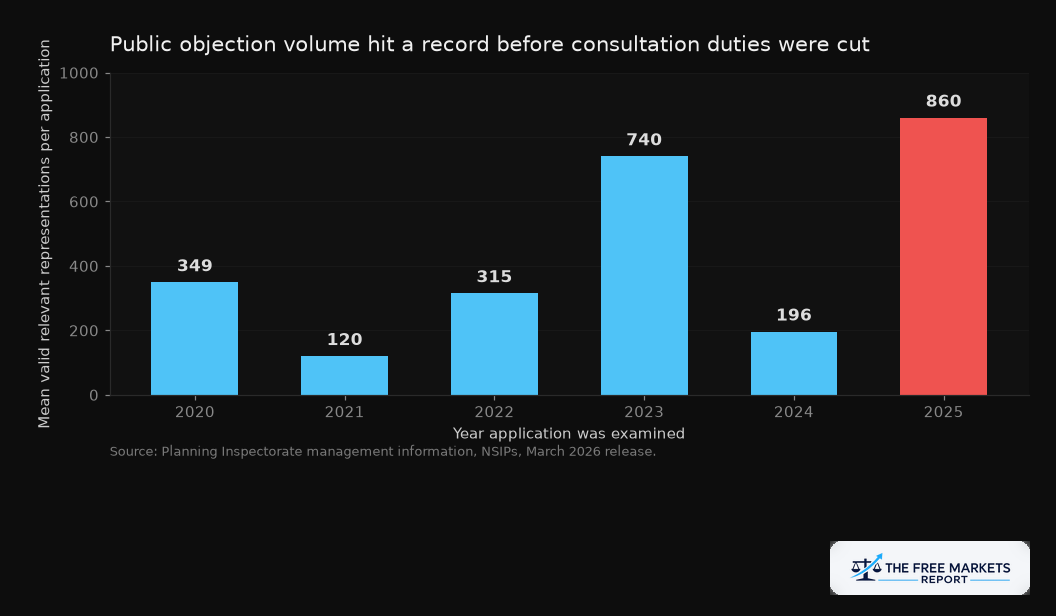
Objection volume averaged 860 valid relevant representations per application in 2025, the highest in the series and more than four times the 2024 figure of 196.6 Those representations enter at examination, a stage the reform did not shorten and which still ran a mean of 5.31 months in 2026. If applicants arrive with thinner engagement records, examining authorities may respond with more hearing days and written questions, and Inspectorate data already shows extra hearing days required in seven of 11 recently examined applications.6
There is also legal exposure. Practitioners note that the common law duty to consult is untouched, that section 46 notification and section 48 publicity survive, and that the amendments carry no transitional provisions, leaving schemes mid-consultation on July 24 to judge how much of their programme to keep.13,14 An applicant treating the repeal as licence to engage less invites judicial review, consuming far more than the 12 months the reform is meant to save. The Inspectorate figures are management information, not official statistics, with samples as small as four projects, so read them as direction rather than precision.6
The Principle
Deregulation is usually analysed as a transfer of cost from the regulated to the public. This one is better read as a transfer of certainty. Parliament did not decide that communities should be heard less; it decided the state would stop specifying how, and would absorb the resulting ambiguity. The value is real but contingent, and it accrues to whichever balance sheet holds the largest queue of unfiled applications and the deepest tolerance for the litigation risk that ambiguity invites. Read the register before the press release.
- Planning and Infrastructure Act 2025, c. 34, section 5 as enacted. legislation.gov.uk
- The Planning and Infrastructure Act 2025 (Commencement No. 4 and Transitional Provisions) Regulations 2026, SI 2026/641, regulation 3 as made. legislation.gov.uk
- Planning Inspectorate, "Nationally Significant Infrastructure Projects: updates to advice pages and other information," published July 27, 2026. gov.uk
- Ministry of Housing, Communities and Local Government, "Fastest infrastructure building in a generation as planning rules overhauled," July 3, 2026. gov.uk
- UK Parliament, written question 47654, answered April 24, 2025. questions-statements.parliament.uk
- Planning Inspectorate, "Planning Inspectorate management information: Nationally Significant Infrastructure Projects, July 2026," data as at June 16, 2026, and the March 2026 release of the same series. gov.uk
- Planning and Infrastructure Act 2025, c. 34, section 7 as enacted. legislation.gov.uk
- Planning and Infrastructure Act 2025, c. 34, section 9 as enacted. legislation.gov.uk
- Planning Inspectorate, register of applications and project search download, retrieved July 28, 2026. planninginspectorate.gov.uk
- Ofgem, "RIIO-3 Final Determinations Overview Document," December 4, 2025. ofgem.gov.uk
- National Grid plc, investor relations full year 2025/26 highlights. nationalgrid.com
- National Grid plc, full year results statement and presentation for the period ended March 31, 2026. nationalgrid.com
- Bryan Cave Leighton Paisner, "The end of statutory pre-application consultation and other DCO regime changes." bclplaw.com
- Burges Salmon, "Statutory consultation falls away for DCO projects: what live schemes need to know." burges-salmon.com
- Perplexity Finance real-time quote and daily price history for NGG and EWU, retrieved July 28, 2026.
The Free Markets Report is provided by Lead-Lag Publishing, LLC. All opinions and views mentioned in this report constitute our judgments as of the date of writing and are subject to change at any time. Information within this material is not intended to be used as a primary basis for investment decisions, and should also not be construed as advice meeting the particular investment needs of any individual investor. Trading signals produced by The Free Markets Report are independent of other services provided by Lead-Lag Publishing, LLC, or its affiliates, and the positioning of accounts under their management may differ. Please remember that investing involves risk, including loss of principal, and past performance may not be indicative of future results. Lead-Lag Publishing, LLC, its members, officers, directors, and employees expressly disclaim all liability with respect to actions taken based on any or all of the information in this writing.
Related coverage: Britain Just Stopped Naming Its Short Sellers; The Swarf Clause