Britain Just Stopped Naming Its Short Sellers. Here's Who Wins.
A new FCA regime scraps public short-seller naming for UK stocks, keeps private reporting intact, and quietly makes London a more workable place to trade.

Key Highlights
- The UK Financial Conduct Authority's new short-selling regime took full effect Monday, July 13, 2026, ending public disclosure of individual short sellers who cross the former 0.5% threshold (FCA press release).
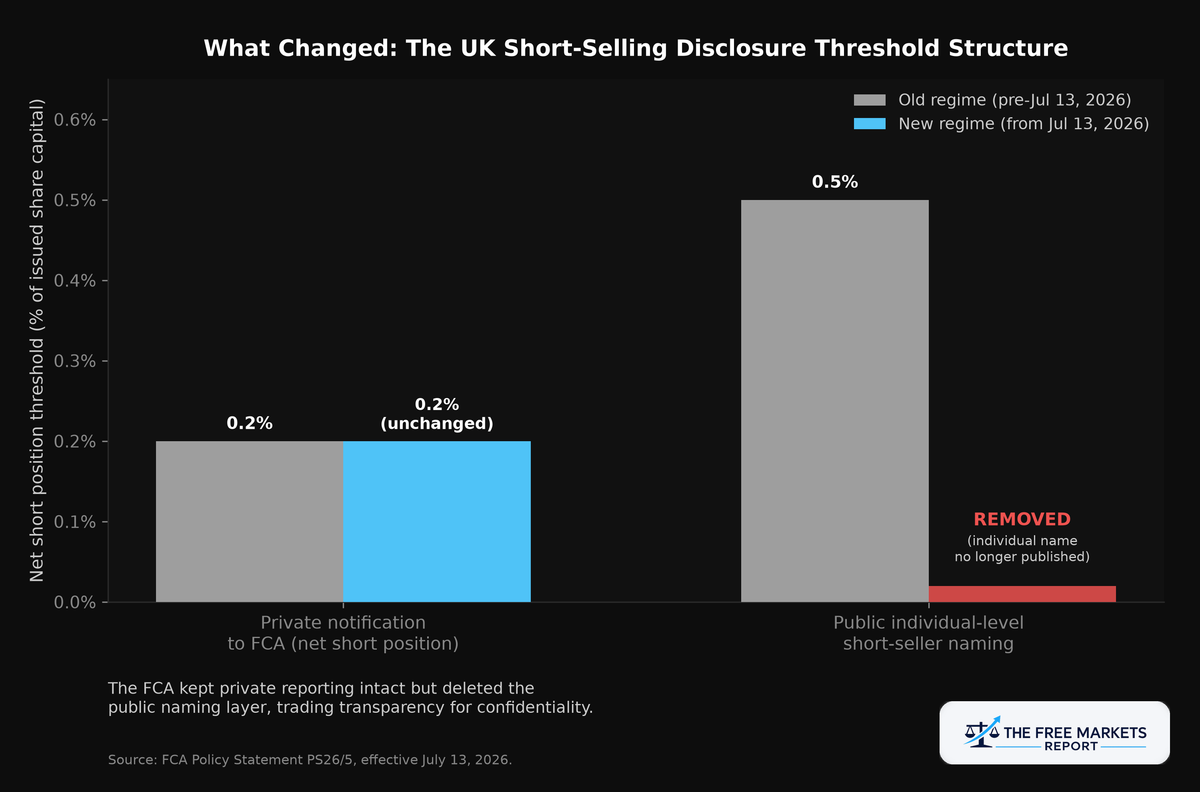
- Individual short positions are no longer named. The FCA now publishes only company-level Aggregate Net Short Positions (ANSPs); private notification to the regulator at the unchanged 0.2% threshold continues (FCA PS26/5).
- A new positive-list "Reportable Shares List" replaced the old negative-list exemption structure, and UK sovereign debt was pulled out of the regime entirely (FCA PS26/5 PDF).
- The government's own impact assessment put the annual net benefit at £509,400 to £2,673,600, a modest number that undersells the bigger prize: keeping London's capital-markets machinery competitive against New York.
- The UK Investor Relations Society flagged a real cost on December 16, 2025: issuers lose a signal they used to watch for activist buildups and hostile bids (IR Society statement).
For nineteen years, if you shorted a UK stock past half a percent of its shares outstanding, the FCA put your name on a public list next to the company you were betting against. As of last Monday, that list is gone. The regulator still knows who you are. The public does not.
That is the entire story in one sentence, and it is a bigger deal than the modest numbers around it suggest.
What the FCA actually changed
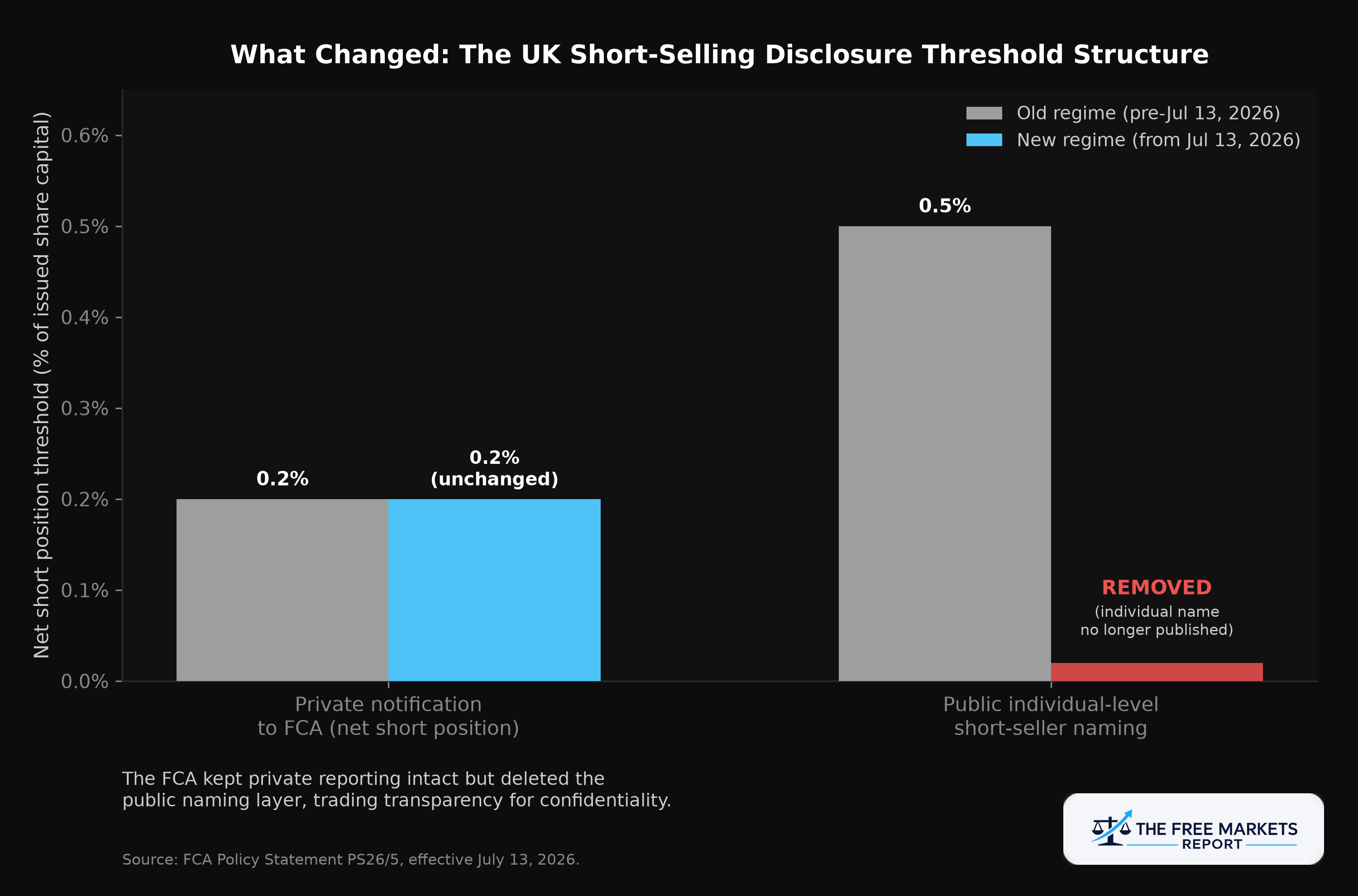
Start with the mechanics, because the difference between "less regulation" and "different regulation" matters here. The private reporting layer, where individual funds tell the FCA directly about net short positions, keeps functioning exactly as before, still triggered at 0.2% of issued share capital with each additional 0.1% increment reported the same way (FCA PS26/5 PDF). Nothing about surveillance changed. What disappeared is the second, public-facing layer: once a position crossed 0.5%, the FCA used to publish the fund's name, the company, and the size of the bet on a public register anyone could search.
Now the FCA publishes an Aggregate Net Short Position by company. You can see that 4% of a stock's shares are held short in aggregate. You cannot see that Marshall Wace holds half of it and a smaller fund holds the rest (FCA: notification and disclosure of net short positions).
Three secondary mechanics reinforce the same direction. First, the exemption list flipped from a negative list (name what's excluded) to a positive "Reportable Shares List," with the first version published the same day the regime took effect (FCA PS26/5 PDF). Second, UK sovereign debt and associated sovereign CDS were removed from position-reporting and covering requirements altogether, though the FCA's emergency intervention powers still reach those instruments if a crisis hits. Third, the reporting deadline for notifications was pushed back from 15:30 UK time on T+1 to 23:59 UK time on T+1, giving funds an extra eight and a half hours to file. None of these three is individually dramatic. Together, they describe a regulator methodically lowering the administrative cost of running a short book in UK-listed names, while keeping its own visibility into systemic risk unchanged.
Market makers got a separate, more structural break. Instead of notifying the FCA instrument by instrument every time they wanted an exemption, they now file a single activity-based attestation once a year, due the first working day of June. Existing exemptions carry over on a transitional basis until January 29, 2027, provided funds re-notify by January 15, 2027.
Why this matters more than the impact assessment says
The UK government's own statutory cost-benefit analysis put the annual net benefit of the underlying regulations at £509,400 to £2,673,600. That is a rounding error next to London's market capitalization. Reading the policy only through that number misses the point. The FCA is not trying to save funds money on compliance paperwork. It is trying to remove one specific reason a hedge fund might choose to run its UK short book through a structure that avoids public attribution, or simply choose not to short UK names at all and take the trade somewhere with looser disclosure. Reputational risk from being publicly named as short a well-known UK company, especially one with a retail shareholder base or media profile, has been a live deterrent for institutional short sellers since the current regime began. Removing the public name removes that deterrent while leaving the FCA's own surveillance untouched.
This is the free-market mechanic worth sitting with: information asymmetry between the regulator and the public is not the same as information asymmetry between the regulator and the market participant. The FCA loses nothing it needs to do its job. The public loses a magazine-cover-ready name to attach to a short bet. What the market gains, in theory, is deeper two-sided liquidity: more willing short sellers means tighter price discovery and less one-directional pressure when good news arrives and shorts have to cover, since there are simply more shorts sitting silently in the aggregate figure.
Who benefits: the infrastructure, not any single stock
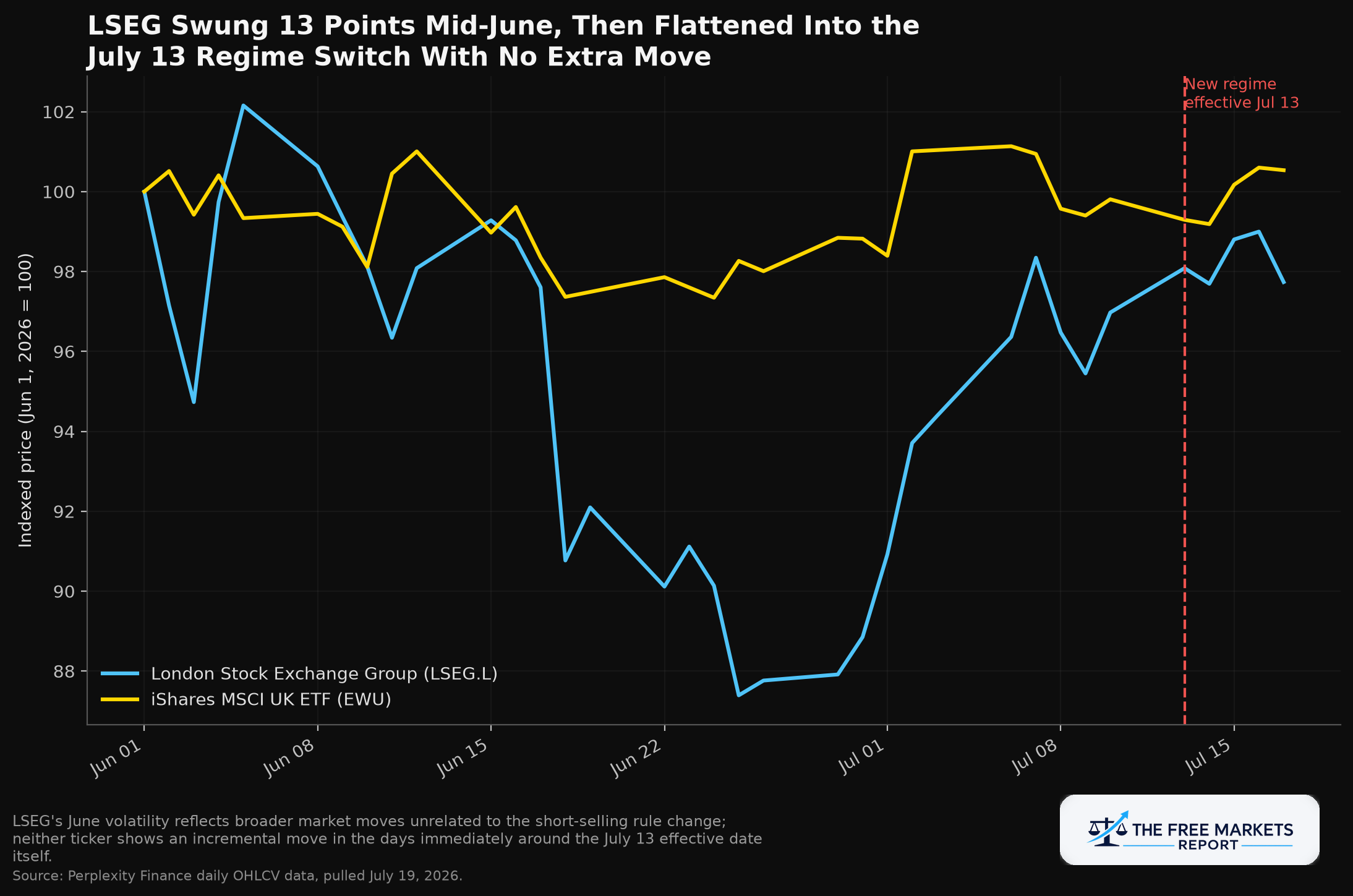
The direct financial beneficiary of a market structure change like this is not any operating company that happens to be domiciled in the UK. It is the infrastructure sitting underneath every trade. London Stock Exchange Group, which already reported FY2025 total income (excluding recoveries) of £8.99 billion, processes the trading volume, licenses the data, and runs the indices this entire disclosure apparatus feeds into. But the cleaner way to express a "more workable UK equity market" thesis without betting on any one company's execution is the country ETF: a basket of the large-cap UK names that were the ones actually named under the old individual-disclosure regime in the first place.
Bear Case
The skeptic's argument here is not weak, and it deserves a direct hearing rather than a strawman. The UK Investor Relations Society made it in December: individual short-seller names were "valuable context for investor engagement and risk monitoring, e.g., in relation to activism or hostile M&A" (IR Society statement). An issuer facing a slow-building activist campaign used to be able to watch a specific fund's disclosed position grow over months and prepare a defense. Under the new aggregate-only regime, that early-warning signal is gone; the company sees the total short interest rise without knowing whether it is one aggressive activist accumulating a stake or ten unrelated funds making unrelated bearish bets for ten unrelated reasons. Those are different risks that used to be distinguishable and now are not. If a wave of opportunistic, less-transparent activist short campaigns emerges against UK small and mid-caps over the next year, specifically because the individual-naming deterrent is gone, that would be the clearest sign this policy traded away more than the FCA's own impact assessment priced in.
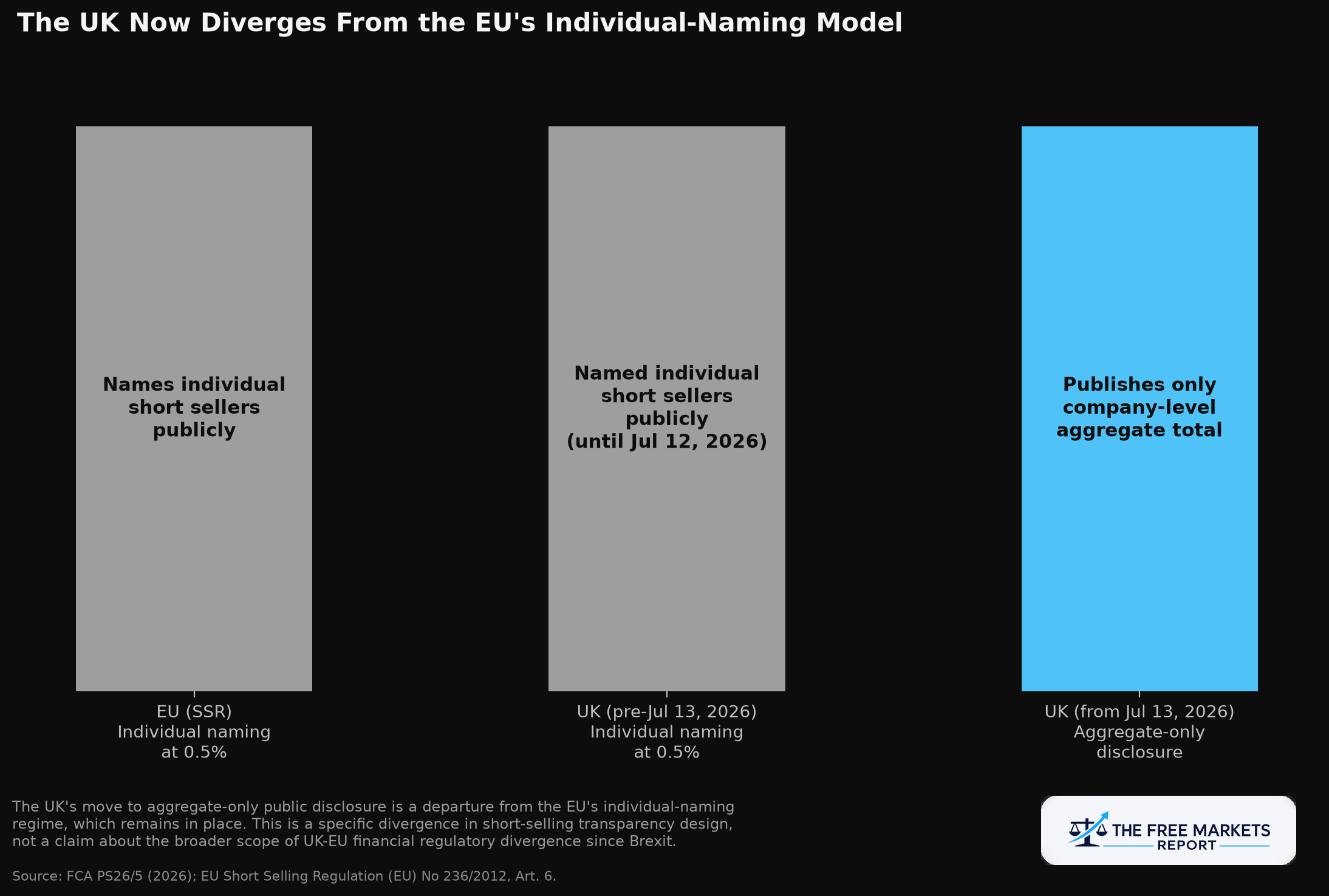
The chart above underscores why this is a structural break, not a technical tweak: the EU still names individual short sellers at the same 0.5% threshold the UK used until July 12. The UK is now the outlier among major European markets, for better or worse.
Investment Idea: iShares MSCI United Kingdom ETF (EWU)
Thesis type: Second-order beneficiary (broad market structure play)
Deregulatory catalyst: FCA PS26/5, effective July 13, 2026, ends individual-level public short-seller naming while preserving private FCA notification, positive-list exemptions, and market-maker attestation simplification.
Current price: EWU traded at $46.94 as of July 17, 2026, against a 52-week range of $39.60 to $48.92 (Perplexity Finance real-time quotes, pulled July 19, 2026).8
Key financial data: EWU carries a market capitalization of approximately $3.66 billion and a trailing P/E of 17.98. Its three largest holdings are HSBC Holdings at 10.9% of assets, AstraZeneca at 8.1%, and Shell at 7.6% (Perplexity Finance ETF holdings data, pulled July 19, 2026).8 Every one of these three was a name that could previously appear on the FCA's public short-seller register if a fund crossed the 0.5% threshold against it.
Regulatory constraint removed: The reputational deterrent against publicly disclosed institutional short positions in large, high-profile UK names. Funds can now build meaningful short exposure to any constituent of this ETF's basket without their name becoming attached to that position in a public register.
Bull case: A lower-friction, less reputationally punitive short-selling environment historically corresponds with deeper two-sided liquidity and tighter bid-ask spreads in the underlying names, a structural tailwind for exactly the large, liquid, heavily covered UK blue chips that dominate this ETF's weight. London Stock Exchange Group's own FY2025 results, with pre-tax profit up 56.5% and Capital Markets segment income up 8.9%, show the exchange operator already capturing rising trading activity independent of this specific rule change, which is the kind of secular tailwind a friendlier disclosure regime should reinforce rather than fight.
Bear case: The loss of individual-level transparency could suppress exactly the kind of activist and hostile-M&A signal that historically made UK large caps attractive re-rating candidates, per the Investor Relations Society's own objection. If the change is genuinely cosmetic (funds keep shorting the same way, at the same size, just anonymously) the ETF sees no flow effect at all, and the thesis reduces to nothing more than normal UK macro exposure.
What to watch: FCA aggregate short-interest data for EWU's top holdings over the next two to three quarters. A sustained rise in aggregate short interest without a corresponding rise in realized volatility would support the liquidity-improvement thesis; a period of unusually volatile drawdowns in previously rarely-shorted mid-cap constituents would support the bear case instead.
Time horizon: 12 to 24 months. Market structure effects of a disclosure regime change take multiple quarters of trading data to separate from ordinary macro noise.
Falsification condition: If FCA aggregate short-interest data published over the next twelve months shows no measurable increase in short positioning across EWU's top 20 holdings relative to the twelve months preceding the rule change, the "friendlier disclosure regime attracts more short liquidity" thesis should be considered disproven for this cycle.
The principle
Regulators occasionally get to choose between two forms of transparency: transparency to the public and transparency to themselves. The FCA chose to keep the second and sacrifice the first, on the theory that its own surveillance is what actually prevents systemic short-selling abuse, and that public naming was mostly serving reputational politics rather than market safety. Whether that trade was correctly priced will not show up in this week's data. It will show up, if it shows up at all, in whether UK-listed companies over the next two years face more opportunistic anonymous pressure campaigns than they did when every meaningful short position carried a name.
Footnotes
- Financial Conduct Authority, Policy Statement PS26/5, "Changes to the UK Short Selling Regime," https://www.fca.org.uk/publications/policy-statements/ps26-5-changes-uk-short-selling-regime
- Financial Conduct Authority press release, "FCA introduces clearer, simpler short-selling rules," https://www.fca.org.uk/news/press-releases/fca-introduces-clearer-simpler-short-selling-rules
- Financial Conduct Authority, "Notification and disclosure of net short positions," https://www.fca.org.uk/markets/short-selling/notification-disclosure-net-short-positions
- Financial Conduct Authority, PS26/5 full policy statement (PDF), https://www.fca.org.uk/publication/policy/ps26-5.pdf
- UK Government, Short Selling Regulations 2025 Impact Assessment, legislation.gov.uk, https://www.legislation.gov.uk/uksi/2025/29/pdfs/uksiod_20250029_en_001.pdf
- UK Investor Relations Society, "Society comments on loss of transparency for UK short selling," December 16, 2025, https://old.irsociety.org.uk/resources/news/item/society-comments-on-loss-of-transparency-for-uk-short-selling
- London Stock Exchange Group plc, FY2025 Preliminary Results RNS, February 26, 2026, https://www.lseg.com/content/dam/lseg/en_us/documents/investor-relations/financial-results/preliminary-results/rns/lseg-2025-preliminary-results-rns-26feb2026.pdf
- Perplexity Finance real-time quotes and ETF holdings data, pulled July 19, 2026.
- Reuters, "Britain's FCA eases short-selling rules for hedge funds," October 28, 2025, https://www.reuters.com/business/finance/britains-fca-eases-short-selling-rules-hedge-funds-2025-10-28/
- CNBC, "FCA UK hedge funds investors short sellers red tape rules regulation," April 16, 2026, https://www.cnbc.com/2026/04/16/fca-uk-hedge-funds-investors-short-sellers-red-tape-rules-regulation-financial-conduct-authority.html
The Free Markets Report is provided by Lead-Lag Publishing, LLC. All opinions and views mentioned in this report constitute our judgments as of the date of writing and are subject to change at any time. Information within this material is not intended to be used as a primary basis for investment decisions, and should also not be construed as advice meeting the particular investment needs of any individual investor. Trading signals produced by The Free Markets Report are independent of other services provided by Lead-Lag Publishing, LLC, or its affiliates, and the positioning of accounts under their management may differ. Please remember that investing involves risk, including loss of principal, and past performance may not be indicative of future results. Lead-Lag Publishing, LLC, its members, officers, directors, and employees expressly disclaim all liability with respect to actions taken based on any or all of the information in this writing.