Trump Invokes a 96-Year-Old Tariff Law Against Canada. Autos Barely Show Up.
A never-used 1930 tariff law hits Canadian lumber and textiles at 50%, but the "motor vehicle" proclamation's own annex excludes cars, and a 30-day clock is running.

Key Highlights
- On July 20, 2026, President Trump signed three proclamations under Section 338 of the Tariff Act of 1930 (19 U.S.C. 1338), imposing an additional 50% duty on Canadian motor-vehicle-related goods (HTSUS 9903.03.14), alcohol (9903.03.12), and dairy (9903.03.13), effective 12:01 a.m. ET on August 19, 2026 (White House proclamation).
- Legal analysts confirm this is the first-ever invocation of Section 338 by any U.S. administration (Trade Law Counsel).
- The Annex II product list runs roughly 400-plus tariff lines across wood, textiles, furniture, and machinery, and explicitly excludes standard passenger-vehicle and auto-parts codes, which stay under the existing Section 232 regime (Annex II).
- The combined three-proclamation package covers close to $20 billion of Canadian imports, about 5.2% of the $382 billion the U.S. imported from Canada in 2025 (White House Fact Sheet; Reuters).
- Carney and Trump spoke by phone on July 21 and agreed to speed up negotiations, but Carney told reporters on July 23 that "everything's on the table" if a deal isn't reached before the effective date (CityNews Toronto).
Washington just reached back nearly a century for a tariff weapon it has never fired. On July 20, 2026, President Trump signed a proclamation invoking Section 338 of the Tariff Act of 1930, a Depression-era provision letting the president impose duties up to 50% on any country found to discriminate against U.S. commerce, and used it against a slice of Canadian goods at exactly that rate (White House proclamation). Trade lawyers note it is the first time any administration has pulled this lever (Trade Law Counsel).
The Mechanism, and the Mismatch
The proclamation frames itself as retaliation for Canada's United States Surtax Order (Motor Vehicles 2025), SOR/2025-118, active since April 9, 2025, and also cites Section 604 of the Trade Act of 1974 and 3 U.S.C. 301 (White House proclamation). That is where the label stops matching the contents.
Pulling the Annex II document directly from whitehouse.gov shows the new HTSUS heading 9903.03.14 covering a list Global Trade Alert independently counts at 439 eight-digit tariff lines (Global Trade Alert). The largest chapter groupings are textiles and apparel, base metals and machinery, chemicals and plastics, and wood products, not vehicles. Standard passenger-vehicle and auto-parts codes are absent entirely; those already sit under the existing Section 232 auto-tariff regime (Annex II). Figure 2 breaks down that composition.
This is a motor-vehicle-branded proclamation that does not tax motor vehicles. Section 338 gives the president broad latitude to pick the retaliation target independent of the sector that triggered it, and administration officials frame the choice as calibrated to hit about 5% of Canadian imports without touching energy, potash, or critical minerals the U.S. still needs (White House Fact Sheet).
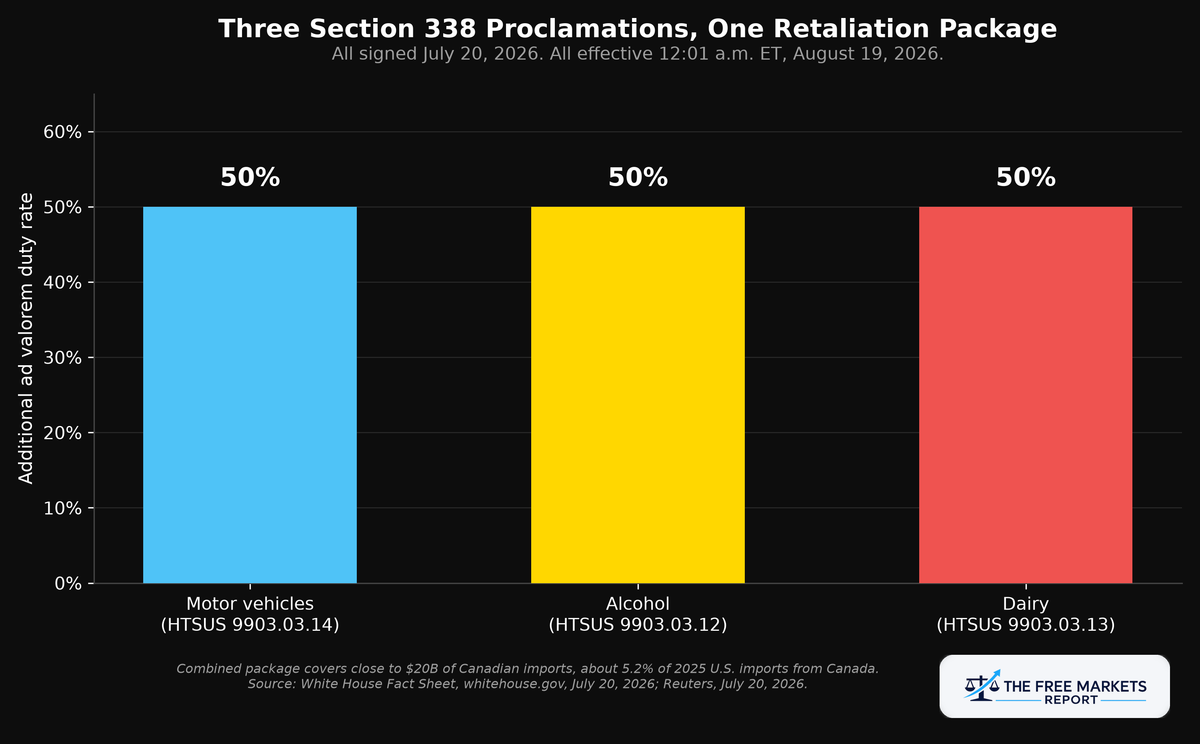
Two companion proclamations signed the same day extend the same logic to Canadian alcohol (9903.03.12) and dairy (9903.03.13), same rate, same effective date. Trade counsel describe the three as a coordinated package, not isolated actions (Dentons). Figure 1 shows that structure.
The Proclamation's Numbers vs. Independent Data
The proclamation's narrative leans on one trade-flow claim: U.S. motor-vehicle exports to Canada fell roughly 22%, from about $25.9 billion to about $20.3 billion, for the year through March 2026, while Canadian vehicle imports from Mexico rose 23.6% and from Japan, Korea, and Germany rose 10.1% to 13.5% (White House proclamation). That figure is single-party and load-bearing, so it needs an independent check.
The USTR's own 2026 USMCA Autos Report corroborates direction, if not exact magnitude: U.S. light-vehicle exports to Canada fell by nearly 171,000 units worth $5.6 billion over that same window (USTR). Canada's own data agrees the sector is shrinking on its side too. Global Affairs Canada's State of Trade 2026 report shows Canadian motor-vehicle and parts exports to the U.S. down 3.0% (-$2.8 billion) in 2025, after a 7.0% (-$7.1 billion) drop in 2024 (Global Affairs Canada), and Statistics Canada shows November 2025 exports down 11.6% month over month (StatCan).
None of that settles causation. The Globe and Mail quotes industry economists arguing the export decline has multiple drivers, including the broader trade disruption itself, not Canada's countermeasure alone (Globe and Mail).
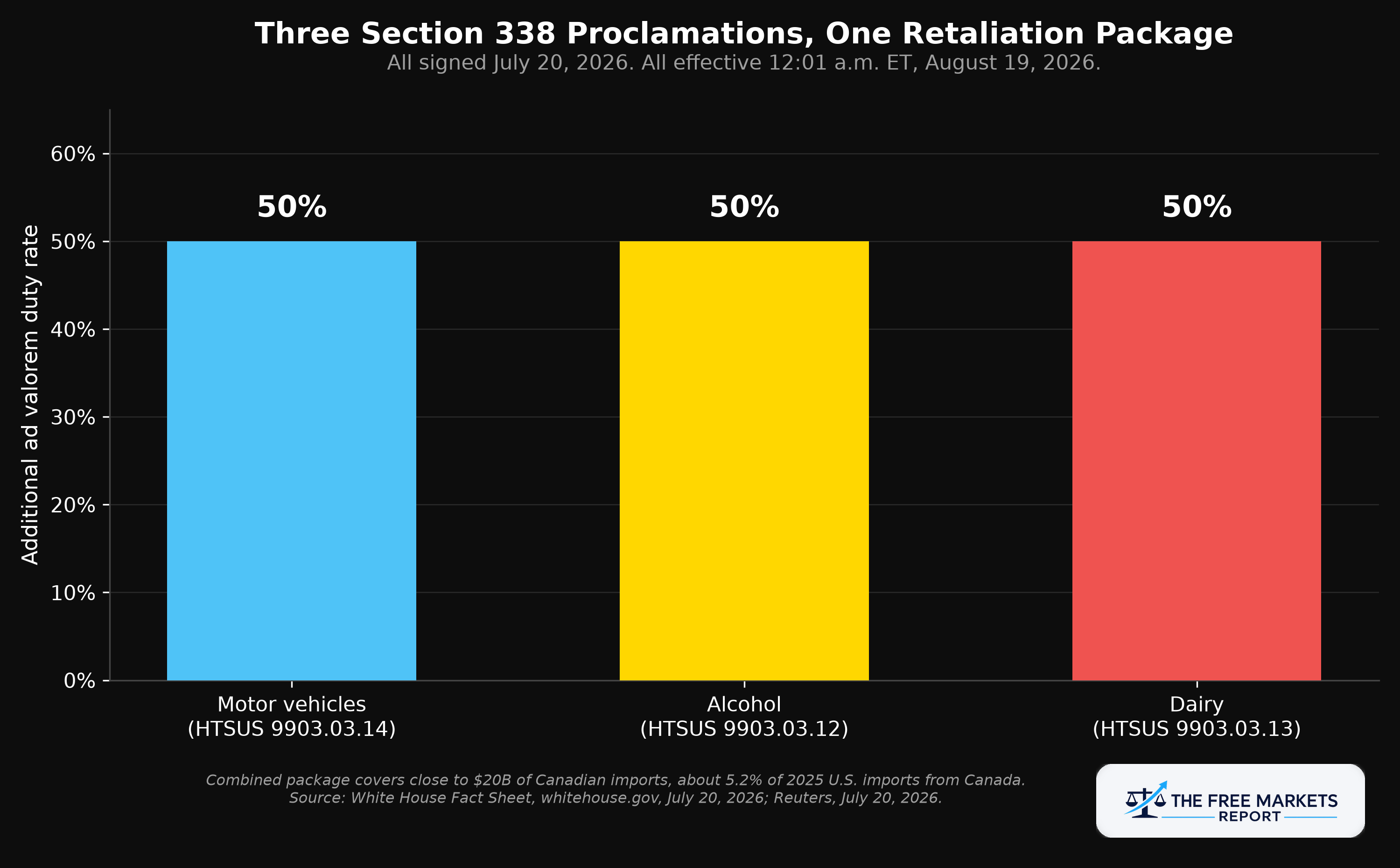
The mechanics: three legal instruments, identical 50% rate, identical effective date, roughly $20 billion combined exposure. Source: White House Fact Sheet and Reuters, July 20, 2026.
A 30-Day Clock, With Talks Already Moving
The proclamation takes effect August 19, 2026, leaving a month for diplomacy to overtake the tariff. Carney's July 20 statement said Canada has made "detailed and comprehensive proposals" to resolve the dispute and modernize CUSMA (PM Carney statement). A day later, he and Trump agreed by phone to speed up negotiations (India Today).
There's a complication: on July 22 the U.S. resumed USMCA-adjacent talks with Mexico in Mexico City, with Canada not present (Reuters). The Canadian Chamber of Commerce's Matthew Holmes said negotiators must use the 30-day window before the tariffs bite (Reuters). By July 23, Carney's tone had hardened: meeting Canada's premiers, he said "everything's on the table" if no deal materializes (CityNews Toronto). Some Canadian economists argue the real scope is narrower, covering roughly 5% of Canada's U.S.-bound exports (India Today). Figure 3 lays out that sequence.
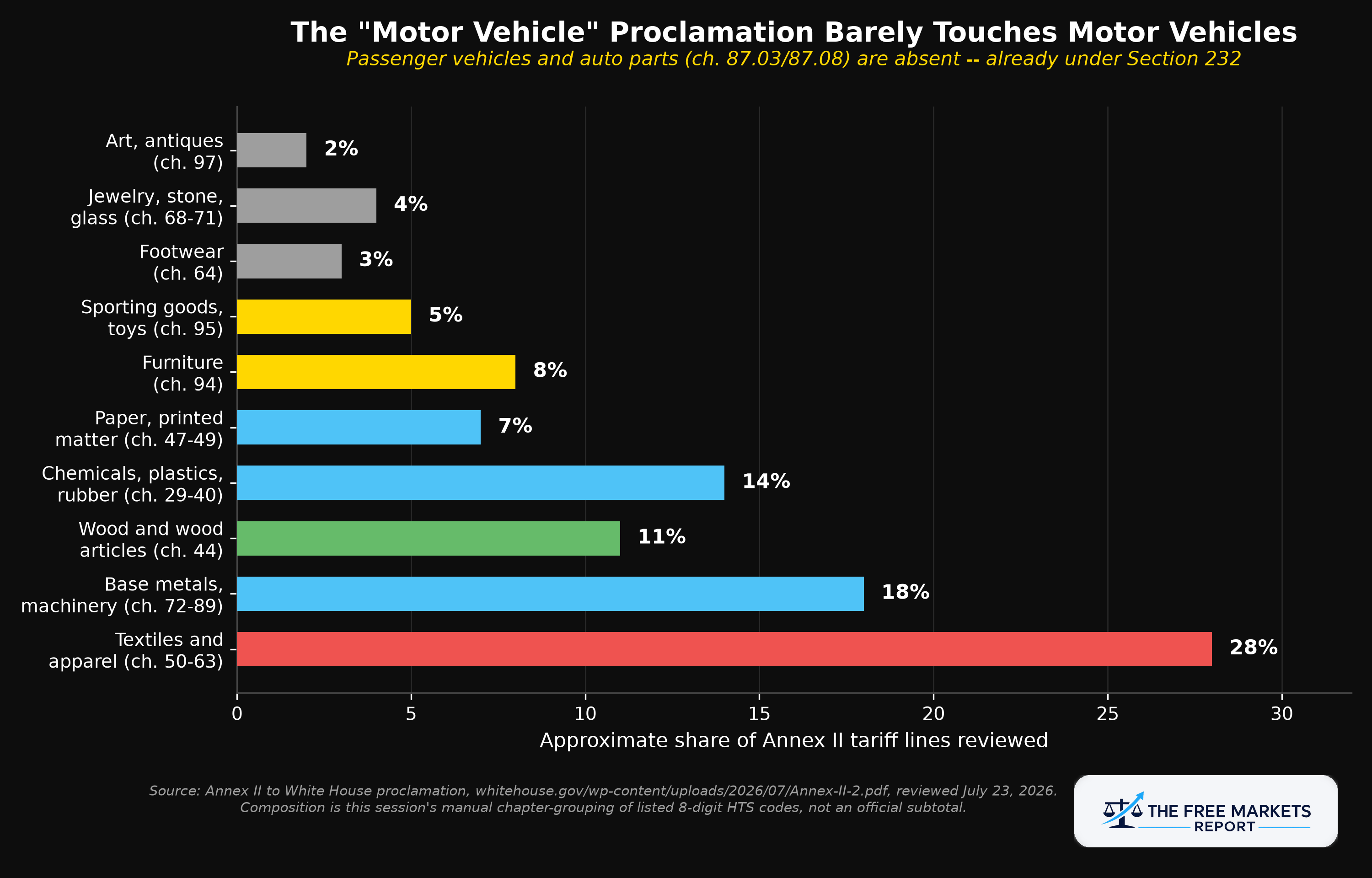
The list behind the label: textiles, base metals, and machinery dominate the "motor vehicle" proclamation's actual tariff lines. Composition is this outlet's own chapter-level grouping of the published HTS codes, not an official government subtotal. Source: Annex II to White House proclamation, reviewed July 23, 2026.
Investment Idea
SECTOR PLAY: Industrial Select Sector SPDR Fund (XLI)
Underlying exposure: broad U.S. industrials, including machinery, aerospace/defense, and building products, several of which sit inside or adjacent to the diffuse Annex II chapter list (base metals and machinery alone account for roughly 18% of the tariff lines identified in the annex).
Current price: $181.94, within a 52-week range of $147.14 to $186.45, as of July 23, 2026 (Perplexity Finance data, fetched this session).
Why the ETF rather than a single company: the Annex II list is a cross-sector grab bag of roughly 400-plus tariff codes, not a concentrated hit on one industry, and no single Canadian exporter dominates any one heading enough for a clean single-name thesis. A sector basket captures the diffuse exposure without betting on which supplier absorbs the duty.
Key mechanism: XLI's direct Canada-facing revenue exposure is modest relative to its scale, so the relevant read-through is domestic industrial pricing power if Canadian inputs get routed around the 50% duty, historically a modest tailwind for large domestic incumbents in fragmented categories like base metals and machinery.
Bear case: the historical base rate for announced-but-not-yet-effective tariffs is a negotiated settlement before the effective date, and Carney's July 20 statement signals Canada is offering CUSMA concessions to get exactly that outcome. If a deal lands before August 19, the duty never takes effect and any XLI premium tied to this catalyst likely fades.
Contrast for context: the iShares MSCI Canada ETF (EWC) traded at $58.82, within a 52-week range of $45.66 to $59.69, as of July 23, 2026 (Perplexity Finance data, fetched this session), a reminder that Canadian equities have stayed close to 52-week highs through this episode, itself a signal markets are pricing a settlement, not a trade war, as the base case.
What to watch: any Federal Register notice modifying the proclamation before August 19; the outcome of the Canada-excluded Mexico City talks; and whether Statistics Canada's next release shows further deterioration in the vehicle sector, which would validate the proclamation's trade-flow claim independent of the White House's own framing.
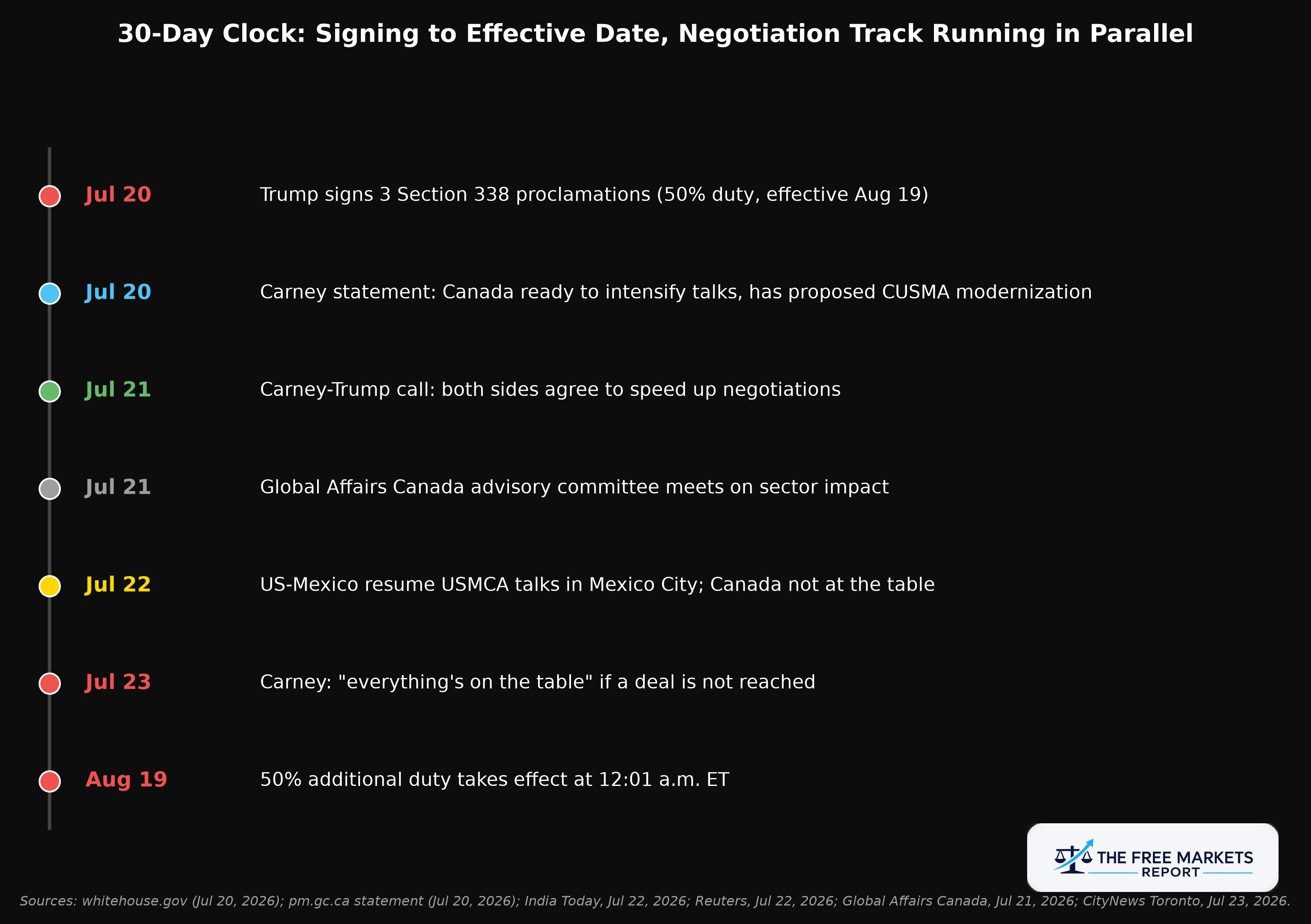
Two tracks running at once: a 30-day tariff clock and an accelerating, still-unresolved negotiation. Sources: whitehouse.gov, pm.gc.ca, India Today, Reuters, Global Affairs Canada, and CityNews Toronto, July 20-23, 2026.
The Principle
A 96-year-old statute fired for the first time ever does not, by itself, tell you where trade policy is headed. What tells you more is the mismatch between the label on the tariff and the goods inside it, and the fact that both governments kept talking through the week the proclamation was signed. The financial mechanics of a diffuse, cross-sector tariff list layered onto an active negotiation suggest markets are pricing this as a pressure tactic with a deal-shaped exit, not a permanent restructuring of Canada-U.S. trade, a read reinforced by Canadian equities holding near 52-week highs through the episode.
The Free Markets Report is provided by Lead-Lag Publishing, LLC. All opinions and views mentioned in this report constitute our judgments as of the date of writing and are subject to change at any time. Information within this material is not intended to be used as a primary basis for investment decisions, and should also not be construed as advice meeting the particular investment needs of any individual investor. Trading signals produced by The Free Markets Report are independent of other services provided by Lead-Lag Publishing, LLC, or its affiliates, and the positioning of accounts under their management may differ. Please remember that investing involves risk, including loss of principal, and past performance may not be indicative of future results. Lead-Lag Publishing, LLC, its members, officers, directors, and employees expressly disclaim all liability with respect to actions taken based on any or all of the information in this writing.
Footnotes
- White House, "Imposing Additional Duties To Offset Canadian Discrimination Against the Commerce of the United States With Respect to Motor Vehicles," July 20, 2026. https://www.whitehouse.gov/presidential-actions/2026/07/imposing-additional-duties-to-offset-canadian-discrimination-against-the-commerce-of-the-united-states-with-respect-to-motor-vehicles/
- Annex II to the above proclamation, whitehouse.gov, July 2026. https://www.whitehouse.gov/wp-content/uploads/2026/07/Annex-II-2.pdf
- White House Fact Sheet, "President Donald J. Trump Imposes Additional Tariffs on Canada," July 20, 2026. https://www.whitehouse.gov/fact-sheets/2026/07/fact-sheet-president-donald-j-trump-imposes-additional-tariffs-on-canada/
- Trade Law Counsel, "Trump Invokes Section 338, Hits Canada With 50% Duties," July 20, 2026. https://www.tradelawcounsel.com/insights-news/2026/7/20/trump-invokes-section-338-hits-canada-with-50-duties-using-section-338
- Dentons, "Trump Administration to Impose New Tariffs on Canada," July 21, 2026. https://www.dentons.com/en/insights/newsletters/2026/july/21/trump-2-0-navigating-change-in-canada/trump-administration-to-impose-new
- Global Trade Alert, Intervention 157660. https://globaltradealert.org/intervention/157660
- USTR, "2026 USMCA Autos Report to Congress," July 1, 2026. https://ustr.gov/sites/default/files/files/agreements/FTA/USMCA/2026%20USMCA%20Autos%20Report%20to%20Congress_070126.pdf
- Global Affairs Canada, "State of Trade 2026." https://international.canada.ca/en/global-affairs/corporate/reports/chief-economist/state-trade/2026
- Statistics Canada, "Canadian International Merchandise Trade, November 2025," January 29, 2026. https://www150.statcan.gc.ca/n1/daily-quotidien/260129/dq260129a-eng.htm
- Prime Minister of Canada, "Statement by the Prime Minister on the United States Administration's Intention," July 20, 2026. https://www.pm.gc.ca/en/news/statements/2026/07/20/statement-prime-minister-carney-united-states-administrations-intention
- India Today, "Canada-US Trade Talks: Carney, Trump Intensify Negotiations After 50% Tariffs," July 22, 2026. https://www.indiatoday.in/amp/world/story/canada-us-trade-talks-carney-trump-intensify-negotiations-after-50-percent-tariffs-ptag-2953309-2026-07-22
- CityNews Toronto, "Carney, Premiers to Meet Amid New U.S. Tariff Threats," July 23, 2026. https://toronto.citynews.ca/2026/07/23/carney-premiers-to-meet-amid-new-u-s-tariff-threats/
- Reuters, "Separate US Talks With Canada, Mexico Test North America's Trilateral Trade Pact," July 22, 2026. https://www.reuters.com/world/americas/separate-us-talks-with-canada-mexico-test-north-americas-trilateral-trade-pact-2026-07-22/
- Reuters, "US Imposes New 50% Tariffs on Canadian Products," July 20, 2026. https://www.reuters.com/business/us-imposes-new-50-tariffs-canadian-products-2026-07-20/
- The Globe and Mail, "Trump Auto Tariffs, Canada Retaliation, Exports." https://www.theglobeandmail.com/business/article-trump-auto-tariffs-canada-retaliation-exports/
- Global Affairs Canada, advisory committee meeting release, July 21, 2026. https://www.canada.ca/en/global-affairs/news/2026/07/advisory-committee-on-canada-us-economic-relations-meets-following-the-intention-of-the-us-to-impose-new-50-tariffs-on-a-number-of-canadian-goods.html
- Perplexity Finance data, XLI and EWC quotes, fetched July 23, 2026.