Cboe Just Loosened the Clearing Door. The Market-Structure Signal Is Bigger.
Four Cboe venues clarified that non-member firms may clear for members, while the qualified-clearing-agency and guarantee chain stays in place.

The Securities and Exchange Commission just published four Cboe exchange rule changes that clarify a non-member firm may clear trades for an exchange member. The edit sounds clerical. It is not. It loosens one layer of exchange access while keeping the clearing agency, guarantee, and settlement obligations intact. SEC notice for Cboe EDGA SEC notice for Cboe EDGX.
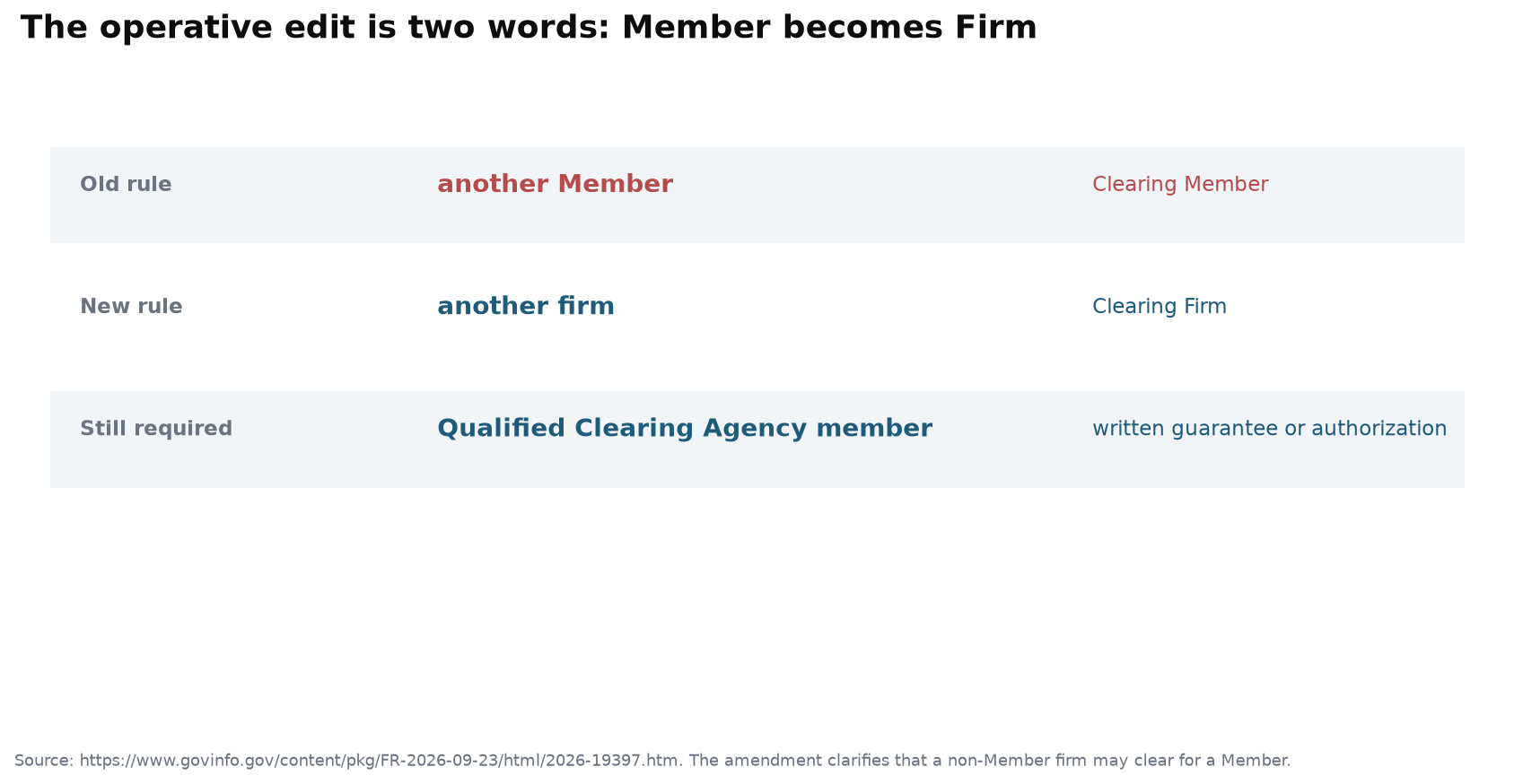
This regulatory change rarely makes a market headline but can alter who provides infrastructure. The rulebook moves from “another Member” and “Clearing Member” to “another firm” and “Clearing Firm.” That is a small wording change with a large institutional implication: exchange membership and clearing responsibility no longer have to sit in the same organization.
The change is broader than one venue
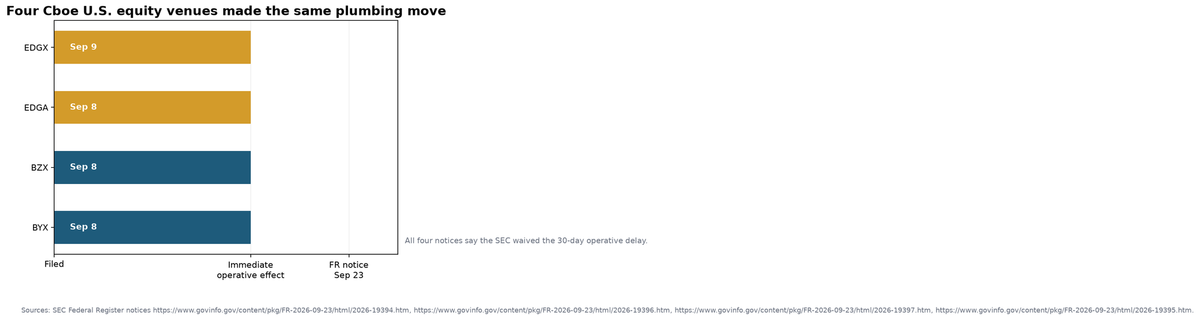
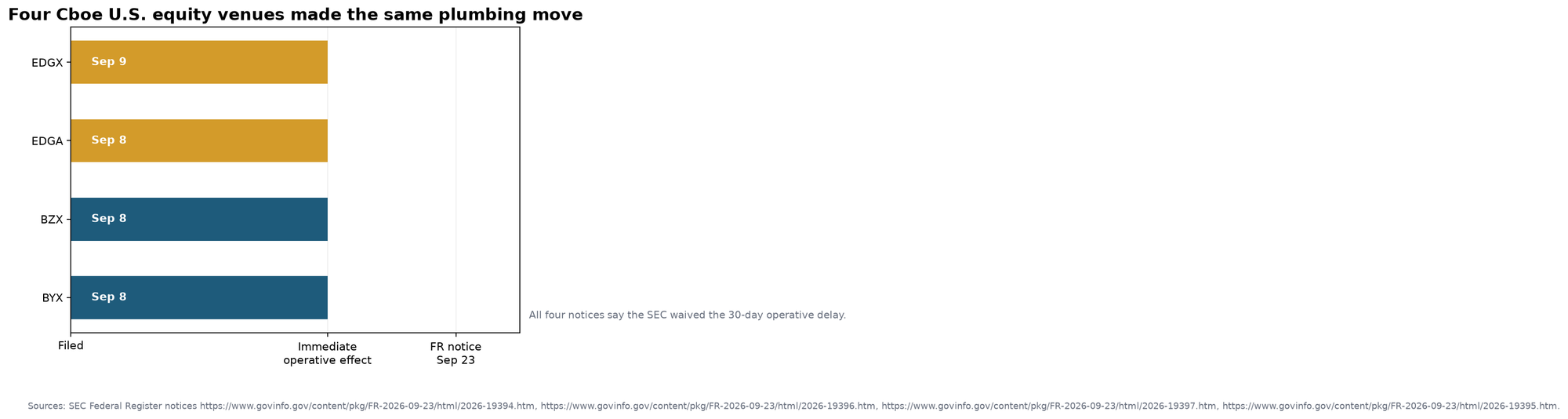
The parallel notices cover Cboe BYX, BZX, EDGA, and EDGX. BYX and BZX filed on September 8, EDGA filed on September 8, and EDGX filed on September 9. Each notice says the change became effective under the Securities Exchange Act's immediate-effectiveness pathway, and each was published in the Federal Register on September 23. BYX notice BZX notice EDGA notice EDGX notice.
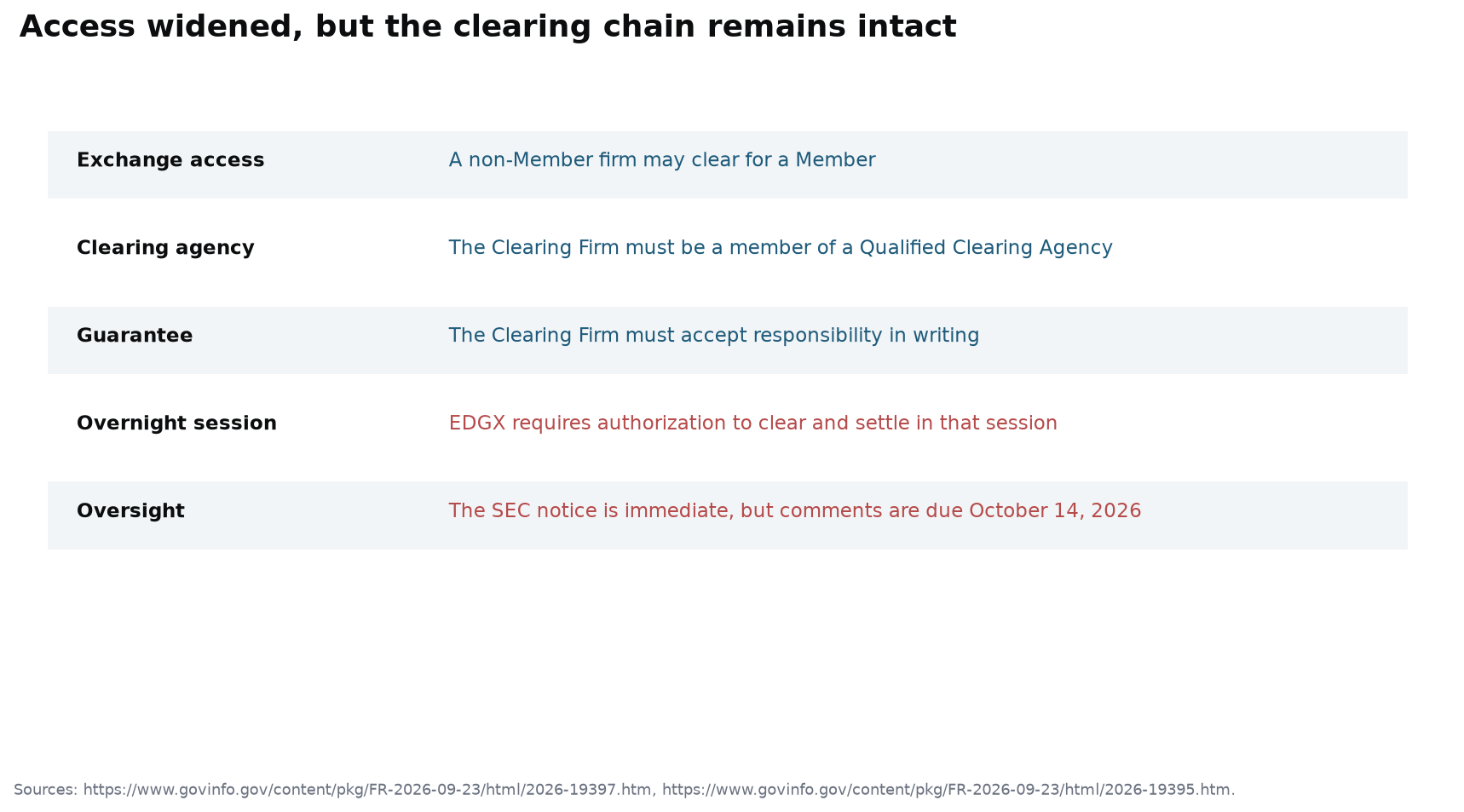
The SEC also waived the usual 30-day operative delay. That means this is not a proposal waiting for a later implementation date. The exchanges can operate under the amended rule language now, even though the notices still provide a public comment window that runs through October 14, 2026. EDGA notice EDGX notice.
Cboe's own rule-filing pages describe the same family of changes as approved and immediately effective. The exchange describes the EDGX amendment as replacing “registered clearing agency” with “Qualified Clearing Agency,” clarifying that a non-member can act as a clearing firm, and, for overnight trading, requiring a separate effective letter of guarantee or authorization. Cboe EDGX rule filings.
Why the wording matters
Under the older EDGA language, a member that wanted to clear through another organization was described as clearing through “another Member” that was a member of a qualified clearing agency. The new wording says “another firm.” It then changes the label from “Clearing Member” to “Clearing Firm.” The legal effect is to clarify that the firm carrying the clearing responsibility does not itself have to be a member of the exchange whose trades it clears. EDGA notice.
That separation can matter for the economics of market plumbing. An exchange member can focus on order handling, routing, and trading access while a different firm provides the clearing relationship. The rule does not guarantee that a new provider will enter, that fees will fall, or that the structure will improve execution. It removes one textual ambiguity that could otherwise force those functions to be bundled.
The change is also a reminder that competition in markets often happens below the level of the visible quote. The public sees the exchange, the ticker, and the execution price. The commercial structure underneath includes membership, clearing, settlement, guarantees, and operating permissions. Opening one of those doors can change who is able to build a service around the exchange.
What did not change
This is not a release from the clearing chain. The Cboe notices retain a requirement that transactions be cleared and settled through a qualified clearing agency using continuous net settlement. A clearing firm must still be a member of that qualified clearing agency. It must also affirm in writing, through a letter of authorization, letter of guarantee, or another acceptable agreement, that it will assume responsibility for clearing and settling the member's trades. EDGA notice BZX notice.
The “qualified” label is not a new free pass. The EDGA notice defines a Qualified Clearing Agency as a clearing agency registered with the SEC under Section 17A of the Exchange Act that the exchange deems qualified. The non-member clearing firm remains subject to the membership requirements of that agency and must execute the appropriate guarantee agreements with the exchange. EDGA notice.
The overnight detail is the tell
EDGX adds an important operating condition for its Overnight Trading Session. The clearing firm must be properly authorized by the relevant qualified clearing agency to clear and settle transactions during that session, and the exchange requires confirmation of that authority. The exchange is widening the identity of the firm that can carry the clearing relationship, not eliminating the need for session-specific capacity and permission. EDGX notice.
That detail is the difference between deregulation that changes a business model and deregulation that simply removes a sentence. Overnight trading creates a longer operational day, and a clearing firm must be ready to manage the settlement obligation when the traditional session is closed. The amendment gives a member more choice in who provides the service, but it does not let the member outsource accountability.
Why now?
The notices do not promise a new market structure. They do show an exchange group aligning rule language across venues. That alignment matters because a fragmented rulebook creates friction for firms that operate across multiple markets. A clearer definition of “Clearing Firm” can reduce the need for venue-by-venue interpretation and make the commercial question more direct: which firm is qualified, authorized, and willing to stand behind settlement?
The independent industry summary is consistent with the primary notices: the September changes allow non-member firms to serve as clearing firms for members on the affected Cboe venues. Daily Federal's market summary. The primary documents are still the controlling source for the exact obligations, especially the qualified-agency and guarantee requirements.
The bear case
The first risk is that access is mistaken for competition. A rule that permits a non-member clearing firm to serve a member does not ensure that another provider will enter, win volume, or lower costs. The value depends on capital, technology, risk controls, and the economics of the clearing relationship.
The second risk is operational concentration. If more exchange members rely on a smaller group of specialized clearing firms, the market could gain flexibility at the venue level while increasing dependence on a few balance sheets. The notices preserve guarantees and qualified-agency membership, but those safeguards do not make operational concentration impossible.
The constructive read is that the SEC and Cboe are removing a membership-boundary constraint without discarding the settlement chain. It is a plumbing reform, not a trading signal. Watch what happens next in three places: whether additional clearing firms use the opening, whether member firms change their venue mix, and whether the comment process produces any attempt to narrow the language. The headline is a rule edit. The real test is whether the edit lets a new layer of market infrastructure compete.
Know someone tracking market structure like this? Forward this one along.
The Free Markets Report is provided by Lead-Lag Publishing, LLC. All opinions and views mentioned in this report constitute our judgments as of the date of writing and are subject to change at any time. Information within this material is not intended to be used as a primary basis for investment decisions, and should also not be construed as advice meeting the particular needs of any individual situation. The accuracy, completeness, and timeliness of the information contained in this document is not guaranteed. The securities and strategies discussed may be unsuitable for investors depending on their specific financial position and investment objectives. Reproduction of this report without the express written consent of Lead-Lag Publishing, LLC is strictly prohibited. Past performance is not indicative of future results, and current performance may be lower or higher than the performance shown. Neither the information nor any opinion expressed in this report constitutes a solicitation, an offer to buy or sell any securities, or an offer to provide investment advice or services. Nothing in this report shall be construed to be an offer to provide investment advisory services in any jurisdiction in which Lead-Lag Publishing, LLC is not authorized to provide such services. All investments involve risk, including the risk of loss of principal. No representation is being made that any security, account, or strategy will or is likely to achieve results similar to those shown. Investing in securities involves risks, and there is always the potential of losing money when you invest in securities. Before investing, consider your investment objectives, and Lead-Lag Publishing, LLC's charges and expenses. This report is not a prospectus and does not contain all of the information necessary to fully evaluate any security or strategy discussed, including, but not limited to, the risk of adverse effects of related market developments. You should not rely solely on the information contained in this report, and should seek advice based on your situation from a licensed investment professional. Carefully consider the investment objectives, risks, charges and expenses of any investment product before investing. This report may not be copied or distributed without the express written consent of Lead-Lag Publishing, LLC. Any decisions made based on any or all of the information in this writing are the sole responsibility of the user, and the user should exercise caution and take appropriate advice before acting.