The CFTC Just Put Tokenized Collateral Inside the Rulebook. The Footnotes Are the Rule.
The CFTC's new FAQ permits tokenized forms of permitted investments and onchain records, but the operating conditions remain the rule.

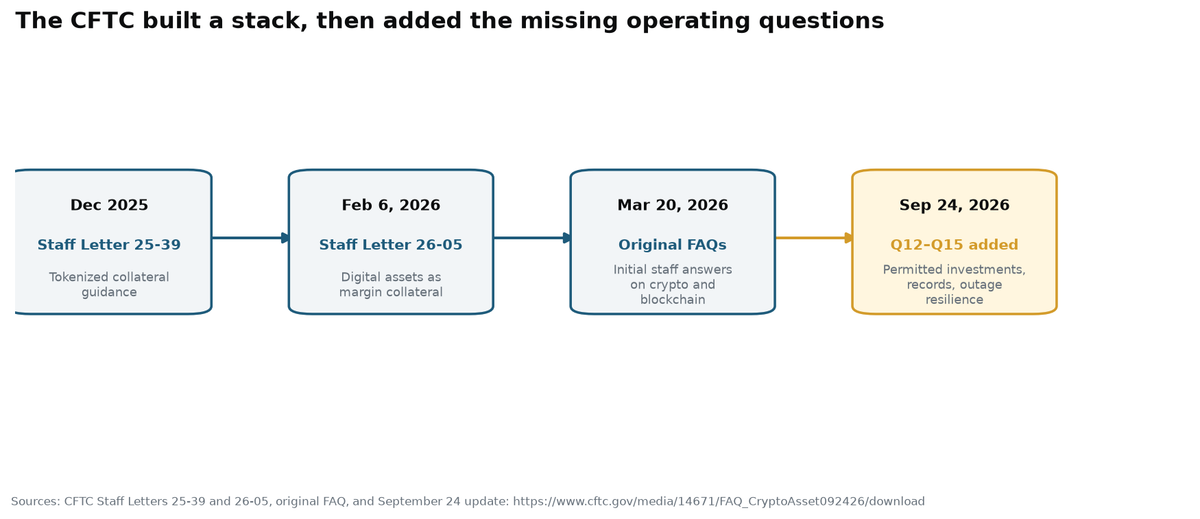
The Commodity Futures Trading Commission just answered four questions that crypto-market infrastructure has been waiting to ask in plain English. Tokenized versions of permitted investments can sit inside customer-fund portfolios. Blockchain can satisfy certain recordkeeping duties. A public chain does not automatically require an offchain duplicate. But every one of those answers is conditional, and the conditions are the story. CFTC release 9303-26 updated FAQ.
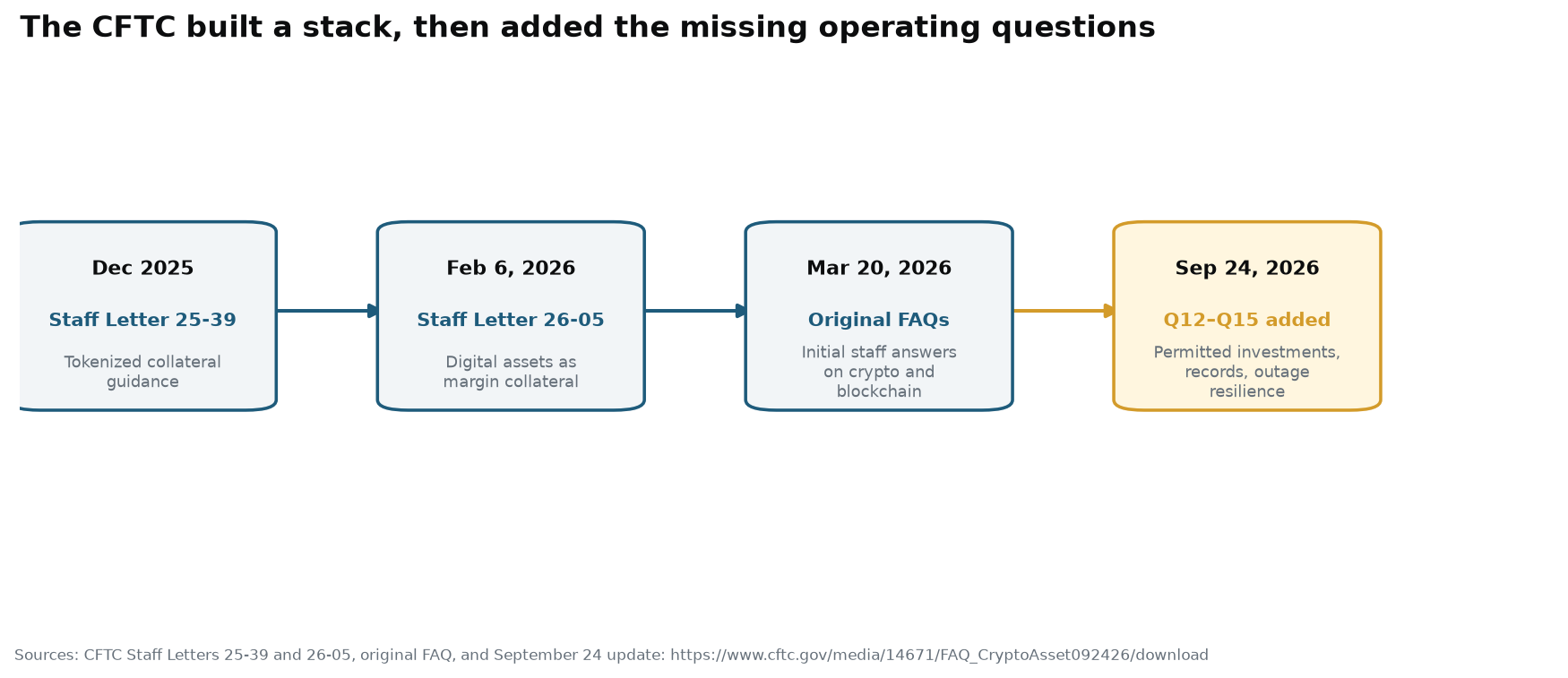
On September 24, 2026, staff from the CFTC's Market Participants Division, Division of Market Oversight, and Division of Clearing and Risk added Q12, Q13, Q14, and Q15 to the agency's crypto and blockchain FAQ. The update also marked Q5 as revised. The agency says the questions address tokenized forms of otherwise permitted investments under Regulation 1.25 and the use of distributed-ledger technology for recordkeeping under Regulations 1.31 and 45.2. CFTC FAQ, footnote 4.
Start with what this is not
The update is not a new CFTC rule. It is staff guidance. The FAQ says it represents only the views of the three divisions, does not create enforceable rights, does not create a no-action position, and does not amend existing regulations. That disclaimer is not boilerplate to skim. It defines the legal weight of the document. CFTC FAQ disclaimer.
The distinction matters because “allowed” in a staff FAQ means staff would not object on the stated facts if the underlying rule is satisfied. It does not mean a firm has been excused from Regulation 1.25, Regulation 1.31, Regulation 45.2, its own risk-management program, or the conditions in the prior staff letters. The CFTC is clarifying the path through the existing framework, not replacing the framework.
Q12: tokenized investments inherit the old rulebook
Q12 answers yes to a narrow question: may a futures commission merchant or derivatives clearing organization invest customer funds in a tokenized form of an otherwise permitted Regulation 1.25 investment? Yes, if the firm can demonstrate four things.
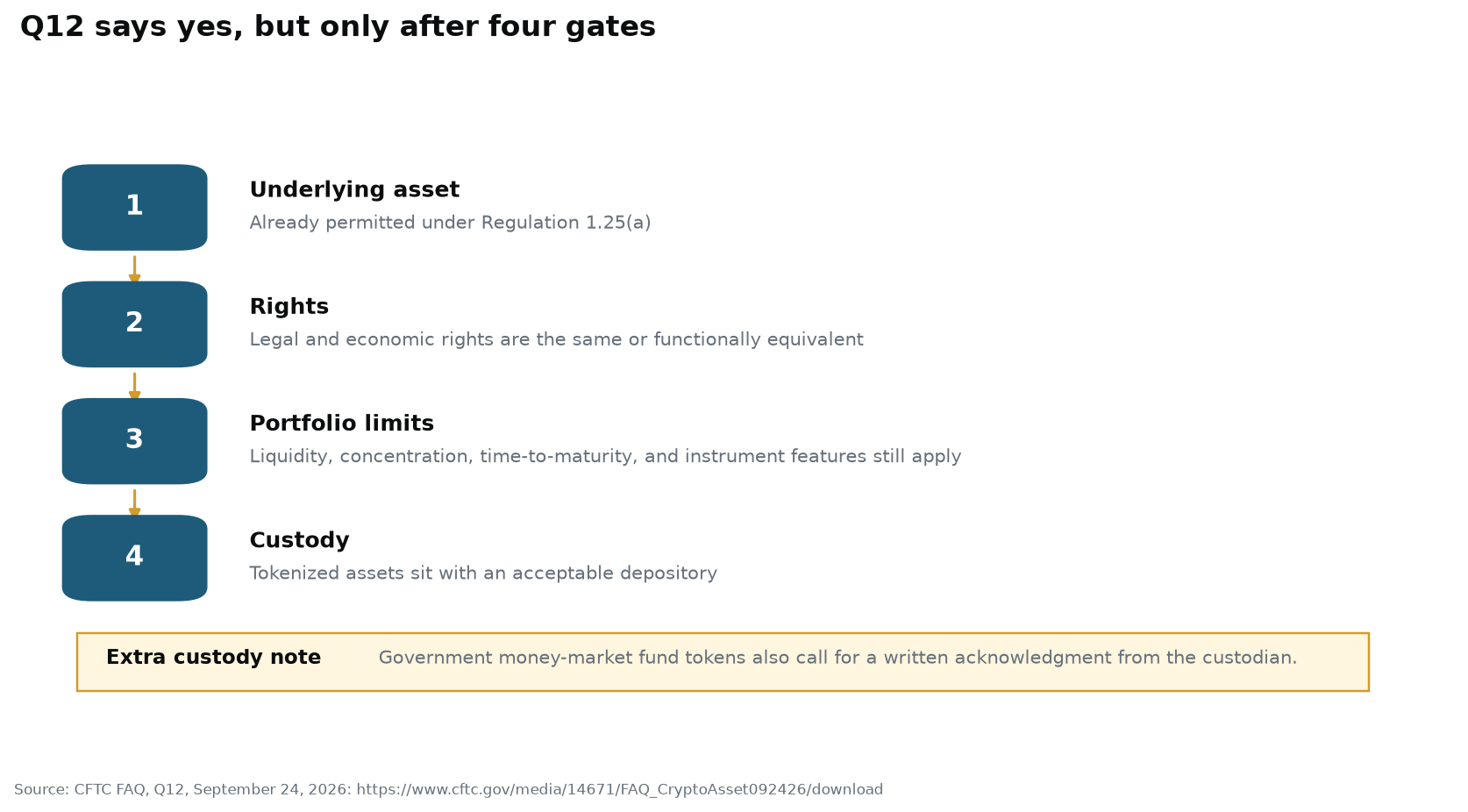
First, the underlying asset itself must already be a permitted investment under Regulation 1.25(a). A token cannot make an ineligible asset eligible. Second, the token must give its holder legal and economic rights that are the same as, or functionally equivalent to, the traditional asset. A digital representation with weaker or different rights does not pass simply because it trades on a ledger.
Third, the investment still has to satisfy the rule's terms and conditions, including liquidity, concentration limits, time-to-maturity, and restrictions on instrument features. Fourth, the tokenized asset must be held with an acceptable depository. For tokenized forms of eligible government money-market funds, the divisions say the FCM or DCO should also obtain a written acknowledgment from the entity responsible for custody under Regulation 1.26(b). CFTC FAQ, Q12 Regulation 1.25.
The practical message is simple: the CFTC is open to changing the settlement representation while keeping the portfolio-construction and custody tests. That is a meaningful opening for infrastructure providers, but it is not a free pass for every asset called “tokenized.”
Q13 and Q14: the ledger can be the record
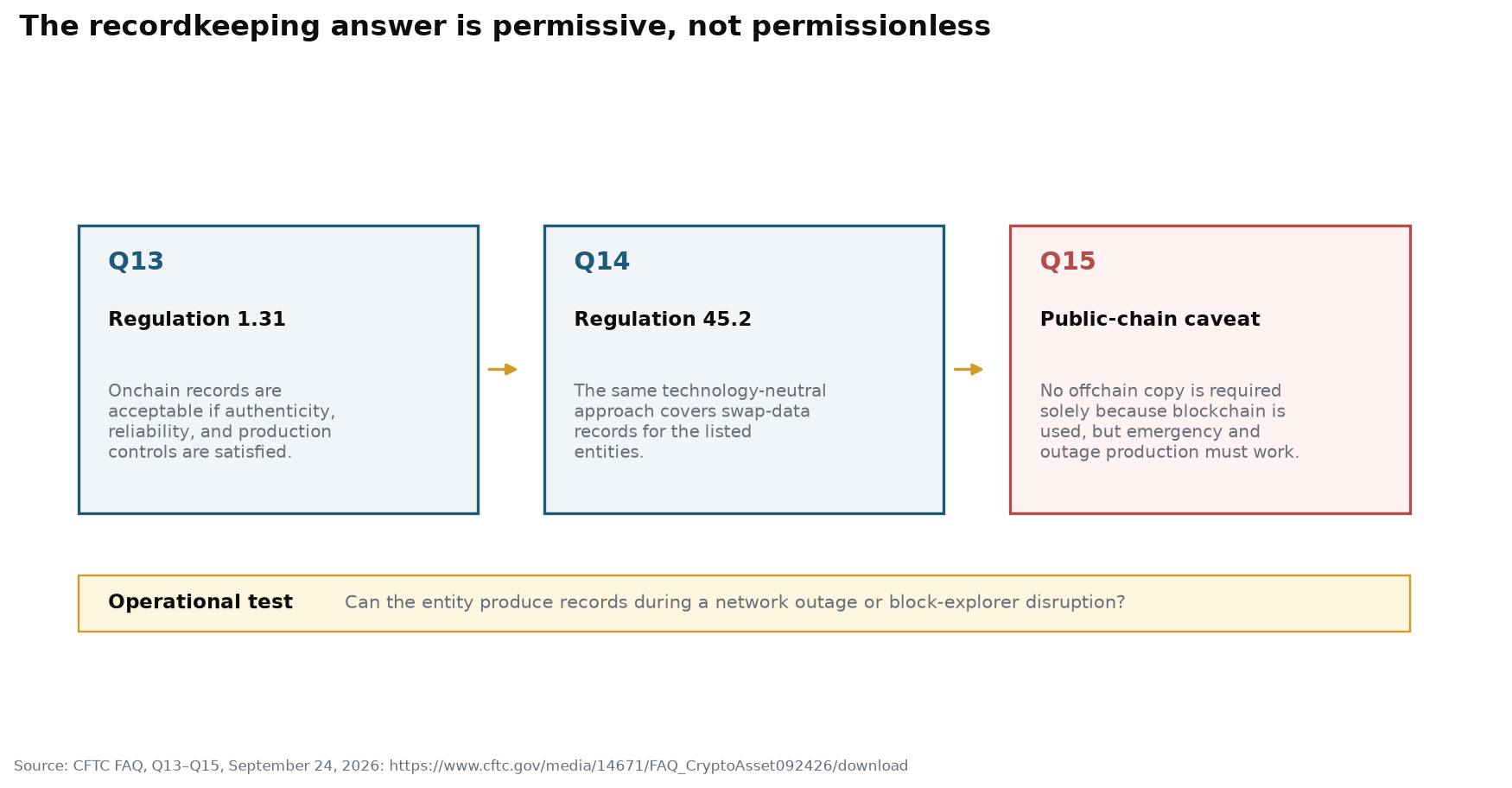
Q13 says a records entity may use blockchain or distributed-ledger technology to create and maintain onchain records under Regulation 1.31, because the rule is technology neutral. The condition is that the entity must fully satisfy the rule, including systems and controls that ensure the authenticity and reliability of electronic regulatory records. The FAQ points firms back to their risk-management frameworks and policies and procedures. CFTC FAQ, Q13 Regulation 1.31.
Q14 applies the same principle to swap-data recordkeeping under Regulation 45.2. The listed entities include swap execution facilities, designated contract markets, derivatives clearing organizations, swap dealers, major swap participants, and certain counterparties. The technology can be distributed. The compliance responsibility cannot be distributed away. CFTC FAQ, Q14 Regulation 45.2.
Q15 is the footnote that will decide the business model
Q15 says staff would not object solely because an entity chooses not to maintain an offchain version of its records. That sentence will travel quickly because it sounds like the removal of a duplication requirement. But the next sentence is the operating constraint: if the entity uses a public and permissionless blockchain, it should establish systems and controls that can retain and produce the records under any circumstances, including an emergency or a disruption to the network or its block explorer.
This is the difference between a ledger being authoritative and a ledger being reachable. A firm may not need to mirror every record in a second database, but it must be able to show the Commission the records when the chain, the explorer, or the firm's access path is impaired. The requirement pushes firms toward recoverability, export procedures, and tested continuity controls even when the source of truth is onchain. CFTC FAQ, Q15.
That caveat also separates private and permissioned systems from public and permissionless networks. The FAQ does not declare one architecture universally superior. It asks the regulated entity to prove that its chosen architecture can meet the production and inspection obligations in Regulation 1.31(c)(2)(ii). A public network may reduce the need for a private reconciliation layer while increasing the need for robust outage planning.
The market-structure read
Independent coverage has read the update in the same direction: the CFTC clarified that regulated firms can use tokenized versions of permitted investments and blockchain technology for recordkeeping, while keeping conditions around collateral, haircuts, and operational controls. Law360 The Crypto Times LCX. The primary FAQ is more important than the headlines because it shows the boundary of the permission.
The more durable consequence is that the agency is expressing the same functional tests across different technological forms. Legal rights, liquidity, custody, authenticity, reliability, and emergency production are the invariant concepts. The token is the variable. That favors firms that can translate an old compliance obligation into a new technical stack, not firms that merely issue a token and ask the rulebook to follow.
The bear case
The first risk is legal over-reading. Because the FAQ is nonbinding staff guidance, a market participant that treats it as a blanket authorization could still fail the underlying regulation or attract an enforcement recommendation. The second risk is operational. A tokenized fund may preserve economic rights on paper while creating a custody, liquidity, or recovery problem in practice. The third risk is governance. Distributed records can be durable and transparent, but a firm still has to decide who controls access, who validates data, and who answers when the network is unavailable.
The constructive read is narrower: tokenized permitted investments and onchain records can fit inside existing derivatives-market rules when functional protections remain intact. Watch whether FCMs and DCOs can document those protections without bespoke workarounds. If they can, the FAQ will look like an infrastructure unlock.
Know someone tracking market structure like this? Forward this one along.
The Free Markets Report is provided by Lead-Lag Publishing, LLC. All opinions and views mentioned in this report constitute our judgments as of the date of writing and are subject to change at any time. Information within this material is not intended to be used as a primary basis for investment decisions, and should also not be construed as advice meeting the particular needs of any individual situation. The accuracy, completeness, and timeliness of the information contained in this document is not guaranteed. The securities and strategies discussed may be unsuitable for investors depending on their specific financial position and investment objectives. Reproduction of this report without the express written consent of Lead-Lag Publishing, LLC is strictly prohibited. Past performance is not indicative of future results, and current performance may be lower or higher than the performance shown. Neither the information nor any opinion expressed in this report constitutes a solicitation, an offer to buy or sell any securities, or an offer to provide investment advice or services. Nothing in this report shall be construed to be an offer to provide investment advisory services in any jurisdiction in which Lead-Lag Publishing, LLC is not authorized to provide such services. All investments involve risk, including the risk of loss of principal. No representation is being made that any security, account, or strategy will or is likely to achieve results similar to those shown. Investing in securities involves risks, and there is always the potential of losing money when you invest. Before investing, consider your investment objectives, and Lead-Lag Publishing, LLC's charges and expenses. This report is not a prospectus and does not contain all of the information necessary to fully evaluate any security or strategy discussed, including, but not limited to, the risk of adverse effects of related market developments. You should not rely solely on the information contained in this report, and should seek advice based on your situation from a licensed investment professional. Carefully consider the investment objectives, risks, charges and expenses of any investment product before investing. This report may not be copied or distributed without the express written consent of Lead-Lag Publishing, LLC. Any decisions made based on any or all of the information in this writing are the sole responsibility of the user, and the user should exercise caution and take appropriate advice before acting.