The FCC Put a 120-Day Clock on City Hall. It Is Only a Proposal.
FCC 26-40 would presume an unlawful prohibition when a wireline permit sits past 120 days and cap local fees at cost, but nothing takes effect and comments close September 21.

Key Highlights
- The FCC published FCC 26-40, "Build America: Eliminating Barriers to Wireline Deployments," WC Docket No. 25-253, at 91 FR 51121 on August 7, 2026, typed by the Federal Register as a proposed rule, not a final one.1
- It would presume a government effectively prohibited wireline service under Section 253(a) if it fails to process all rights of way authorizations within 120 days, and would cap fees at actual and direct rights of way management costs.2
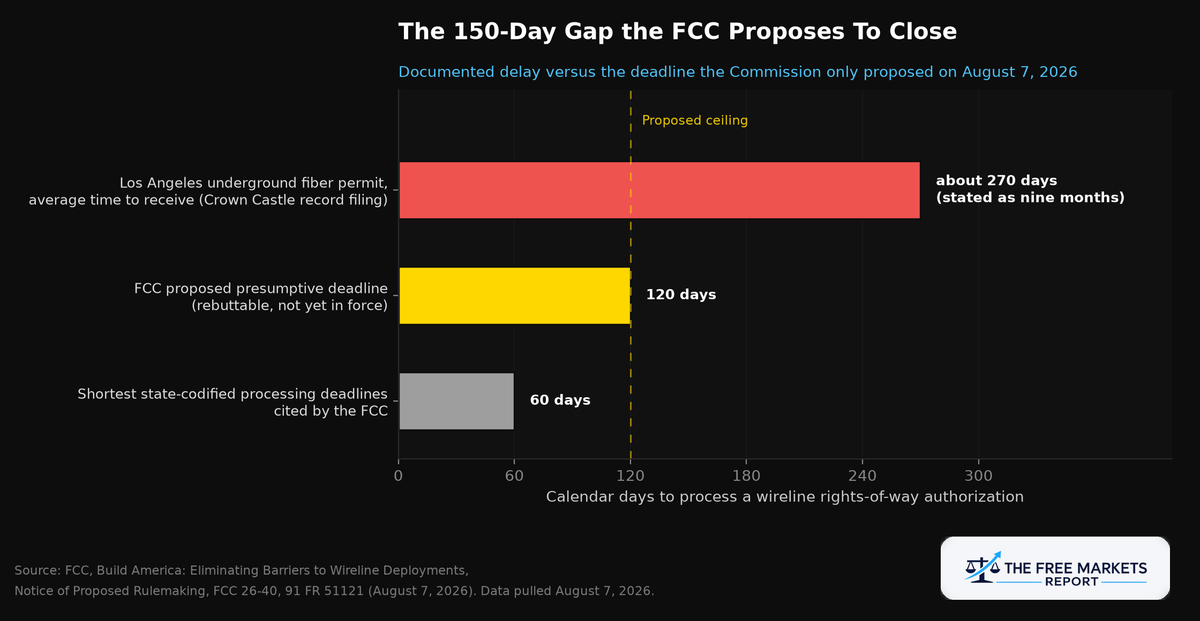
- The record includes Crown Castle's nine month Los Angeles fiber permit average, an Ohio city requiring 13 departments and 70 individuals per application, and a Minnesota city seeking close to $30,000 in per linear foot fees for one block.2
- Crown Castle (CCI), source of the marquee delay statistic, closed the divestiture of its fiber business on May 1, 2026 for $8.4 billion net cash, leaving the buyers of that friction private.3
- Comments close September 21, 2026 and reply comments November 5, 2026, and the notice asks whether capping fees at cost would be a Fifth Amendment taking.1,2
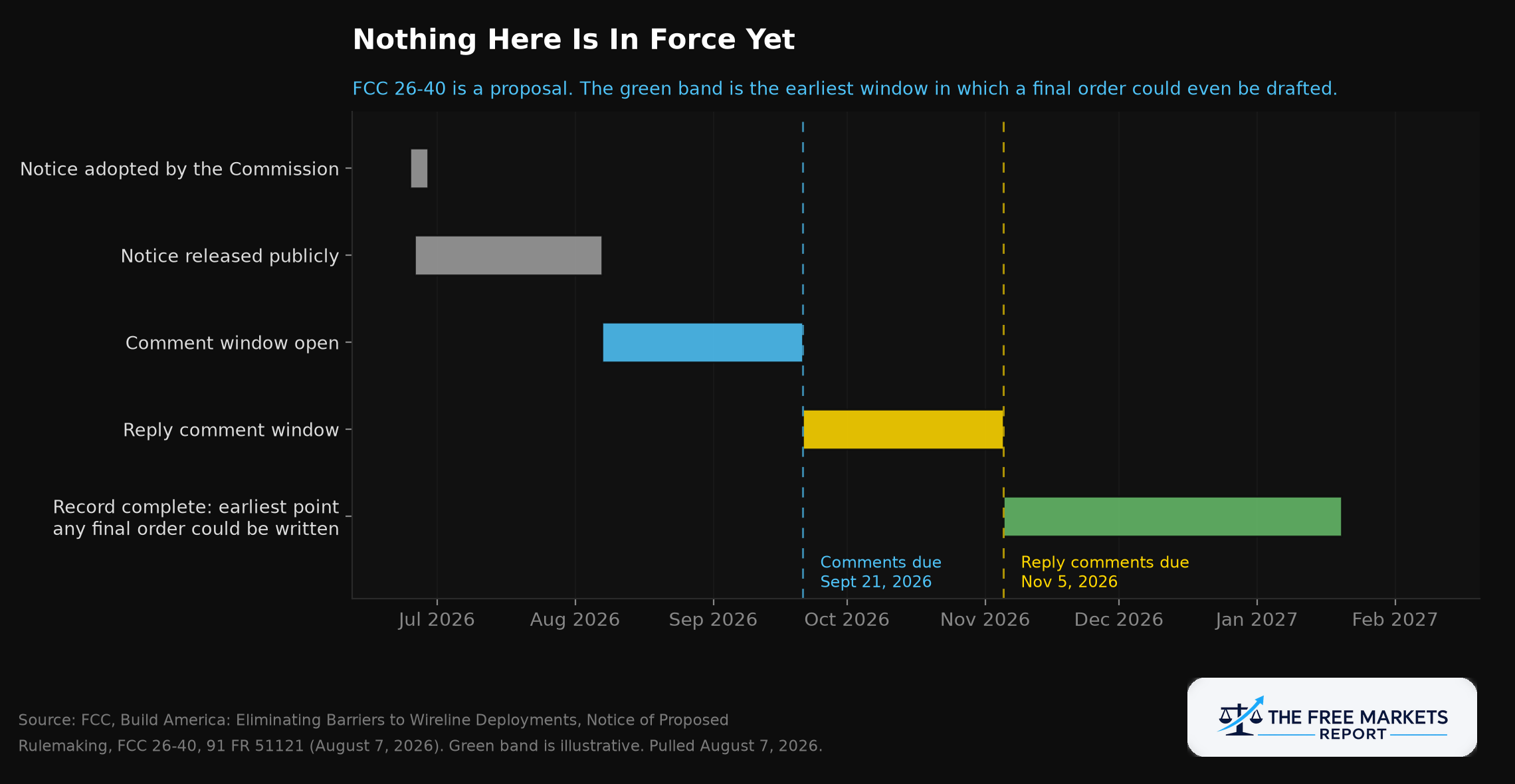
Most regulatory stories in this publication over the past week concerned rules that already switched on. This one is different, and the difference is the story. On August 7, 2026, the Federal Communications Commission published a Notice of Proposed Rulemaking, FCC 26-40, that would put a 120 day presumptive clock on every state and local authorization needed to lay fiber in a public right of way, and cap the fees those governments may charge at a reasonable approximation of their actual and direct costs.1,2 Nothing in it is in force. Nothing in it will be in force this year. Comments close September 21, 2026, reply comments run to November 5, and the Commission's own text asks whether the fee cap survives the Fifth Amendment.2 So the investable question is not "what changed today," but narrower: the docket has now quantified how much of American fiber construction is gated by a municipal in-tray, and which listed companies book that gate as a line item.
A Proposal, Not a Rule. Start There.
The Federal Register itself draws the distinction. Document 2026-16196 is typed as a Proposed Rule, action field "Proposed rule," and carries no effective date because there is nothing yet to make effective.1 It was adopted June 25, 2026, released the next day, and published six weeks later.2 Everything in it is a proposal on which the Commission seeks comment.
This is not a technicality. FCC 26-19, "Reducing Barriers to Network Improvements and Service Changes," was a final rule in WC Dockets 25-208 and 25-209, published April 20, 2026 at 91 FR 20913 and effective May 20, 2026.4 That one is law. FCC 26-40 is a question. Conflating the two mis-times the thesis.
The Scoreboard: Nine Months Against a Proposed 120 Days
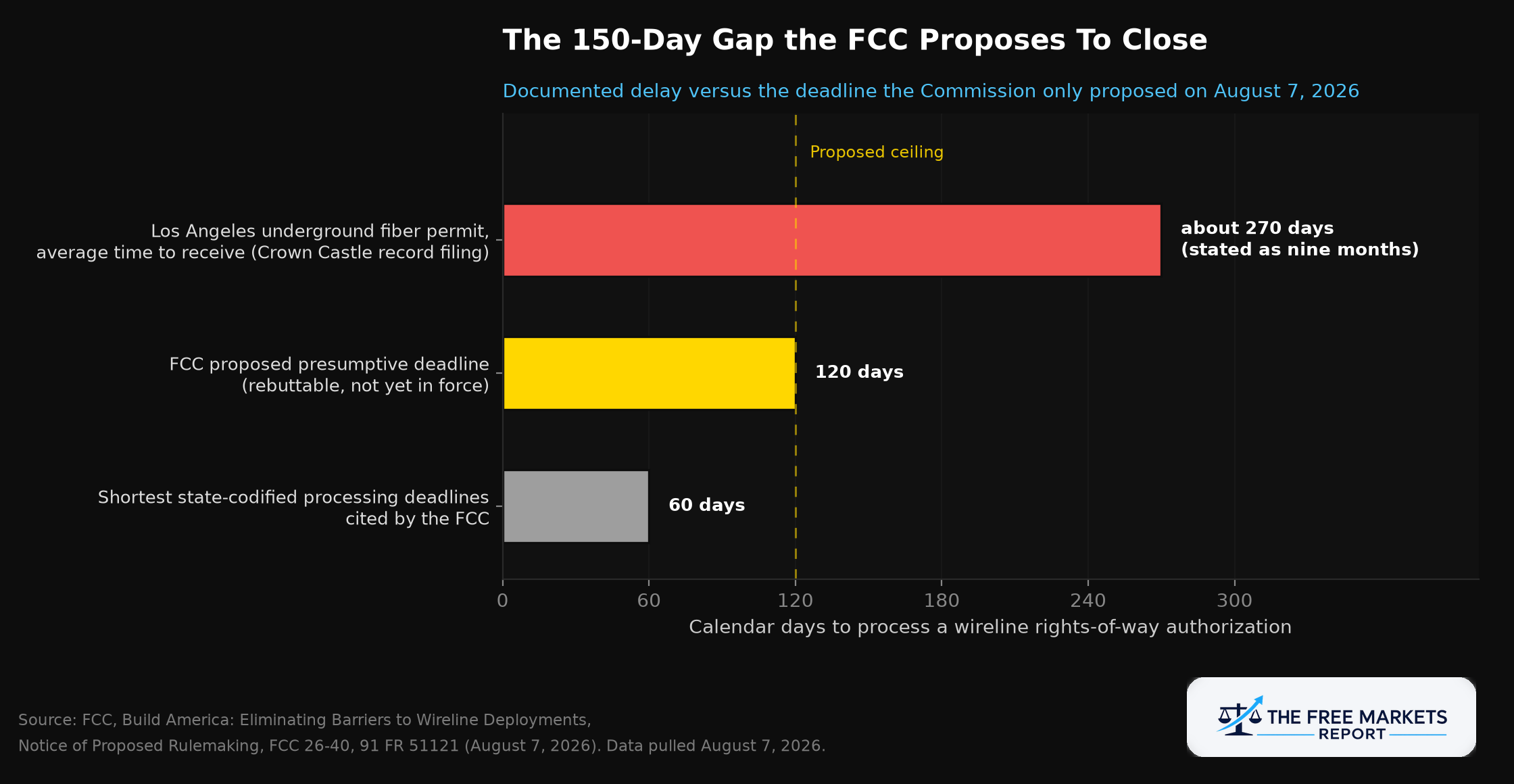
Start with the numbers, because the record is unusually specific. Crown Castle told the Commission that in Los Angeles, "the average time to receive a permit from the Department of Transportation for installation of underground fiber facilities is nine months."2 T-Mobile described an Ohio city where fiber construction "requires 13 different departments with 70 different individuals to review a single application."2
Against that, the proposed ceiling is 120 days. Some states have codified far shorter windows for their own subdivisions, in some cases 60 days.2 The proposed deadline is not a stretch target. It is roughly double what several states require of themselves, and still under half the documented Los Angeles average.
What the Fee Cap Actually Does, in Dollars
The fee half is more concrete, because the notice works an example. If a municipality could collect $3,000 under safe harbor levels the Commission might adopt, and requires the provider to install $1,200 of conduit for municipal use, that $1,200 counts against the $3,000 and the municipality may presumptively collect no more than $1,800 in cash. Reverse it and a $2,800 fee leaves room for no more than $200 of in-kind demands.2 Counting in-kind contributions toward the cash cap converts a soft negotiating lever into a hard accounting offset, and that is the part practitioners will fight over.
The record explains why. USTelecom reported one Minnesota city seeking close to $30,000 in per linear foot fees for a single block, and T-Mobile cited another charging $160 for every structure installed, including handholds and vaults.2 At $30,000 per linear foot, the fee is the project.
One caveat on the proposed fee standard: the Commission did not propose a national dollar figure. It proposes the standard and asks for data on where the safe harbor should sit.2 The number that would make this modelable does not exist.
The Company That Supplied the Evidence No Longer Owns the Assets
The expectation is that the companies quoted in the record are positioned to capture the relief. The filings say otherwise.
Crown Castle (CCI), whose nine month Los Angeles statistic anchors the FCC's delay case, divested its entire fiber business on May 1, 2026. Zayo acquired the fiber solutions business and EQT the small cells business, and Crown Castle received net cash proceeds of $8.4 billion against a gross price of $8.5 billion less $124 million of preliminary adjustments, booking a $625 million loss from disposal of discontinued operations in the first half of 2026.3 Both acquirers are private. The most-cited victim of municipal permitting in this docket exited four months before publication, and the entities holding its permit queue do not trade.
T-Mobile (TMUS), the other named filer, is a $190 billion market capitalization wireless carrier whose fiber exposure runs through joint ventures. A 120 day clock is real for it and immaterial to it. When the parties documenting a constraint are either private or too large to move on it, the investable exposure sits one layer down, in the contractors who bill the labor.
Where the Friction Is Booked
Dycom Industries (DY) is the largest listed pure-play on that labor. Fiscal 2026, ended January 31, 2026, produced contract revenues of $5,545.9 million, of which $5,450.1 million, 98 percent, came from Communications.5 Dycom obtains rights of way and permits for its own engineering work and for customers, so permitting is part of the service line, not an externality.5
The disclosure that matters is the backlog language. Dycom tells investors that contract revenues in backlog "may be realized in different periods from those previously anticipated" because of "regulatory interruptions" and "commercial issues such as permitting," and warns that "delays in obtaining necessary permits" can raise costs on work already priced.5,6 That is a company naming municipal process as a determinant of when awarded work becomes revenue.
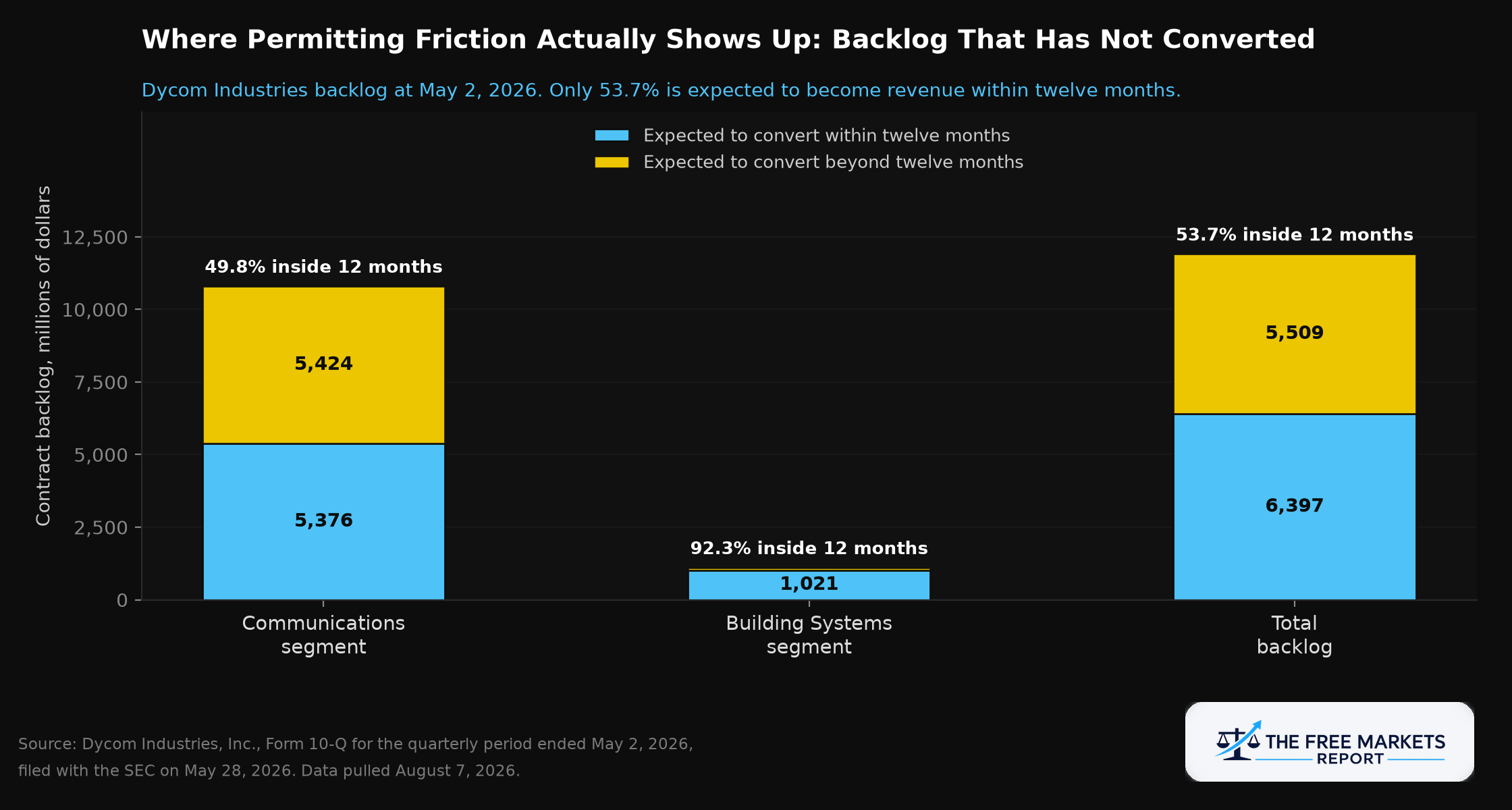
Now the deferred bucket. At May 2, 2026, total backlog stood at $11,906.0 million, and only $6,397.0 million, 53.7 percent, was expected to convert inside twelve months. In Communications, $10,800.3 million of backlog carried only $5,376.1 million inside twelve months, 49.8 percent.6 Half the awarded communications work is scheduled to land beyond a year, and permitting is one of the named reasons.
The Case for Skepticism
First, the strongest argument against this thesis is printed on the document: this is a proposal. The record does not close until November 5, 2026, and a proposal drawing heavy state and municipal opposition can be narrowed, delayed, or abandoned with no court involvement.1,2 Anyone modeling a 2026 benefit is modeling a document with no legal effect.
Second, the Commission raises legal durability against itself. Government commenters argue a cost-based fee cap would be a Fifth Amendment taking requiring fair market value. The FCC answers that the Ninth Circuit rejected that argument in upholding the Small Cell Order's cost-based standard,8 and cites FCC v. Florida Power Corp. for the proposition that non-confiscatory rate regulation is permissible. It then asks commenters to address the question anyway.2 A regulator that briefs the constitutional objection in its own notice is telling you where litigation will start.
Third, the remedy is thin. The Commission observes that Section 253(d) does not expressly authorize injunctive relief, so it cannot compel a city to issue a permit, and it declines to propose the "deemed granted" remedy some commenters requested.2 Preemption is not a permit in hand.
Fourth, a faster clock is not capital. The notice addresses authorization timing and fees, not financing cost, labor availability, construction capacity, or end-market demand, all of which bind independently. A permit granted in 120 days instead of 270 accelerates a project already funded and staffed. It does not create one.
Fifth, the affected carriers are not the listed beneficiaries. The Commission's Initial Regulatory Flexibility Analysis counts 3,027 of 3,403 Wired Telecommunications Carriers, 88.95 percent, as small under the SBA standard, and 4,531 of 4,971 Form 499A filers, 91.15 percent, as small.7 By headcount, this relief flows to companies no public investor can own.
Falsification condition: if the FCC has not released a final order in WC Docket 25-253 adopting a numerical processing deadline by December 31, 2027, or adopts a deadline with no fee standard, treat the deployment-economics thesis as failed rather than delayed.
INVESTMENT IDEA: Dycom Industries, Inc. (DY)
Thesis type: Second-order beneficiary

Deregulatory catalyst: FCC 26-40, "Build America: Eliminating Barriers to Wireline
Deployments," Notice of Proposed Rulemaking, WC Docket No. 25-253, 91 FR 51121,
published August 7, 2026. Proposed, not final. Comments due September 21, 2026;
reply comments due November 5, 2026.

Current price: $407.99 as of August 7, 2026; market capitalization approximately
$12.25 billion (Perplexity Finance quote data, pulled August 7, 2026).

Key financial data: Fiscal 2026 contract revenues of $5,545.9 million, of which
$5,450.1 million (about 98 percent) from the Communications segment (Form 10-K for
the fiscal year ended January 31, 2026). Total backlog of $11,906.0 million at
May 2, 2026, with $6,397.0 million (53.7 percent) expected to convert within
twelve months (Form 10-Q for the quarter ended May 2, 2026).

Regulatory constraint addressed: State and local authorization timing and fees.
Dycom discloses that backlog conversion timing is affected by "regulatory
interruptions" and "commercial issues such as permitting," and that "delays in
obtaining necessary permits" can raise costs on priced work. The FCC record
quantifies the same friction at nine months for a Los Angeles underground fiber
permit and close to $30,000 per linear foot in one Minnesota fee demand.

Bull case: Dycom's constraint is not order intake, it is conversion timing.
Communications backlog of $10,800.3 million carried only 49.8 percent in the
next-twelve-months bucket at May 2, 2026. A codified 120-day presumptive ceiling
on the authorizations that gate that work would compress the interval between
award and construction, which shows up in revenue recognition and crew utilization
rather than in new bookings. The financial mechanics suggest the constraint is
real and disclosed; a shorter authorization clock changes when disclosed backlog
becomes revenue.

Bear case: FCC 26-40 is a proposal with no legal effect and a record that stays
open until November 5, 2026. The Commission itself briefs a Fifth Amendment
objection to its fee cap and concedes Section 253(d) may not support injunctive
relief, so even adoption could mean years of litigation before behavior changes.
Dycom's revenue growth is currently driven by acquisition and customer capital
plans, not permitting, so attributing any 2026 or 2027 result to this docket would
be a causality error. Permitting is one named factor among many in the same
disclosure sentence, alongside customer spending priorities, scheduling, job site
conditions, and weather.

What to watch: (1) whether the FCC releases a final order in WC Docket 25-253
adopting a numerical deadline and a fee safe harbor with a stated dollar level;
(2) Dycom's disclosed next-twelve-months share of total backlog, currently
53.7 percent, in subsequent 10-Q filings; (3) whether state and municipal
commenters file Fifth Amendment takings arguments by September 21, 2026.

Time horizon: 18 to 36 months, event-driven on the docket.
The Principle
Regulatory friction becomes investable only when someone must write it down. The FCC has assembled a record pricing municipal delay in months and fees in dollars per linear foot, and a listed contractor has told shareholders that permitting decides when its awarded work becomes revenue. Two documents, one constraint, opposite ends.
But a proposal is a question, not an answer. The clock in FCC 26-40 does not start on August 7. It starts, if it ever starts, after November 5. Read the type field before the headline: the Federal Register said "Proposed Rule," and that phrase is doing more work here than the 120 days.
- Federal Register, document metadata for 2026-16196, "Build America: Eliminating Barriers to Wireline Deployments," type "Proposed Rule," 91 FR 51121, WC Docket No. 25-253, FCC 26-40, published August 7, 2026. federalregister.gov
- Federal Register, full text of "Build America: Eliminating Barriers to Wireline Deployments," Notice of Proposed Rulemaking, FCC 26-40, 91 FR 51121 through 51138, August 7, 2026, and the GovInfo print edition. federalregister.gov
- Crown Castle Inc., Form 10-Q for the quarterly period ended June 30, 2026, filed August 5, 2026, Note 3, Discontinued Operations. sec.gov
- Federal Register, document metadata for 2026-07622, "Reducing Barriers to Network Improvements and Service Changes," final rule, FCC 26-19, 91 FR 20913, published April 20, 2026, effective May 20, 2026. federalregister.gov
- Dycom Industries, Inc., Form 10-K for the fiscal year ended January 31, 2026, filed March 9, 2026. sec.gov
- Dycom Industries, Inc., Form 10-Q for the quarterly period ended May 2, 2026, filed May 28, 2026. sec.gov
- Initial Regulatory Flexibility Analysis, Tables 1 and 2, in FCC 26-40, 91 FR 51121, August 7, 2026 (GovInfo print edition). govinfo.gov
- Federal Register, "Accelerating Wireless and Wireline Broadband Deployment by Removing Barriers to Infrastructure Investment," FCC 18-133, 83 FR 51867, October 15, 2018, the Small Cell Order whose cost-based fee standard and shot clocks the FCC uses as precedent. federalregister.gov
The Free Markets Report is provided by Lead-Lag Publishing, LLC. All opinions and views mentioned in this report constitute our judgments as of the date of writing and are subject to change at any time. Information within this material is not intended to be used as a primary basis for investment decisions, and should also not be construed as advice meeting the particular investment needs of any individual investor. Trading signals produced by The Free Markets Report are independent of other services provided by Lead-Lag Publishing, LLC, or its affiliates, and the positioning of accounts under their management may differ. Please remember that investing involves risk, including loss of principal, and past performance may not be indicative of future results. Lead-Lag Publishing, LLC, its members, officers, directors, and employees expressly disclaim all liability with respect to actions taken based on any or all of the information in this writing.
Related coverage: The FCC Just Handed AT&T a Wrecking Ball for Its Own Copper; The Tariff Wall Got Rebuilt Under a Different Statute