Europe's AI Labelling Rule Went Live Today. No Listed Company Owns It.
Article 50 transparency duties began applying on 2 August 2026, and the US-listed companies closest to content provenance describe the mandate as a cost, not a market.

Article 50 transparency duties began applying on 2 August 2026, and the US-listed companies closest to content provenance describe the mandate as a cost, not a market.
Key Highlights
- The EU AI Act's Article 50 transparency obligations began applying on 2 August 2026: chatbot disclosure, deepfake labelling, and machine-readable marking of synthetic content.
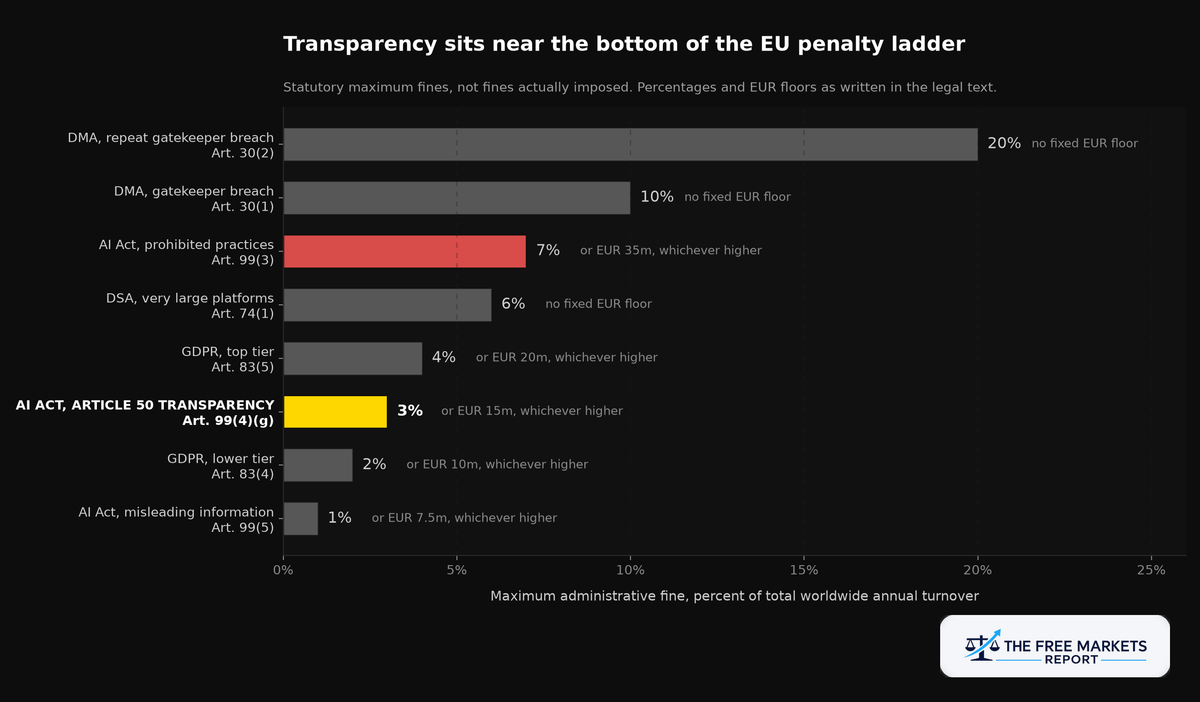
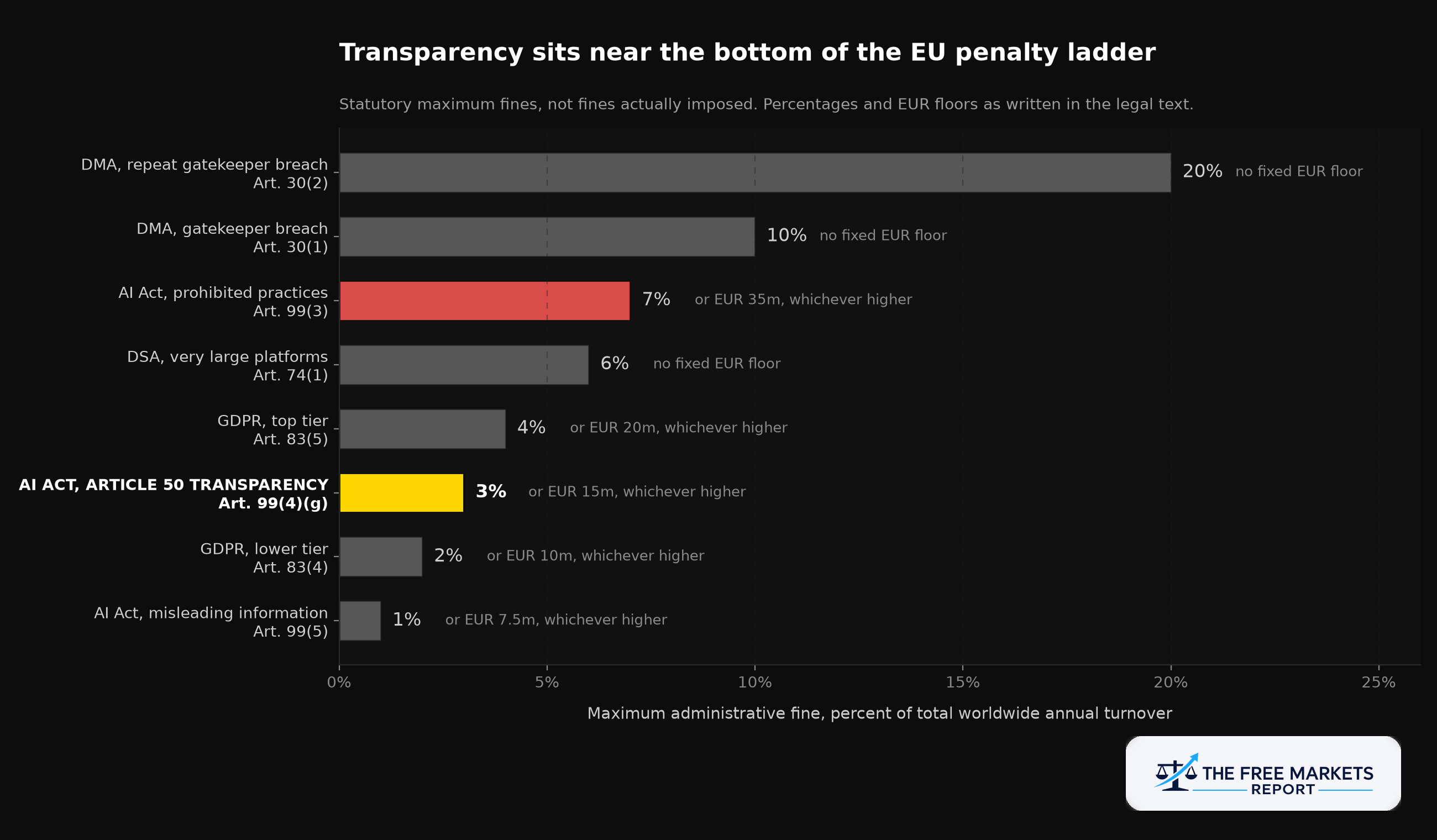
- Breaches carry fines up to EUR 15 million or 3 percent of worldwide turnover, below the GDPR, DSA and DMA ceilings.
- More than 180 organisations signed a Code of Practice on AI-generated content. The code is voluntary, while Article 50 is a legal obligation.
- No US-listed company discloses quantifiable provenance revenue: Adobe treats the Act as a risk factor, and Digimarc never mentions it in its fiscal 2025 10-K.
Start with what the fine schedule says about seriousness. Brussels spent two years building an enforcement architecture for artificial intelligence, and when the transparency chapter began applying today, it arrived carrying a maximum penalty of EUR 15 million or 3 percent of global turnover. That is below a top-tier GDPR breach, and less than half what a gatekeeper faces under the Digital Markets Act. The obligation that most visibly changes what European consumers see on screen is, by the legislature's own arithmetic, among the cheapest things to get wrong.
The GDPR Template, Eight Years On
The architecture is not new. GDPR began applying on 25 May 2018 with a two-tier fine structure, a dual cap set at the higher of a fixed euro amount or a share of worldwide turnover, and enforcement delegated to national supervisory authorities.7 It also built a voluntary off-ramp: Article 40 encouraged codes of conduct, Article 24(3) made adherence "an element by which to demonstrate compliance," and Article 83(2)(j) made it a mitigating factor.7
Read Article 50 against that template and the resemblance looks deliberate. The Commission published its Code of Practice on 10 June 2026 and confirmed it as an adequate voluntary tool for demonstrating compliance.8 The code is voluntary. Article 50 is not. Signatories gain "predictability, legal certainty and trust across all Member States," while non-signatories "will have to demonstrate that those measures are adequate," assessed individually by different market surveillance authorities.8 Sign the code and get a lighter supervisory relationship. Decline, and defend yourself twenty-seven times.
The limits of the comparison matter. GDPR governed a process, the handling of personal data, that firms already performed and could document. Article 50 governs an artefact: a machine-readable mark that must survive compression, cropping and deliberate removal. There is no GDPR equivalent to a requirement defeated by a screenshot. Any inference from 2018 to 2026 is directional, not predictive.
What Actually Landed Today
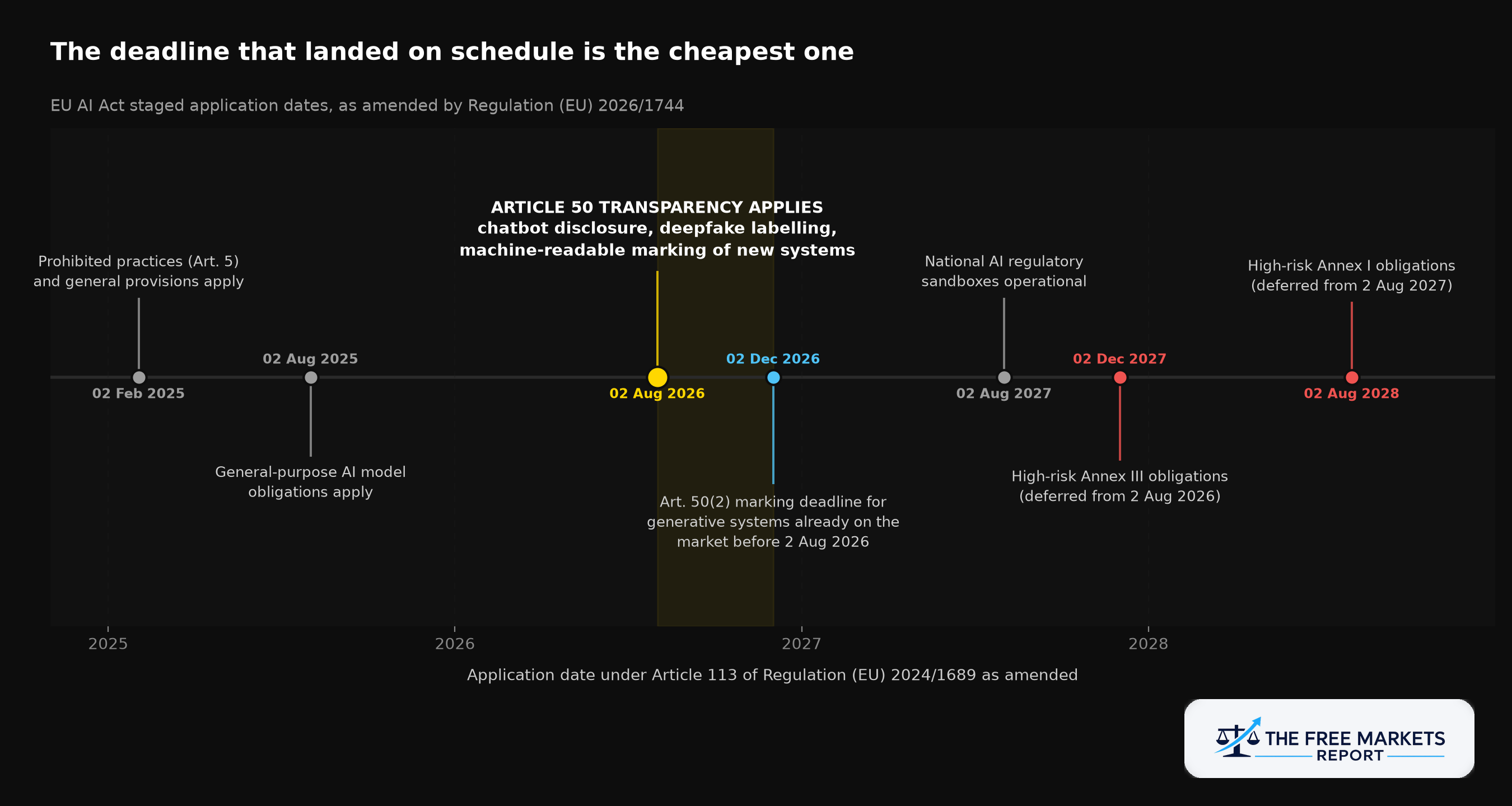
The expected reaction to 2 August 2026 was that the AI Act's heavy machinery finally switched on. What happened is narrower. The Digital Omnibus on AI moved the expensive part out: Annex III high-risk obligations now apply from 2 December 2027 and Annex I obligations from 2 August 2028, deferrals of sixteen and twelve months.4 Parliament adopted it on 16 June 2026 by 423 votes to 57.9
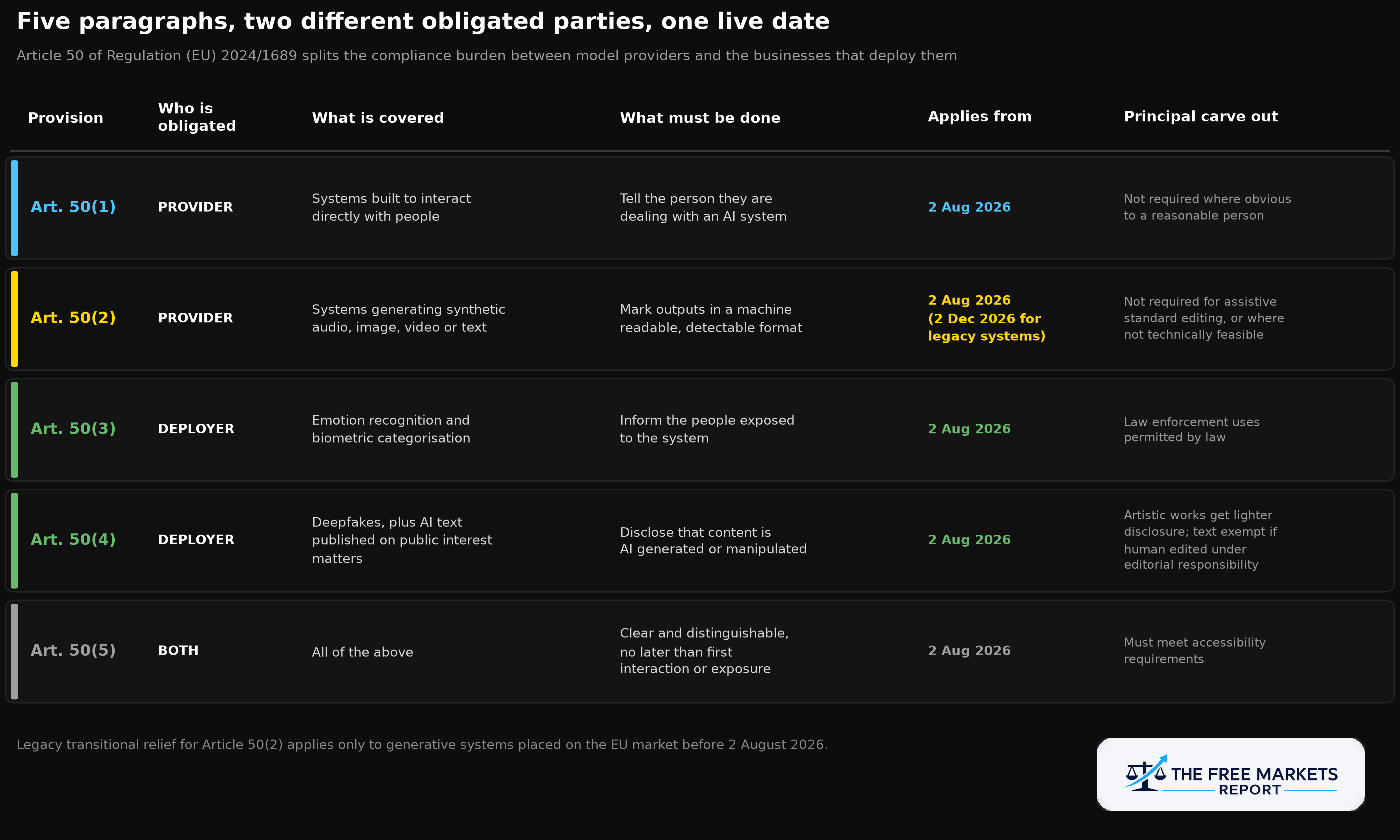
Transparency stayed on schedule. Providers of systems that interact directly with people must inform users they are dealing with an AI system unless that is obvious to a reasonably well-informed observer. Providers of generative systems must mark outputs in a machine-readable, detectable format that is "effective, interoperable, robust and reliable as far as this is technically feasible." Deployers of deepfake generators, and of AI-written text on public-interest matters, must disclose it, unless the text passed human review under editorial responsibility.10 Legacy systems have until 2 December 2026.4
The Forward Signal: Who Pays, and Who Gets Paid
The cost lands on two populations. Article 50(1) and 50(2) bind providers, the model developers. Article 50(3) and 50(4) bind deployers, the businesses using those models. The Commission's signatory list shows the split: providers include Anthropic, Google, Meta, Microsoft, Mistral, OpenAI and Synthesia; deployers include Bulgari, Getty Images, Iberdrola, Lenovo and Lufthansa.11
So who monetises the plumbing? Tested against filings, the honest answer is nobody listed. A full-text search of Form 10-K filings over the past twelve months returns two filers using "Content Credentials," zero using "C2PA," and nine using "watermarking."12 Adobe's fiscal 2025 10-K confirms every Firefly asset carries Content Credentials, attributes no revenue to it, and discusses the AI Act only under risk factors, warning it "may increase our compliance, governance and research and development costs."5 Digimarc, whose entire business is digital watermarking, never mentions the AI Act, and reported fiscal 2025 revenue of USD 33.9 million against USD 38.4 million a year earlier, with a USD 33.2 million operating loss.6 Getty Images, a named signatory, lists the Act among a catalogue of privacy statutes in its risk factors.13
Investment Idea: The AI Provenance Mandate (sector framing, no ticker)
- Regulatory catalyst: EU AI Act Article 50, applying from August 2, 2026, with the legacy marking deadline on December 2, 2026.
- Key data: Exposure capped at EUR 15 million or 3 percent of worldwide turnover. More than 180 Code of Practice signatories. Two Form 10-K filers in the past twelve months using the term "Content Credentials."
- Why no ticker: Adobe discloses no provenance revenue and frames the Act as a cost. Digimarc reported revenue of USD 33.9 million, a USD 33.2 million operating loss, and zero AI Act references. Getty Images treats it as a risk-factor line. None clears a quantifiable, primary-sourced disclosure test.
- Structural read: The change creates a structural tailwind for scale providers who absorb marking internally rather than for vendors offering it as a product. Marking is built inside the model stack, not procured outside it, so the spend never surfaces as revenue for a third party.
- What to watch: Whether any provenance vendor discloses quantified EU AI Act revenue for the quarter ending December 31, 2026.
- Falsification condition: A listed company naming AI Act compliance as a revenue driver before March 31, 2027 would invalidate this framing.
- Time horizon: Event driven, first test December 2, 2026.
Bear Case
The strongest argument against reading this as a compliance-cost story is that it may be a cost-reduction story. The Commission's stated purpose in approving the Code is to give signatories predictability, legal certainty and reduced administrative burden across all Member States.8 For a multinational already labelling AI content across a patchwork of US state statutes, one harmonised EU rulebook can be cheaper than negotiating twenty-seven national interpretations. That is a deregulatory-adjacent outcome hiding inside a regulation.
Three counterweights follow. First, enforcement timing: the Commission adopted its Article 50 guidelines, C(2026) 5054 final, on 20 July 2026, thirteen days before the obligations applied.14 Authorities across twenty-seven Member States are unlikely to bring coordinated cases on that runway, and supervision of signatories will focus on adherence to the code.11 Second, interoperability: Article 50(2) requires effectiveness only "as far as this is technically feasible," accounting for "the generally acknowledged state of the art."10 A standard that bends to the state of the art is a weak forcing function for procurement. Third, for SMEs fines are capped at the lower of the percentage or the fixed amount.2
The Principle
Rules create costs before they create markets, and the two are not the same thing. The temptation today is to trace a mandate to a vendor and call it a trade. The filings do not support it. Article 50 has produced a compliance layer absorbed into the balance sheets of the largest model providers, a voluntary code that converts uncertainty into a supervisory relationship, and a fine ceiling below the EU's own data-protection tier. The question is not who supplies the watermark. It is which incumbents can carry a permanent, non-revenue-generating obligation without noticing, and which cannot.
- European Commission, "Safer and more transparent AI," August 2, 2026. commission.europa.eu
- Regulation (EU) 2024/1689, Article 99(3) to 99(6) and Article 101(1), EUR-Lex. eur-lex.europa.eu
- European Commission, "Commission starts enforcing AI Act rules and new transparency requirements on 2 August," July 31, 2026. digital-strategy.ec.europa.eu
- Council of the European Union, adopted text of the Digital Omnibus on AI, document ST-10599-2026-INIT, new Article 111(4) and amended Article 113(3)(c). data.consilium.europa.eu
- Adobe Inc., Form 10-K for fiscal year ended November 28, 2025, filed January 15, 2026, US Securities and Exchange Commission. sec.gov
- Digimarc Corporation, Form 10-K for fiscal year ended December 31, 2025, filed March 11, 2026, US Securities and Exchange Commission. sec.gov
- Regulation (EU) 2016/679 (GDPR), Articles 24(3), 40, 42, 83(2)(j), 83(4), 83(5) and 99(2), EUR-Lex. eur-lex.europa.eu
- European Commission, "Code of Practice on Transparency of AI-generated Content," Shaping Europe's digital future. digital-strategy.ec.europa.eu
- European Parliamentary Research Service, briefing on the Digital Omnibus on artificial intelligence, PE 782651, 2026. europarl.europa.eu
- Regulation (EU) 2024/1689, Article 50(1) to 50(5), EUR-Lex. eur-lex.europa.eu
- European Commission, AI Act Service Desk, "Resources," updated July 31, 2026. ai-act-service-desk.ec.europa.eu
- US Securities and Exchange Commission, EDGAR full-text search of Form 10-K filings, August 1, 2025 to August 2, 2026. efts.sec.gov
- Getty Images Holdings, Inc., Form 10-K for fiscal year ended December 31, 2025, filed March 16, 2026, US Securities and Exchange Commission. sec.gov
- European Commission, "Guidelines on transparency obligations for providers and deployers of AI systems," C(2026) 5054 final, adopted July 20, 2026. digital-strategy.ec.europa.eu
Related analysis
Read next: Japan's fraud-data rule change
Read next: Britain's infrastructure rulebook reset
The Free Markets Report is provided by Lead-Lag Publishing, LLC. All opinions and views mentioned in this report constitute our judgments as of the date of writing and are subject to change at any time. Information within this material is not intended to be used as a primary basis for investment decisions, and should also not be construed as advice meeting the particular investment needs of any individual investor. Trading signals produced by The Free Markets Report are independent of other services provided by Lead-Lag Publishing, LLC, or its affiliates, and the positioning of accounts under their management may differ. Please remember that investing involves risk, including loss of principal, and past performance may not be indicative of future results. Lead-Lag Publishing, LLC, its members, officers, directors, and employees expressly disclaim all liability with respect to actions taken based on any or all of the information in this writing.