The Treasury Just Opened 60 Million Investment Accounts in One Day
Automatic enrollment completed October 1: every eligible child under 18 now has a Trump Account. The only number that matters now is the claim rate on 60 million passive accounts.

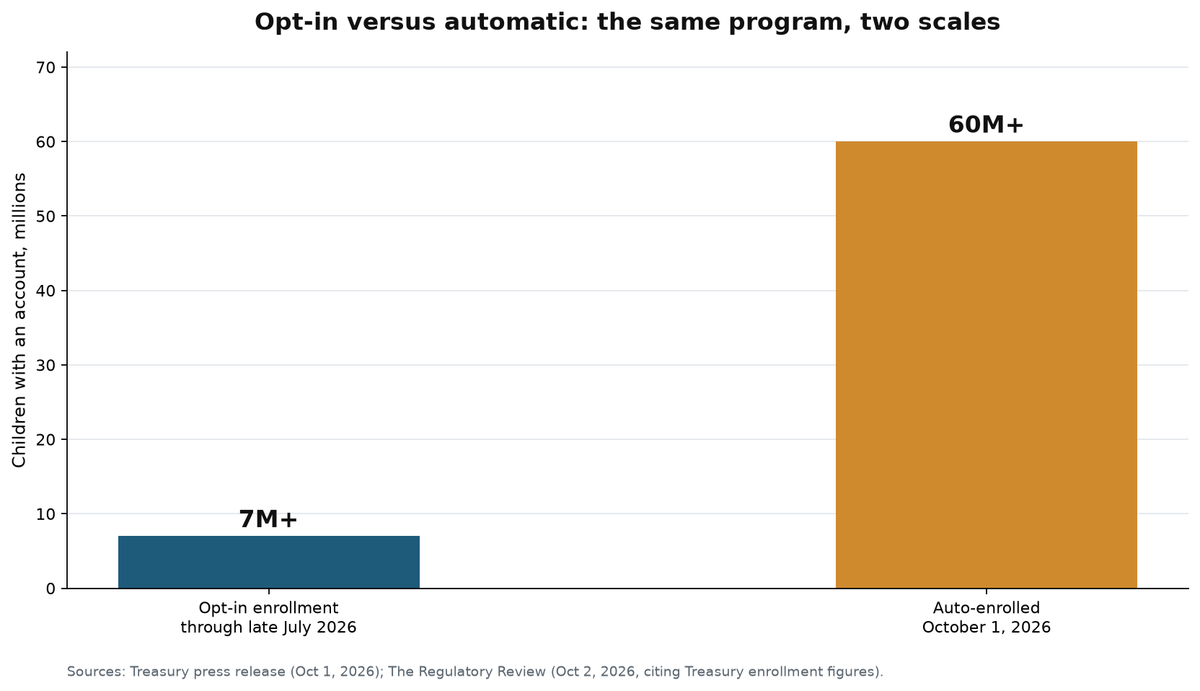
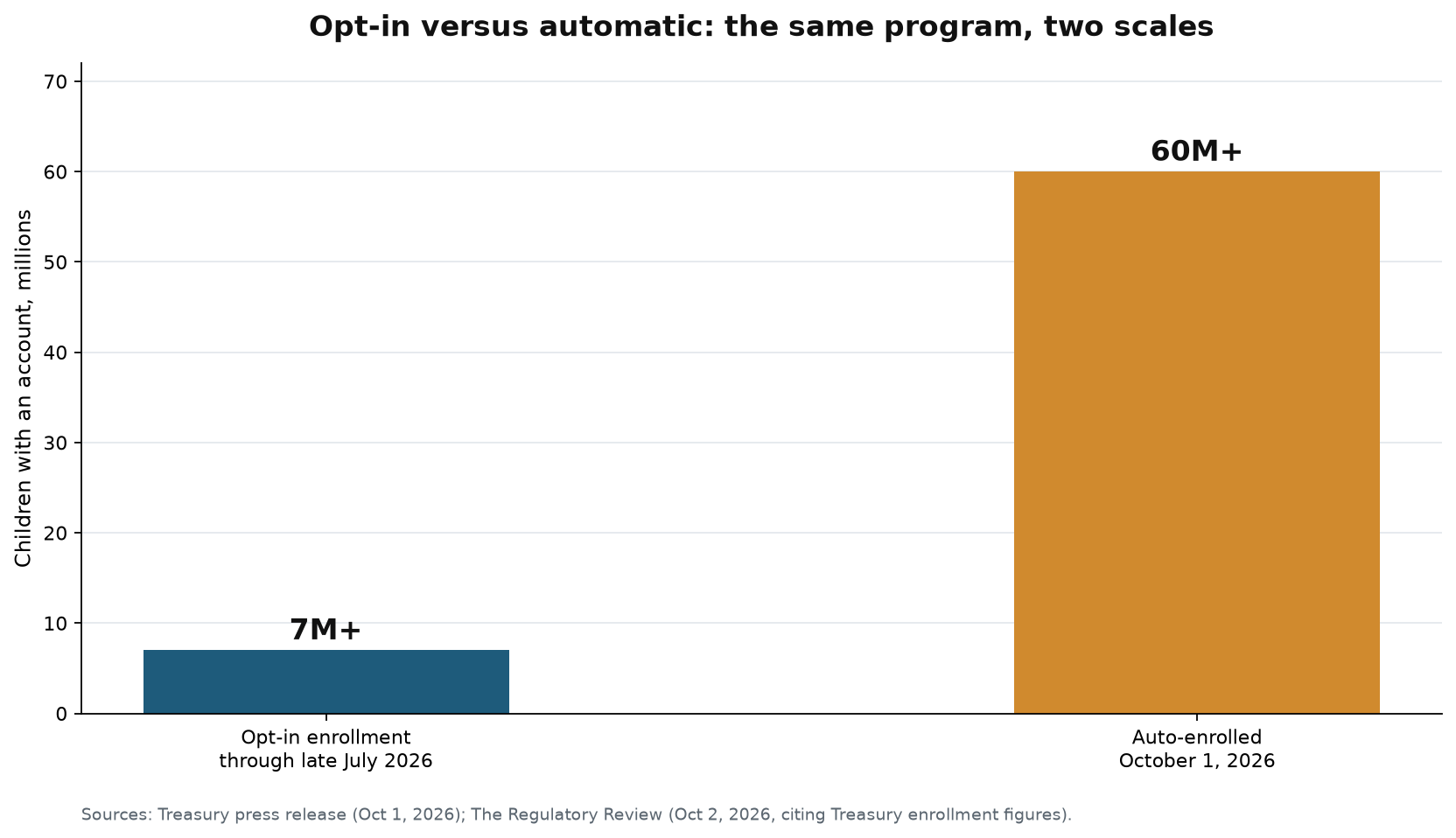
The federal government just became the largest account opener in American financial history. On October 1, the Treasury Department announced the completion of automatic enrollment for Trump Accounts: every eligible child under 18 with a valid Social Security number now has one, more than 60 million accounts created in a single administrative step. The opt-in process the program launched with had drawn 7 million. The rule change multiplied the program's footprint by nearly a factor of nine without a single new customer decision.
What the rule did
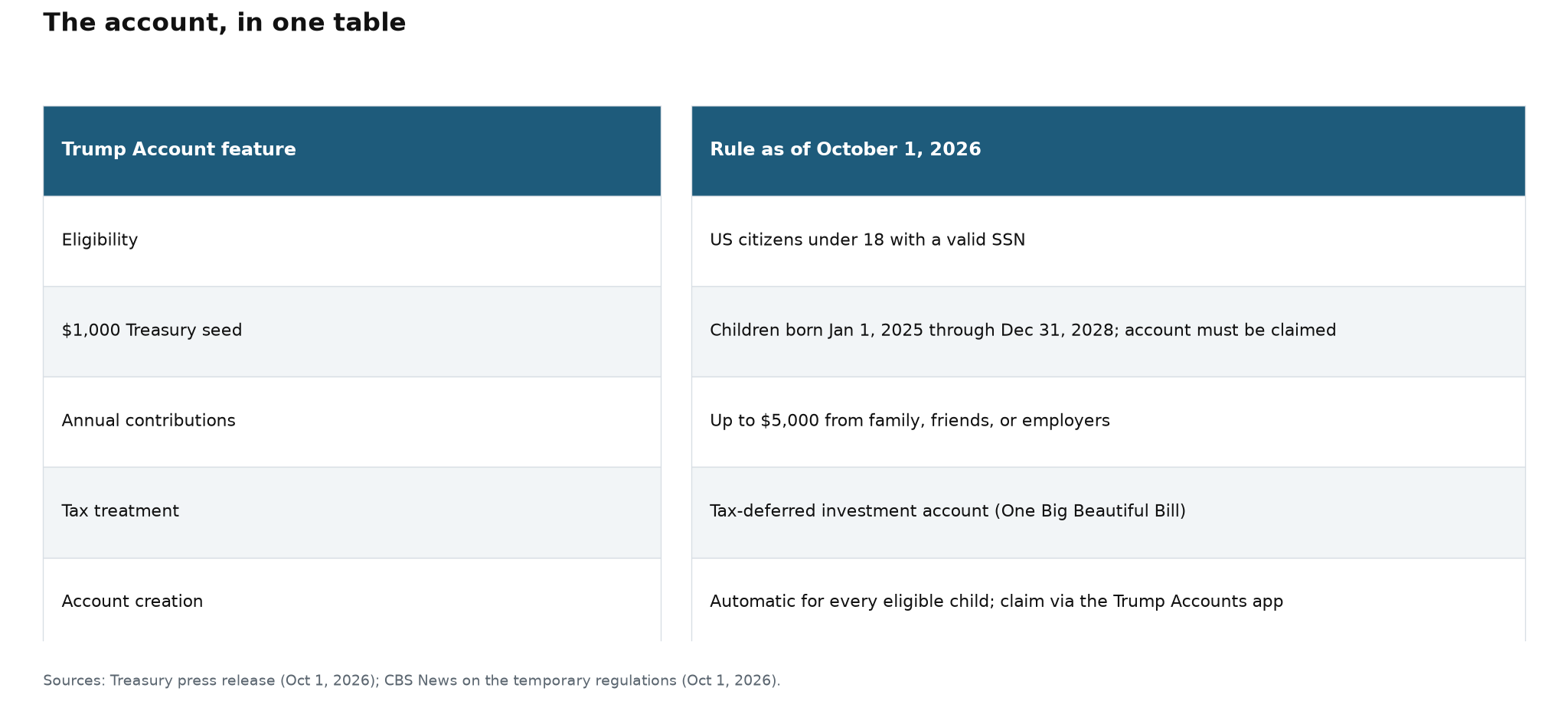
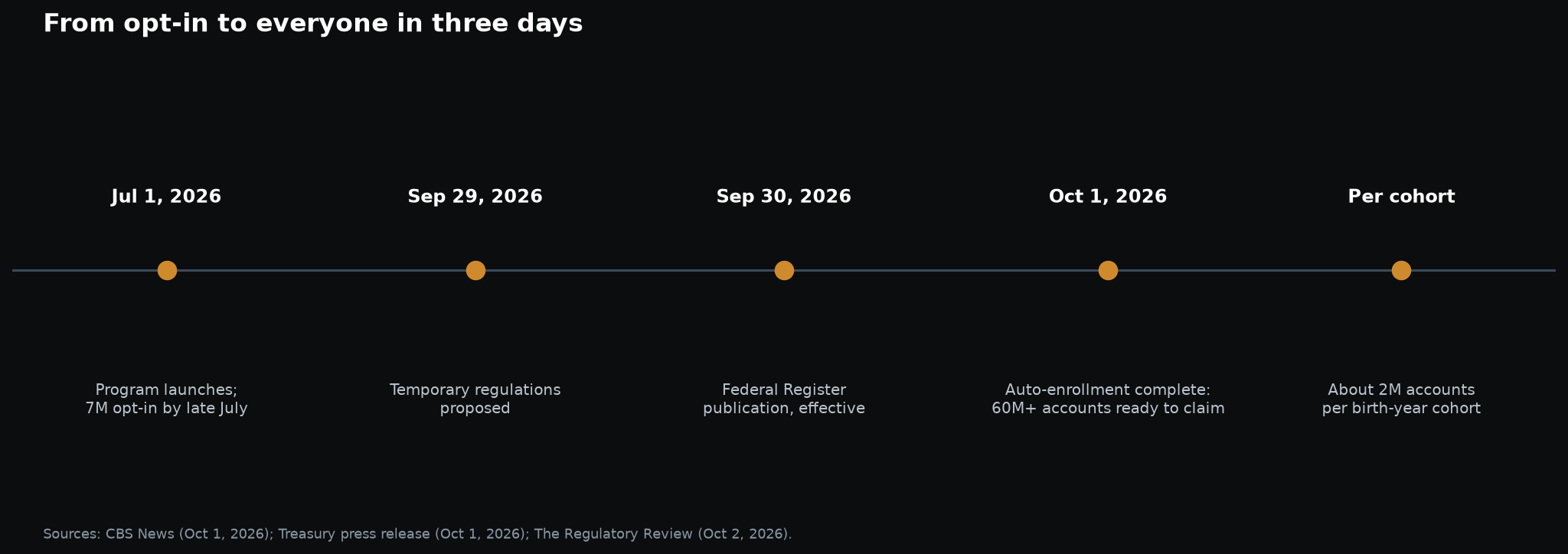
The mechanics came in temporary regulations published in the Federal Register on September 30 and effective the same day, with auto-enrollment beginning October 1. Under the prior framework, a parent or guardian had to open the account themselves, which Treasury had identified as the binding constraint on participation. The new rules, as CBS News reported, allow broad automatic enrollment by the Secretary of the Treasury, using personal information from tax returns and Social Security Administration records, while Treasury withdrew the earlier regulation because it did not permit the automatic structure.
The accounts themselves are tax-deferred investment vehicles created under the One Big Beautiful Bill. Children born between January 1, 2025 and December 31, 2028 are eligible for a one-time $1,000 seed contribution from Treasury, and family, friends, or employers may contribute up to $5,000 per year. Treasury expects the automatic structure to add roughly 2 million accounts per birth-year cohort and estimates the incremental value of class contributions at billions of dollars per year across tens of millions of children.
The quiet part is the claim rate
Here is what separates an account from an investor: nothing happens until a parent or guardian claims it. Treasury's release is explicit that the $1,000 seed arrives only for claimed accounts, and claiming requires downloading the official app, verifying identity and relationship, and accepting the terms. Sixty million accounts exist. The number that matters to every downstream participant, from the custodians to the fund companies whose products sit in the investment menu, is what fraction of those 60 million ever gets claimed.
The opt-in era offers the benchmark. By late July, 7 million children had accounts, and Treasury reported roughly 86 percent of those families earned under $200,000, per enrollment figures cited by The Regulatory Review. Those were households motivated enough to file a form with a tax return or apply through a website. Automatic enrollment removes the motivation requirement, which is exactly its purpose, but it also means the new cohort starts at zero engagement. The claim rate on 60 million passive accounts is the single number that will determine whether this program is a market structure event or a registry.
The market consequence
If claims materialize at anything like the scale of enrollment, this is the largest coordinated onboarding of first-time investors ever attempted in the United States. Treasury's own estimate of billions per year in new contributions is a permanent, annually recurring flow into the capital markets, indexed to birth cohorts rather than market sentiment. It arrives through a structure that starts every participant at a young age with a tax-deferred wrapper, which is the precise design that made 401(k) auto-enrollment the most successful behavioral intervention in the history of American savings.
The design lineage matters. Automatic enrollment is the same mechanism that transformed retirement saving after the Pension Protection Act era: participation rates jumped when the default flipped from opt-in to enrolled. Treasury has now applied the default flip to childhood investing, and the withdrawal of the old regulation rather than its amendment shows the agency understood that the default, not the marketing, was the entire product.
What to watch
Three numbers settle whether this becomes real. First, the claim rate: how many of the 60 million accounts get claimed in the first six months, which Treasury has not projected publicly. Second, the seed disbursement pace: each claimed 2025-2028 birth cohort account triggers a $1,000 federal outlay, so Treasury's own payment data will reveal claim rates before any survey does. Third, the investment menu disclosures: which funds, which fees, and which custodians get the flow, because a wrapper this large shapes product design for years.
The takeaway: the federal government just ran the default-flip experiment on an entire generation, and the entire question of whether it matters now reduces to a single conversion rate. The rule did not create demand. It removed friction, and friction was the product. Few understand this.
Know someone tracking market structure like this? Forward this one along.
The Free Markets Report is provided by Lead-Lag Publishing, LLC. All opinions and views mentioned in this report constitute our judgments as of the date of writing and are subject to change at any time. Information within this material is not intended to be used as a primary basis for investment decisions and should also not be construed as advice meeting the particular investment needs of any individual situation. The accuracy, completeness, and timeliness of the information contained in this document is not guaranteed. The securities and strategies discussed may be unsuitable for investors depending on their specific financial position and investment objectives. Reproduction of this report without the express written consent of Lead-Lag Publishing, LLC is strictly prohibited. Past performance is not indicative of future results, and current performance may be lower or higher than the performance shown. Neither the information nor any opinion expressed in this report constitutes a solicitation, an offer to buy or sell any securities, or an offer to provide investment advice or services. Nothing in this report shall be construed to be an offer to provide investment advisory services in any jurisdiction in which Lead-Lag Publishing, LLC is not authorized to provide such services. All investments involve risk, including the risk of loss of principal. No representation is being made that any security, account, or strategy covered by or is likely to achieve results similar to those shown. Investing in securities involves risks, and there is always the potential of losing money when you invest in securities. Before investing, consider your investment objectives, and Lead-Lag Publishing, LLC's charges and expenses. This report is not a prospectus and does not contain all of the information necessary to fully evaluate any security or strategy discussed, including, but not limited to, the risk of adverse effects of related market developments. You should not rely solely on the information contained in this report, and should seek advice based on your situation from a licensed investment professional. Carefully consider the investment objectives, risks, charges and expenses of any investment product before investing. This report may not be copied or distributed without the express written consent of Lead-Lag Publishing, LLC. Any decisions made based on any or all of the information in this writing are the sole responsibility of the user, and the user should exercise caution and take appropriate advice before acting.