The SEC Just Made Crypto's Legal Boundary Easier to Read. It Did Not Make It Disappear.
The SEC's new crypto FAQ clarifies staking receipts, functional networks, buybacks, and promoter questions. The conditions are the story.

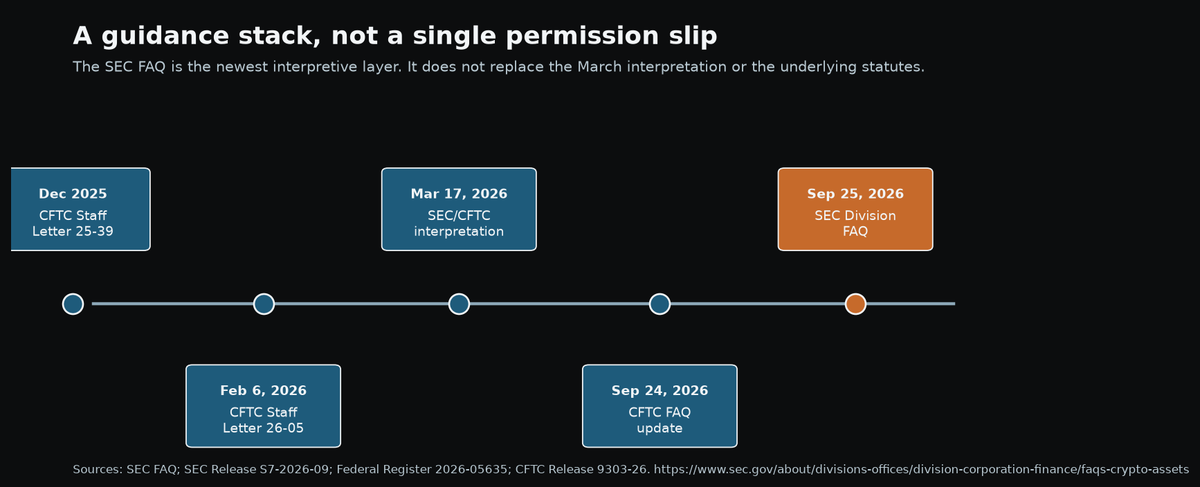
The SEC just made crypto's legal boundary easier to read. It did not make the boundary disappear. A new staff FAQ says a staking receipt token can be a digital tool, a token issued by a protocol-based liquid-staking provider may be a digital commodity, and upkeep of a functional network does not automatically become the managerial effort that turns a sale into an investment contract. The same document says the answer changes when the network is unfinished, the issuer promises profit, or the instrument gives holders more than a receipt for what they already own. SEC Division of Corporation Finance FAQ, Sept. 25, 2026.
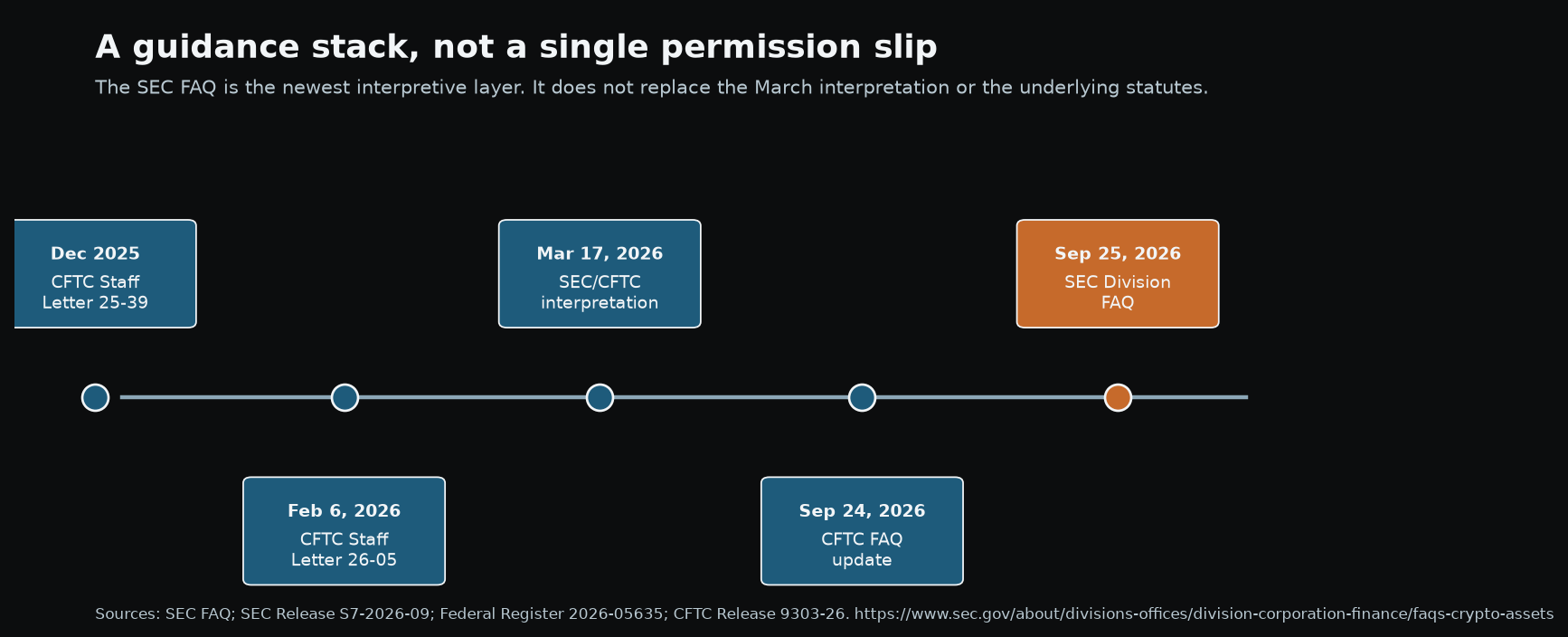
The FAQ represents the views of SEC Corporation Finance staff. The Commission has neither approved nor disapproved it, and the answers have no legal force or effect. They do not amend federal securities law or create new obligations. The document is best understood as a map of how staff reads the commission's March interpretation, not as a safe harbor that makes every token outside the securities laws. SEC FAQ SEC Release S7-2026-09.
The category is not the whole legal analysis
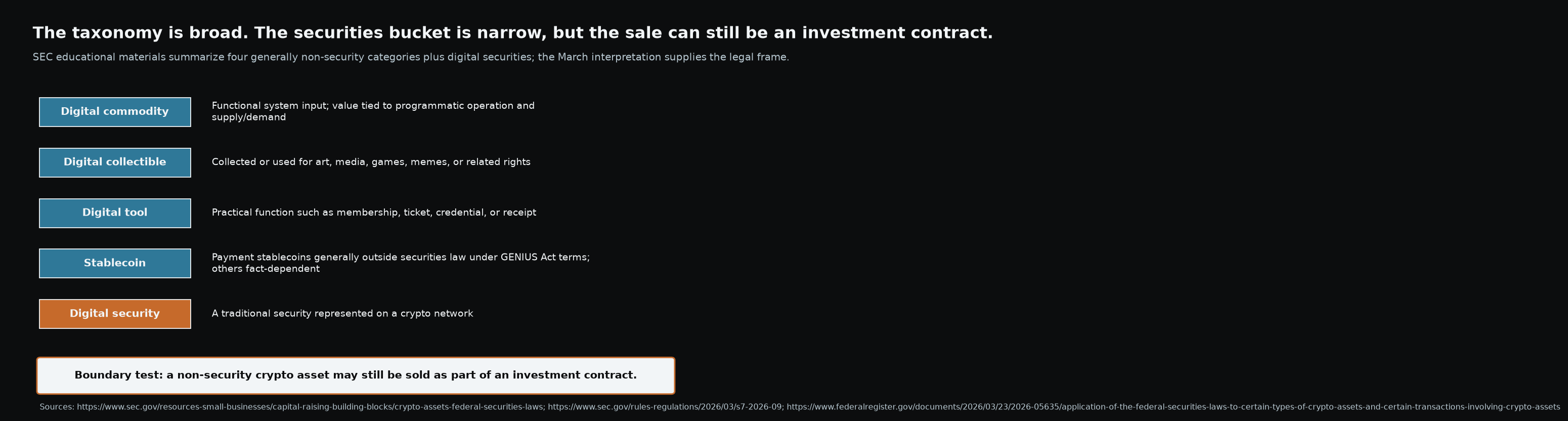
The March interpretation created a taxonomy that separates digital commodities, digital collectibles, digital tools, stablecoins, and digital securities. In the SEC's summary, the first three perform a system, collection, or practical function, while a digital security is a traditional financial instrument represented on a crypto network. Payment stablecoins are generally outside securities law under the terms of the GENIUS Act, while other stablecoins remain fact-dependent. SEC Crypto Assets and the Federal Securities Laws.
But the label does not end the inquiry. The Federal Register release says a non-security crypto asset can still be subject to the federal securities laws when it is offered or sold as part of an investment contract. The asset's category and the transaction's promises are related questions, not interchangeable ones. A token can be useful inside a functioning system while the way it was sold still creates an investment-contract analysis. Federal Register 2026-05635.
The staking receipt is the cleanest example
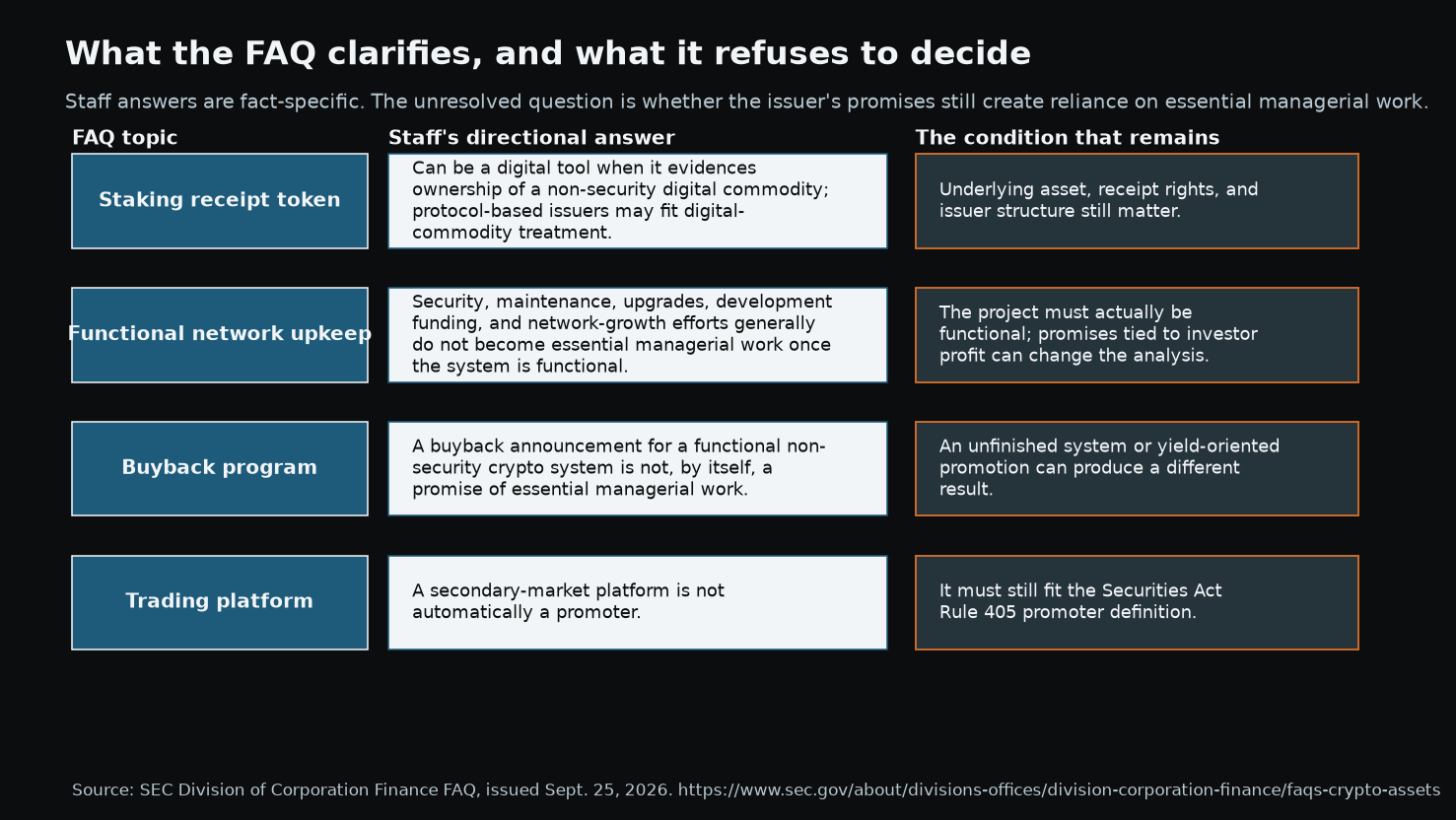
The FAQ's staking-receipt answer is precise. When the underlying asset is a digital commodity not subject to an investment contract, a staking receipt token that evidences ownership can itself be a digital tool. If issued by a protocol-based liquid-staking provider, it may instead be a digital commodity because it is tied to a functional crypto system and to supply and demand. SEC FAQ, staking receipt answers.
The important word is receipt. The receipt must represent ownership of a stated amount of an asset deposited with a custodian, without giving the holder an additional financial benefit. The FAQ's logic therefore points away from a simple name-based test. If the issuer can transfer, lend, pledge, rehypothecate, or otherwise use the deposited asset, the instrument may no longer fit the narrow receipt concept described by staff. That is not a blanket conclusion about any named token. It is the condition the document tells market participants to examine. SEC FAQ.
Functional does not mean finished forever
The FAQ also answers a question that matters to every crypto project that continues to operate after launch: when does maintenance stop looking like the essential managerial work investors were promised? Staff says that, once a crypto system is functional, work to secure, maintain, improve, or enhance it, fund development projects, or help network effects grow would not, under the circumstances described, be essential managerial work. A functional network can require work without every workstream recreating an investment contract. SEC FAQ.
That is the soft line. The hard line is the promise. If the system is not yet functional, or if a buyback or marketing campaign is presented as a way for holders to earn yield or returns, the same fact pattern can be characterized differently. A buyback on a functional network is not, by itself, a promise to perform essential managerial work. A buyback tied to a promised return for holders on an unfinished network is a different question. The FAQ does not remove the facts-and-circumstances test; it tells firms which facts will matter. SEC FAQ.
The CFTC is building the other half of the rail
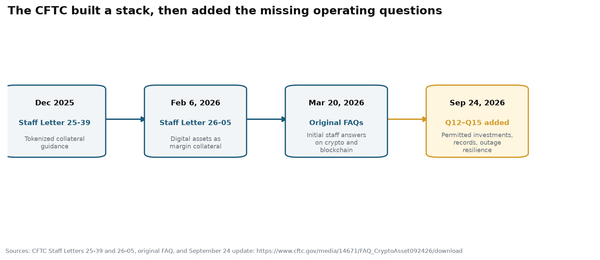
The timing matters. On September 24, the CFTC updated its own crypto and blockchain FAQ to address investments of customer funds in tokenized forms of permitted investments and the use of blockchain technology for recordkeeping. Its release says the update added the Market Oversight division to the prior work by Market Participants and Clearing and Risk staff. CFTC Release 9303-26.
The CFTC's answer is operational rather than taxonomic. Tokenization does not turn an ineligible asset into an eligible one. The underlying investment must already fit the applicable rules, and the token must preserve legal and economic rights that are the same as or functionally equivalent to the traditional asset. The updated FAQ also addresses how regulated entities can use distributed-ledger systems for records while retaining the authenticity, reliability, production, and continuity controls required by the Commodity Exchange Act. CFTC updated FAQ, Sept. 24, 2026.
Read together, the two agencies are converging on a functional test. The SEC asks what the asset does, what was promised, and whether the system is functional. The CFTC asks whether the tokenized wrapper preserves eligibility, rights, custody, and recordkeeping controls. In both cases, the technology changes the implementation. It does not cancel the old obligation.
The market-structure read
The bullish interpretation is that regulated crypto infrastructure can now be designed around explicit interfaces. A staking receipt can evidence ownership without automatically becoming a new security. A functional network can receive maintenance without every upgrade being treated as a managerial promise. A derivatives firm can explore tokenized permitted investments and onchain records if it preserves the rights and controls that mattered before the token existed.
The bear case is more consequential than the headline. Staff guidance is not binding, and the questions are fact-specific. A project that markets future profits, an issuer that uses deposited assets, or a platform that crosses the Rule 405 promoter definition can move back into a securities-law analysis. A firm that adopts a public ledger without a tested outage and production plan can satisfy the technical story while failing the regulatory one.
Watch the next filings for evidence that firms are redesigning custody, disclosure, and recordkeeping around these conditions rather than treating the FAQs as permission to skip them. The SEC has made the line softer around functional crypto infrastructure. The footnote is that the line still moves when the promise, the rights, or the system's functionality changes.
Know someone tracking market structure like this? Forward this one along.
The Free Markets Report is provided by Lead-Lag Publishing, LLC. All opinions and views mentioned in this report constitute our judgments as of the date of writing and are subject to change at any time. Information within this material is not intended to be used as a primary basis for investment decisions, and should also not be construed as advice meeting the particular needs of any individual situation. The accuracy, completeness, and timeliness of the information contained in this document is not guaranteed. The securities and strategies discussed may be unsuitable for investors depending on their specific financial position and investment objectives. Reproduction of this report without the express written consent of Lead-Lag Publishing, LLC is strictly prohibited. Past performance is not indicative of future results, and current performance may be lower or higher than the performance shown. Neither the information nor any opinion expressed in this report constitutes a solicitation, an offer to buy or sell any securities, or an offer to provide investment advice or services. Nothing in this report shall be construed to be an offer to provide investment advisory services in any jurisdiction in which Lead-Lag Publishing, LLC is not authorized to provide such services. All investments involve risk, including the risk of loss of principal. No representation is being made that any security, account, or strategy will or is likely to achieve results similar to those shown. Investing in securities involves risks, and there is always the potential of losing money when you invest. Before investing, consider your investment objectives, and Lead-Lag Publishing, LLC's charges and expenses. This report is not a prospectus and does not contain all of the information necessary to fully evaluate any security or strategy discussed, including, but not limited to, the risk of adverse effects of related market developments. You should not rely solely on the information contained in this report, and should seek advice based on your situation from a licensed investment professional. Carefully consider the investment objectives, risks, charges and expenses of any investment product before investing. This report may not be copied or distributed without the express written consent of Lead-Lag Publishing, LLC. Any decisions made based on any or all of the information in this writing are the sole responsibility of the user, and the user should exercise caution and take appropriate advice before acting.