The FCC Just Freed a Gigahertz and Rewrote Its Own Environmental Footprint
The September 30 vote opened 1,000+ MHz for satellite broadband and removed FCC NEPA review from spacecraft operations, spectrum authorizations and earth stations. Same meeting, same bottleneck.

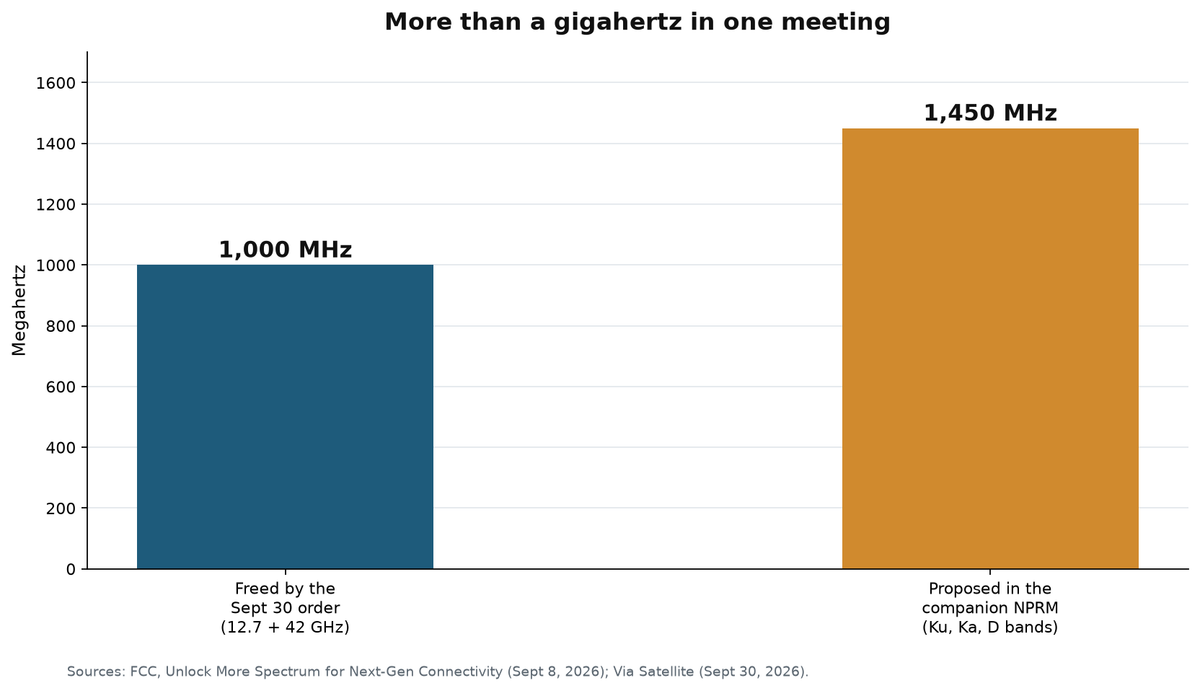
Wednesday's FCC meeting did something unusual: it moved a full gigahertz of spectrum and rewrote its own environmental review footprint in the same afternoon. The vote on September 30 finalized two of the agency's biggest infrastructure decisions of the year, and together they say something about how the next generation of connectivity gets built: faster, and with fewer federal checkpoints.
What the commission did
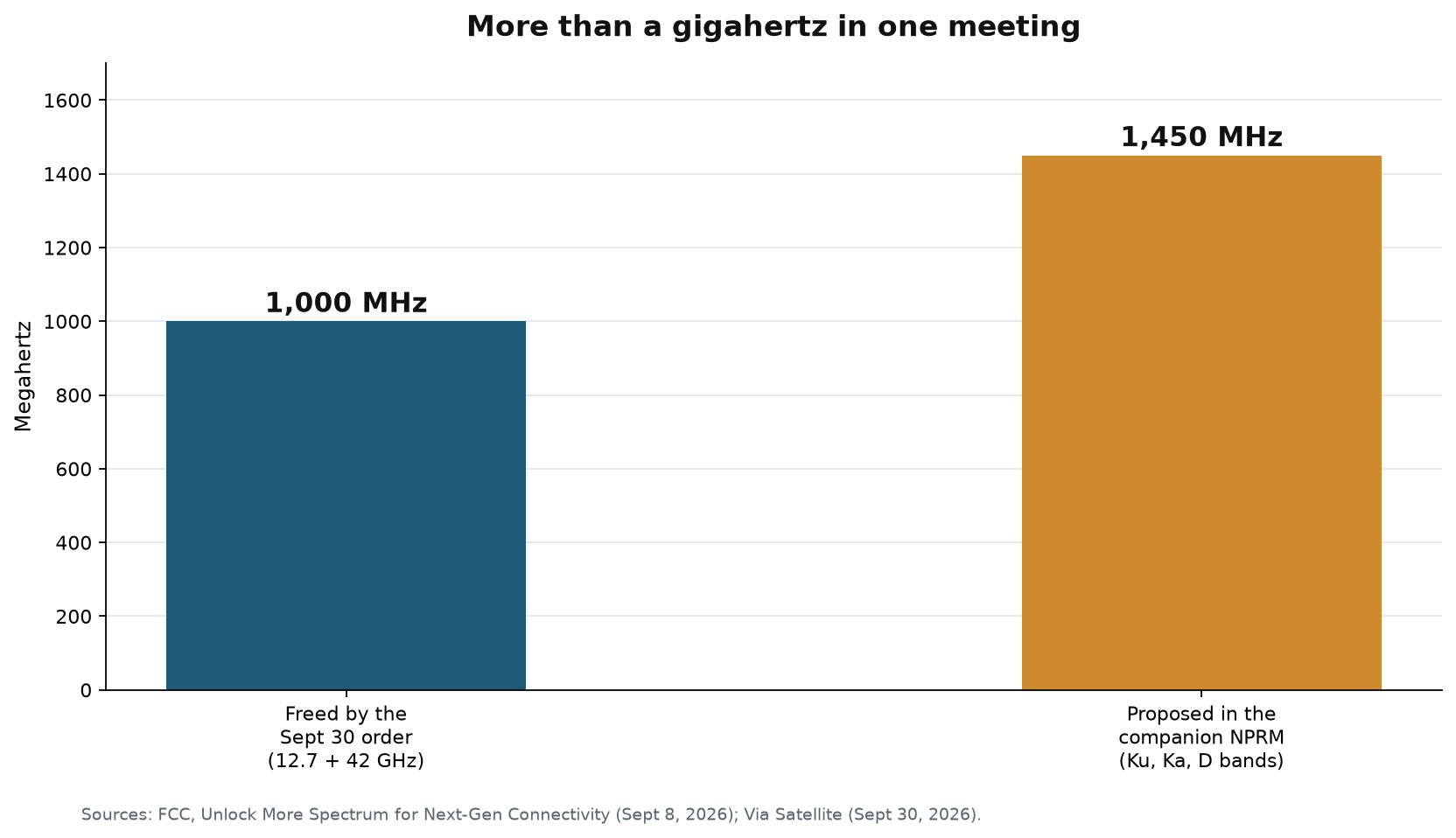
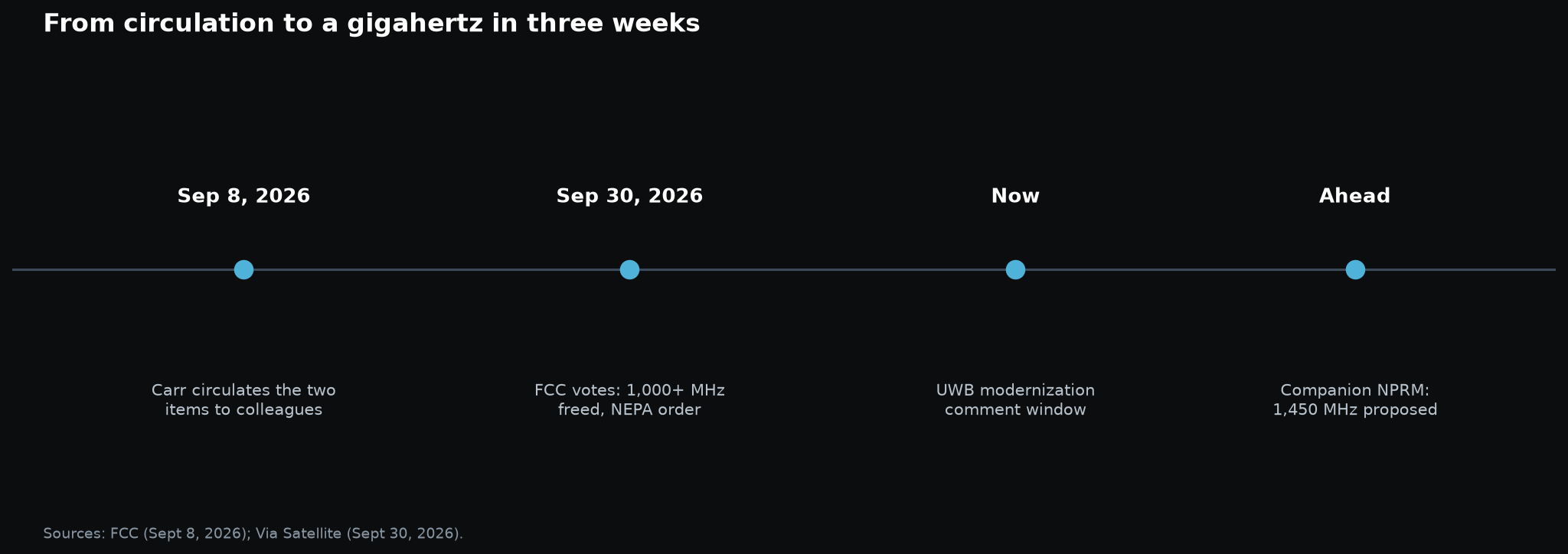
The first item is the spectrum abundance order. The FCC freed more than 1,000 megahertz of spectrum in the 12.7 GHz and 42 GHz bands for a range of connectivity services, including next-generation satellite broadband. A companion notice of proposed rulemaking seeks comment on freeing another 1,450 megahertz across the Ku-band, Ka-band and D-band, plus additional spectrum for novel space activities. Chairman Brendan Carr framed the pair, announced for vote on September 8, as pushing more commercial spectrum into the marketplace than ever before.
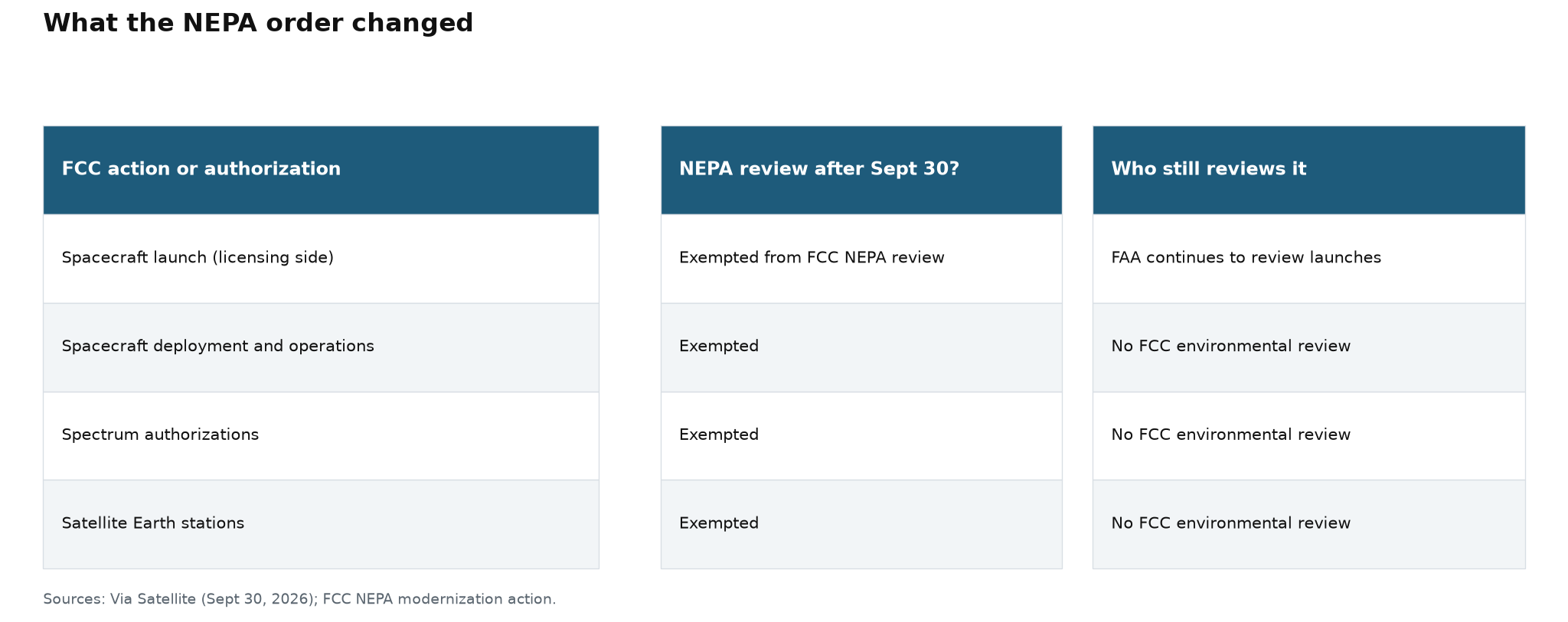
The second item is the quieter one with the longer shadow. The FCC voted to modernize its approach to National Environmental Policy Act obligations, and in doing so clarified that an entire category of its own activity is no longer subject to federal environmental review: spacecraft launch licensing as handled by the commission, spacecraft deployment and operations, spectrum authorizations, and satellite earth stations are no longer classified as major federal actions requiring FCC NEPA review. The agency did not eliminate review of space activity generally: launches remain regulated and reviewed by the Federal Aviation Administration. What changed is the FCC's own layer, which for satellite constellations and their ground infrastructure was often the slower one.
Why the two belong together
Spectrum and environmental review are usually treated as separate regulatory universes. For satellite broadband they are the same bottleneck. A constellation needs two things from Washington: frequencies it can use, and permission to build the ground and space infrastructure that uses them. Wednesday's vote moved both at once. More than a gigahertz of capacity now has a path to commercial use, and the deployments that carry it just shed a federal review layer that added time and litigation exposure to every earth station and authorization.
The market consequence is deployment speed. Satellite broadband competes with fiber and terrestrial wireless on latency and price, but it wins or loses on how fast operators can re-plan, re-file, and re-launch capacity as demand shifts. Cutting the FCC's environmental review out of the loop for routine satellite operations compresses the part of the timeline nobody puts in the marketing deck. Carr's September 8 statement made the competitive intent explicit: consumers should continue to benefit from competitive, high-speed Internet delivered from next-gen satellites.
The pattern, again
This is the third time in a month an agency has used a rulemaking to redefine its own jurisdiction rather than waiting for a court to do it. The FTC rewrote its rules of practice. NHTSA recalibrated its standards. Now the FCC has declared a category of its own activity outside NEPA's scope. Each move follows the same logic: the enabling statute predates the industry it now governs, the market moved, and the agency would rather draw the boundary itself than litigate it case by case.
What to watch
Three things. First, the ultra-wideband modernization also circulated on September 8 now heads to comment: it is described as the first comprehensive modernization of those rules, and unlicensed-device economics move quietly underneath a huge share of consumer technology. Second, the 1,450 megahertz NPRM comment period: whether satellite operators and terrestrial carriers fight over the Ku- and Ka-band shares, which is where the spectrum abundance agenda usually meets its ceiling. Third, whether the NEPA order draws a court challenge, because an agency self-defining its way out of a review statute is exactly the kind of move that environmental litigators exist to test.
The takeaway: a gigahertz of spectrum and an exemption from environmental review arrived in the same meeting, because for the infrastructure the FCC is trying to accelerate, they were the same problem. The agencies that build the next network are the ones redrawing their own boundaries fastest. Few understand this.
Know someone tracking market structure like this? Forward this one along.
The Free Markets Report is provided by Lead-Lag Publishing, LLC. All opinions and views mentioned in this report constitute our judgments as of the date of writing and are subject to change at any time. Information within this material is not intended to be used as a primary basis for investment decisions and should also not be construed as advice meeting the particular investment needs of any individual situation. The accuracy, completeness, and timeliness of the information contained in this document is not guaranteed. The securities and strategies discussed may be unsuitable for investors depending on their specific financial position and investment objectives. Reproduction of this report without the express written consent of Lead-Lag Publishing, LLC is strictly prohibited. Past performance is not indicative of future results, and current performance may be lower or higher than the performance shown. Neither the information nor any opinion expressed in this report constitutes a solicitation, an offer to buy or sell any securities, or an offer to provide investment advice or services. Nothing in this report shall be construed to be an offer to provide investment advisory services in any jurisdiction in which Lead-Lag Publishing, LLC is not authorized to provide such services. All investments involve risk, including the risk of loss of principal. No representation is being made that any security, account, or strategy covered by or is likely to achieve results similar to those shown. Investing in securities involves risks, and there is always the potential of losing money when you invest in securities. Before investing, consider your investment objectives, and Lead-Lag Publishing, LLC's charges and expenses. This report is not a prospectus and does not contain all of the information necessary to fully evaluate any security or strategy discussed, including, but not limited to, the risk of adverse effects of related market developments. You should not rely solely on the information contained in this report, and should seek advice based on your situation from a licensed investment professional. Carefully consider the investment objectives, risks, charges and expenses of any investment product before investing. This report may not be copied or distributed without the express written consent of Lead-Lag Publishing, LLC. Any decisions made based on any or all of the information in this writing are the sole responsibility of the user, and the user should exercise caution and take appropriate advice before acting.