The DOE Just Tried to Make Its Own Deregulation Permanent
A new Process Rule would cut 30 of DOE's 86 appliance rulemakings while claiming to keep 91.5 percent of the savings, and Whirlpool is the test case for whether that math matters.

Key Highlights
- DOE issued a Notice of Proposed Rulemaking on June 30, 2026 (Docket EERE-2025-BT-STD-0001) rewriting the Process Rule that governs future appliance efficiency rulemakings.
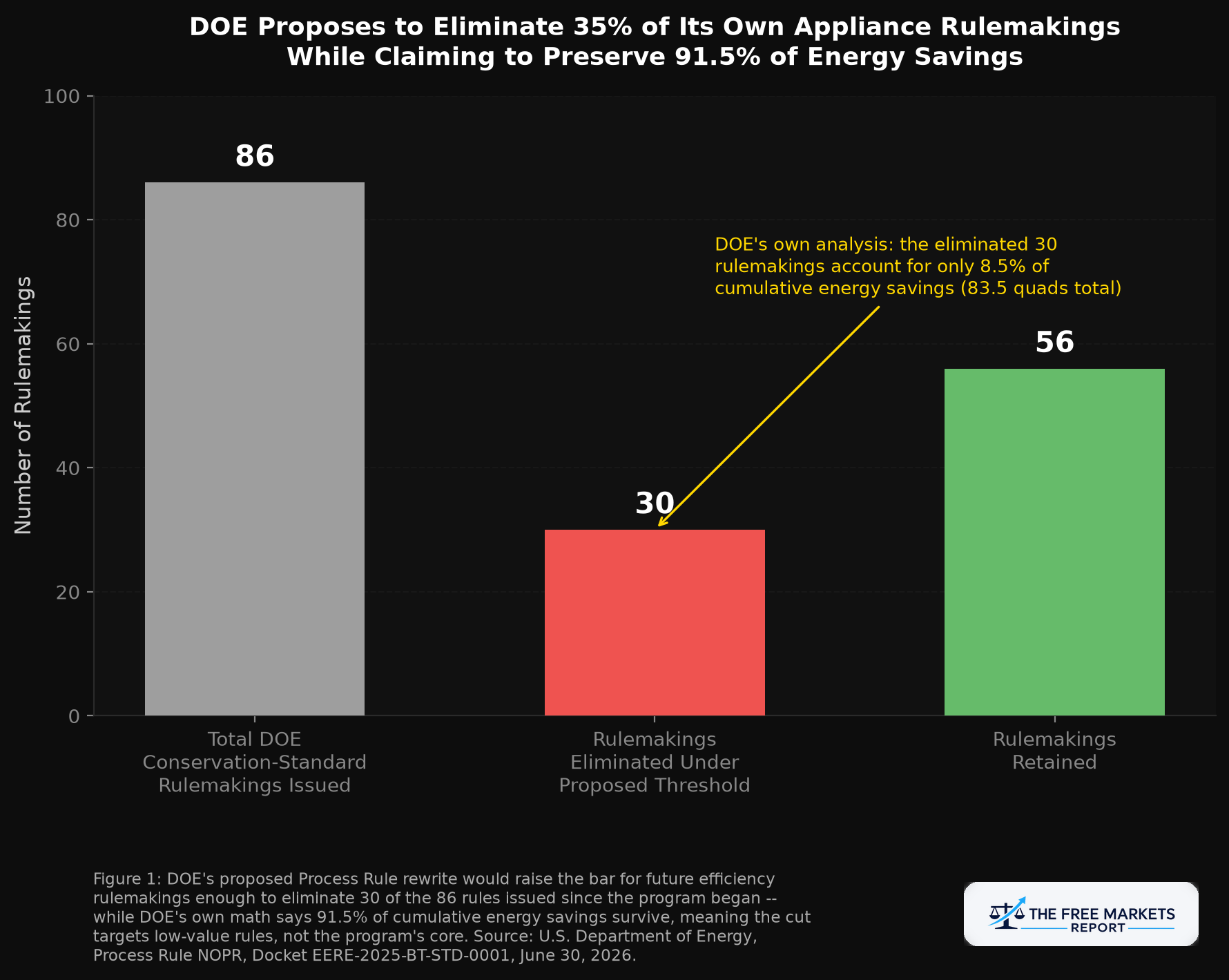
- DOE's own analysis says the proposed threshold would eliminate 35% of future rulemakings (30 of 86) while retaining 91.5% of cumulative energy savings.
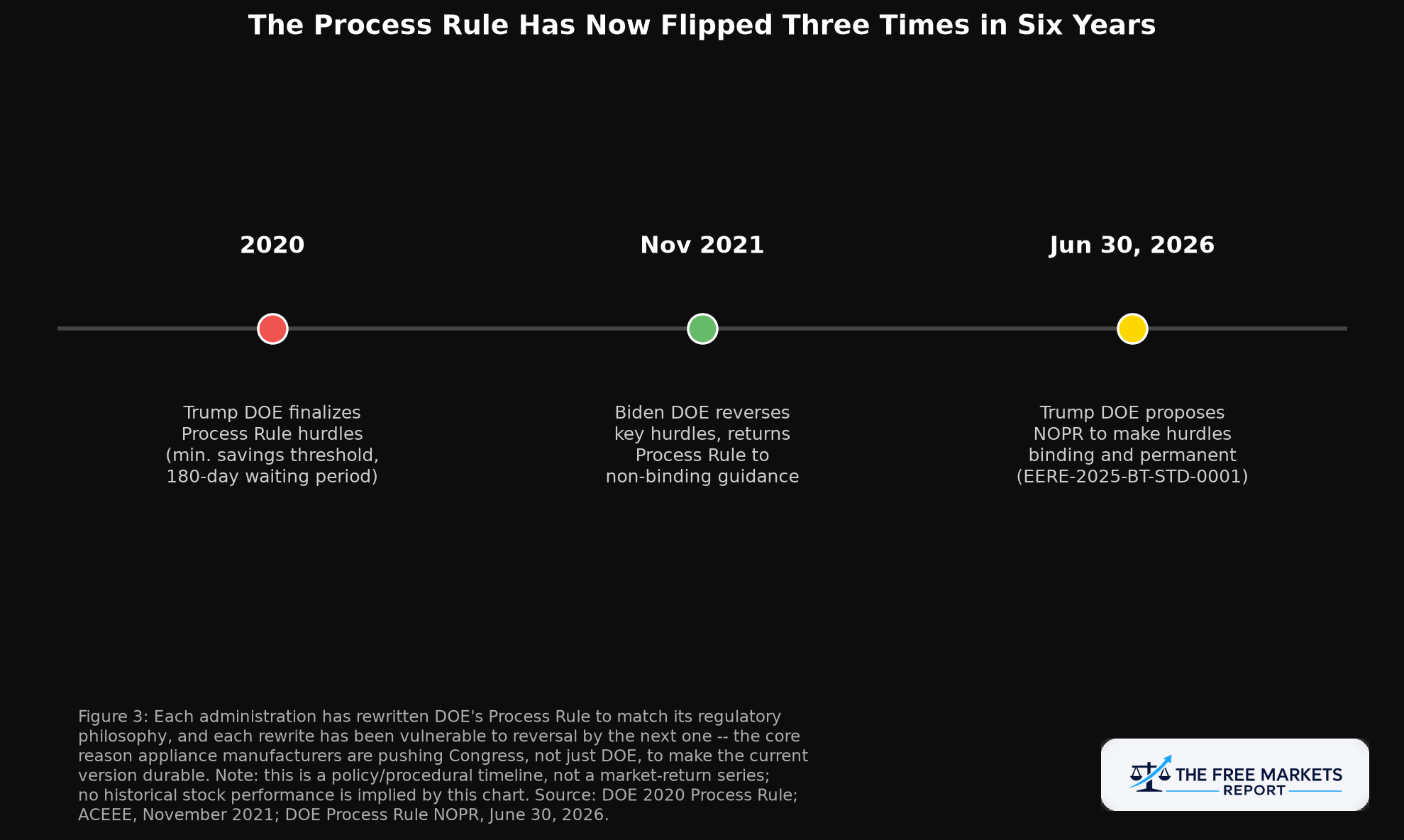
- The rule adds consumer-choice factors, drops environmental impact as a standalone factor, and reinstates 2020-era hurdles a Biden DOE dismantled in 2021, the third reversal in six years.
- Whirlpool (WHR) reported a Q1 2026 net loss of $85 million as North America EBIT margin collapsed to 0.3% from 6.2%, making compliance-cost relief relevant to 2026 guidance.
- Comments close 30 days after Federal Register publication, and Democratic state attorneys general have signaled litigation risk on related efficiency rollbacks.
On June 30, 2026, Assistant Secretary of Energy Audrey Robertson signed a document that tries to solve a problem DOE created for itself. The document, a Notice of Proposed Rulemaking docketed as EERE-2025-BT-STD-0001, is not about any single appliance. It is the rulebook DOE uses to write rules, the Process Rule, and it has been rewritten three times since 2020, each version undone by the next administration. This time, DOE wants the rewrite to stick.
A Rulebook That Keeps Getting Rewritten
The Process Rule is the gatekeeping mechanism for every federal energy-efficiency standard on dishwashers, dryers, water heaters, and dozens of other appliance categories. In 2020, the first Trump DOE finalized a version with real teeth: a minimum energy-savings threshold plus a mandatory 180-day waiting period. Eleven months into the Biden administration, a November 2021 rule stripped those hurdles out, returning it to non-binding guidance.
Now the pendulum swings again. The June 30 NOPR proposes binding hurdles plus two new factors absent from both prior versions, preserving "consumer product availability and choice" and "market competition," while dropping environmental impact as a standalone factor in favor of "other factors the Secretary considers relevant." It also reinstates 2020-era provisions on coverage determinations, test procedures, and negotiated rulemaking.
Energy Secretary Chris Wright announced the proposal July 2, framing it as an effort to "permanently end home appliance and equipment mandates." Robertson's language is narrower: the goal, she said, is to "promote affordability, preserve consumer choice, and meet the highest standards for transparency and due diligence." It targets future rulemaking only, not standards already in effect.
The Math Behind "35 Percent Fewer Rules"
Start with the numbers DOE itself put in the docket. Since the conservation-standards program began, DOE has issued 86 final rules, delivering a cumulative 83.5 quads of site energy savings. The NOPR proposes a new "significant energy savings" threshold: either a 10% reduction in full-fuel-cycle energy use over 30 years, or a 2-quad reduction, to clear the bar. DOE's own retrospective analysis produces a quotable number: 30 of the 86 rulemakings, 35% of the total, would not have cleared it.
Put those figures together and the framing sharpens: cutting 35% of past rulemakings while losing only 8.5% of cumulative savings implies the eliminated rules are, by DOE's own math, disproportionately low-value. That reads as either a well-targeted filter or a threshold calibrated backward from a desired outcome. The docket does not name which 30 rules would fail the new test, so the claim is hard to verify independently.
The proposal also adds three consumer-economic thresholds: a 10% installed-cost-increase cap, a 20% cap on consumers incurring net costs, and a maximum simple payback period of 50% of a product's useful lifetime. Each is a new veto point absent from the 2021 guidance-only version.
Kelly Mariotti, president and CEO of AHAM, the manufacturers' trade group, endorsed the proposal in terms that say more about the investment case than the environmental one. She noted the Process Rule's history of changing "from administration to administration" creates "uncertainty and instability," and called on Congress, not just DOE, to codify the reforms into the Energy Policy and Conservation Act. That AHAM wants legislation, not just a rule, is a tacit admission that DOE-level "permanence" is aspirational absent statute.
Whirlpool's Numbers Show Why This Matters Now
Regulatory compliance costs are not abstractions for appliance manufacturers; they show up in the same segment reporting that already shows demand and pricing stress. Whirlpool Corporation (WHR), the largest US-headquartered major appliance manufacturer, reported Q1 2026 net sales of $3,273 million, down 9.6% year-over-year, with a GAAP net loss of $85 million, versus net earnings of $71 million a year earlier.
The segment detail is sharper: Whirlpool's Major Domestic Appliance North America unit, most exposed to DOE compliance costs, reported Q1 2026 net sales of $2,237 million, down 7.5% from $2,419 million, while EBIT fell from $149 million to $6 million, a 96% decline, pushing EBIT margin from 6.2% to 0.3%. Whirlpool still guided full-year 2026 net sales of roughly $15.0 billion and ongoing EPS of $3.00 to $3.50.
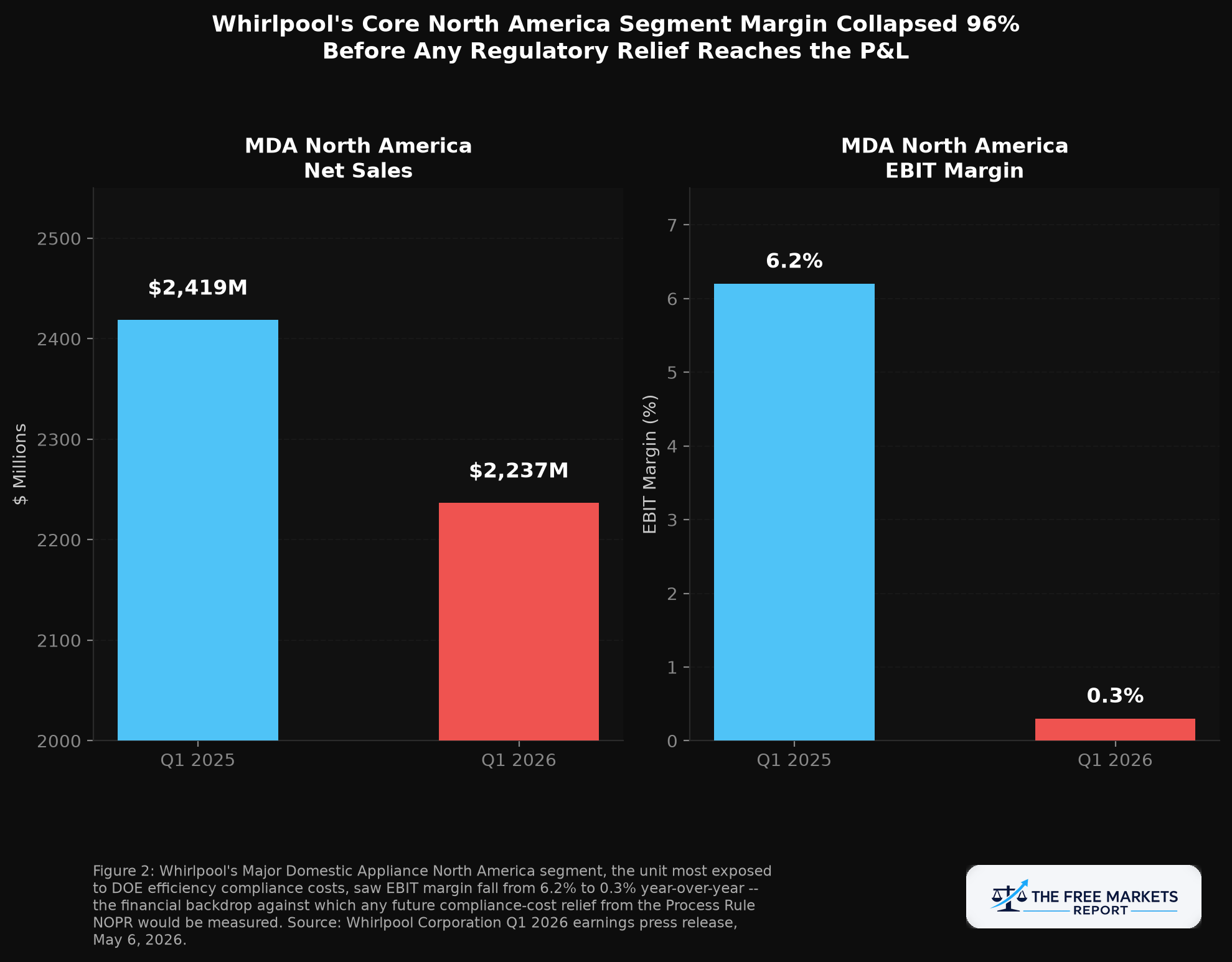
A 0.3% EBIT margin leaves little room to absorb compliance costs, which is why shrinking the pipeline of mandatory redesigns is relevant to Whirlpool's cost structure, even though it changes nothing about standards already in force. The mechanics run through the forward pipeline: fewer new rulemakings mean fewer forced redesign and certification cycles, and more planning stability, the same "uncertainty and instability" Mariotti cited. None of that shows up in Q1 2026 numbers, since the NOPR postdates the quarter; it would surface, if at all, over the multi-year cycles the rule governs.
The Case for Skepticism, and Why It Matters for Investors
The consensus expectation might be that a rule reducing DOE's reach is straightforwardly bullish for manufacturers. The primary sources instead show a proposal with no legal force yet and an opposition coalition already on record.
Andrew deLaski of the Appliance Standards Awareness Project called it an "obstacle course of restrictions" that would hinder DOE's congressional mandate, warning the timing is bad "as data centers strain our electric grid." His group's analysis, cited by the Washington Post, estimates efficiency updates due for 2029-2035 could cut peak summer electricity demand by 34 gigawatts by 2040, roughly 34 large nuclear reactors' worth, under the current rule. That is the measurable metric this NOPR puts at risk.
There is also legal risk. Federal law generally bars DOE from weakening standards already in effect, so existing mandates on dishwashers, dryers, and water heaters are not undone here. The Washington Post reports a coalition of Democratic-led states is poised to sue over related rollbacks. The NOPR is procedural, narrowing its immediate exposure, but litigation risk remains once DOE applies it to specific future standards.
The strongest argument against this thesis is the rule's own history: this is the third version of the Process Rule in six years, and every prior version was undone within roughly one election cycle. A rule AHAM itself does not trust to survive without congressional codification is not a durable catalyst for a multi-year re-rating of compliance-cost expectations. The relief this NOPR promises is conditional on surviving past 2028.
Falsification condition: If the NOPR is not published in the Federal Register within a reasonable window, or the comment period produces a materially narrowed final rule dropping the consumer-economic thresholds, the relief thesis weakens substantially. If a state-attorney-general coalition secures a stay or injunction, the thesis is invalidated for affected categories.
Investment Idea
INVESTMENT IDEA: Whirlpool Corporation (WHR)
Thesis type: Second-order beneficiary / contrarian caution
Deregulatory catalyst: DOE Process Rule NOPR (Docket EERE-2025-BT-STD-0001), which would shrink the forward pipeline of mandatory redesign and recertification cycles.
Current price: $38.10 (July 5, 2026, StockTitan; down approximately 47% from $72.18 at the start of 2026).
Key financial data: Q1 2026 net sales of $3,273 million (down 9.6% YoY); GAAP net loss of $85 million; MDA North America EBIT margin of 0.3%, down from 6.2%. Full-year 2026 guidance of roughly $15.0 billion in net sales and $3.00-$3.50 ongoing EPS.
Regulatory constraint removed: A narrower rulemaking pipeline would cut forced redesign and recertification cycles; DOE says the proposed threshold would have eliminated 35% of its historical rulemakings.
Bull case: If finalized as proposed, Whirlpool's North America segment gains multi-year cost-planning certainty precisely when its core margin has collapsed to near breakeven, freeing capital for the turnaround already embedded in guidance.
Bear case: This is the third reversal in six years, the rule has no legal effect yet, AHAM wants Congress rather than DOE to make it permanent, and Whirlpool's margin problem stems overwhelmingly from demand and cost pressures the rule does not address. A new administration or a successful legal challenge would reset the pipeline toward 2021 guidance-only status.
What to watch: Federal Register publication and the final threshold surviving comment; NOPR commentary on Whirlpool's next earnings call, expected around July 27-28, 2026; whether the state-AG coalition sues within two quarters.
Time horizon: 18-36 months (rulemaking and legal-challenge cycle, not a near-term catalyst)
What Permanent Actually Means
A regulatory agency cannot bind its successor by rule alone. That is the plain lesson of a Process Rule rewritten in 2020, reversed in 2021, and rewritten again in 2026, each time by the DOE that happened to hold office.
The math in this NOPR is real: 30 of 86 rulemakings eliminated, 91.5% of energy savings preserved, by DOE's own analysis. Real math applied to a rule with a six-year half-life is not a durable catalyst.
Footnotes
- U.S. Department of Energy, "Process Rule NOPR," Docket No. EERE-2025-BT-STD-0001, RIN 1904-AF72, signed June 30, 2026. https://www.energy.gov/documents/process-rule-nopr
- U.S. Department of Energy, "Trump Administration Moves to Permanently End 'Green New Scam' Appliance Mandates," press release, July 2, 2026. source
- Robert Walton, "DOE Proposes Rule to Permanently End Appliance Mandates," Utility Dive, July 2, 2026. source
- Robert Walton, Utility Dive, July 2, 2026 (Kelly Mariotti, AHAM, quoted). source
- Robert Walton, Utility Dive, July 2, 2026 (Andrew deLaski, Appliance Standards Awareness Project, quoted). source
- American Council for an Energy-Efficient Economy (ACEEE), "DOE Nixes Key Trump-Era Roadblocks to Updating Appliance Efficiency Standards," press release, November 2021. source
- Whirlpool Corporation, Q1 2026 Earnings Press Release, Investor Relations, May 6, 2026. source
- Evan Halper, "Energy Department Wants to Weaken Efficiency Standards for Home Appliances," Washington Post, July 2-3, 2026. source
- StockTitan, Whirlpool Corporation (WHR) market data, accessed July 5, 2026. source
- MarketBeat, Whirlpool Corporation (WHR) earnings calendar, accessed July 5, 2026. source
The Free Markets Report is provided by Lead-Lag Publishing, LLC. All opinions and views mentioned in this report constitute our judgments as of the date of writing and are subject to change at any time. Information within this material is not intended to be used as a primary basis for investment decisions, and should also not be construed as advice meeting the particular investment needs of any individual investor. Trading signals produced by The Free Markets Report are independent of other services provided by Lead-Lag Publishing, LLC, or its affiliates, and the positioning of accounts under their management may differ. Please remember that investing involves risk, including loss of principal, and past performance may not be indicative of future results. Lead-Lag Publishing, LLC, its members, officers, directors, and employees expressly disclaim all liability with respect to actions taken based on any or all of the information in this writing.