California Just Overrode Every City's Zoning Map Near a Train Stop
SB 79 took effect July 1 and lets nine-story apartment buildings replace single-family zoning near transit. Los Angeles just showed the entire state how a city fights back.

Key Highlights
- SB 79 took effect July 1, 2026, forcing 482 cities across eight California counties to accept state-mandated height and density minimums near transit stops, regardless of local zoning (California HCD).
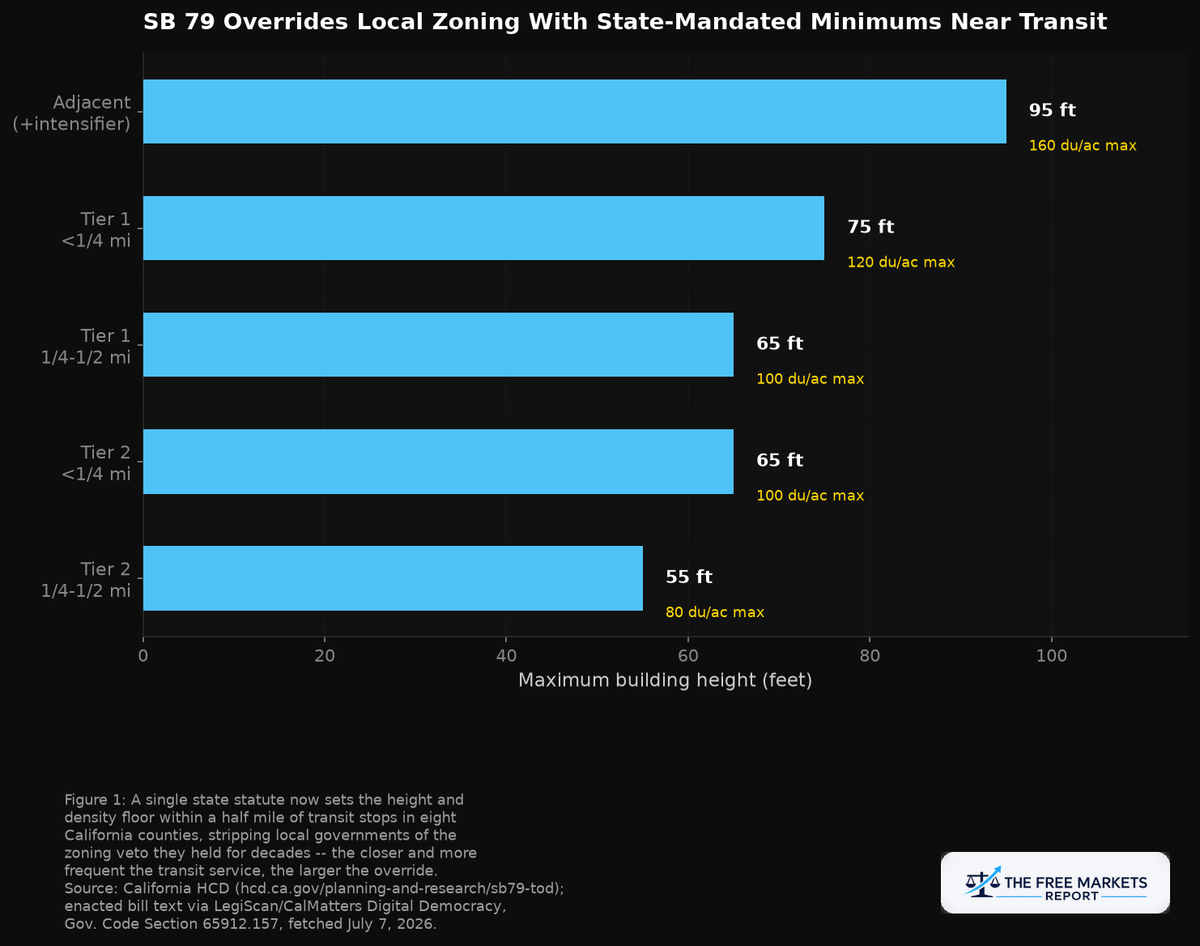
- Qualifying projects next to the busiest rail stations can now rise to 95 feet and 160 dwelling units per acre by right, a ceiling no local council vote can lower (Holland & Knight; LegiScan enacted text).
- Los Angeles used the law's own local-alternative-plan carve-out to push full upzoning near roughly 150 transit stops out to 2030, substituting a smaller four-story ordinance instead (Los Angeles Times).
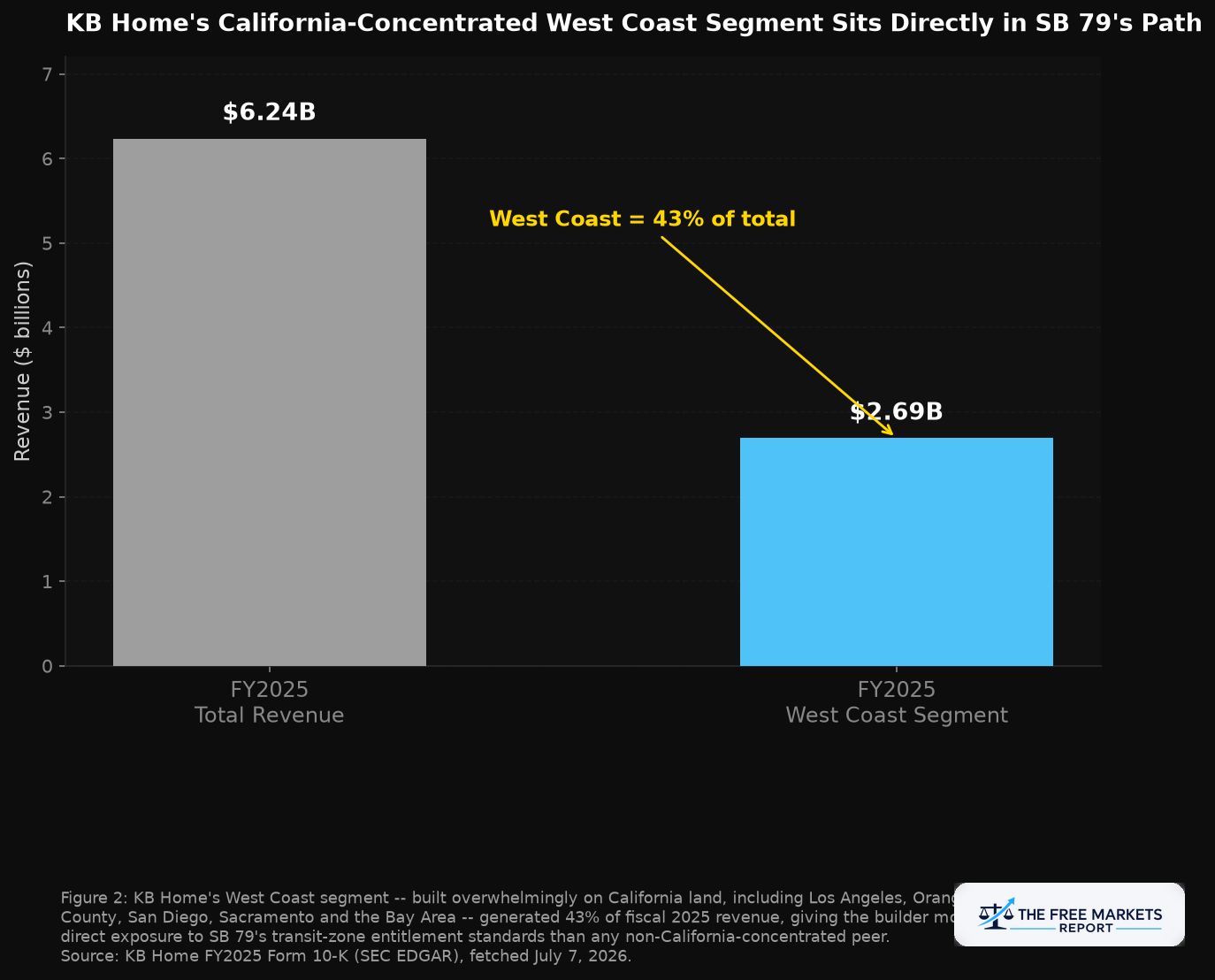
- KB Home (NYSE: KBH) drew 43% of fiscal 2025 revenue, $2.69 billion of $6.24 billion, from a West Coast segment concentrated in the counties SB 79 targets (KB Home FY2025 10-K).
- Starting January 1, 2027, cities that deny a qualifying SB 79 project in a high-resource area are presumed to have violated the Housing Accountability Act (CalMatters Digital Democracy).
Nine stories. Zero city council vote required. That is the blunt mechanical reality that went live across California on July 1, 2026, and almost nobody outside the state's land-use bar noticed it happen.
SB 79, formally the Abundant and Affordable Homes Near Transit Act, does something California zoning fights have circled for eight years and never landed: it takes the density decision away from the city council for a defined category of land and hands it to a state statute. Sacramento tried this twice before under different bill numbers and failed both times. This time it passed. Governor Gavin Newsom signed it on October 10, 2025, and its principal upzoning provisions, now codified at Government Code Sections 65912.155 through 65912.162, became binding law last week (California HCD).
The textbook story about state preemption bills is that they pass, then quietly die in implementation. SB 79 was supposed to be different. It is, mostly. But Los Angeles just spent its first week of compliance proving the textbook story still has life. That split, most cities complying, the biggest one negotiating, is the actual investable story here.
A State Law Walks Into 482 Cities
SB 79 does not touch every parcel in California. It applies only in the eight counties that already have 16 or more passenger rail stations: Los Angeles, Orange, San Diego, Santa Clara, San Mateo, San Francisco, Alameda, and Sacramento (Holland & Knight). Inside those counties, the law layers a service tier and a quarter-mile distance band around every qualifying transit stop.
Sen. Scott Wiener, a San Francisco Democrat, authored this bill. It was his third attempt at transit-adjacent density reform after 2018's SB 827 and 2020's SB 50 both died in committee (Holland & Knight). The bill cleared the Senate 21-13 and the Assembly 43-19 (Wikipedia, corroborating LegiScan/Trackbill vote record). Third time, apparently, was the charm.
The Math Behind the Upzoning
Start with the numbers, because the numbers are the entire mechanism.
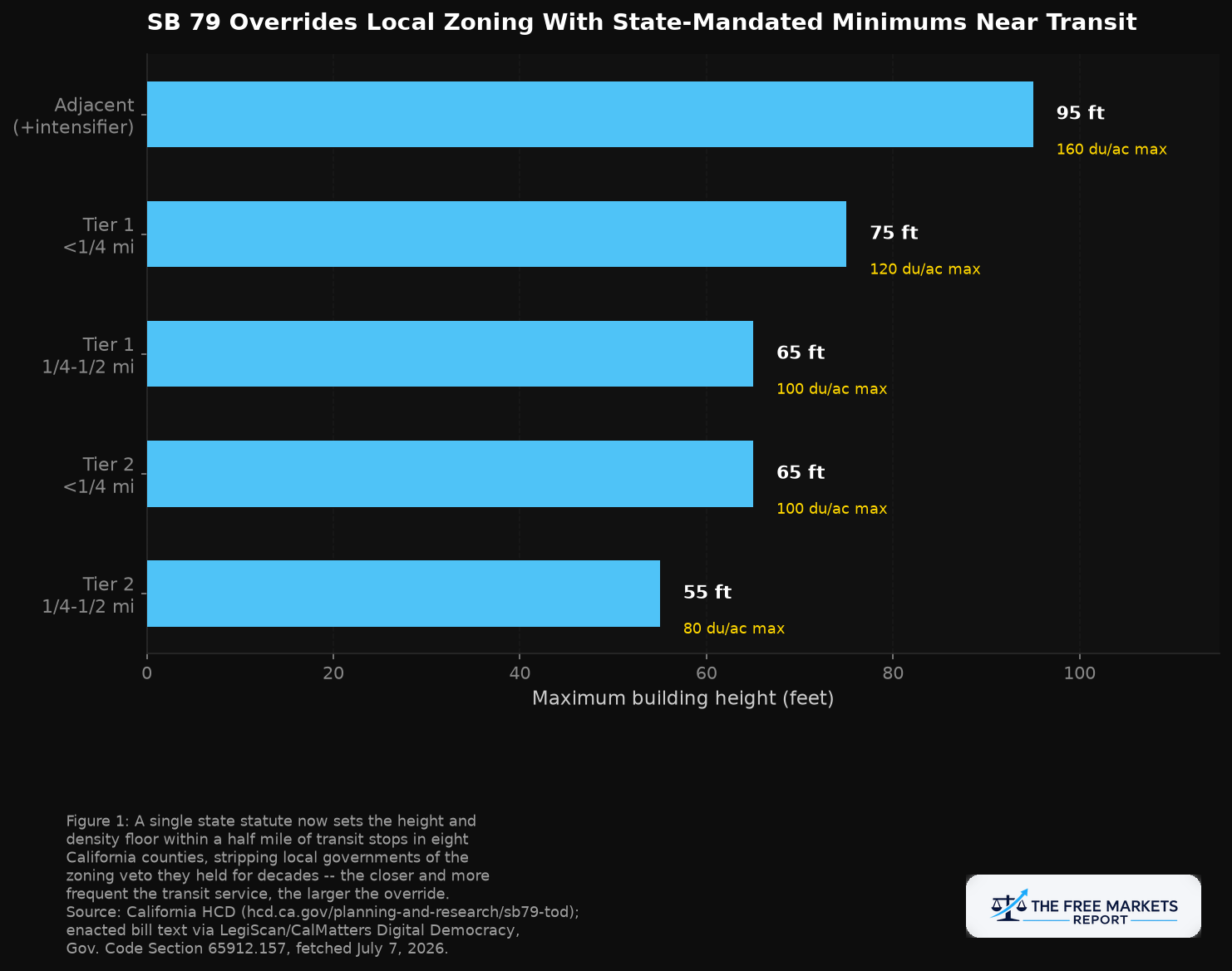
Tier 1 stops, heavy or commuter rail running 72 or more trains per day, allow up to 75 feet of height and 120 dwelling units per acre within a quarter mile, stepping down to 65 feet and 100 units per acre out to a half mile, in cities above 35,000 population (Holland & Knight). Tier 2 stops, light rail, less-frequent commuter rail, or bus rapid transit, allow 65 feet and 100 units per acre within a quarter mile, stepping down to 55 feet and 80 units per acre. Projects immediately adjacent to a stop get an intensifier on top of either tier: 20 more feet, 40 more units per acre, and one additional point of floor-area ratio (LegiScan enacted bill text). Stack the adjacency bonus onto a Tier 1 quarter-mile parcel and the ceiling reaches 95 feet and 160 units per acre. That is roughly nine stories where, in many of these same neighborhoods a year ago, the zoning code allowed one house on one lot.
The law layers more mechanics on top. Every qualifying project must hit a minimum density of 30 units per acre (or the local minimum, whichever is higher), cap average unit size at 1,750 net habitable square feet, and include at least five residential units (ABAG SB 79 Summary). Projects of 11 units or more must set aside 7% of units for extremely low income households, 10% for very low income, or 13% for lower income, whichever is greater; projects of 10 units or fewer are exempt. Anything above 85 feet triggers SB 35/423 prevailing-wage rules plus skilled-and-trained workforce requirements once a contractor collects three qualifying bids (Holland & Knight). That is the difference between a paper entitlement and a project that actually pencils.
There is also a deadline unrelated to construction. Starting January 1, 2027, a city that denies a qualifying SB 79 project in a defined high-resource area is presumed to have violated the state's Housing Accountability Act, exposing it to immediate penalties (CalMatters Digital Democracy). That gap between July 2026 and January 2027 is the window cities have to get their own implementation plans in order before the legal risk of simply saying no gets worse.
Los Angeles Wrote Its Own Escape Hatch
Consensus expected Los Angeles, the state's largest city, to resist SB 79 outright. It did, for a while. The city council passed a resolution calling the bill a "one-size-fits-all mandate," and Mayor Karen Bass personally urged Governor Newsom to veto it in September 2025 (Los Angeles Times). The numbers say something else happened once the veto request failed.
Rather than simply losing the fight, Los Angeles found the exit SB 79 itself built in: a local-alternative-plan provision letting a city substitute its own upzoning plan if it hits comparable density targets by another route. The city council approved a Low-Rise Ordinance in late June 2026 permitting four-story, 16-unit buildings on lots previously zoned single-family only, across 57 identified neighborhoods (Los Angeles Times). That is real density reform relative to the status quo. It is also a fraction of what SB 79's own standards would have required, and it buys a deferral: full SB 79 upzoning near roughly 150 of the city's transit stops does not arrive until 2030. Beverly Hills, Pasadena, and Glendale ran the identical playbook.
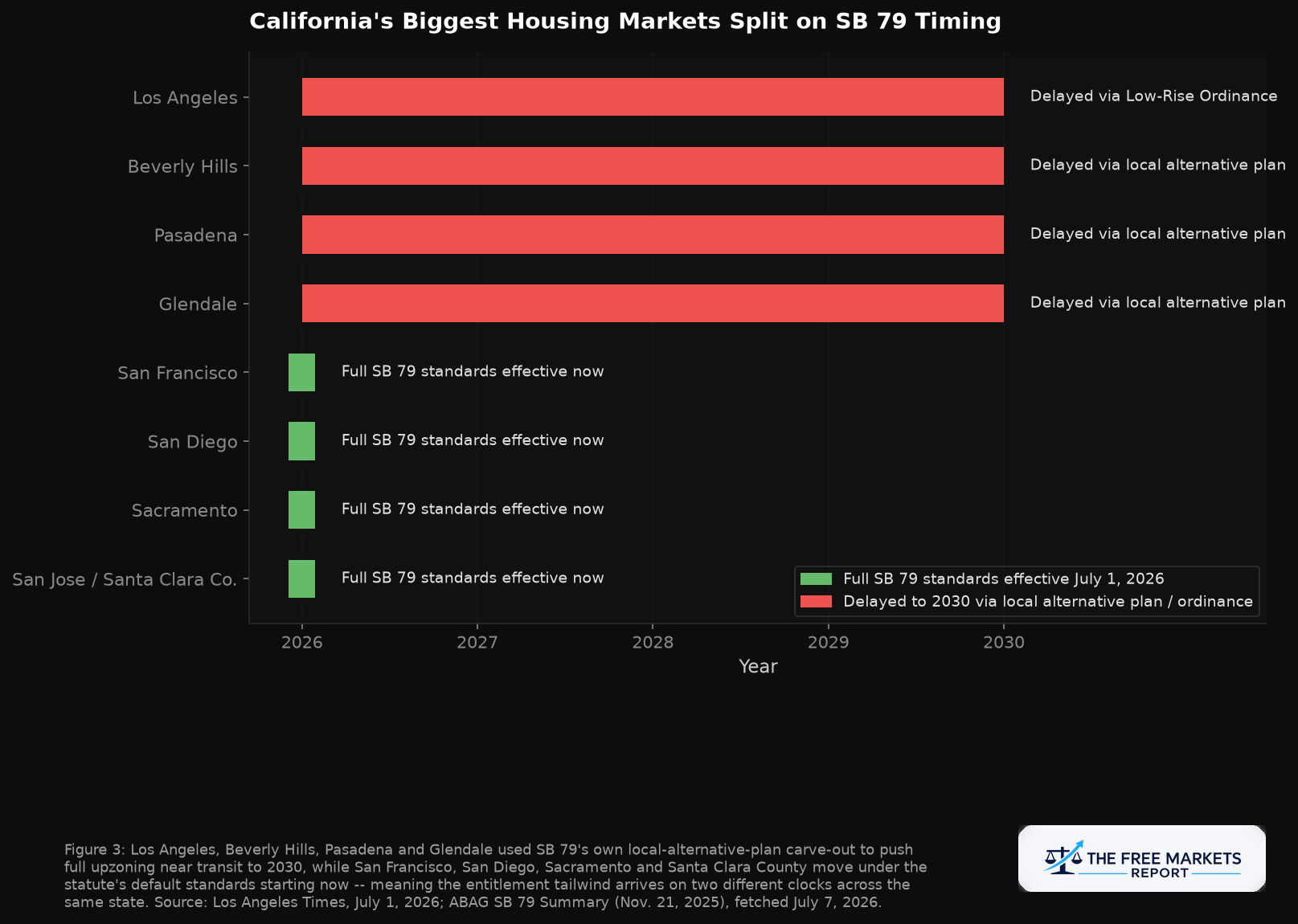
That is not defeat for SB 79's proponents; a four-story-by-right ordinance across 57 neighborhoods is a real shift for a city that defended single-family zoning for decades. But it is a smaller, slower unlock than the statute's headline numbers imply. The investment case now runs on two clocks: immediate in San Francisco, San Diego, Sacramento, and San Jose, deferred to 2030 in Los Angeles's highest-value transit-dense parcels.
The Builder With the Most Exposure to the Fine Print
Which public homebuilder actually owns land where this mechanism bites? KB Home is the cleanest answer in the public markets.
KB Home's fiscal 2025 Form 10-K reports total company revenue of $6.24 billion, of which its West Coast segment, primarily California, generated $2.69 billion, roughly 43% of the total (KB Home FY2025 10-K via StockTitan/SEC EDGAR). Homebuilding made up 99.6% of FY2025 revenue; this is a pure-play builder, not a diversified conglomerate with offsetting segments to hide behind. The West Coast segment's named markets, Los Angeles, Orange County, San Diego, Sacramento, San Francisco, and San Jose, map almost one-for-one onto the eight counties SB 79 governs.
The more recent quarter tells a demand story, not a regulatory story. KB Home's second quarter of fiscal 2026, ended May 31, 2026, showed total revenue of $1.11 billion and net income of $27.3 million, with diluted EPS of $0.43, down 27% year over year (KB Home Q2 2026 press release). The company delivered 2,395 homes at an average price of $461,900, with backlog of 4,526 homes valued at $2.14 billion. Management guided full-year fiscal 2026 housing revenue to $4.90 billion to $5.30 billion on 10,500 to 11,000 deliveries. KB Home shares closed at $59.78 on July 6, 2026, market capitalization near $3.7 billion (StockTitan).
That earnings picture is soft; affordability pressure has been compressing volume and margin sector-wide, and nothing about SB 79 changes near-term demand economics. What SB 79 changes is the supply side: the entitlement cost and timeline for any West Coast parcel inside a quarter mile of a qualifying stop. A builder holding land near transit in San Francisco, San Diego, Sacramento, or San Jose now has a state-mandated density floor working in its favor instead of a discretionary approval process working against it. That is optionality on future land value, not a near-term earnings catalyst.
The Case for Skepticism, and Why It Matters for Investors
Here is the steelman, stated as plainly as the bull case above: Los Angeles just showed the state's largest, most valuable transit-adjacent land market can substantially defer SB 79's bite, and Beverly Hills, Pasadena, and Glendale immediately copied it (Los Angeles Times). If other large, resistant cities follow before 2027, the near-term entitlement unlock across California is considerably smaller than SB 79's headline numbers suggest. A statute setting a 95-foot, 160-unit-per-acre ceiling on paper is not the same as a market where builders can pull permits at that scale on that timeline; Los Angeles just proved the gap can run five years wide in the state's highest-value submarket.
That gap is the variable to track. The falsification condition is specific: if, by the start of KB Home's fiscal 2028 in December 2027, fewer than 10% of the company's disclosed West Coast lot pipeline has been re-entitled or newly acquired citing SB 79 standards or a local TOD alternative-plan pathway, the near-term thesis is wrong, and SB 79's effect on large builders' land economics should be treated as immaterial through the decade. Watch the fiscal 2027 land-acquisition disclosures; they will tell the story before construction data does.
Investment Idea: KB Home (NYSE: KBH)
Thesis type: Individual stock, deregulatory land-entitlement optionality
Deregulatory catalyst: SB 79 preempts local zoning discretion near transit stops in eight California counties, replacing case-by-case municipal review with state-mandated minimum height, density, and floor-area-ratio standards effective July 1, 2026 (California HCD).
Current price: $59.78 per share, close of July 6, 2026; market capitalization near $3.7 billion (StockTitan).
Key financial data: FY2025 total revenue $6.24 billion, West Coast segment $2.69 billion (43% of total); Q2 FY2026 revenue $1.11 billion, net income $27.3 million, diluted EPS $0.43 (down 27% year over year); FY2026 guidance of $4.90 billion to $5.30 billion in housing revenue on 10,500 to 11,000 deliveries; approximately 62.6 million shares outstanding as of the February 28, 2026 10-Q (KB Home FY2025 10-K; KB Home Q2 2026 press release; KB Home Q1 2026 10-Q).
Regulatory constraint removed: Discretionary local zoning review and single-family-only restrictions near qualifying transit stops, replaced by a state density and height floor a city council cannot vote down for compliant projects.
Bull case: KB Home's West Coast land pipeline sits disproportionately inside the eight counties SB 79 governs. As the entitlement clock runs (immediately in San Francisco, San Diego, Sacramento, and San Jose; by 2030 in Los Angeles, Beverly Hills, Pasadena, and Glendale), a builder with existing land near qualifying stops gains a structural tailwind on effective density per acre, a historical base rate for margin expansion on infill parcels once entitlement risk drops.
Bear case: Los Angeles's Low-Rise Ordinance shows the state's largest transit-adjacent market can substantially defer SB 79's effect through the law's own carve-out, and other resistant cities may follow before the January 2027 Housing Accountability Act presumption takes hold. Near-term demand and margin trends at KB Home currently reflect affordability pressure, not regulatory tailwind, and could stay soft regardless of entitlement improvement.
What to watch: KB Home's fiscal 2027 land-acquisition disclosures for explicit SB 79 or local TOD alternative-plan references; whether more large cities pursue Los Angeles-style deferrals; the January 1, 2027 Housing Accountability Act checkpoint.
Time horizon: Multi-year, through fiscal 2028, consistent with a land-entitlement optionality thesis rather than a near-term earnings catalyst.
A state legislature spent eight years and three bills trying to take the zoning pen away from city councils near transit stops. It finally succeeded on paper July 1. Los Angeles spent its first week of compliance proving paper and permits are not the same thing, and that a determined city with the state's most valuable land can still buy itself years. Both facts are true at once. The investor who tracks only the statute's density numbers will overstate the near-term case. The investor who tracks only Los Angeles's delay will understate the medium-term one. The honest position sits in the gap between the two, and the fiscal 2027 land disclosures will close it.
Footnotes
1. California Department of Housing and Community Development, "SB 79 Transit-Oriented Development": hcd.ca.gov/planning-and-research/sb79-tod
2. Holland & Knight, "California Gov. Gavin Newsom Signs SB 79" (October 2025): hklaw.com/en/insights/publications/2025/10/california-gov-gavin-newsom-signs-sb-79
3. LegiScan, SB 79 enacted bill text: legiscan.com/CA/text/SB79/id/3259737
4. Association of Bay Area Governments, "SB 79 Summary" (November 21, 2025): abag.ca.gov SB-79-Summary-11212025.pdf
5. CalMatters Digital Democracy, SB 79 bill status and enacted text summary: calmatters.digitaldemocracy.org/bills/ca_202520260sb79
6. Los Angeles Times, "SB 79 is here. See which neighborhoods are getting upzoned" (July 1, 2026, Jack Flemming): latimes.com/california/story/2026-07-01/sb-79-is-here-see-which-neighborhoods-are-getting-upzoned
7. Wikipedia, "California Senate Bill 79," corroborating LegiScan/Trackbill vote record: en.wikipedia.org/wiki/California_Senate_Bill_79
8. KB Home, "KB Home Reports 2026 Second Quarter Results" (June 23, 2026): finance.yahoo.com/real-estate/articles/kb-home-reports-2026-second-201000476.html
9. KB Home Form 10-K, fiscal year 2025 (SEC EDGAR, via StockTitan): stocktitan.net/sec-filings/KBH/10-k-kb-home-files-annual-report-af45de5a0f87.html
10. KB Home Form 10-Q, Q1 fiscal 2026 (SEC EDGAR, via StockTitan): stocktitan.net/sec-filings/KBH/10-q-kb-home-quarterly-earnings-report-fa61e8f81af0.html
11. StockTitan, KB Home (KBH) stock news page: stocktitan.net/news/KBH
The Free Markets Report is provided by Lead-Lag Publishing, LLC. All opinions and views mentioned in this report constitute our judgments as of the date of writing and are subject to change at any time. Information within this material is not intended to be used as a primary basis for investment decisions, and should also not be construed as advice meeting the particular investment needs of any individual investor. Trading signals produced by The Free Markets Report are independent of other services provided by Lead-Lag Publishing, LLC, or its affiliates, and the positioning of accounts under their management may differ. Please remember that investing involves risk, including loss of principal, and past performance may not be indicative of future results. Lead-Lag Publishing, LLC, its members, officers, directors, and employees expressly disclaim all liability with respect to actions taken based on any or all of the information in this writing.