States vs Feds: When Federal Deregulation Preempts State Environmental Laws
Federal and state environmental rules are in a rare tug-of-war.

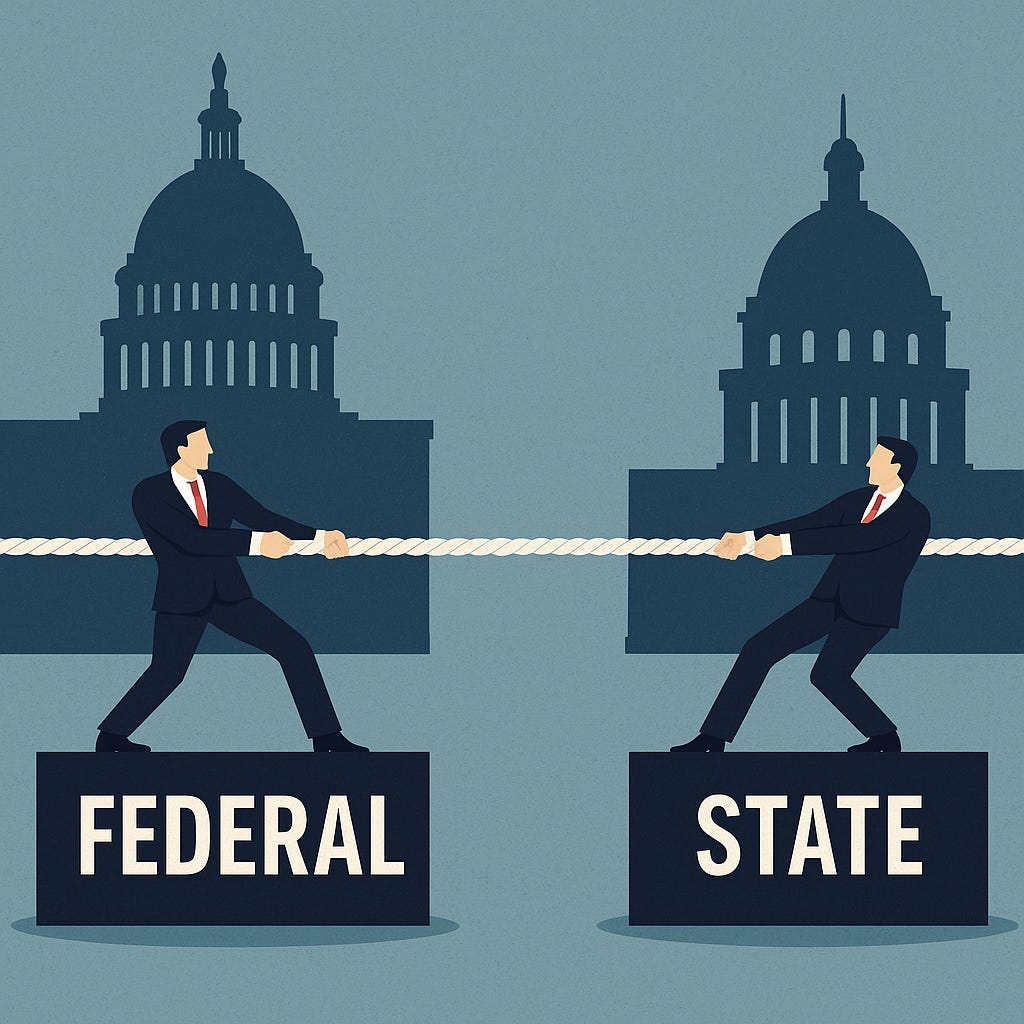
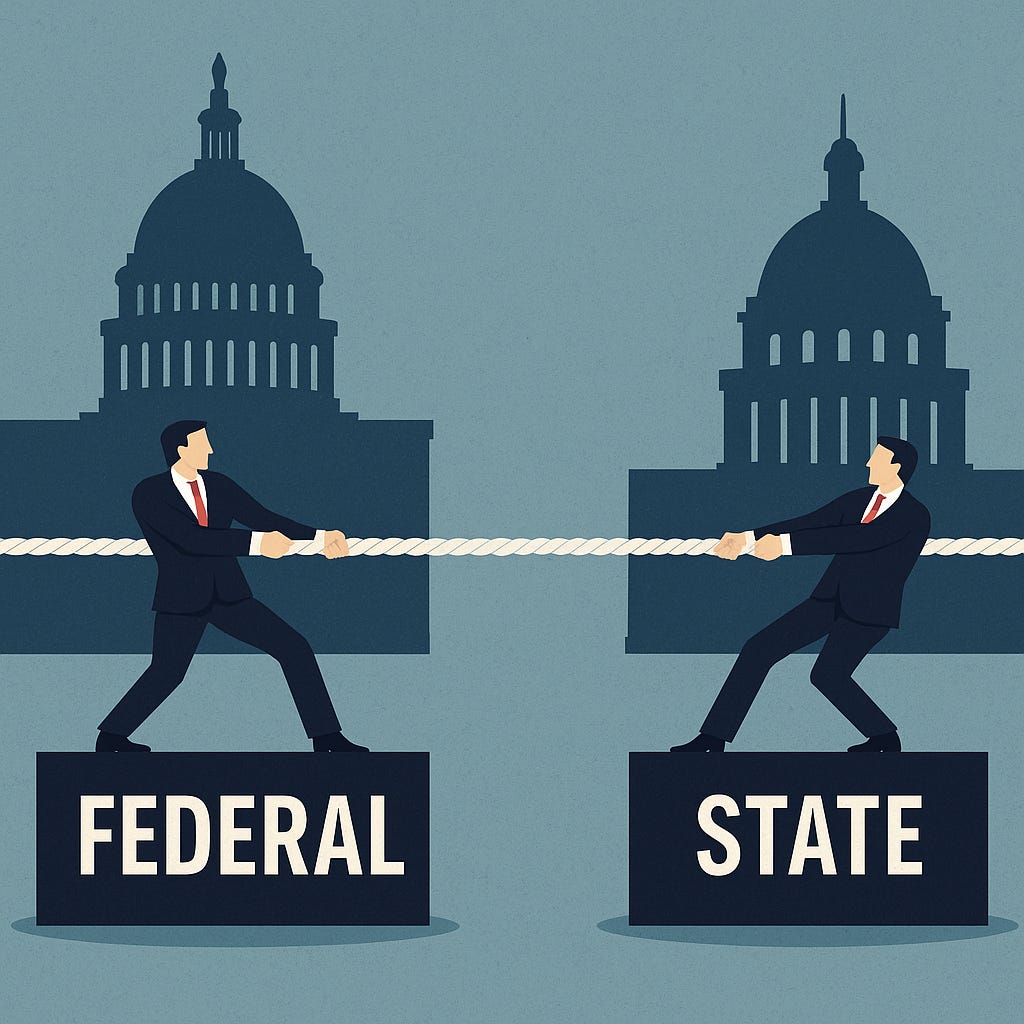
Federal and state environmental rules are in a rare tug-of-war. In 2025, the federal government launched a sweeping rollback of climate and pollution regulations—even as states like California and New York were tightening theirs. In March, EPA Administrator Lee Zeldin unveiled plans to rescind or rewrite over 30 rules affecting emissions, vehicle standards, and energy permitting¹. At the same time, a new executive order directed the Department of Justice to challenge state and local climate laws viewed as unconstitutional or preempted by federal authority².
These moves collided with long-standing state powers. Under the Clean Air Act, California had received EPA waivers to set stricter tailpipe standards, which other states adopted. That arrangement was upended when Congress used the Congressional Review Act in 2025 to eliminate EPA’s waiver authority for greenhouse gas rules³. EPA then issued a “One National Program” rule declaring that federal standards now override state-level emissions policies⁴. This effectively nullified California’s clean car and truck programs⁵.
Federal regulators also took aim at broader state policies, calling New York’s corporate climate accountability law and California’s cap-and-trade system potential overreaches⁶. Legal analysts say this opens the door for preemption lawsuits across the country, injecting more uncertainty into already complex regulatory terrain⁷.
For investors, the impact is uneven. Traditional energy and industrial sectors could benefit in the short term from looser federal rules, with lower compliance costs for fossil fuel projects, vehicles, and power plants⁸. Utilities operating in deregulated states may find permitting and expansion easier under these conditions.
On the flip side, clean energy developers, electric vehicle manufacturers, and ESG-focused portfolios face new headwinds. They now operate in a fragmented landscape: states may keep pushing green mandates, but federal support is retreating in key areas⁹. Some federal grants may even be withheld from states pursuing “incompatible” environmental laws¹⁰.
Ultimately, the regulatory landscape has shifted from a coordinated model to a contested one. What was once cooperative federalism now looks like a legal battleground. States continue to pass ambitious climate laws. The federal government questions their legitimacy. And the courts may soon decide how far state authority can go before it crosses into federally governed territory¹¹.
For investors, the takeaway is to watch both legal and political trends. Deregulation could temporarily benefit legacy energy firms. But state resistance, court rulings, and future administrations could reverse course again. Portfolios that price in that volatility—rather than betting on a single policy direction—will likely be better positioned.
Footnotes
- Environmental Protection Agency, “EPA Finalizes Deregulatory Actions,” March 2025, https://www.epa.gov/newsreleases.
- White House Executive Order on Federal Preemption of State Climate Law, April 2025, https://www.whitehouse.gov/briefing-room.
- Congressional Record, “Resolution Disapproving EPA Waiver Authority,” April 2025, https://www.congress.gov/bill.
- EPA, “One National Program Rule,” Final Rule, June 2025, https://www.federalregister.gov/documents.
- California Air Resources Board, “Impacts of EPA Waiver Withdrawal,” 2025, https://ww2.arb.ca.gov.
- Department of Justice Memo on State Climate Laws, May 2025, https://www.justice.gov.
- Covington & Burling LLP, “Federal Preemption and Climate Litigation,” June 2025, https://www.cov.com/en/news.
- S&P Global, “Impact of Environmental Rollbacks on Energy Sector,” July 2025, https://www.spglobal.com.
- Bloomberg Law, “States Push Ahead on Climate Goals Despite EPA Cutbacks,” August 2025, https://news.bloomberglaw.com.
- Legal Alert: “Federal Conditions on Climate Grants,” Perkins Coie, July 2025, https://www.perkinscoie.com.
- Natural Resources Defense Council, “The Legal Fight Over Climate Authority,” July 2025, https://www.nrdc.org.
The Free Markets Report is provided by Lead-Lag Publishing, LLC. All opinions and views mentioned in this report constitute our judgments as of the date of writing and are subject to change at any time. Information within this material is not intended to be used as a primary basis for investment decisions, and should also not be construed as advice meeting the particular investment needs of any individual investor. Trading signals produced by The Free Markets Report are independent of other services provided by Lead-Lag Publishing, LLC, or its affiliates, and the positioning of accounts under their management may differ. Please remember that investing involves risk, including loss of principal, and past performance may not be indicative of future results. Lead-Lag Publishing, LLC, its members, officers, directors, and employees expressly disclaim all liability with respect to actions taken based on any or all of the information in this writing.