NHTSA Just Cut the Mileage Mandate by a Third. The Enforcement Died Last Year.
The 2031 fleet target falls from 50.4 to 34.9 mpg. But the penalty died in July 2025, and new-credit trading phases out from MY 2028.


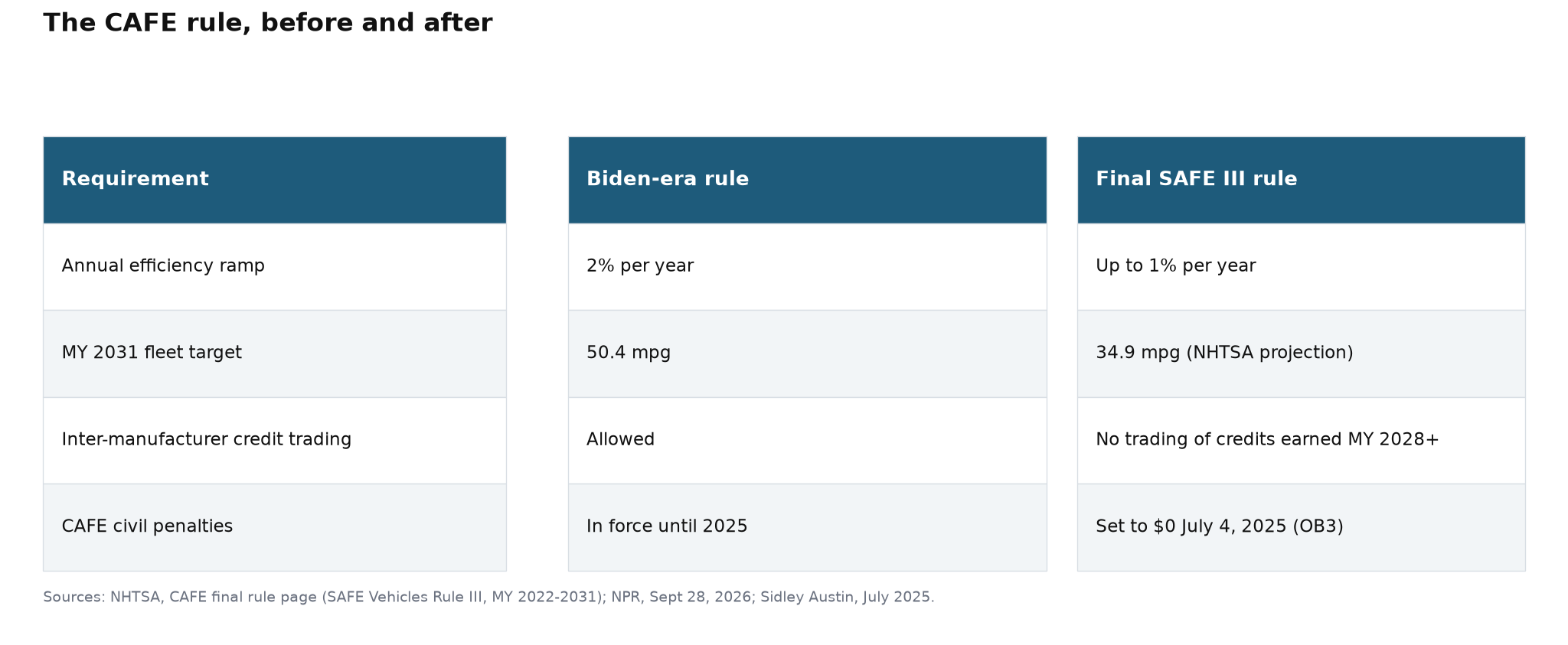
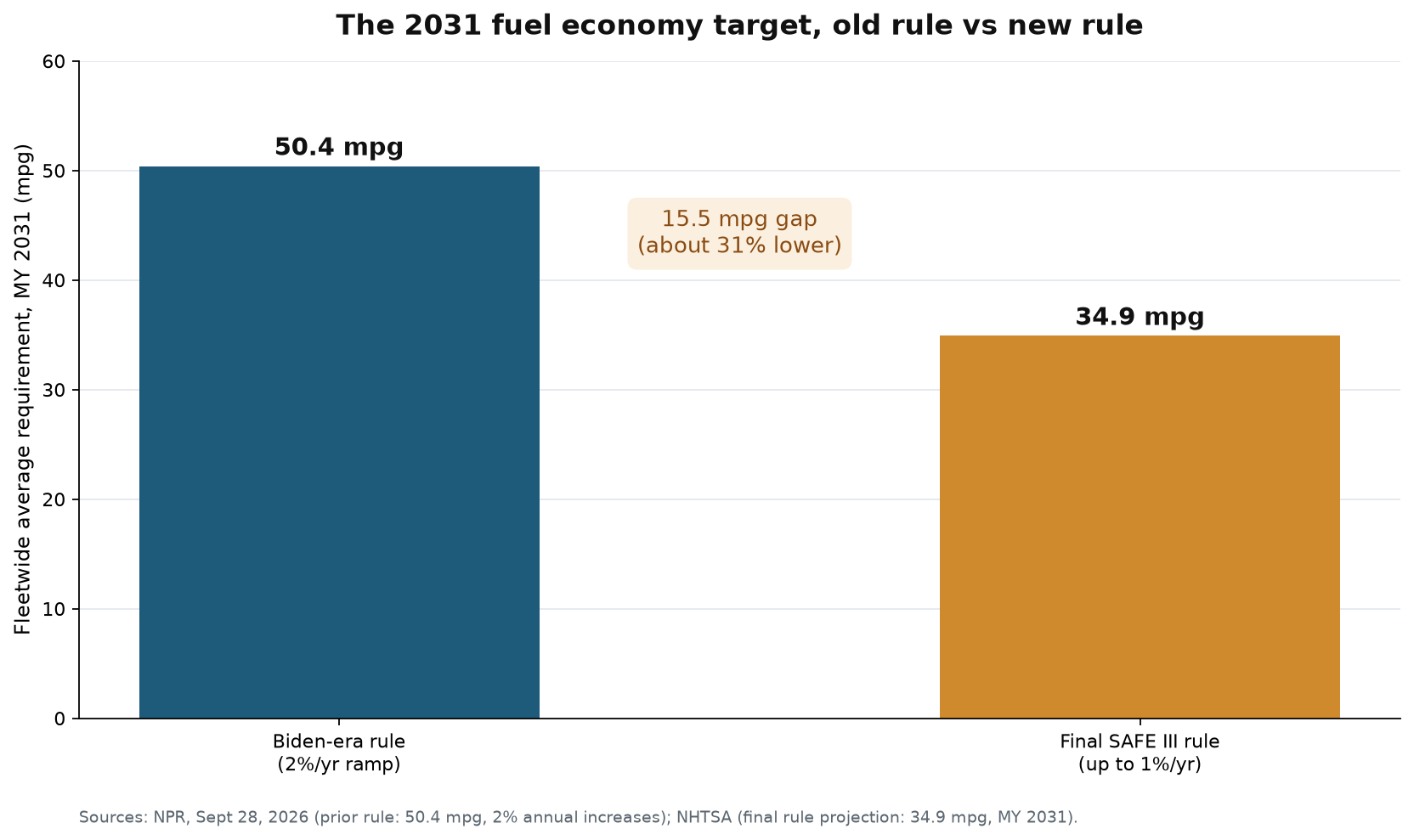
The fuel economy mandate that shaped two decades of American vehicle design just lost roughly a third of its force. On Monday, the Department of Transportation finalized new Corporate Average Fuel Economy standards that require carmakers to improve fleet fuel economy by up to 1% per year, down from the 2% annual increases demanded by the prior rule. The projected industry fleetwide average for model year 2031 falls from the roughly 50.4 mpg the Biden-era framework was built around to a NHTSA-projected 34.9 mpg. That is a 15.5-mile-per-gallon gap in the headline number. But the number is not where the real deregulation happened.
What the rule does
The final rule, signed September 25, 2026 and announced Monday, covers the Safer Affordable Fuel-Efficient Vehicles Rule III for model years 2022 through 2031 passenger cars and light trucks. NHTSA describes it as a reset of the maximum feasible fuel economy standards under the Energy Policy and Conservation Act of 1975 and the Energy Independence and Security Act of 2007, issued in line with the Unleashing American Energy executive order and the Secretary's Fixing the CAFE Program memorandum.
Three structural changes ride along with the headline stringency cut. First, the annual efficiency ramp drops from 2% to as little as 1% per year. Second, NHTSA is ending trading of credits earned in model year 2028 and later, winding down the system under which automakers bought compliance credits from EV-heavy manufacturers to offset less efficient vehicles. Credits earned through model year 2027 remain tradable and usable for five model years. Third, the agency is reworking the light-duty fleet classification system starting in model year 2030, allocating vehicles between passenger and non-passenger fleets based on attributes and capabilities rather than the old category lines.
The quiet part is the plumbing
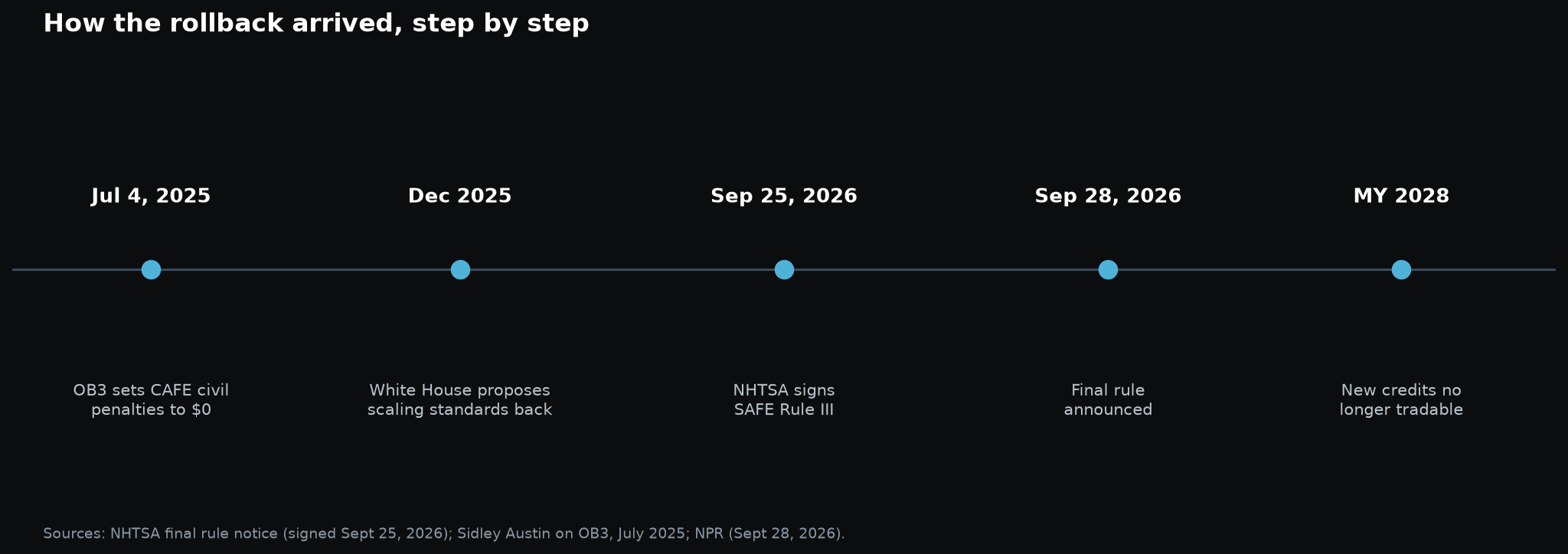
The striking thing about this rollback is how much of it had already happened before Monday. The one credible enforcement mechanism in the old system, the CAFE civil penalty, was set to zero on July 4, 2025, when Section 40006 of the One Big Beautiful Bill Act, Pub. L. No. 119-21, eliminated the penalties outright. The White House had proposed scaling the standards back in December 2025, and NHTSA ran its comment period from there. By the time the final rule arrived, the agency was formalizing a program whose penalty structure had been dead for more than a year.
That context matters for reading the stringency numbers. A mandate without a penalty is a set of targets, not a constraint. Monday's rule cuts the targets, but Congress had already removed much of the bite. The genuinely new structural decision is the credit trading elimination. Under the prior framework, a manufacturer with a truck-heavy lineup could buy credits from one with an EV-heavy lineup, which effectively created a small compliance market inside the CAFE program. The market winds down rather than shuts off: credits earned through model year 2027 remain tradable and usable for five model years, so 2027-vintage credits can still offset compliance through model year 2032, while nothing generated after that can be traded. Combined with a lower target, the marginal cost of selling a low-mileage vehicle still falls twice: once through the number, once through the plumbing.
The market math
Administration officials estimate the scaled-back standards will reduce new-car sticker prices by about $1,300, and Transportation Secretary Sean Duffy framed the change as delivering relief to families and reviving American manufacturing. NHTSA's own rule text argues the prior system pushed manufacturers to, in its words, fit square vehicle pegs in round classification holes to force technology adoption that does not meet the demands of American families, and that this added inefficiency and cost in an already unaffordable new-car market.
Critics read the same math in reverse. Dan Becker of the Center for Biological Diversity's Safe Climate Transport Campaign told NPR the rollback will increase gasoline usage and pollution, costing consumers at the pump and at the doctor's office. The administration's $1,300 sticker estimate is a savings at purchase; the critics' case is that it transfers cost to the fuel line over the vehicle's life. Both claims rest on consumer behavior assumptions that the market will test over the next several model years.
What to watch
Three follow-through points will determine whether this is the whole story or the first chapter. First, the rule has been submitted for Federal Register publication, which starts the clock on legal challenges, and environmental groups have previewed exactly that. Second, the classification overhaul in model year 2030 is the piece with the widest blast radius: which vehicles count as passenger versus non-passenger determines which averages they pull down, and NHTSA's square-pegs language suggests the agency believes the old lines were being gamed. Third, watch what automakers actually do with the freed-up capital. The CAFE pressure to build EVs for compliance is gone, but consumer demand, battery costs, and state-level rules are separate forces, and manufacturers have already sunk capital into electrification plans.
The pattern here is the one that keeps repeating across this deregulation cycle. The headline number moves, and it is real: a 15.5 mpg reduction in the 2031 requirement is a large change in what the fleet is required to become. But the deeper shift is structural. A penalty removed by statute, a compliance market closed by rule, a classification system rewritten. Those are the parts that determine how the mandate actually binds, and by Monday evening, all three had moved.
Know someone tracking market structure like this? Forward this one along.
The Free Markets Report is provided by Lead-Lag Publishing, LLC. All opinions and views mentioned in this report constitute our judgments as of the date of writing and are subject to change at any time. Information within this material is not intended to be used as a primary basis for investment decisions and should also not be construed as advice meeting the particular needs of any individual situation. The accuracy, completeness, and timeliness of the information contained in this document is not guaranteed. The securities and strategies discussed may be unsuitable for investors depending on their specific financial position and investment objectives. Reproduction of this report without the express written consent of Lead-Lag Publishing, LLC is strictly prohibited. Past performance is not indicative of future results, and current performance may be lower or higher than the performance shown. Neither the information nor any opinion expressed in this report constitutes a solicitation, an offer to buy or sell any securities, or an offer to provide investment advice or services. Nothing in this report shall be construed to be an offer to provide investment advisory services in any jurisdiction in which Lead-Lag Publishing, LLC is not authorized to provide such services. All investments involve risk, including the risk of loss of principal. No representation is being made that any security, account, or strategy covered by or is likely to achieve results similar to those shown. Investing in securities involves risks, and there is always the potential of losing money when you invest in securities. Before investing, consider your investment objectives, and Lead-Lag Publishing, LLC's charges and expenses. This report is not a prospectus and does not contain all of the information necessary to fully evaluate any security or strategy discussed, including, but not limited to, the risk of adverse effects of related market developments. You should not rely solely on the information contained in this report, and should seek advice based on your situation from a licensed investment professional. Carefully consider the investment objectives, risks, charges and expenses of any investment product before investing. This report may not be copied or distributed without the express written consent of Lead-Lag Publishing, LLC. Any decisions made based on any or all of the information in this writing are the sole responsibility of the user, and the user should exercise caution and take appropriate advice before acting.