Canada's New Drug Reliance Order Echoes a 2019 Oncology Experiment
Health Canada's new order to rely on FDA and EMA drug decisions has a real precedent: Project Orbis, whose peer-reviewed results now offer a preview of what to expect.

Key Highlights
- Health Canada's Order SOR/2026-162 (registered July 7, 2026; effective July 15, 2026) lets the department rely on decisions or documents from the U.S. FDA and the EMA for certain drug submissions, through three pathways: General Deeming, 120-day Filing, and Joint Reviews.1
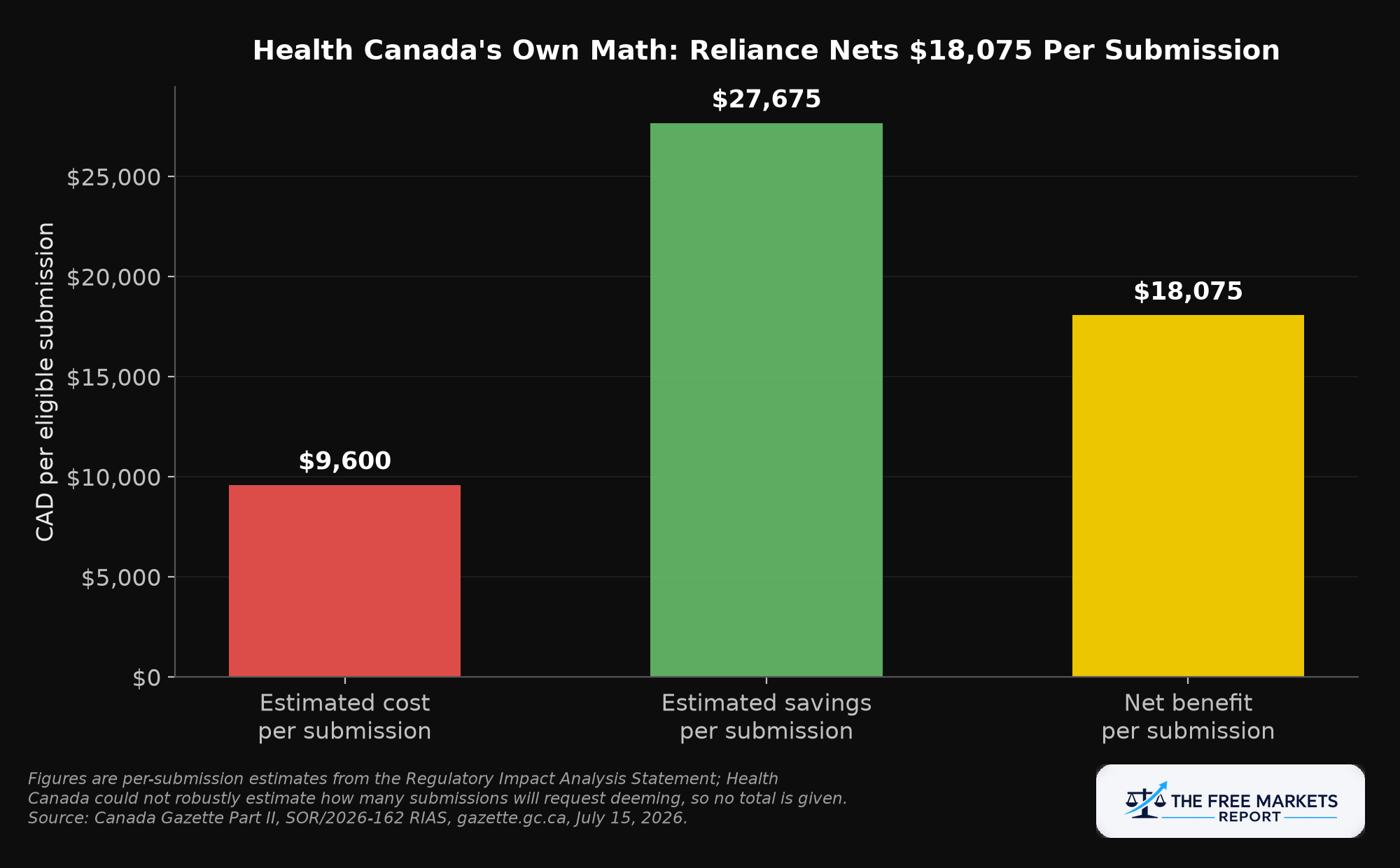
- The Regulatory Impact Analysis Statement estimates a net benefit of $18,075 per submission that uses these pathways, against an estimated cost of $9,600 per submission, for net savings of $27,675 per qualifying submission.1
- A 2024 peer-reviewed study of the FDA's Project Orbis, a 2019 oncology collaborative-review framework built on the same reliance logic, found Swissmedic's median submission gap fell from 168 days to 33 days and median review time fell from 314 days to 235.5 days for Orbis-track filings versus non-Orbis filings (p<0.0001 and p=0.0002).2
- Health Canada projects review timelines up to 40% shorter by the end of 2028 as reliance pathways scale, building on a base where the department already met its service standard more than 95% of the time over the past five years for Division 8 drugs.1
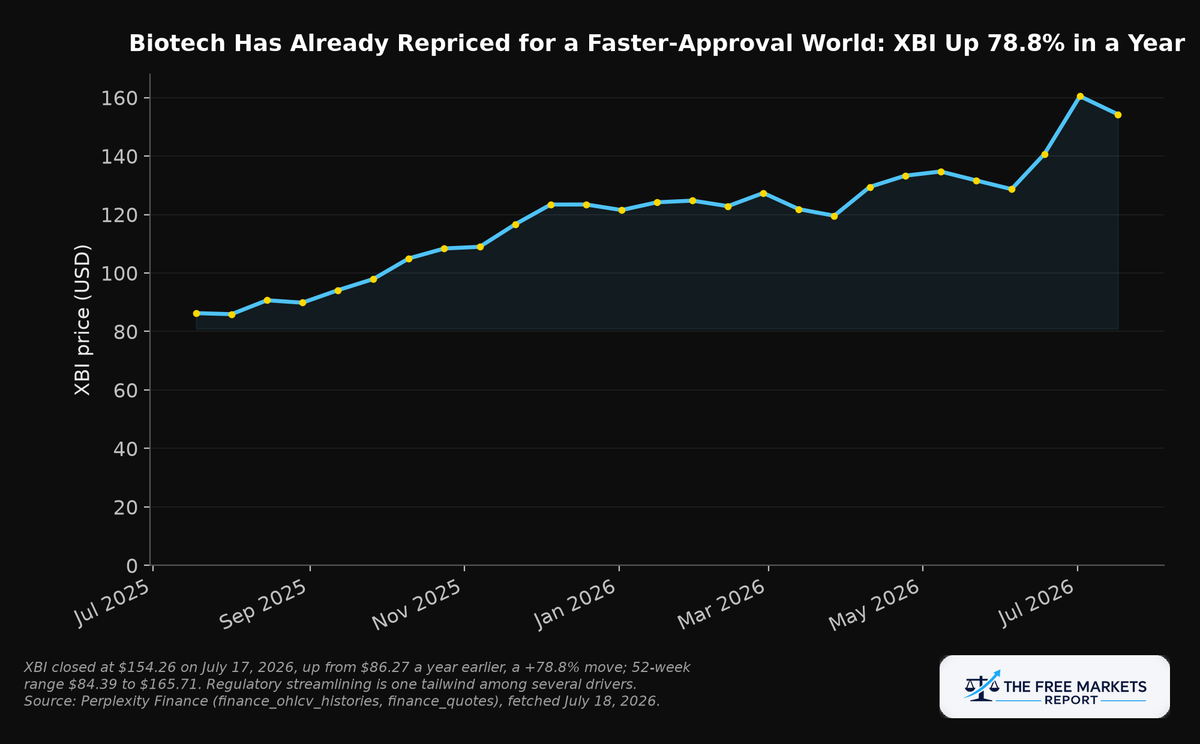
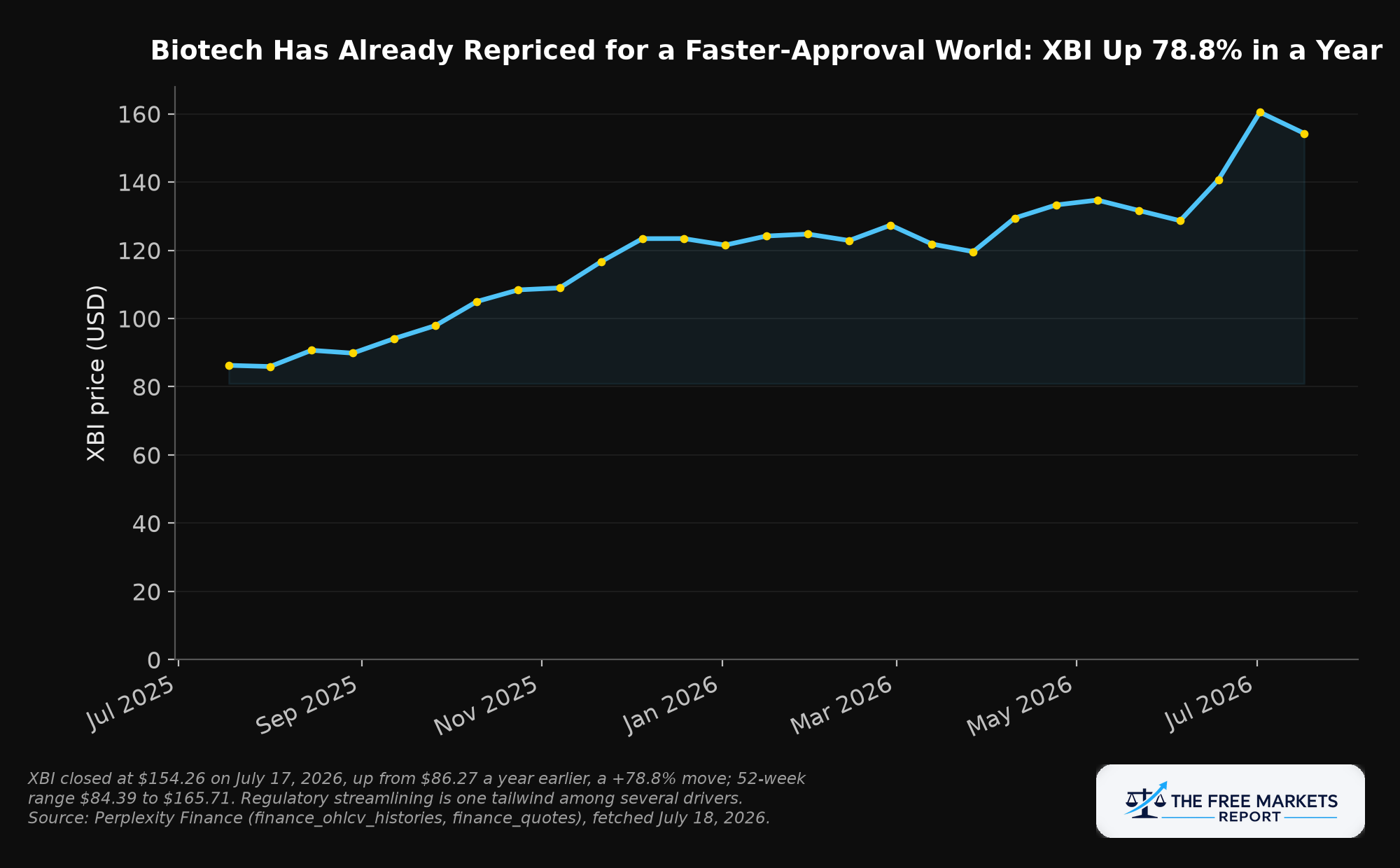
- The SPDR S&P Biotech ETF (XBI) closed at $154.26 on July 17, 2026, up 78.8% over the trailing year, offering diversified exposure to the class of company most sensitive to review-timeline compression.3
The bet that international regulatory reliance meaningfully compresses drug review timelines isn't new. It has already run once, in oncology, since 2019, and the results are measurable. On July 15, 2026, Canada Gazette Part II published SOR/2026-162, an order permitting Health Canada to rely on decisions or documents produced by foreign regulatory authorities, namely the FDA and the European Medicines Agency, when reviewing certain drug submissions.1 The order was registered eight days earlier, on July 7, 2026, by Minister of Health Marjorie Michel under section 30.06 of the Food and Drugs Act.1 It is a narrow administrative order. But narrow orders that let one regulator lean on another's work are exactly the mechanism Project Orbis tested at scale starting in May 2019, and that prior experiment left behind a data trail worth reading before drawing conclusions about the new one.
The Historical Episode: Project Orbis
Project Orbis launched in May 2019 out of the FDA's Oncology Center of Excellence.2 The idea mirrors what Health Canada just adopted: instead of each regulator independently re-reviewing the same oncology application, participating authorities review concurrently, leaning on each other's conclusions where appropriate. What began as a three-way arrangement between the FDA, Australia's Therapeutic Goods Administration, and Health Canada grew to roughly ten participating authorities.2
A 2024 peer-reviewed analysis published via PubMed tested the mechanism, comparing 31 Orbis-track marketing authorization applications against 41 non-Orbis applications reviewed by Switzerland's Swissmedic.2 The submission gap, the time between a drug's first global filing and its Swissmedic filing, fell from a median of 168 days for non-Orbis applications to 33 days for Orbis applications, a statistically significant difference (p<0.0001). Median review time fell from 314 days to 235.5 days (p=0.0002).2 Consensus decision rates were comparable across both groups: 81% for Orbis filings versus 76% for non-Orbis filings.2
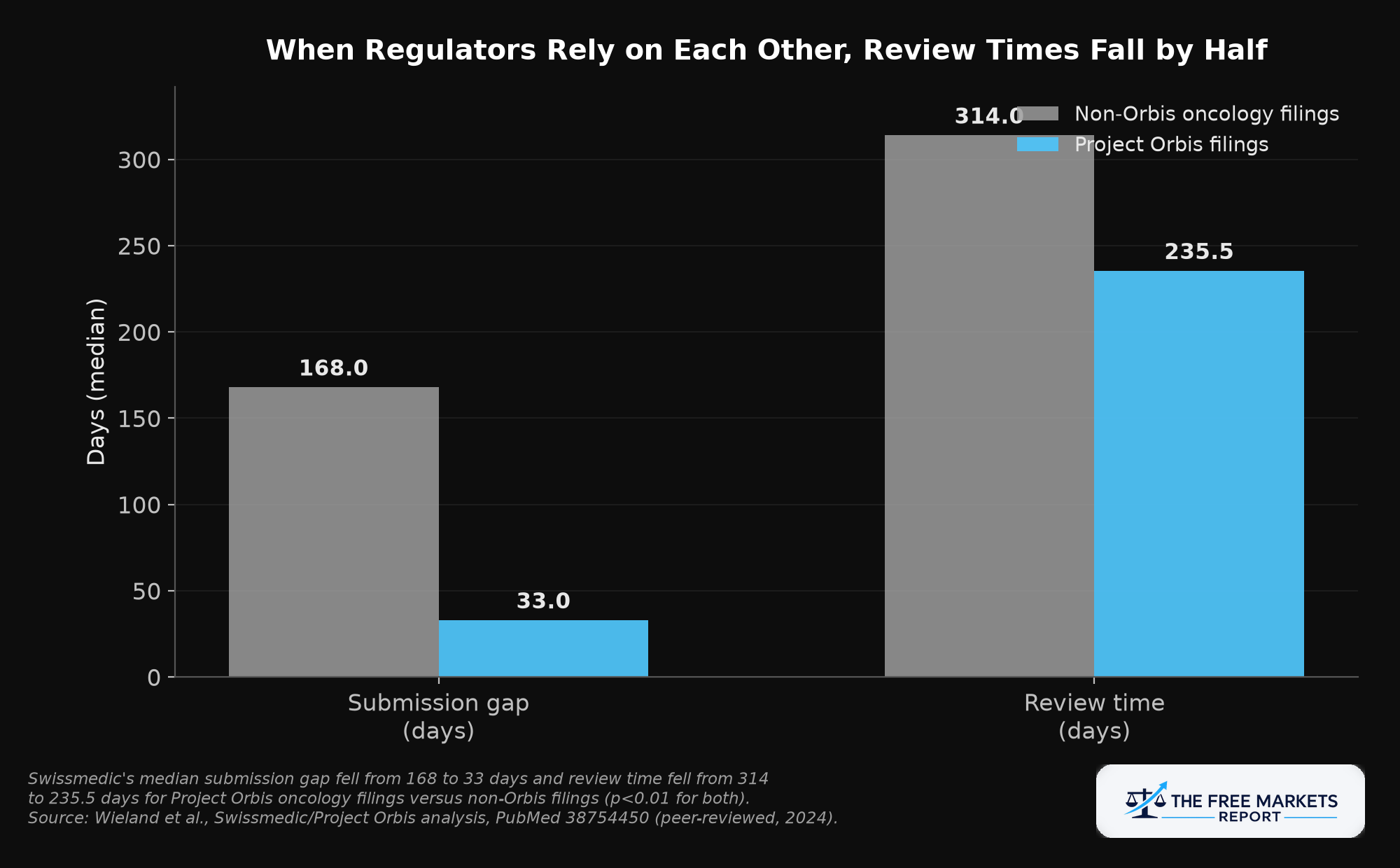
Figure 1 makes the mechanism visible. Reliance-based frameworks did not just marginally speed up review. They cut the submission gap by roughly 80% and review time by roughly 25% in this dataset, the specific, quantified precedent SOR/2026-162 now attempts to replicate outside oncology.
A limits-of-comparison caveat matters. Project Orbis is a voluntary, concurrent, multi-authority review network built for oncology drugs. SOR/2026-162 is a unilateral Canadian order letting Health Canada draw on a completed FDA or EMA decision across a broader drug category, not a coordinated concurrent review limited to cancer.1 Both rest on the same premise, that duplicated review work shrinks when one regulator's conclusions inform another's, but they are not the same program, and Orbis's oncology-specific gains should not be read as a precise forecast here.
The Current Parallel: SOR/2026-162
Health Canada's order establishes three reliance pathways.1 General Deeming lets the department deem certain foreign decisions as satisfying Canadian requirements outright. The 120-day Filing pathway compresses the review clock for submissions including a qualifying foreign decision. Joint Reviews let Health Canada reviewers work alongside FDA or EMA counterparts on a shared submission instead of duplicating the review.
The RIAS attaches real numbers to this, unusual for a Canadian regulatory order and worth taking seriously. The department estimates a net benefit of $18,075 per submission using a reliance pathway against an estimated cost of $9,600, for net savings of $27,675 per qualifying submission.1 Costs are itemized: responding to an information request runs an estimated $18,450; demonstrating basic pathway eligibility costs $1,150 per filing; documenting differences between Canadian and foreign submissions costs $8,450 (range $5,000 to $12,500); and filing a foreign safety or post-market report costs an estimated $2,085.1
Health Canada already meets its service standard more than 95% of the time over the past five years for Division 8 drugs, and its 2024 median review time for priority submissions was 223 days, ranking first internationally by the department's own account.1 Canada is not catching up; it is already fast, getting faster where duplicated foreign review adds cost without adding safety value. Health Canada projects review timelines up to 40% shorter by the end of 2028 as reliance pathways take hold.1 A separate authority, the Agile Licensing framework for Risk Management Plans, comes into force April 1, 2027, but is not subject to this Order's deeming provisions and should not be conflated with SOR/2026-162's scope or date.1
Two dates attach here and mean different things. SOR/2026-162 was registered July 7, 2026. It came into force July 15, 2026, the date it was published in Canada Gazette Part II, per the coming-into-force clause.1 The RIAS also documents an 84-day consultation running December 20, 2025 to March 14, 2026, during which the department heard from 120 stakeholders.1
The Forward Signal
The Orbis data suggests the mechanism works on a real bottleneck, but the payoff is not universal, and this order is one piece of a longer harmonization push, not a single catalytic event. A companion ISPOR 2026 poster on the same dataset found regulatory acceleration did not fully translate into faster real-world patient access, because health technology assessment and provincial funding timelines run on their own clock, independent of how fast the approval moves.4 SOR/2026-162 can compress the review clock. It cannot, by itself, compress the reimbursement clock that determines when a company's Canadian revenue line actually sees the benefit.
For investors, the durable signal is structural, not event-driven: Canada joining the Orbis pattern adds one data point to a trend of regulators converging on reliance rather than independent review. The IbR List, the register of foreign decisions Health Canada will rely on, was not yet populated as of the effective date. That is why this piece frames the story at the sector level, not a single-company angle the source does not support.
Investment Idea: The Sector Read
SECTOR PLAY: SPDR S&P Biotech ETF (XBI)
Underlying exposure: XBI tracks the S&P Biotechnology Select Industry Index, equal-weighted toward small- and mid-cap biotechs, the segment most sensitive to review-timeline compression given thinner cash runways and concentrated pipelines.3
AUM: $10,209.94 million. Expense ratio: 0.35% gross. Both per SSGA's official fund page.3
Deregulatory catalyst: The multi-year reliance trend SOR/2026-162 extends, following the template Project Orbis set in oncology starting 2019.1 2
Performance since catalyst: XBI closed at $154.26 on July 17, 2026, up 78.8% over the trailing year, against a 52-week range of $84.39 to $165.71.3 This reflects broader biotech sentiment well beyond any single order and should not be read as a market reaction to SOR/2026-162, too recent and narrow to be a standalone price driver.
Why the ETF rather than individual stocks: No company has a documented submission filed under SOR/2026-162's pathways; the IbR List was not yet populated as of the effective date. Single-stock selection under an unpopulated framework would be speculation dressed as analysis. A diversified vehicle captures the thesis without a premature bet on which company benefits first.
Key holdings: Apogee Therapeutics, Kymera Therapeutics, Erasca, Moderna, and Twist Bioscience are among the fund's larger weights.3 None has a disclosed connection to SOR/2026-162.
Bull case: If pathways scale as the RIAS projects, up to 40% shorter timelines by 2028, smaller biotechs with drugs already cleared by the FDA or EMA gain a faster, lower-cost route to a third major market, improving the value of every approved-elsewhere asset across XBI's holdings.
Bear case: Orbis's own data shows timeline compression does not reliably translate into faster commercial access, because reimbursement and provincial funding timelines run on an independent clock this Order does not touch.4 The IbR List remains unpopulated, meaning the order lacks a documented use case yet, and adoption could fall short of the 2028 projection if implementation lags the statute.
What to watch: The first IbR List entries naming specific foreign frameworks, and the first approval attributed to General Deeming, 120-day Filing, or Joint Review. If no submissions process within 18 months of the effective date, or review-time reduction lands materially below target, this thesis is falsified.
Time horizon: 18 to 36 months, tied to IbR List population and the first tranche of approvals.
The Principle
Regulatory reliance is not a novel idea. It is a tested one. Project Orbis proved, with peer-reviewed data, that when one regulator leans on another's completed work, submission gaps and review times fall by a wide, significant margin. SOR/2026-162 extends that logic to a broader class of Canadian submissions, with real dollar figures attached. The mechanism has a track record. The commercial payoff for any company still depends on a funding clock that no reliance order, alone, can turn faster.
Footnotes
- Canada Gazette, Part II, Volume 160, Number 14, "Order Providing for Reliance on Decisions of, or Documents Produced by, Foreign Regulatory Authorities in Respect of Certain Drugs: SOR/2026-162," registered July 7, 2026, published July 15, 2026. https://gazette.gc.ca/rp-pr/p2/2026/2026-07-15/html/sor-dors162-eng.html
- Wieland et al., "Project Orbis: Impact on Swissmedic Review Timelines for Oncology Drugs," peer-reviewed analysis, PubMed ID 38754450, published June 17, 2024. https://pubmed.ncbi.nlm.nih.gov/38754450/
- State Street Global Advisors, "SPDR S&P Biotech ETF (XBI)" official fund page, data as of July 16, 2026 (AUM, expense ratio, holdings); Perplexity Finance quote and price history data, July 17-18, 2026 (price, 52-week range, 1-year return). https://www.ssga.com/us/en/intermediary/etfs/state-street-spdr-sp-biotech-etf-xbi
- ISPOR 2026, "Project Orbis: Does Regulatory Acceleration Translate to Faster Global Patient Access," poster session, 2026. https://www.ispor.org/heor-resources/presentations-database/presentation-cti/ispor-2026/poster-session-5-3/project-orbis-does-regulatory-acceleration-translate-to-faster-global-patient-access
The Free Markets Report is provided by Lead-Lag Publishing, LLC. All opinions and views mentioned in this report constitute our judgments as of the date of writing and are subject to change at any time. Information within this material is not intended to be used as a primary basis for investment decisions, and should also not be construed as advice meeting the particular investment needs of any individual investor. Trading signals produced by The Free Markets Report are independent of other services provided by Lead-Lag Publishing, LLC, or its affiliates, and the positioning of accounts under their management may differ. Please remember that investing involves risk, including loss of principal, and past performance may not be indicative of future results. Lead-Lag Publishing, LLC, its members, officers, directors, and employees expressly disclaim all liability with respect to actions taken based on any or all of the information in this writing.