Canada's Mad Cow Rules Are 25 Years Old. Ottawa Just Started Unwinding Them.
A CFIA proposal to loosen Canada's feed ban turns rendering waste into revenue, and Darling Ingredients already owns the facilities that stand to benefit.

Key Highlights
- Canada's Food Inspection Agency published a proposal on July 11, 2026 to harmonize the country's Enhanced Feed Ban, repealing two provisions outright. (Canada Gazette Part I, Vol. 160, No. 28)
- CFIA's own math puts the net benefit to industry and government at $97.6 million over ten years, or $13.9 million a year, versus roughly $4.4 million in new cost. (Canada Gazette Regulatory Impact Analysis Statement)
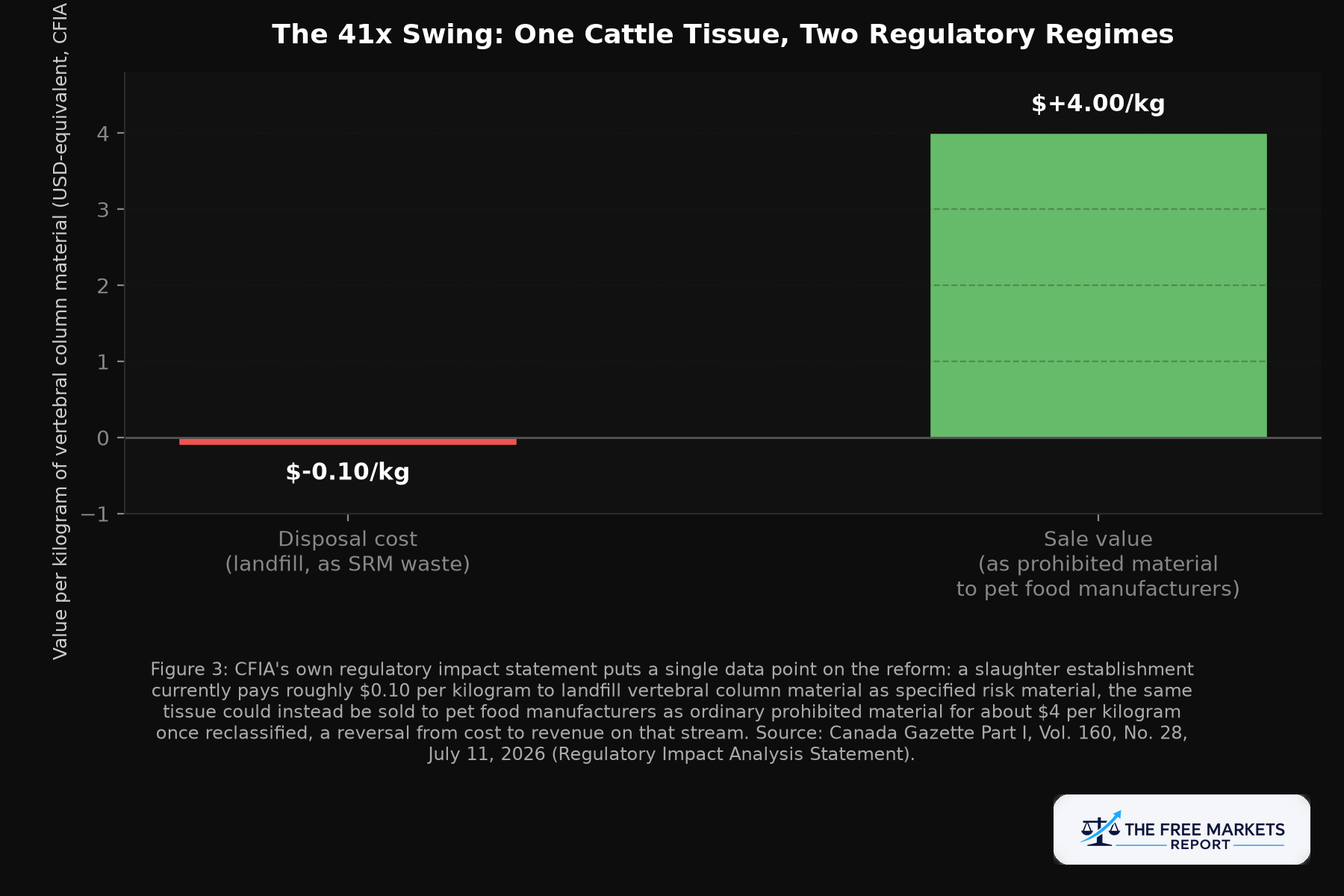
- Material now costing about $0.10 a kilogram to landfill as specified risk material could sell for roughly $4.00 a kilogram once reclassified. (Canada Gazette Regulatory Impact Analysis Statement)
- Darling Ingredients (NYSE: DAR) runs Canada's largest rendering network, six facilities across Manitoba, Ontario, Quebec, and Nova Scotia. (Darling Ingredients Canada)
- The rule is still a proposal, carrying a 60-day comment window from July 11, 2026. (Canada Gazette Part I, Vol. 160, No. 28)
Canada has not had a confirmed case of classical mad cow disease since 2015, in an animal born in 2009, and has held the World Organisation for Animal Health's "negligible risk" status since May 2021. Only two classical BSE cases have surfaced worldwide since 2017, both in the United Kingdom. Yet Canadian slaughterhouses still operate under feed-ban rules written for a disease environment that, by the government's own numbers, stopped existing here over a decade ago. (Canada Gazette Part I, Vol. 160, No. 28)
On July 11, 2026, CFIA published a proposal to close that gap, aligning Canada's specified risk material (SRM) rules with the United States, which already permits use of tissues Canada restricts. CFIA estimates a net benefit to industry and government of $97.6 million over ten years, $13.9 million annualized, against roughly $4.4 million in new cost. (Canada Gazette Regulatory Impact Analysis Statement)
What actually changes
Two provisions are repealed outright: the separate-storage requirement for SRM, and an obsolete BSE-free-country exemption. In their place, CFIA defines a new "eligible SRM" category, skull, eyes, certain nerve tissue, tonsils, and distal ileum, that processors can separate under a new voluntary permit and repurpose. High-risk material, brain and spinal cord from older cattle, stays banned from every use. That distinction is the whole trade: tissue CFIA's own science now treats as manageable risk, that slaughterhouses currently pay to destroy. (Canada Gazette Part I, Vol. 160, No. 28)
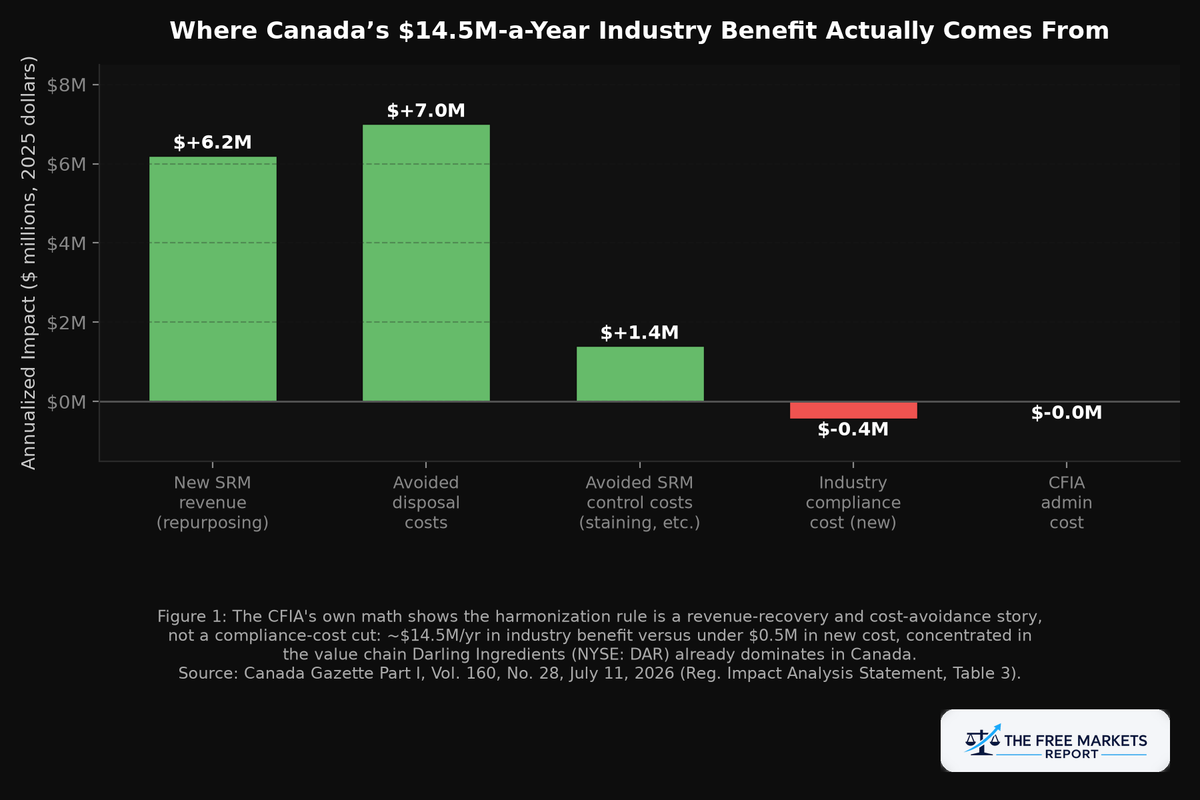
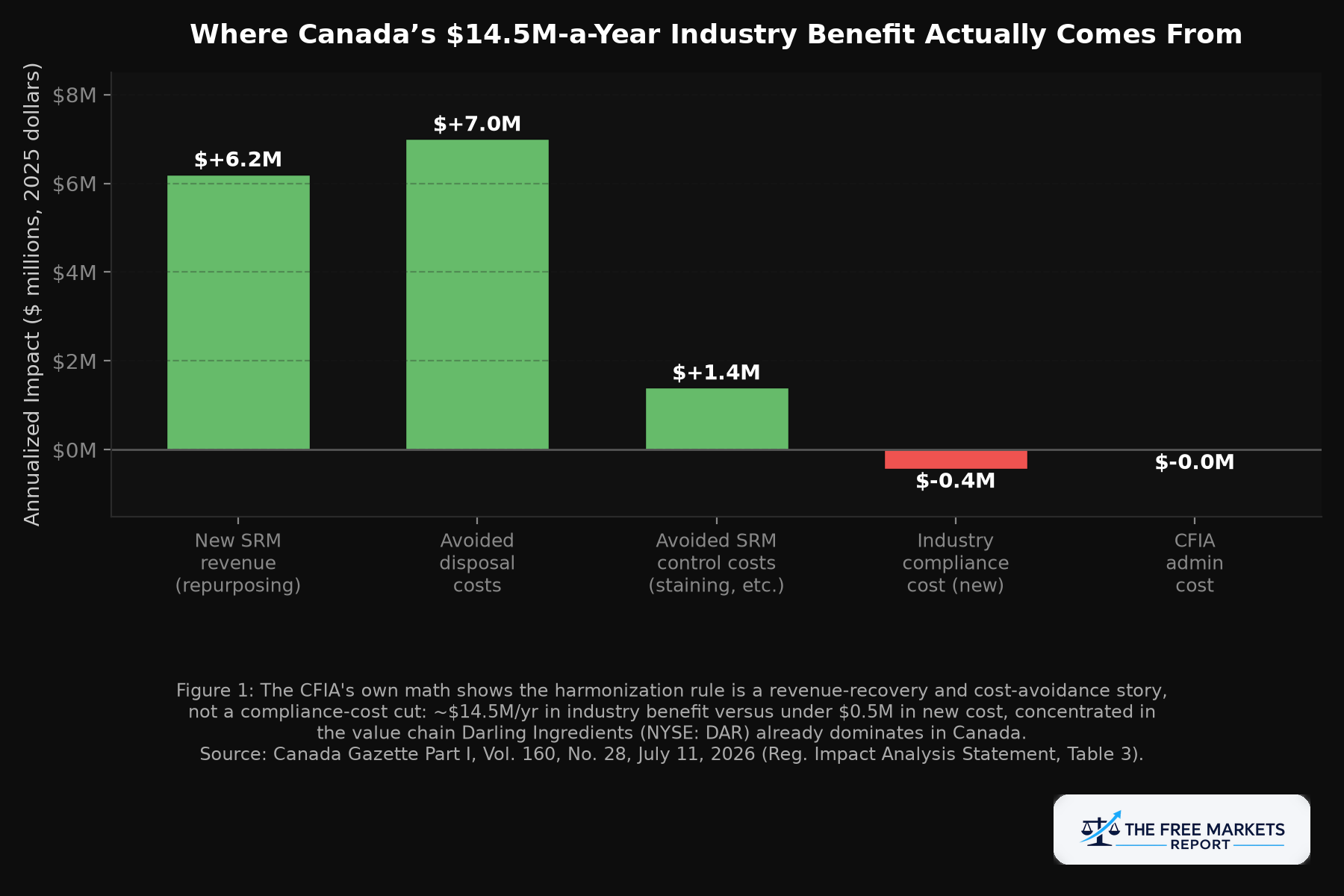
CFIA's own breakdown is revenue and cost avoidance, not compliance relief: about $6.2 million a year in new SRM revenue, $7.0 million in avoided disposal, and $1.4 million in avoided control costs, against roughly $0.4 million in new compliance cost. (Canada Gazette Regulatory Impact Analysis Statement, Table 3)
Under the one-for-one rule, this scores as burden-out: savings across the 424 affected businesses run $948,276.96 a year annualized, averaging $2,347.22 per small business among the 404 small businesses in that group. (Canada Gazette Regulatory Impact Analysis Statement)
Bear case, stated plainly
This is a proposal with a 60-day comment period, not law; nothing changes today. Adoption is voluntary: CFIA anticipates only about 92 new permits against roughly 640 establishments, so benefit concentrates among larger operators. Darling does not break out Canadian rendering economics separately, so the specific dollar impact cannot be isolated from currency and commodity effects in a $6.1 billion global sales base. (Canada Gazette Part I, Vol. 160, No. 28; Darling Ingredients Q4 2025 earnings release)
Darling Ingredients runs Canada's largest rendering network, six facilities across Manitoba, Ontario, Quebec, and Nova Scotia, the plants that currently pay to landfill or segregate the SRM this rule reclassifies. (Darling Ingredients Canada) Its Feed Ingredients segment posted FY2025 net sales of approximately $3.99 billion within total net sales of approximately $6.1 billion, combined adjusted EBITDA approximately $1.03 billion. (Darling Ingredients Q4 2025 earnings release)
Investment Idea
Company: Darling Ingredients Inc. (NYSE: DAR)
Thesis type: Second-order regulatory beneficiary
Catalyst: CFIA's harmonization proposal reclassifies a category of SRM as sellable rather than landfill-only waste. (Canada Gazette Part I, Vol. 160, No. 28)
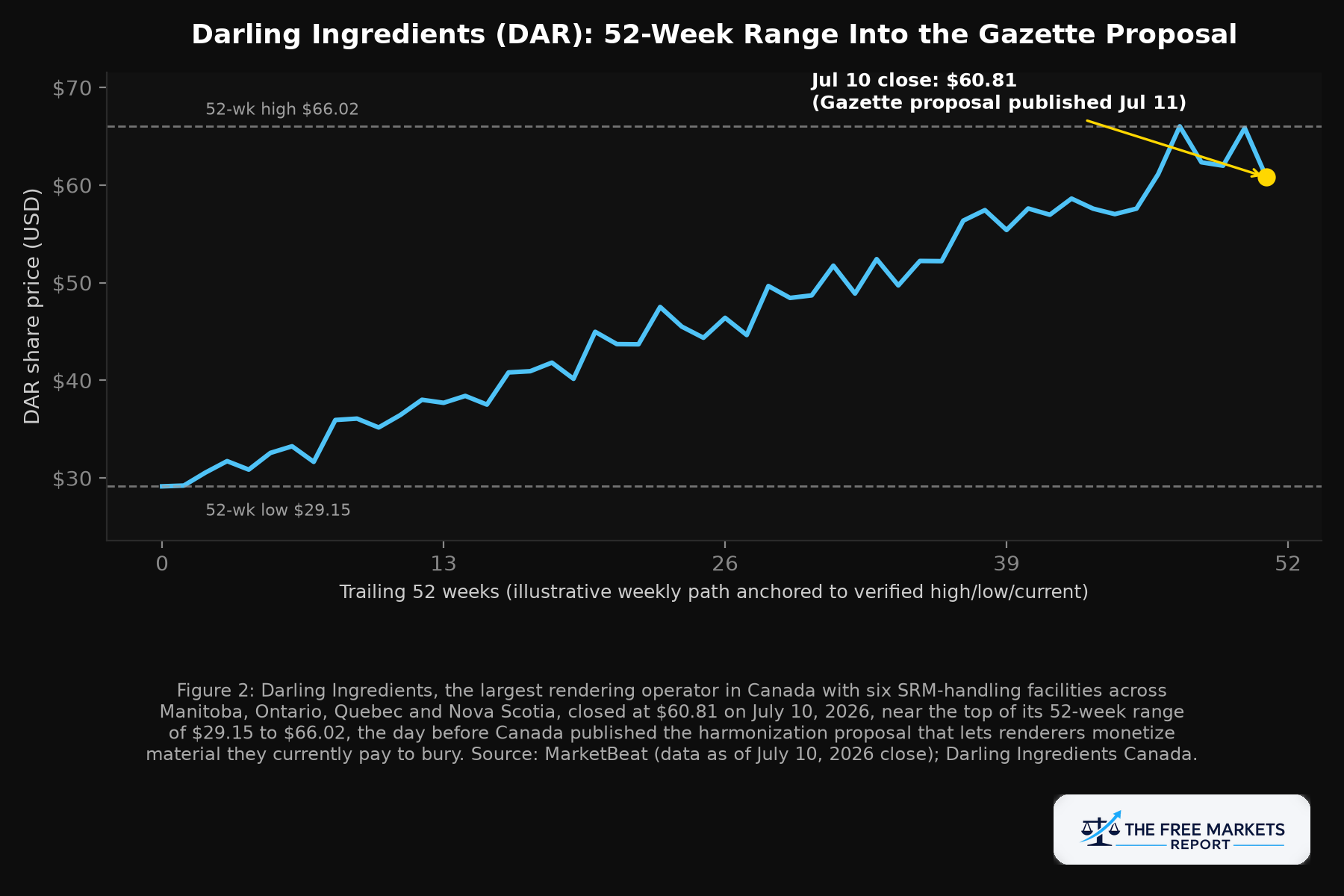
Price: $60.81 at the July 10, 2026 close, 52-week range $29.15-$66.02, market cap approximately $9.66 billion. (MarketBeat)
Financials: FY2025 net sales approximately $6.1 billion; Feed Ingredients segment approximately $3.99 billion; adjusted EBITDA approximately $1.03 billion. (Darling Ingredients Q4 2025 earnings release)
Constraint removed: Blanket SRM storage-and-disposal requirement and an obsolete exemption.
Bull case: Darling already owns the footprint needed to capture this, with no build-out cost beyond a permit; the per-kilogram swing from cost to revenue is a structural tailwind for its rendering economics.
Bear case: Only about 92 new permits are anticipated industry-wide, and Darling's filings do not isolate Canadian rendering economics from the rest of the segment.
What to watch: Whether the rule finalizes as proposed near September 2026.
Time horizon: 12 to 24 months.
Falsification condition: Withdrawal, narrowing, or delay past 2027 falsifies the thesis.
The principle
Regulation that outlives its risk does not sit quietly. It taxes an industry every year it stays on the books, in disposal costs and foregone revenue on material that could be sold instead. CFIA's own numbers show that tax running near $13.9 million a year for a single category of cattle tissue, two decades after the epidemiological case for the strictest version of the rule had faded. When a regulator's own math shows the safety case is stable but the cost case keeps compounding, the rule is a candidate for revision, and the operators already holding the infrastructure to act are positioned to capture it first.
Footnotes
- Canada Gazette Part I, Vol. 160, No. 28, "Regulations Amending Certain Regulations Relating to Harmonization of the Enhanced Feed Ban," published July 11, 2026: https://gazette.gc.ca/rp-pr/p1/2026/2026-07-11/html/reg1-eng.html
- Darling Ingredients Inc., "Darling Ingredients Inc. Reports Fourth Quarter 2025 Results," published February 11, 2026: https://www.darlingii.com/media/news/20260211-darling-ingredients-inc-reports-fourth-quarter-2025-results
- Darling Ingredients Canada, company facilities disclosure: https://www.darlingii.com/darling-canada
- MarketBeat, Darling Ingredients (NYSE: DAR) stock price and 52-week range, data as of July 10, 2026 close: https://www.marketbeat.com/stocks/NYSE/DAR/
- Investing.com, Darling Ingredients (NYSE: DAR) stock price corroboration: https://www.investing.com/equities/darling-international
The Free Markets Report is provided by Lead-Lag Publishing, LLC. All opinions and views mentioned in this report constitute our judgments as of the date of writing and are subject to change at any time. Information within this material is not intended to be used as a primary basis for investment decisions, and should also not be construed as advice meeting the particular investment needs of any individual investor. Trading signals produced by The Free Markets Report are independent of other services provided by Lead-Lag Publishing, LLC, or its affiliates, and the positioning of accounts under their management may differ. Please remember that investing involves risk, including loss of principal, and past performance may not be indicative of future results. Lead-Lag Publishing, LLC, its members, officers, directors, and employees expressly disclaim all liability with respect to actions taken based on any or all of the information in this writing.