The SEC's EU Debt Proposal Skips a Line It Used for 22 Years
The SEC wants to add EU debt to a 1984 futures rule that has always worked country by country. Here's what changes, and what doesn't.

On August 28, 2026, the Securities and Exchange Commission proposed something it has never done in the four-decade history of Exchange Act Rule 3a12-8: designate a supranational borrower, rather than a sovereign nation, for the rule's futures-trading exemption. The proposal would add debt obligations issued by the European Union itself to the list of foreign-government debt that can serve as the underlying reference for U.S. futures contracts, distinct from the debt of individual EU member states already on that list (SEC press release, Aug. 28, 2026). It is a narrow, technical filing. It is also a useful test case for how a 1984-vintage rule behaves when the borrower it needs to classify no longer fits the nation-state box the rule was built around.
Key Highlights
- The SEC proposed amending Rule 3a12-8 to add EU debt obligations to the exempted-securities list used for futures marketing and trading (SEC proposing release, S7-2026-29).
- Futures on EU debt would fall under exclusive CFTC jurisdiction; the SEC keeps jurisdiction over the underlying EU debt securities (SEC proposing release).
- The rule's existing substantive conditions, including the requirement that covered debt not be registered in the U.S., are unchanged (SEC press release).
- The comment period runs 60 days after Federal Register publication; no fixed deadline has posted yet (SEC proposing release).
- Rule 3a12-8 already lists debt from 21 designated foreign governments, added one at a time since 1984, including several individual EU member states (CFTC foreign products overview).
A Rule Built for Nations, Applied 21 Times
Rule 3a12-8 exists because of a jurisdictional quirk: the Commodity Exchange Act bars futures trading on individual securities unless the underlying is an "exempted security" under federal law, and foreign sovereign debt does not automatically qualify (SEC Portugal proposing release, 1999). The SEC's fix, adopted in 1984 under Section 3(a)(12) exemptive authority, was to designate specific countries' debt as exempted for the narrow purpose of futures trading, while the underlying bonds stayed fully subject to securities law. The rule started with the United Kingdom and Canada, then over the next fifteen years added Japan, Australia, France, New Zealand, Austria, Denmark, Finland, the Netherlands, Switzerland, Germany, Ireland, Italy, Spain, Mexico, Brazil, Argentina, Venezuela, Belgium and Sweden, one country per rulemaking (SEC Portugal proposing release).
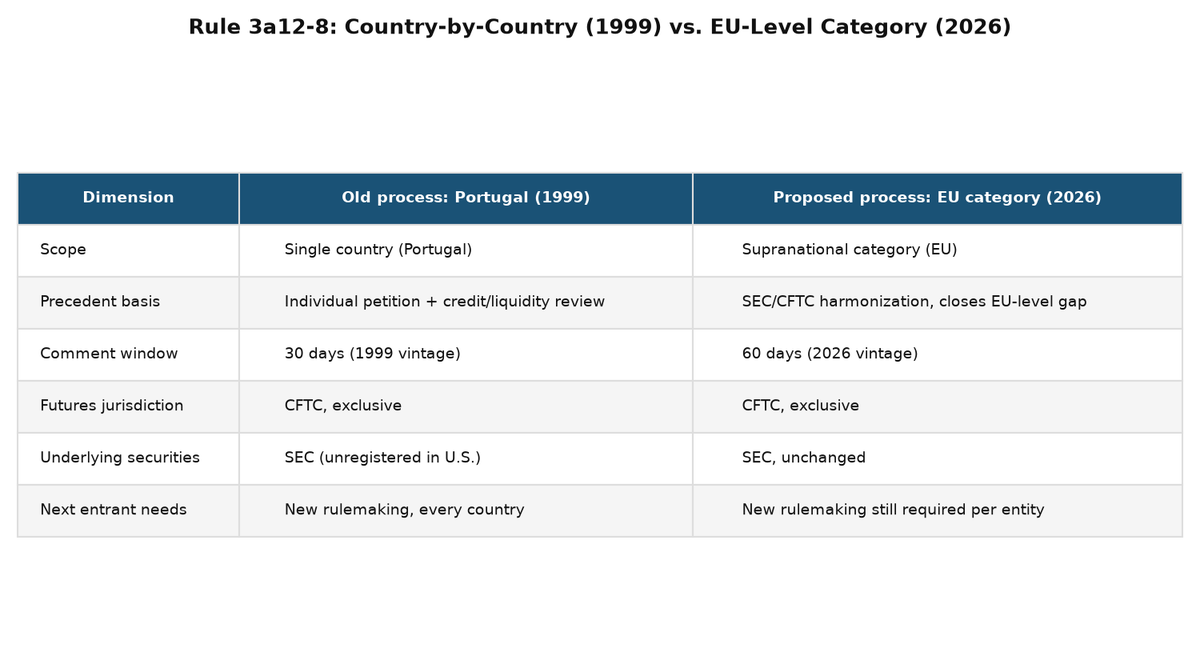
Figure 1 compares the pre-2026 country-by-country designation model, using the 1999 Portugal filing as the reference case, against the 2026 EU-level proposal across scope, precedent basis, and the SEC/CFTC jurisdictional split. Source: SEC 1999 Portugal proposing release; SEC 2026 EU proposing release, S7-2026-29.
Portugal, 1999: The Template in Its Purest Form
The 1999 Portugal filing is the cleanest illustration of how the old model worked, because the SEC's reasoning is fully documented. The Bolsa de Derivados do Porto petitioned the SEC because it had already been trading futures on Portuguese "OT 10" fixed-rate bonds domestically since 1996 and wanted to lawfully market those contracts to U.S. investors (SEC Portugal proposing release). The SEC evaluated credit quality (Aa2 from Moody's, AA from S&P) and market depth, citing roughly $125 billion in secondary trading of Portuguese OT bonds in 1998 alone. Every prior addition to Rule 3a12-8 followed this same pattern: a specific exchange or government pushes for access, the SEC checks credit ratings and liquidity data, and the Commission amends one line item in the regulation. Sweden and Belgium, both added earlier in 1999, went through the identical exercise (SEC Portugal proposing release). The CFTC's own summary of the rule today still lists all 21 designated governments as an alphabetized roster, a record of that one-at-a-time accretion (CFTC foreign products overview).
Regulatory mechanics like this rarely make headlines, but they set the terms for what gets listed and traded next. Get the next one first. Free, daily, one email when a new regulatory catalyst breaks. Subscribe free.
What Actually Changes With an EU-Level Designation
The 2026 proposal keeps the same statutory hook and the same operative language: EU debt would be designated "exempted securities" solely for marketing and trading futures contracts, with SEC Chairman Paul Atkins framing the move as closing a gap where "the debt of several EU member states was covered but debt of the European Union itself was not" (SEC press release, Aug. 28, 2026). Structurally, the mechanism matches Portugal in 1999: one rulemaking, one new line in the list, a comment window, exclusive CFTC jurisdiction over the futures contract, and continued SEC jurisdiction over the underlying bonds (SEC proposing release, S7-2026-29). What is new is the category of borrower. The EU issues joint debt, distinct from the sovereign debt of France, Germany, Italy, the Netherlands, Austria, Finland, Belgium, Denmark, Ireland or Spain, all already on Rule 3a12-8's list individually (CFTC foreign products overview). Adding the EU as its own designated entity means the rule now recognizes a supranational issuer as a category alongside nation-states, something the 1984 rule and its 20 subsequent amendments never had to contemplate.
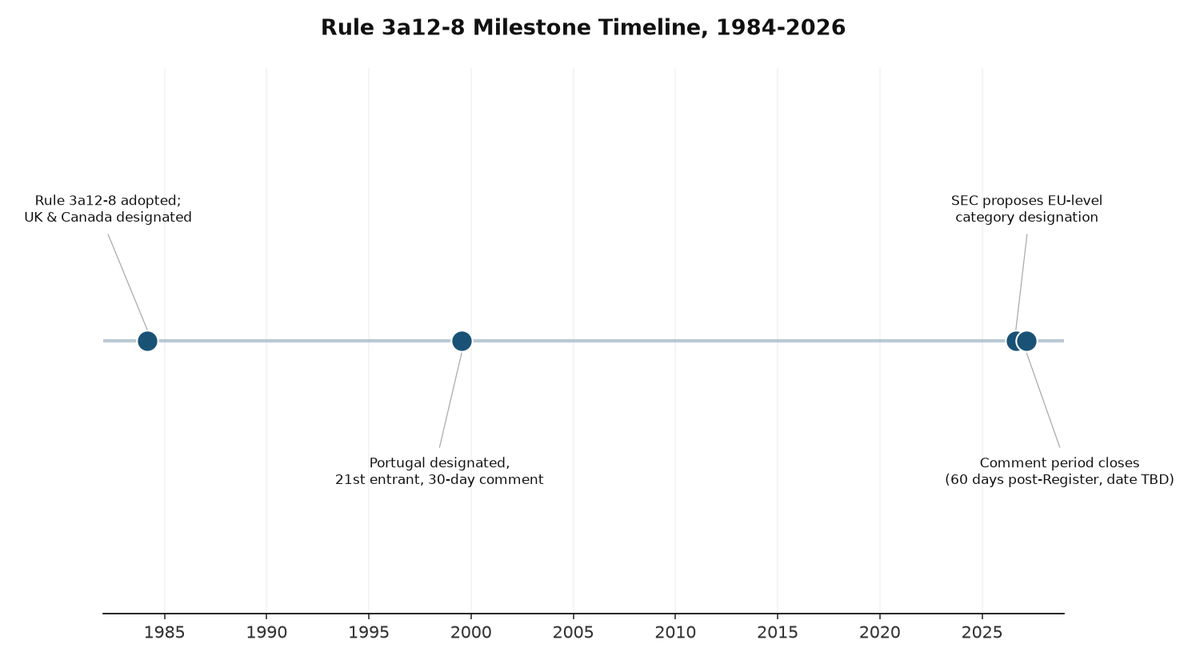
Figure 2 plots four milestones on the rule's timeline: the 1984 original adoption covering the UK and Canada, the 1999 Portugal designation as the 21st entrant, the August 28, 2026 EU proposal, and the open 60-day comment window that follows Federal Register publication. Source: SEC 1999 Portugal proposing release; SEC 2026 EU press release and proposing release.
Does This Streamline Future Additions, or Just Relabel Them?
The proposal streamlines exposure to EU-level instruments specifically, without changing the legal machinery for anything else. If adopted, futures referencing EU-issued bonds clear the exemption in one shot rather than a separate rulemaking, the way Belgium and Sweden each required in 1999. But the rule's country-by-country architecture for non-EU sovereigns, and for any EU member state whose debt isn't already listed, stays untouched; the SEC would still need a fresh petition, a fresh credit and liquidity review, and a fresh comment period for the next one. This is a category expansion, not a procedural overhaul. The proposing release is explicit that "the existing substantive requirements and provisions of Rule 3a12-8" carry over unchanged (SEC press release). Any futures contract on the newly designated EU debt would still need an intermediary registered with the CFTC, or exempted from registration, under Part 30 of the CFTC's rules, exactly as futures on the 21 existing designated countries' debt do today (CFTC foreign products overview).
Bear Case
This is a proposal, not a final rule. Nothing changes for market participants until the Commission adopts a final rule, and the 60-day comment period, which starts only once the release is published in the Federal Register, could produce revisions or a delay (SEC proposing release). Second, it is not obvious there is pent-up demand for a distinct EU-level futures product: no exchange or clearinghouse has publicly announced a specific EU-debt futures contract tied to this filing, and the 1999 Portugal case shows that in the old model, designation typically followed a specific exchange's petition and an existing home-market contract already in circulation, evidence the EU proposal's public materials do not cite. Third, and most important for scope: this change, if finalized, affects only the futures market's access to EU debt as a reference instrument. It does not touch the underlying EU debt securities themselves, which remain governed by existing U.S. securities law exactly as before, and creates no new disclosure, registration, or trading pathway for EU bonds sold directly to U.S. investors (SEC proposing release).
The mechanism, not the borrower, is what makes this proposal legible. A rule written in 1984 to sort nation-states into a single list is now being asked to classify an issuer that is not a nation-state, and the SEC's answer is to treat the EU as its own line item rather than rewrite the rule's architecture. That is a modest, defensible choice, and it leaves the country-by-country model fully intact for everything else the rule will ever need to classify.
Have a regulatory filing we should be tracking? Hit reply.
Related analysis
Read next: The UK's Payments Mandate Borrows a Template It Hasn't Fully Delivered
Read next: The Beef Import Quota Just Learned How to Repeat Itself
Know someone who should be reading this?
One deregulation story and one stock idea, every day, free. Send it to someone who thinks markets work better than mandates.
The Free Markets Report is provided by Lead-Lag Publishing, LLC. All opinions and views mentioned in this report constitute our judgments as of the date of writing and are subject to change at any time. Information within this material is not intended to be used as a primary basis for investment decisions, and should also not be construed as advice meeting the particular investment needs of any individual investor. Trading signals produced by The Free Markets Report are independent of other services provided by Lead-Lag Publishing, LLC, or its affiliates, and the positioning of accounts under their management may differ. Please remember that investing involves risk, including loss of principal, and past performance may not be indicative of future results. Lead-Lag Publishing, LLC, its members, officers, directors, and employees expressly disclaim all liability with respect to actions taken based on any or all of the information in this writing.