
The FTC Just Told Redfin It Has Six Months to Compete With Zillow Again
The FTC's proposed stipulated order in the Zillow-Redfin rental-advertising antitrust case requires Redfin to rebuild a competing ILS business within six months of court entry, unwinding the 2025 deal that paid Redfin $100 million to exit the market for up to nine years.

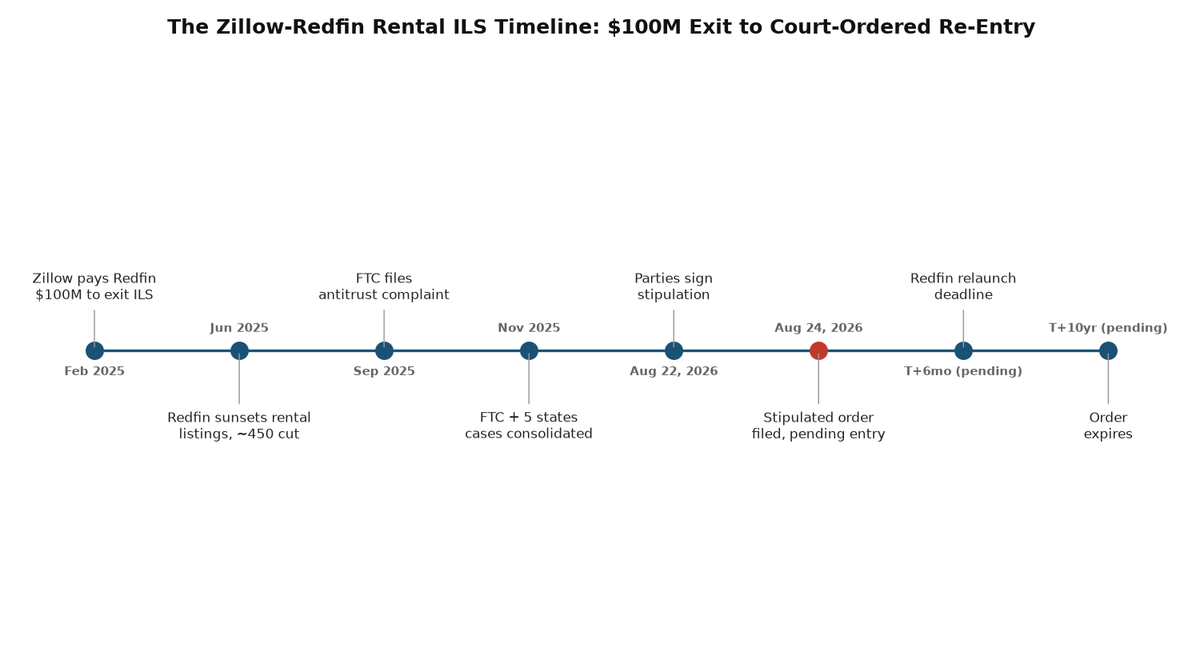
A federal antitrust settlement is about to force Redfin back into a business it was paid $100 million to abandon. On August 24, 2026, the FTC and five state Attorneys General filed a proposed stipulated order in the Eastern District of Virginia unwinding the core of Zillow's February 2025 rental-advertising deal with Redfin. The investor question: what happens to Zillow's fastest-growing revenue segment when the FTC compels its own paid-off rival back into the ring.
The FTC and five states settled with Zillow the day before a scheduled trial, ending litigation pursued since September 2025.
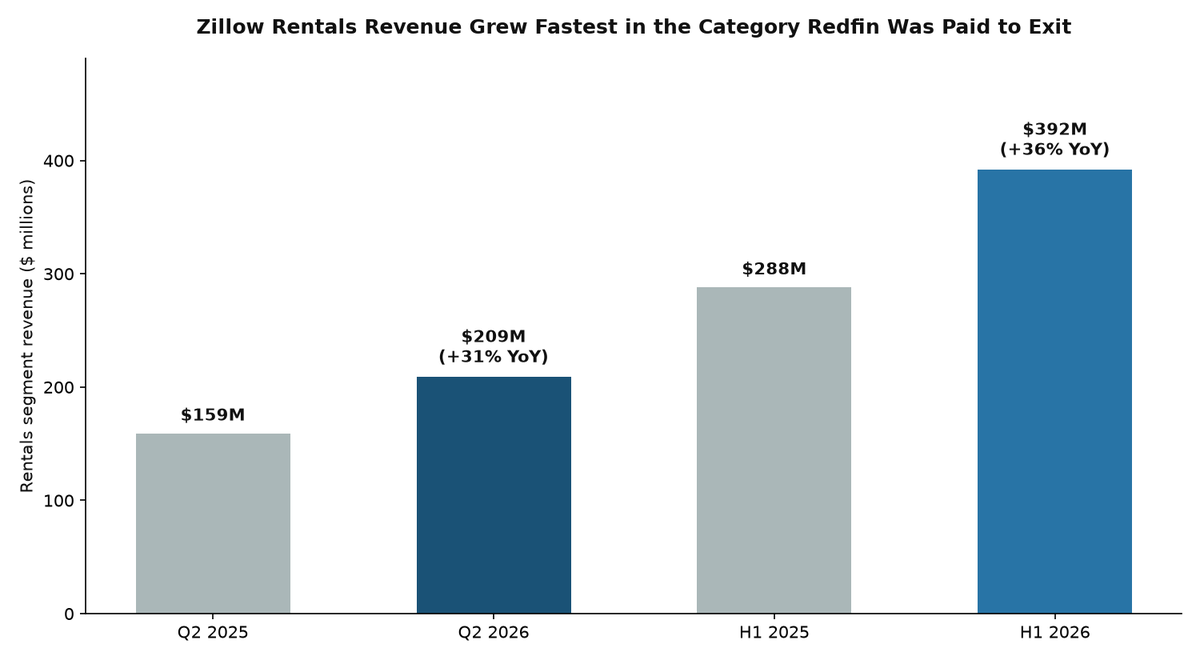
Key HighlightsThe FTC and Attorneys General of Arizona, Connecticut, New York, Virginia, and Washington filed a proposed stipulated order (Case No. 1:25-cv-1638-AJT-WBP, Document 400-1) on August 24, 2026, per the FTC's press release and the order itself.In February 2025, Zillow paid Redfin $100 million to exit multifamily internet-listing-services (ILS) advertising for up to nine years, per the FTC's complaint.Redfin must relaunch a competing ILS business within six months of court entry, with a general manager, sales staff, and support, per the stipulated order.Zillow's Rentals segment posted $209 million in Q2 2026 revenue, up 31% year over year, with multifamily revenue up 42%, per Zillow's SEC exhibit.The order is proposed, not entered: the public PDF shows a blank judicial signature line, and the FTC's docket lists the matter as pending.
What the Order Actually Says
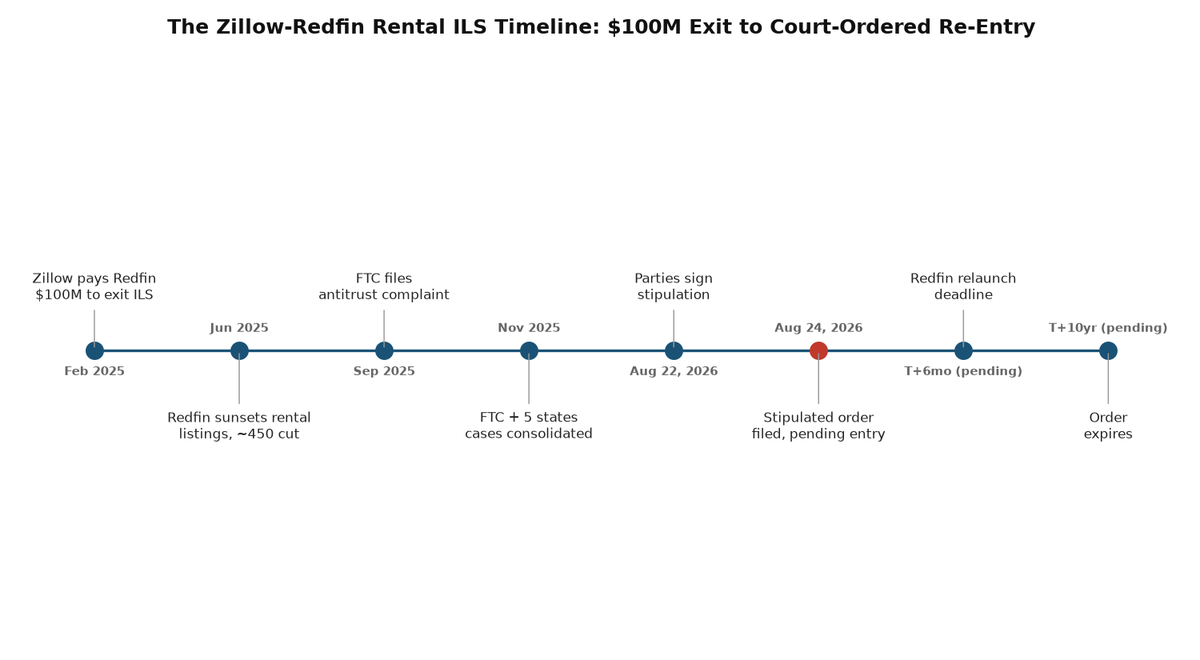
In February 2025, Zillow and Redfin signed a Partnership Agreement and Content License Agreement. Zillow paid Redfin $100 million, disclosed in its SEC filing under "Intangible Assets" as "Customer relationships," plus a $75 million first-year minimum lead-fee guarantee, per the FTC's complaint. Redfin agreed to terminate its multifamily rental contracts (25-plus units), move customers to Zillow, and stay out for up to nine years. The complaint alleges Redfin fired roughly 450 employees tied to the business, turning its rental sites into mirrors of Zillow's listings.
The FTC's theory was not subtle: this looked like paying a competitor to disappear. The complaint alleges Zillow, Redfin, and CoStar together held more than 85% of nationwide rental-ILS revenue in 2024, with market concentration well above the threshold the 2023 DOJ/FTC Merger Guidelines treat as highly concentrated. Reuters reported an FTC expert estimated Zillow's listing prices rose roughly 14.5% after Redfin exited.
The proposed order, running 10 years from court entry, unwinds the restraint rather than the relationship. Redfin must rebuild a real ILS operation within six months: a customer portal across Redfin.com, Rent.com, and ApartmentGuide.com, a billing system, a general manager, salespeople, and trained support, per the stipulated order. Redfin also commits to a multiyear operating horizon and capital investment, though the dollar figure and headcount minimums are redacted (Nonpublic Appendices D and E). Zillow must hand over employee lists and waive noncompete and no-poach restrictions blocking staff from joining Redfin, while being barred for two years from soliciting Redfin's employees.
Get the next one first. Free, daily, one email when a regulatory catalyst like this one actually moves a stock. Subscribe free.
The Penalty Structure Is Modest, and That's the Point
If Redfin misses the six-month deadline, the order imposes an initial $1,000,000 penalty plus $100,000 per month, capped at $1,600,000, after which Redfin faces contempt exposure, per the stipulated order. Zillow and Redfin also owe the plaintiff states $2 million within 30 days of entry, characterized as reimbursement rather than a penalty. Those figures are small next to either company: Zillow generated $772 million in total revenue in Q2 2026 alone, per its SEC exhibit. The mechanics suggest the FTC is relying more on compliance reporting, which runs through at least mid-2031, than on the penalty ladder itself.
What This Means for Zillow's Rentals Story
Rentals revenue hit $209 million in Q2 2026, up 31% year over year, with multifamily revenue growing 42% and multifamily property count reaching an all-time high of 79,000, up 23% from a year earlier, per Zillow's Q2 2026 SEC exhibit. Average monthly active rental listings stood at 2.8 million. That growth occurred, at least in part, during the exact window in which the FTC alleges Redfin was contractually sidelined as a competing seller of the same advertising product.
The order does not require Zillow to divest anything; it requires a competitor to come back and try to take share. That is a materially different remedy than a divestiture: it restores a competitive process, not a guaranteed outcome. Whether Redfin's relaunched business recovers meaningfully inside a six-month window is genuinely unknown from the current record.
Bear Case
The strongest argument against reading this as a near-term drag on Zillow: the order does not touch its existing market position or customer contracts. Zillow's own August 24, 2026 disclosure said the settlement fully resolves the litigation with no admission of liability, that the Zillow-Redfin syndication partnership continues through at least June 30, 2030, and that the company reaffirmed its full-year 2026 outlook.
Execution risk runs mostly against Redfin. Rebuilding a general manager, sales force, and support team inside six months is a real lift for a business that dismantled roughly 450 of those exact roles in 2025, per the FTC's complaint. A thin relaunch relative to the redacted capital and headcount commitments could keep Zillow's pricing power intact for years despite the order's 10-year term. A $1.6 million penalty cap is not large enough alone to force a genuinely competitive rebuild; the FTC's compliance-reporting cadence through 2031 is the more binding constraint, and how firmly the agency enforces it is not yet demonstrated.
Finally, a mechanical point rather than a hedge: the order is not yet in force. The public PDF's approval line reads "SO ORDERED this ________ day of ________, 2026," with no judge's signature or date filled in, and the FTC's own case page lists the matter as pending. Every deadline, the six-month relaunch clock chief among them, is anchored to a court entry that has not yet occurred.
What to Watch Next
The falsifiable signal here is not a stock price; it is Redfin's own disclosed rental-advertising metrics once the six-month clock starts from judicial entry: whether Redfin stands up a general manager and functioning ILS portal, whether its customer count recovers, and whether Zillow's Rentals growth rate decelerates afterward. A second signal is the exclusive-syndication approval mechanism for sub-25-unit properties, live through July 1, 2030, the one place the FTC retained an ongoing veto over deal structure rather than a one-time fix.
The irreducible principle: a regulatory reversal that removes a restraint is not the same as one that restores a market. The FTC bought Redfin's re-entry with legal leverage; whether that becomes a durable second seller of multifamily rental advertising depends on capital and headcount commitments the public record does not currently disclose.
Have a regulatory angle we should be tracking? Hit reply and let us know.
Related analysis
Read next: The EBA's New Waiver Rulebook Is a Real Proportionality Valve, Not a Loophole.
Read next: The CFTC Wants Swap Venues to Stop Maintaining an Order Book Nobody Uses.
Know someone who should be reading this?
One deregulation story and one stock idea, every day, free. Send it to someone who thinks markets work better than mandates.
The Free Markets Report is provided by Lead-Lag Publishing, LLC. All opinions and views mentioned in this report constitute our judgments as of the date of writing and are subject to change at any time. Information within this material is not intended to be used as a primary basis for investment decisions, and should also not be construed as advice meeting the particular investment needs of any individual investor. Trading signals produced by The Free Markets Report are independent of other services provided by Lead-Lag Publishing, LLC, or its affiliates, and the positioning of accounts under their management may differ. Please remember that investing involves risk, including loss of principal, and past performance may not be indicative of future results. Lead-Lag Publishing, LLC, its members, officers, directors, and employees expressly disclaim all liability with respect to actions taken based on any or all of the information in this writing.