The Beef Import Quota Just Learned How to Repeat Itself
A second beef tariff-rate quota expansion in seven months looks different from the first: bigger, open to every eligible country instead of one, and built with a price-monitoring trigger that can shut it off mid-stream. Here is what would confirm this becomes a standing tool.

On August 26, 2026, the White House opened the beef tariff-rate quota for the second time this year, and much wider than the first. A new proclamation, Further Ensuring Affordable Beef for the American Consumer, temporarily adds 300,000 metric tons to the 2026 in-quota allowance for lean beef trimmings, the fatty-lean blend mixed with domestic trim to make ground beef. Unlike February's action, this one is not earmarked for one country; it is open, first-come-first-served, to "other countries or areas" generally. The question is not whether this helps ground beef supply for 90 days. It is whether Washington has built a repeatable policy lever for food prices, or patched a herd that is still shrinking.
Key Highlights
- The August 26 proclamation adds 300,000 metric tons to the 2026 beef TRQ for lean beef trimmings, in three 100,000-ton first-come-first-served tranches running September through November 2026, allocated entirely to "other countries or areas" rather than a named supplier (White House proclamation).
- It preserves, unchanged, the separate 80,000-metric-ton Argentina-specific increase from February 6, 2026, so two parallel channels now run concurrently (February proclamation).
- USDA and USTR must confirm imports clear at least 25% below market price for lean beef trimmings; failing that lets the President cancel what remains of the increase (White House proclamation).
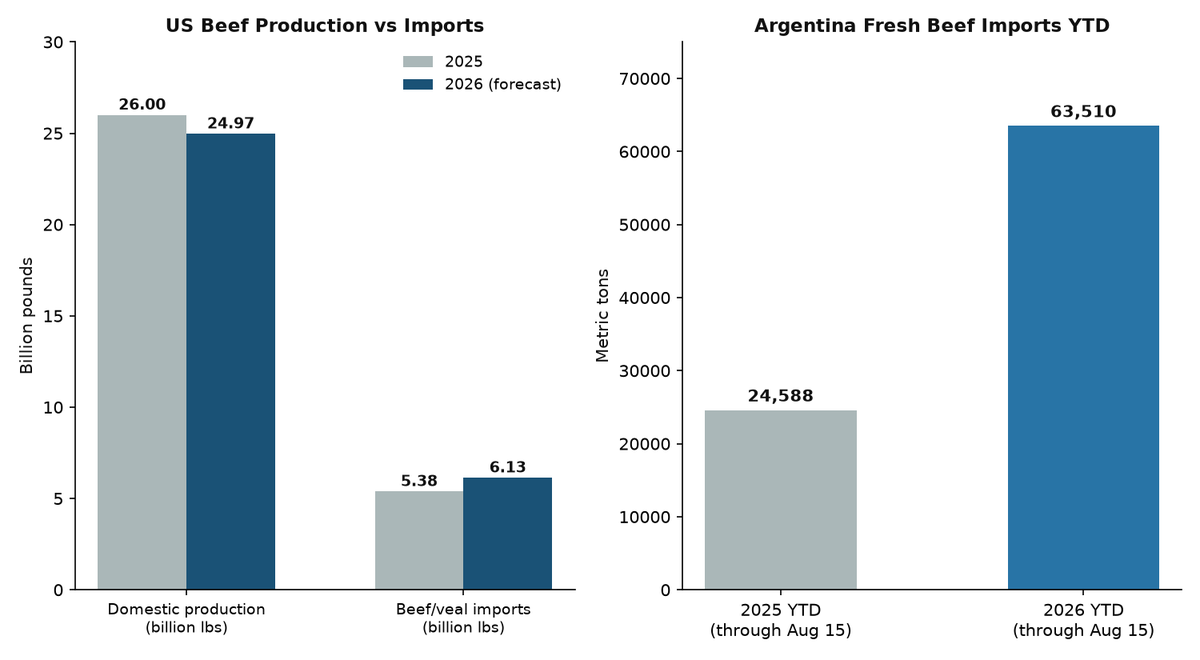
- USDA's August 2026 outlook forecasts 2026 domestic beef production down 4% to 24.967 billion pounds, with beef/veal imports up 14% to 6.132 billion pounds (USDA Livestock, Dairy, and Poultry Outlook, August 2026).
- The fact sheet frames the increase as roughly 10% of projected 2026 U.S. beef output, applying only to trimmings blended into ground beef, not fed-cattle competition (White House fact sheet).
A Narrow Legal Lever, Used Twice in Seven Months
Both proclamations invoke Section 404(b) of the Uruguay Round Agreements Act, which lets the President temporarily raise the in-quota volume on an agricultural TRQ when domestic supply will be inadequate to meet demand at reasonable prices because of natural disaster, disease, or major market disruption. February used that authority to add 80,000 metric tons of trimmings sourced entirely from Argentina, citing a U.S. cattle herd at 94.2 million head, its lowest in 75 years, and ground beef prices that hit $6.69 per pound in December 2025, the highest reading since the Bureau of Labor Statistics began tracking the series (February proclamation).
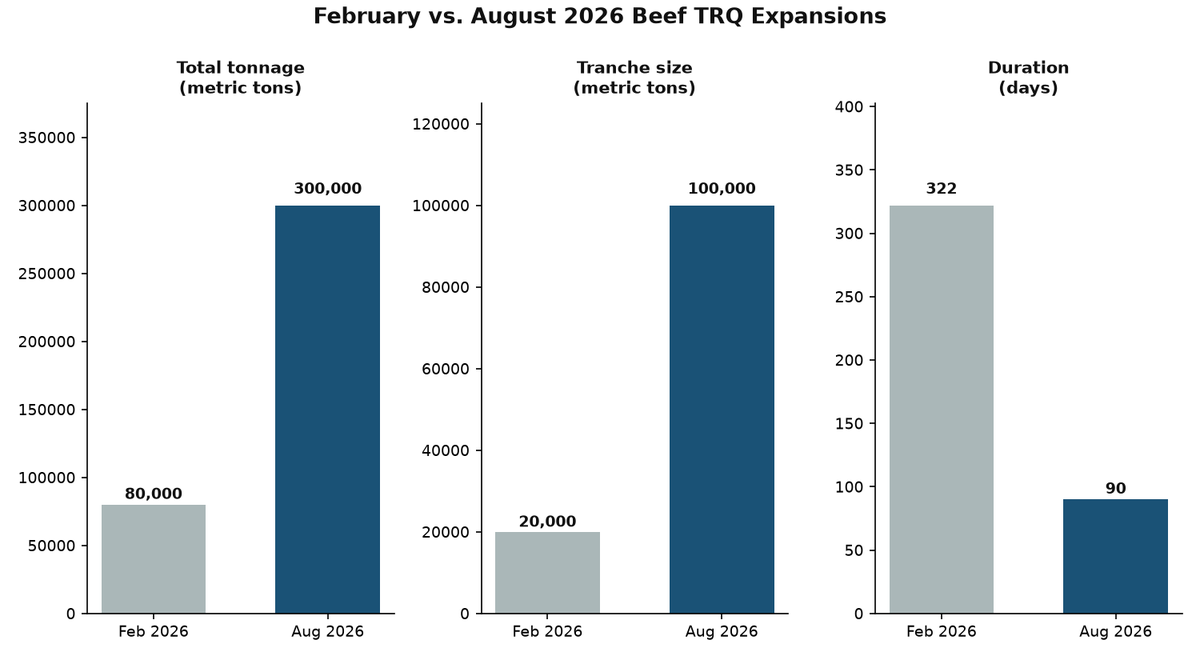
The August action is nearly four times the size of February's and structurally different in three ways: it is country-agnostic, it carries an explicit price-monitoring trigger, and it runs on a compressed, front-loaded calendar. February's quota moved in four 20,000-ton tranches spread across the full year; August's moves in three 100,000-ton tranches compressed into 90 days, September 1 through November 30. February named Argentina as sole beneficiary; August states the additional 300,000 metric tons "is allocated in its entirety to 'other countries or areas,'" while explicitly preserving the Argentina allocation as a separate, untouched channel (White House proclamation, clause 8). Both restrict eligibility to the same four HTSUS lines: 0201.30.5091, 0201.30.5097, 0202.30.5091, and 0202.30.5097.
Regulatory catalysts like this move markets before most investors notice the mechanism. Get the next one first, free, one email when a new trade or agricultural policy shift breaks. Subscribe free.
Why Breadth, Not Just Size, Is the Real Change
The bigger structural shift is not the tonnage, it is who can supply it. February's increase was a single-country carve-out under URAA Section 404(d)(3). August's design opens the additional 300,000 metric tons to any eligible exporter on a first-come-first-served basis, turning the TRQ into a general pressure-release valve that requires no bilateral relationship to execute. If August's design becomes the template rather than the exception, the beef TRQ stops being an occasional trade-policy instrument and starts looking like a standing domestic-price lever pulled whenever the production-demand gap widens. The proclamation directs the Secretary of Agriculture to keep monitoring domestic supply and recommend further action if warranted, treating this as a live, watched program rather than a one-time fix (White House proclamation, clause 6(a)).
The other new feature is the price-monitoring condition. Nothing in February required USDA or USTR to verify Argentine trimmings actually reached consumers at a discount. August builds that check in directly: the two agencies must monitor whether imports clear at least 25% below the market price for lean beef trimmings, and if not, must notify the President so he can decide whether to cancel what remains (White House proclamation, clause 6(b)). The fact sheet frames the structure around one goal: making sure relief reaches consumers rather than becoming a windfall for foreign shippers (White House fact sheet). That condition, more than the tonnage, is what should make this repeatable: a data-driven off-ramp instead of an all-or-nothing decision if the policy underperforms.
The Numbers the Policy Is Responding To
USDA's August 2026 outlook explains the urgency: 2026 domestic beef and veal production is forecast at 24.967 billion pounds, down 4% from 2025, while imports rise 14% to 6.132 billion pounds (USDA Livestock, Dairy, and Poultry Outlook, August 2026). Both proclamations try to close that gap with imported trimmings rather than a rebuilt herd, which takes years. The fact sheet pegs the addition at roughly 10% of the 2026 production baseline, competing mainly with cull-cow markets, not the fed-cattle market that drives retail steak prices (White House fact sheet).
The Argentina channel this proclamation leaves untouched is already running well ahead of last year: USDA's weekly import data through August 15, 2026 shows Argentine fresh beef imports at 63,510 metric tons year-to-date versus 24,588 metric tons in the same 2025 span, a 158% increase (USDA weekly import report). February's increase is already working through the system at scale, before the August tranches even open.
Bear Case
The case for a genuine, repeatable mechanism has real limits. The fact sheet is explicit that this is temporary: 90 days from September 1, 2026, capped at 100,000 tons per month, with no modification to free-trade-agreement commitments (White House fact sheet). Neither proclamation commits to repeating this in 2027. The 25% discount condition is also a genuine off-ramp for cancellation: if USDA and USTR determine the threshold is not met, the President can eliminate the remainder mid-tranche, injecting execution uncertainty for any importer counting on the full 300,000 tons clearing (White House proclamation, clause 6(b)). And the underlying constraint, a cattle herd at a 75-year low, compounded by continuing Mexican live-animal import restrictions tied to New World Screwworm containment, is not something a 90-day trimmings quota fixes (February proclamation). USDA's own data shows domestic production still falling 4% even after February's increase had months to work: herd rebuilding, measured in years of heifer retention, remains the real constraint no matter how many TRQ tranches open (USDA outlook, August 2026). A TRQ expansion changes where imported pounds come from; it does not change how many domestic pounds exist.
The Forward Signal
What would confirm this is becoming a repeatable tool: a third TRQ action before year-end 2026 or in early 2027 using the all-country design, plus a USDA/USTR determination that keeps tranches open rather than triggering a mid-stream cancellation. What would undercut the thesis: cancellation of a 2026 tranche on discount-compliance grounds, or a 2027 outlook showing the herd rebuilding fast enough that further relief becomes unnecessary.
This is not a stock-picker's story, and forcing one onto it would be a disservice to readers. No single publicly traded company is a clean beneficiary of a 90-day quota split across an unnamed group of "other countries or areas"; the beneficiaries are foreign packers with no obligation to disclose U.S.-specific volume. The investable idea here is the mechanism itself: regulators are building a faster, more conditional, more broadly applicable version of an emergency trade tool, and that template is what deserves tracking, not a single ticker. The base rate stands at two uses of Section 404(b) in seven months, one narrow and one broad, enough of a pattern to watch for a third, but not yet enough to call it policy.
Have a regulatory angle we should be tracking? Hit reply and tell us what to dig into next.
Related analysis
Read next: The FTC Just Told Redfin It Has Six Months to Compete With Zillow Again.
Read next: The EBA's New Waiver Rulebook Is a Real Proportionality Valve, Not a Loophole.
Know someone who'd want this in their inbox before the next tranche opens? Forward this one.
Know someone who should be reading this?
One deregulation story and one stock idea, every day, free. Send it to someone who thinks markets work better than mandates.
The Free Markets Report is provided by Lead-Lag Publishing, LLC. All opinions and views mentioned in this report constitute our judgments as of the date of writing and are subject to change at any time. Information within this material is not intended to be used as a primary basis for investment decisions, and should also not be construed as advice meeting the particular investment needs of any individual investor. Trading signals produced by The Free Markets Report are independent of other services provided by Lead-Lag Publishing, LLC, or its affiliates, and the positioning of accounts under their management may differ. Please remember that investing involves risk, including loss of principal, and past performance may not be indicative of future results. Lead-Lag Publishing, LLC, its members, officers, directors, and employees expressly disclaim all liability with respect to actions taken based on any or all of the information in this writing.