The Free Markets Report Is Back: What You Missed in 5 Months of Deregulation
A comprehensive catch-up on the most aggressive deregulatory year in modern American history — and what it means for your portfolio.


I went quiet in November. That was a mistake.
Not because the deregulation story ended — but because it accelerated faster than at any point in modern American history, and this publication wasn’t here to cover it.
Let me fix that. The Free Markets Report is back, and the landscape I left in November 2025 is barely recognizable. What follows is a comprehensive catch-up on everything that happened while I was away — and why this matters far more for your portfolio than most investors realize.
The Scoreboard: 129-to-1
Let’s start with the headline number. By year-end 2025, the Trump administration had finalized 646 deregulatory actions against just 5 new regulatory actions — a ratio of 129-to-1, obliterating the president’s own 10-to-1 target. The estimated net cost savings: $211.8 billion, or roughly $600 per American.
That’s not rhetoric. That’s the official count from the White House regulatory review, and it represents the most aggressive deregulatory year since modern regulatory accounting began.
But the raw numbers only tell part of the story. The composition of these actions reveals a coordinated, sector-by-sector dismantling of regulatory infrastructure that’s still in motion today.
The SEC Is Being Rewired
For market participants, the SEC developments alone would justify restarting this publication.
Chairman Paul Atkins has signaled a fundamental rethinking of how public companies interact with the Commission. The highlights:
Semiannual reporting is on the table. The SEC continues to advance President Trump’s directive to shift mandated periodic reporting from quarterly to semiannual. The Division of Corporation Finance has indicated that formal rulemaking is forthcoming, with a flexible approach — some companies may shift to twice-yearly reporting while others retain quarterly cadence. If implemented, this would be the most significant change to public company disclosure requirements in decades.
Shareholder proposals are being rethought. In November 2025, the Division of Corporation Finance announced it would largely stop reviewing no-action requests related to shareholder proposals under Rule 14a-8. An executive order issued in December directed the SEC to review and potentially revise or rescind rules governing shareholder proposals — particularly those related to DEI and ESG matters. Companies now effectively bear responsibility for determining whether to exclude proposals, which creates both freedom and litigation risk.
The Enforcement Manual got its first overhaul since 2017. On February 24, 2026, the Division of Enforcement released a substantially revised manual — only the second major revision since 2008. The updates introduce greater transparency in the Wells process, an enhanced corporate cooperation credit framework, tighter standards for criminal referrals, and a commitment to annual reviews. Chairman Atkins called it “a long-overdue step.” The signal is clear: enforcement is becoming more predictable and more restrained.
The EPA Made History
On February 12, 2026, the EPA finalized the rescission of the 2009 Endangerment Finding — the foundational rule that has underpinned virtually all federal regulation of greenhouse gas emissions for the past 17 years.
The EPA called it the “single largest deregulatory action in U.S. history.” It’s hard to argue.
By rescinding the Endangerment Finding, the EPA removed the legal basis for GHG emission standards on light-, medium-, and heavy-duty vehicles. The agency’s rationale was primarily legal — arguing it lacks the statutory authority under the Clean Air Act to regulate emissions based on global climate concerns, citing the Supreme Court’s decisions in West Virginia v. EPA and Loper Bright.
The rescission becomes effective April 20, 2026. Legal challenges are already underway, and a judicial stay is probable. But even if the courts intervene, the administrative signal is unmistakable: the regulatory architecture around carbon emissions is being dismantled piece by piece.
Simultaneously, the Department of Transportation proposed a dramatic rollback of CAFE standards — from the Biden-era target of 50.4 mpg by 2031 down to 34.5 mpg. The proposal would also eliminate the tradeable compliance credit system that has been a cornerstone of the CAFE program.
For energy, auto, and industrial equities, these are not marginal adjustments. They are structural shifts in the cost environment.
The CFPB: Death by a Thousand Cuts
The Consumer Financial Protection Bureau is being dismantled from the inside — not through legislation, but through budget starvation, personnel reduction, and aggressive deregulatory rulemaking.
The administration’s approach has been multi-pronged. Budget cuts in the reconciliation package slashed the CFPB’s funding mechanism from 12% of the Fed’s operating expenses to 6.5%. The Trump administration’s legal theory — that the CFPB cannot draw funds from the Fed because the central bank isn’t profitable — would effectively zero out the agency’s budget. Acting Director Russell Vought signaled the agency could close within months.
Meanwhile, the CFPB has advanced 24 rules generally aimed at industry-friendly deregulation across the consumer finance ecosystem: loosening fair lending oversight, narrowing the small-business lending rule, revising open banking regulations, raising larger participant thresholds to shrink supervisory jurisdiction, and easing mortgage servicing requirements.
On March 13, 2026, Trump signed an executive order titled “Promoting Access to Mortgage Credit” — the most comprehensive signal yet that the administration intends to revisit core elements of the post-Dodd-Frank mortgage compliance infrastructure. The order directs regulators to consider broader Qualified Mortgage safe harbors, modifications to ability-to-repay requirements, and exemptions from rescission rights for certain refinance transactions.
For financials, fintech, and consumer lending, the regulatory moat that defined the post-2008 era is shrinking rapidly.
Banks Are Getting Relief from Every Direction
The bank deregulation story accelerated on March 19, 2026, when the Federal Reserve, FDIC, and OCC approved proposed rule changes that would reduce core safety buffer requirements for the largest banks by an average of 4.8%, and for smaller banks by as much as 7.8%.
Fed Chair Jerome Powell acknowledged that “it has been almost two decades since the crisis” and that “aspects of the post-crisis regulatory regime warrant recalibration.”
At the same time, a “capital neutral” Basel III Endgame proposal was released — significantly watered down from the widely criticized July 2023 version. The operational risk framework was softened, Category IV banks were largely exempted, and the gold-plated credit risk elements were removed.
The Fed also proposed changes to make annual stress tests more favorable to banks, including averaging results over two years to reduce volatility. And the supervisory workforce is being cut by 30%.
The top 13 U.S. banks currently hold approximately $200 billion in excess capital. With capital requirements dropping, that surplus becomes fuel for loan growth, buybacks, dividends, and M&A.
The INVEST Act: Opening Private Markets
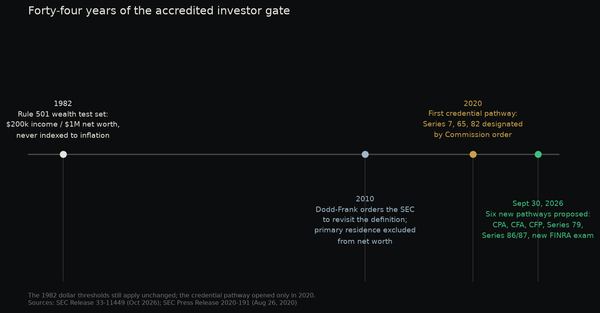
On December 11, 2025, the House passed the INVEST Act — a package of 22 bills designed to increase capital formation in private markets and encourage IPOs. Key provisions include prohibiting the SEC from imposing accredited-investor-only restrictions on closed-end funds investing in private funds, expanding the venture capital fund definition, raising investment adviser exemption thresholds, and removing disincentives for funds to invest in Business Development Companies.
This is deregulation that directly expands the investable universe for retail investors.
What Comes Next
If the first five months I missed were about laying the groundwork, the next five months are about implementation and market impact. The Endangerment Finding rescission takes effect April 20. CAFE rulemaking is entering public comment. The SEC’s semiannual reporting proposal is forthcoming. Basel III Endgame finalization is ahead.
The deregulation theme is no longer theoretical. It’s being priced — or, in many cases, not yet priced — into specific sectors and securities.
That’s what this publication exists to cover: the intersection of deregulatory policy and investment opportunity, in real time, as it happens.
The Free Markets Report will publish 2-3 times per week going forward. Monday editions will track the week’s most significant regulatory rollbacks. Midweek, we’ll go deep on specific sectors where deregulation is reshaping the competitive landscape. And periodically, we’ll publish scorecards and data-driven takes on where the deregulatory wave is heading next.
Welcome back. There’s a lot to cover.
— Michael A. Gayed, CFA
The Free Markets Report is provided by Lead-Lag Publishing, LLC. All opinions and views mentioned in this report constitute our judgments as of the date of writing and are subject to change at any time. Information within this material is not intended to be used as a primary basis for investment decisions, and should also not be construed as advice meeting the particular investment needs of any individual investor. Trading signals produced by The Free Markets Report are independent of other services provided by Lead-Lag Publishing, LLC, or its affiliates, and the positioning of accounts under their management may differ. Please remember that investing involves risk, including loss of principal, and past performance may not be indicative of future results. Lead-Lag Publishing, LLC, its members, officers, directors, and employees expressly disclaim all liability with respect to actions taken based on any or all of the information in this writing.